

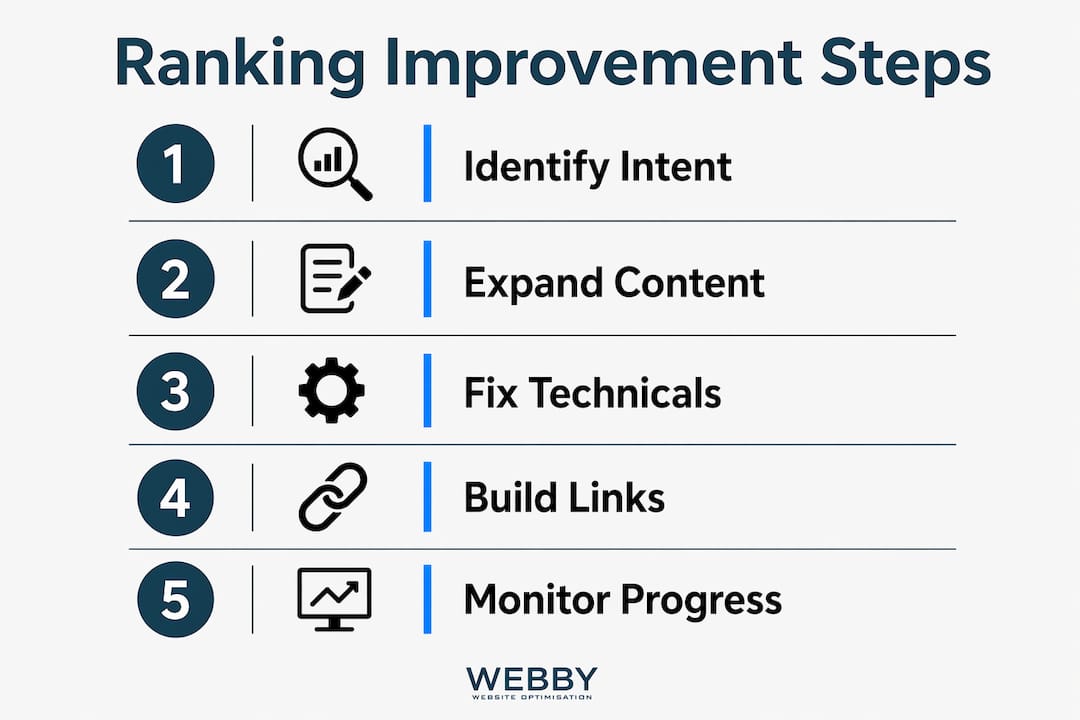
Ranking higher in Google search results is the result of combining precise search intent matching, technical site health, topical authority, quality backlinks, and AI citation optimization. Google’s E-E-A-T standards (Experience, Expertise, Authoritativeness, and Trustworthiness) define what the algorithm rewards, and no universal shortcuts exist. The businesses that win in search do so by building a multi-layered SEO foundation, not by chasing quick fixes. This guide breaks down each layer so you can apply it to your own site.
How does search intent help you rank higher in Google search results?
Search intent is the single most important content factor in SEO. Matching content precisely to intent outperforms content that tries to serve multiple intents at once. Google reads the pattern of results it already shows for a query and uses that to determine what type of content belongs on page one.
There are four core intent types:
- Definitional intent: The user wants a clear explanation. Example: “what is Core Web Vitals.”
- Transactional intent: The user is ready to buy or book. Example: “hire SEO agency Perth.”
- Navigational intent: The user wants a specific website or brand. Example: “Webby Website Optimisation contact.”
- Comparative intent: The user is weighing options. Example: “SEO vs. Google Ads for small business.”
The most common mistake business owners make is cramming all four intents into one page. A page titled “SEO Services: What Is SEO, How to Buy It, and Why We’re the Best” confuses Google and users equally. One page, one intent.
To identify the right intent, search your target keyword and study the top five results. Check the People Also Ask boxes. If the top results are all listicles, your page should be a listicle. If they are all service pages, write a service page. The SERP tells you exactly what Google expects.

Pro Tip: Use the People Also Ask section as a free keyword research tool. Each question reveals a sub-intent your content can address, which builds topical depth without creating separate pages.
You can also read more about aligning content with search intent to understand how this principle applies across different business types and industries.
What is topical authority and why does it boost your rankings?
Topical authority is the degree to which Google recognizes your site as a reliable, focused source on a specific subject. Sites tightly focused on a niche rank faster and more reliably than generalist sites covering dozens of unrelated topics. Think of it as Google’s way of asking: “Is this site a specialist or a dabbler?”
Building topical authority requires three things:
- Define your site radius. Choose a core topic and a set of closely related subtopics. A plumbing business in Perth should cover emergency plumbing, hot water systems, blocked drains, and pipe repairs. It should not publish articles about home renovation trends or garden design.
- Audit and prune existing content. Pages that cover unrelated topics dilute your site’s focus. Remove or redirect them. Topical authority requires auditing and pruning unrelated content to signal concentrated expertise to Google.
- Build internal links deliberately. Every new page you publish should link back to at least two related pages on your site. This creates a content web that reinforces your topical focus and passes authority between pages.
Content expansion matters too. Once you cover your core topic thoroughly, expand into adjacent subtopics that your ideal customer also searches for. A window cleaning business that ranks for “window cleaning Perth” can expand into “commercial window cleaning,” “high-rise window cleaning safety,” and “how often to clean windows.” Each new page strengthens the authority of the others.
Pro Tip: Run a content audit every six months. Any page with fewer than 200 words, zero backlinks, and no organic traffic in 12 months is a candidate for pruning or consolidation.
The 4x increase in Google visibility for Masters Window Cleaning is a real example of what focused topical strategy delivers for a local service business.
What technical SEO factors does Google require to rank well?
Technical SEO is the foundation that everything else sits on. Without crawlability and technical health, content quality and backlinks have limited impact. Google cannot rank a page it cannot crawl, index, and load quickly.
Core technical requirements
| Technical Factor | What to fix | Why it matters |
|---|---|---|
| Broken links | Use a crawl tool to find and fix 404 errors | Broken links waste crawl budget and hurt user experience |
| XML sitemap | Submit a valid sitemap in Google Search Console | Helps Google discover and index all your pages |
| Mobile performance | Pass Google’s Core Web Vitals on mobile | Mobile-first indexing means mobile speed directly affects rankings |
| Page speed | Compress images, use caching, minimize JavaScript | Slow pages lose rankings and users |
| HTTPS | Confirm your SSL certificate is active | Google treats HTTPS as a ranking signal |
Fixing broken links, validating XML sitemaps, and ensuring mobile performance are prerequisites before any other SEO work delivers results.
Schema markup is the technical factor most business owners overlook. Structured data tells Google exactly what your page contains: a service, a product, a FAQ, a local business. Specialized schema markup and AI-friendly content structure can increase Google AI Overview visibility by over 200% and traffic from AI platforms by 75%. That is not a marginal gain. For service pages, ItemList schema and LocalBusiness schema are the two most impactful types to implement. You can generate structured data quickly using a JSON-LD schema generator to get the code right without manual errors.
Run a full technical audit at least once per quarter. Use Google Search Console to monitor crawl errors, index coverage, and Core Web Vitals scores. Fix issues within two weeks of discovery. Technical debt compounds fast.
Why do backlinks still matter for improving your Google ranking?
Backlinks remain one of Google’s strongest ranking signals. Editorial links from topically relevant, authoritative sites yield higher ranking impact than volume alone. A single link from a respected industry publication outweighs 50 links from unrelated directories.
The most effective backlink sources for small and medium-sized businesses include:
- Guest posts on industry publications. Write a genuinely useful article for a site your customers already read. The link you earn carries real authority.
- Local business citations. Get listed on directories like True Local, Yellow Pages, and local chamber of commerce sites. These build local authority signals.
- Partnerships and supplier pages. If you work with other businesses, ask them to link to your site from their partner or supplier page.
- Expert quotes in media. Journalists regularly look for business owners to quote. A quote in a local news article or trade publication earns a high-quality editorial link.
Avoid buying links or joining link schemes. Google’s spam detection identifies unnatural link patterns and penalizes sites that use them. A spammy backlink profile can undo months of legitimate SEO work.
The key test for any backlink opportunity is relevance. Ask: “Would a customer of mine also visit this site?” If the answer is no, the link is probably not worth pursuing.
How do you optimize content for Google AI Overviews and AI citations?
Ranking and citation visibility are two distinct layers. A page can rank in the top 10 but not appear in AI-generated answers, or be cited in AI Overviews without ranking in the top 10 at all. This distinction matters because hundreds of millions of daily queries trigger Google’s AI Overviews, making AI citation optimization a separate and necessary strategy.
Structuring content for AI citation requires four specific practices:
- Lead with a direct answer. The first sentence of every section should answer the question the heading poses. AI systems pull the most direct, quotable statements.
- Add a key takeaways section. Summarized, structured content is easier for AI to extract and cite. Tables and bullet summaries work especially well.
- Use FAQPage schema. Google’s AI Overviews often cite content with direct-answer leads, FAQ schema, and original substance worth quoting. Mark up your FAQ section with FAQPage structured data.
- Include original data or unique insights. AI systems prefer content that adds something new. Proprietary case study results, local data, or firsthand experience all qualify.
Critically, 52% of sources used in AI-generated answers come from pages ranked outside Google’s traditional top 10. That means a well-structured page on page two of Google can still earn AI citation visibility. This changes the calculus for smaller businesses that cannot yet compete for top organic positions.
Pro Tip: Write every H2 heading as a direct question your customer would type into Google. This structure aligns with both traditional featured snippets and AI Overview citation patterns.
For a deeper look at the search features where citations appear, the 2026 Google search features guide covers each format and how to target them.
Key Takeaways
Ranking higher in Google search results requires combining search intent precision, topical authority, technical site health, quality backlinks, and AI citation structuring into one consistent strategy.
| Point | Details |
|---|---|
| Match search intent exactly | One page, one intent. Study the top SERP results to confirm what format Google expects. |
| Build topical authority | Audit and prune unrelated content. Focus your site on a tight niche to rank faster. |
| Fix technical SEO first | Crawlability, mobile speed, and schema markup are prerequisites for all other SEO gains. |
| Earn relevant backlinks | One editorial link from a topically relevant site outweighs dozens of unrelated directory links. |
| Structure for AI citation | Use direct-answer leads, FAQ schema, and original data to appear in Google AI Overviews. |
What I’ve learned after watching hundreds of businesses chase Google rankings
Most business owners I talk to want a single fix. They ask whether it’s the keywords, the backlinks, or the website speed. The honest answer is that it’s all of them, and they have to work together.
The businesses I’ve seen climb consistently in search share one trait: they stop treating SEO as a campaign and start treating it as infrastructure. They fix their technical foundation first, then build content around a focused niche, then earn links through genuine relationships. They do not chase algorithm updates.
The AI shift in search has added a new layer, and I think it’s actually good news for smaller businesses. 52% of AI-cited sources rank outside the top 10. That means a well-written, well-structured page on a niche topic can earn brand visibility in AI Overviews even before it cracks the first page of organic results. That is a real opportunity if you structure your content correctly.
My practical advice: spend the first month fixing your technical health. Spend the next three months building out topical content. Then focus on earning one or two genuinely relevant backlinks per month. Patience is not a weakness in SEO. It is the strategy. If your website is low on Google, start with the technical audit before touching anything else.
— Steve Doig
How Webby Website Optimisation helps Perth businesses rank
Small and medium-sized businesses in Perth often have the right service but the wrong website. A slow, poorly structured site blocks every SEO effort before it starts.
Webby Website Optimisation builds SEO-ready websites designed from the ground up to rank. Every site includes mobile performance, schema markup, and a content structure aligned with Google’s current ranking requirements. For businesses that need a strong web presence but are working with a tight budget, Webby also offers a pro bono website design program for qualifying Perth businesses. If your current site is holding your rankings back, a free audit is the right first step.
FAQ
What is the fastest way to improve Google search ranking?
Fix your technical SEO first. Broken links, slow mobile speed, and missing schema markup block rankings regardless of content quality.
How long does it take to rank higher on Google?
Most businesses see meaningful ranking improvements within 3–6 months of consistent SEO work, though competitive keywords can take longer.
Does content length affect Google rankings?
Length matters less than relevance and intent match. A 400-word page that precisely answers a query outranks a 2,000-word page that misses the intent.
Can a small business compete with large sites in Google search?
Yes, by focusing on a narrow niche and building topical authority. Smaller sites with concentrated expertise regularly outrank larger generalist sites on specific queries.
What is Google E-E-A-T and why does it matter?
E-E-A-T stands for Experience, Expertise, Authoritativeness, and Trustworthiness. Google uses these signals to assess content quality and determine which pages deserve top rankings.
Recommended
- My website is low on Google. How do I increase my ranking?
- Types of Google Search Features: 2026 SEO Guide
If this post raised some questions feel free to ask me a question
Trackbacks/Pingbacks