
When you see an offer for a 'free domain name', it's easy to feel like you've struck gold. But let's be real – in business, there's rarely such a thing as a free lunch. A free domain name isn't really a gift; it's a marketing tool. It’s almost always a one-year teaser bundled with a hosting plan or a permanent subdomain that you never actually own.
What a Free Domain Name Really Means

Seeing that "free domain" banner can make you feel you're saving money right from the start. But these offers are carefully designed to get you in the door. Think of your domain name like the street address for your online business, and your web hosting as the plot of land you build it on.
Many hosting companies will give you the "address" for free for the first year, just to convince you to build on their "land". They’re banking on the fact that once your site is up and running, the hassle of moving it somewhere else will keep you with them, paying their renewal fees year after year.
The Two Common Types of Free Domains
To make a savvy choice for your Aussie business, you need to know what kind of "free" you're being offered. There are generally two flavours.
The Bundled Domain: This is the one you’ll see most often. You sign up for a web hosting plan—usually for at least a year—and they throw in a domain name at no charge for the first 12 months. The catch? Once that first year is up, you’ll have to pay their standard renewal rates, which can be surprisingly steep.
The Subdomain: Some website builders like WordPress.com or Wix give you a permanently free option, but it’s a subdomain. So instead of a clean
yourbusiness.com.au, you end up with something likeyourbusiness.wordpress.com. It costs you nothing, but it looks less professional and you don't actually own the name.
A "free" domain is essentially a marketing hook. The provider is betting that the convenience of the initial offer will outweigh the long-term costs and limitations you'll face later on.
Why Providers Make These Offers
The strategy behind giving away free domains is pretty simple. The web hosting market is incredibly crowded, so providers use freebies to get noticed. By footing the small bill for your first year's domain registration (usually around $20-$30), they lock in a long-term customer.
They know you'll be paying for hosting, email, and eventually, those pricey domain renewals. For them, it's a smart investment. For you, it can be a tempting shortcut that leads to unexpected costs and headaches down the road. That's why you have to look past the zero-dollar price tag and figure out what you’re really signing up for.
Uncovering the Hidden Costs and Risks

Grabbing a free domain name can feel like a savvy move when you're just starting out. But what seems like a great deal upfront can quickly sour, leaving you with unexpected bills, headaches, and a business that’s stuck in digital quicksand.
The reality is, these offers almost always come with strings attached that can impact your finances, your brand, and your freedom to grow. Before you jump at that "free" offer, it pays to look past the shiny price tag and understand what you're really signing up for.
The Problem of True Ownership
The single biggest risk with a bundled free domain is that you might not actually own it. At least, not in the way that matters. When your hosting provider registers the domain for you as part of a package deal, they often list themselves as the main contact or registrant.
This becomes a massive problem when you want to make a change. Say you find a better, faster, or cheaper web host down the track. You'll quickly discover that moving your domain isn't so simple. Your current provider might hit you with a steep "release fee" or bog you down in so much red tape that it feels easier to just stay put. This effectively holds your online identity hostage.
"A bundled domain ties your most important digital asset—your web address—to your hosting service. This lack of separation gives the hosting company immense leverage over your business, limiting your freedom to choose the best services as you grow."
It’s a classic lock-in tactic. They absorb the small cost of the domain for the first year, knowing they'll make it back (and then some) through hosting fees, especially once you realise how difficult it is to leave.
Exposing High Renewal Fees
That "free for the first year" offer has a nasty surprise waiting for you at the 12-month mark: the renewal fee. It's almost guaranteed to be way higher than what you'd pay if you'd registered the domain yourself through a proper registrar.
For perspective, a standard .au domain might set you back $20-$30 per year. But the renewal price on a bundled "free" domain can easily be double that. These inflated costs are usually buried deep in the terms and conditions, and for a small Aussie business watching every dollar, that kind of unexpected expense really stings.
SEO and Brand Credibility Damage
Then there's the other type of free domain: the subdomain, like yourbusiness.wordpress.com or yourbusiness.wixsite.com. While these are often permanently free, they can do some serious damage to your brand reputation and your ability to get found on Google.
Put yourself in a customer's shoes. A subdomain just looks a bit amateur, doesn't it? It suggests the business isn't established or serious enough to invest in its own professional address. That first impression can be enough to send potential clients clicking away to a competitor.
For search engines, the problem is even more technical. Here’s why subdomains are an SEO dead-end:
- Borrowed Authority: Google sees
yourbusiness.wordpress.comas part of thewordpress.commothership, not as its own independent site. This makes it incredibly difficult to build your own domain authority and rank for valuable keywords. - Weak Trust Signals: A proper domain like
yourbusiness.com.autells search engines and users that you're a legitimate, local business. A subdomain doesn't carry that same weight and can hurt your click-through rates. - Building on Rented Land: Any SEO effort you pour into your subdomain—all those backlinks and all that great content—ultimately benefits the parent company (like Wix or WordPress). If you ever decide to upgrade to a real domain, you leave all that hard-earned value behind and have to start all over again.
In the end, opting for a free domain name is a clear trade-off. You save a tiny amount of cash upfront, but you sacrifice control, predictability, and credibility. For any serious Australian business with long-term ambitions, it’s a compromise that just isn’t worth it.
To see the differences laid out clearly, let's compare a free domain against a professionally registered one side-by-side.
Free Domain vs Paid Domain: A Head-to-Head Comparison
| Feature | Free Domain (Bundled or Subdomain) | Paid Domain (e.g., yourbusiness.au) |
|---|---|---|
| Ownership & Control | You often don't have full legal ownership. The provider controls it, making it hard to move. | You are the legal registrant. You have full control to move or manage it as you see fit. |
| Branding & Credibility | Looks unprofessional (e.g., yourbiz.wixsite.com). Damages customer trust. | Professional and trustworthy. Reinforces your brand identity (yourbusiness.com.au). |
| SEO Impact | Very difficult to build domain authority. You're building value for the parent platform, not yourself. | Builds long-term SEO equity. All your efforts contribute to an asset you own. |
| Email Address | You can't create a professional email (e.g., info@yourbusiness.au). Stuck with Gmail/Outlook. | Create custom, branded email addresses, which builds immense trust with clients. |
| Long-Term Cost | "Free" for the first year, but followed by inflated, non-negotiable renewal fees. | Transparent and predictable annual fee (typically $20-$30 for a .au domain). |
| Flexibility | You are locked into the provider's ecosystem. Moving is difficult and often costly. | Complete freedom. You can point your domain to any web host or service, anytime. |
As the table shows, the small initial saving from a free domain is quickly outweighed by the significant long-term costs to your brand, your marketing efforts, and your operational freedom. Investing in your own domain from day one is one of the smartest, most foundational decisions you can make for your business.
Why a Professional .AU Domain Is a Smart Investment
Choosing a domain name can feel like a small task on a very long to-do list, but it's one of the most important decisions you'll make for your business. A free domain name might look tempting as a way to cut costs early on, but investing in a professional .au domain is a strategic move that pays for itself in trust, visibility, and security.
Think of it this way: a free domain is like having a temporary pop-up stall, whereas a professional .au domain is like owning a permanent, trusted local shopfront.
For any Australian business, having a .au or .com.au at the end of your web address is a powerful signal. It instantly tells potential customers you’re local, you understand their needs, and you operate right here in Australia. This isn’t a minor detail; it’s a crucial first step in building rapport and credibility with your audience.
It’s a bit like choosing a phone number. An international number might work, but a local area code just feels more familiar, accessible, and trustworthy. Your domain name functions in exactly the same way online.
Build Instant Trust with Aussie Customers
In the online world, trust is everything. A professional .au domain is one of the quickest ways to earn it. It shows you’re a legitimate Australian business that’s committed to serving the local community.
This sense of local identity isn't just a fuzzy feeling; it has a real impact on how people shop. When an Aussie sees a .au extension, they automatically feel more confident about making a purchase, sharing their details, or getting in touch. It removes that little bit of doubt that can creep in with unfamiliar international domains.
The data on this is crystal clear. Recent research from .au Domain Administration (auDA) found that 75% of Australian consumers have greater trust in businesses with a .au domain. Even more telling, a massive 50% will exclusively buy from Australian online stores. Getting that local domain isn't just about branding—it's about meeting your customers where they are.
Boost Your Local SEO Performance
Search engines like Google want to give users the most relevant results possible. If someone in Sydney is looking for a service, a local business is almost always going to be a better match than one based overseas. Your .au domain is a huge, flashing sign for Google that says, "Hey, we're Australian!"
This geographical signal gives you a serious leg-up in local search rankings. When potential customers in your area are searching for what you offer, your website has a much better chance of showing up on the first page. This isn't just a small tweak; it’s a cornerstone of a solid local SEO strategy. You can learn more about this in our quick guide on SEO.
A professional domain also helps you build something called domain authority, which is an SEO term for how credible your website is. Every blog post you write and every link you earn builds value in an asset that you actually own, rather than just boosting the profile of a free platform.
Investing in a
.audomain is an investment in your long-term visibility. It’s a foundational piece that helps Google understand who you are, where you are, and why you are the best answer for local search queries.
Benefit from a Secure and Regulated Environment
Not all domain extensions are created equal. The .au domain space is managed by auDA, a regulatory body that has strict rules about who can register one. To get a .au domain, for instance, you need to have a verifiable Australian presence, like an Australian Business Number (ABN).
This regulation creates a much safer and more reliable online space for everyone. It helps filter out many of the spammers and dodgy operators you find in less-regulated corners of the internet, which adds another layer of trust to your web address.
When you choose a .au domain, you aren't just buying a name—you're joining a protected ecosystem. This helps keep your digital identity secure and gives your customers the confidence to interact with you, knowing you’re part of a legitimate Australian framework. That small annual fee is easily one of the smartest investments you can make.
How to Secure and Connect Your Domain to WordPress
Moving from a temporary subdomain to a professional domain you actually own is a huge step. It’s the moment you plant your flag and take full control of your online identity. This guide will walk you through the surprisingly simple steps to buy a domain and hook it up to your WordPress website, giving your Aussie business the proper online address it deserves.
You don't need to be a tech wizard to get this done. We'll break it all down into a clear, step-by-step checklist you can follow with confidence.
Purchasing Your Professional Domain
First things first, you need to secure your address on the web. This just involves picking a reputable registrar, finding the perfect name, and making it yours.
Choose a Trusted Australian Registrar: Go with a registrar accredited by auDA, which is the official governing body for all
.audomains. Look for providers with clear pricing, good local reviews, and a dashboard that’s easy to navigate. Try to sidestep registrars that constantly push upsells and stick to those that keep things simple.Search for Your Domain Name: Use the search bar on the registrar’s site to see if your dream domain is available. It’s smart to have a few alternatives ready, just in case your first choice is already taken. Pro tip: aim for a name that’s short, easy for customers to spell, and memorable.
Complete the Purchase and Add Privacy: Found an available name? Great, add it to your cart. During checkout, you'll need to provide your details—including your ABN if you're grabbing a
.audomain. I highly recommend adding Domain Privacy Protection. This service hides your personal contact info from public databases, which is a lifesaver for avoiding spam calls and emails.
This simple flowchart shows the value you unlock with a proper .au domain—it’s all about building trust, boosting your SEO, and creating a secure online presence.
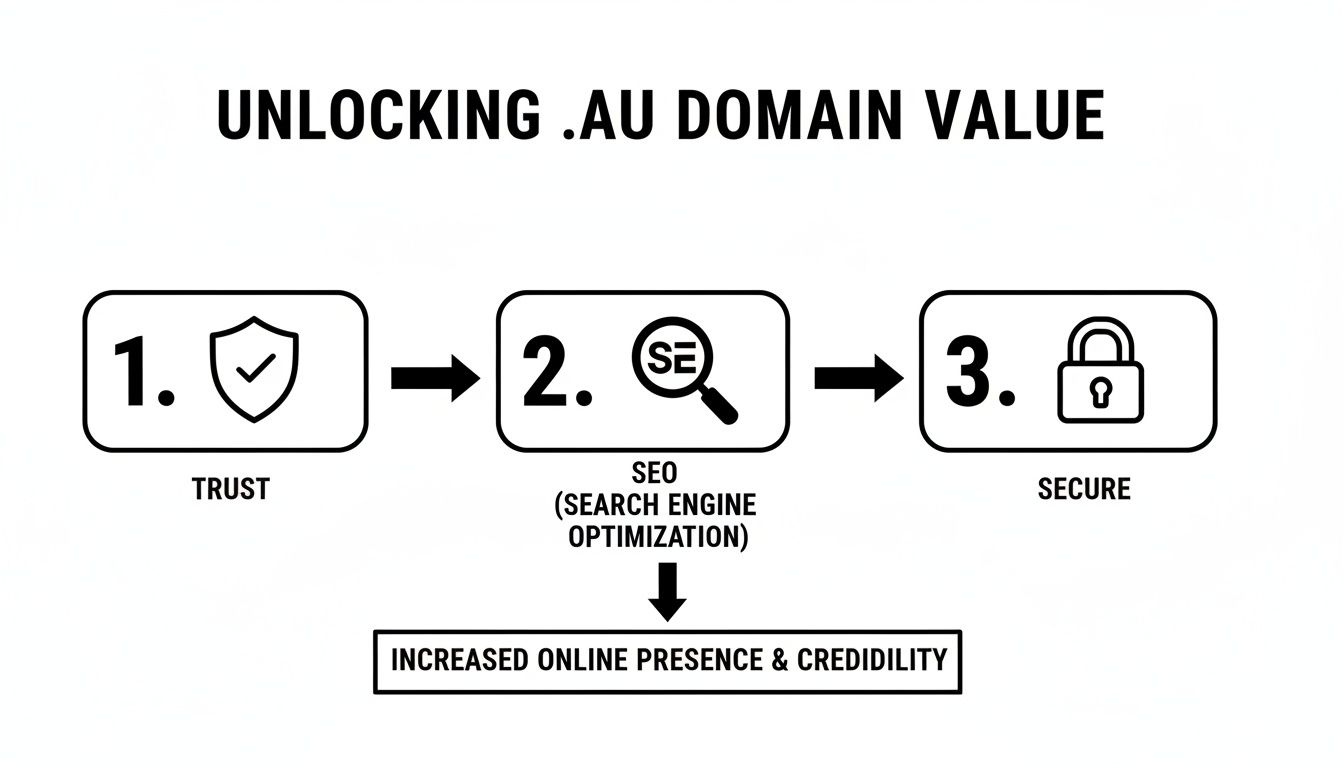
As you can see, a professional domain is much more than just a name. It’s a core business asset that directly builds your credibility and online security from day one.
Connecting Your Domain to Your WordPress Site
With your new domain in hand, the next job is to point it to your WordPress website. This is how you tell web browsers where to find your site when someone types in your new address.
The exact clicks might vary a little depending on your hosting provider, but the main idea is the same everywhere. Think of it as officially updating your address with Australia Post, but for the internet. If you need specific instructions, guides like this one for connecting your OVH domain name to Hostmora can be really helpful.
Here’s a general checklist that will get you there:
Log in to Your Hosting Provider: Jump into the control panel or dashboard where your WordPress site is hosted. Remember, this is separate from where you just bought your domain.
Find the 'Domains' Section: Have a look around for a menu item called ‘Domains’, ‘Addon Domains’, or ‘Domain Manager’. This is the spot where you'll introduce your host to your new domain name.
Add Your New Domain: Follow the on-screen steps to add your newly purchased domain to the hosting account. You’ll usually just need to type in the name (like
yourbusiness.com.au).Update Your WordPress Address: Now, log in to your WordPress dashboard. Head to Settings > General. You’ll see two fields: ‘WordPress Address (URL)’ and ‘Site Address (URL)’. Update both of these to your new professional domain, making sure to include the
https://at the start.
Important Takeaway: By pointing your domain correctly and updating those WordPress settings, you make sure everyone—visitors and search engines alike—lands in the right place. This one step really solidifies your professional online presence.
Once you save those changes, your website should pop up when you visit your new, professional domain name. It’s a great feeling! This process gives you the power to manage your brand independently, which is absolutely vital for long-term growth. For more tips on keeping your site in top shape, have a look at our WordPress best practices checklist.
Finding Smart and Affordable Domain Alternatives
Once you realise the pitfalls that come with a free domain name, the next step isn’t to splash a lot of cash. It’s to shop smarter. Securing a professional online address doesn't need a huge budget; it just requires a bit of strategy. This means sidestepping the deceptive lure of "free" and focusing on genuine value from reputable, low-cost providers.
The real goal here is to find an affordable domain that gives you full ownership, credibility, and control. You want to avoid the hidden fees and lock-in tactics that often come with those bundled "free" offers. Thankfully, for Australian businesses, there are plenty of excellent, budget-friendly options that deliver a professional result.
Choosing a Reputable Low-Cost Registrar
The key to a great deal is simply knowing where to look. When you’re picking an Australian domain registrar, always prioritise transparency and useful features over flashy, temporary discounts. A cheap upfront price can be a smokescreen if the renewal costs are sky-high or essential services are treated as expensive add-ons.
Here are the critical features to look for in a registrar:
- Transparent Pricing: Look for clear, upfront costs for both the initial registration and the ongoing renewal. A good registrar won't bury their renewal fees in the fine print.
- Included Domain Privacy: WHOIS protection is an absolute must-have. It shields your personal contact details from being public, preventing a flood of spam calls and emails. Many top-tier registrars now include this for free.
- User-Friendly Management Tools: Sooner or later, you'll need to manage your domain's settings. An intuitive dashboard makes this process straightforward, even if you’re not particularly tech-savvy.
The Real Cost of an Australian Domain
It's important to have realistic expectations about what you'll pay. While you can find dirt-cheap international domains, the regulated .au space has a standard price floor. There's no such thing as a genuinely free .au domain for life. Some providers might offer a promotional first-year price, but renewal is inevitable.
Typically, a basic .com.au or .au registration will set you back between AUD $20 and $50 per year. This price is influenced by wholesale costs set by auDA, which have been steadily rising and are scheduled to hit $9.30 including GST in 2025. When it’s time to renew, expect to pay around $30-$60. Add-ons can push the total annual cost anywhere from $40 to $120.
Pro Tips for Picking the Perfect Domain Name
Once you’ve found a registrar you trust, the fun part begins. The name you choose is a core piece of your brand identity, so it’s worth taking the time to get it right. An effective domain is an asset that works for you around the clock. When you’re looking at alternatives to free options, knowing how to value domain names can help you make a smart investment.
Here are a few tips to help you choose a winner:
- Keep It Short and Simple: Shorter names are much easier to remember, type, and share. Steer clear of long, complicated names that customers might misspell.
- Make It Memorable: Your domain should be catchy and give a clue about what your business does. Think
bunnings.com.au—it's short, branded, and totally unforgettable. - Avoid Hyphens and Numbers: These almost always cause confusion. People might hear "two" and type "2," or forget the hyphen entirely, sending them to the wrong website.
- Ensure It’s Easy to Pronounce: If you can't easily say your domain name over the phone, it’s too complicated. The old "radio test" is a great way to check for clarity.
By investing a small, predictable annual fee in a domain you truly own, you’re securing a foundational asset for your business. It's a small price to pay for the control, credibility, and peace of mind that comes with it, ensuring your brand's digital home is truly yours.
Ultimately, moving away from a free domain name toward a low-cost, professional alternative is one of the smartest early decisions you can make. The total cost of a website is more than just the domain, but getting this piece right sets a strong foundation. You can read more about this in our guide on how much a website really costs.
Frequently Asked Questions About Australian Domains
When you're trying to get a business off the ground in Australia, the world of domain names can seem a bit confusing. You've got questions, and getting clear, straightforward answers is the only way to feel confident about your decisions. Let's tackle some of the most common queries we hear from Aussie business owners and clear up the confusion for good.
We’ll dig into the reality of those "free" domain offers, explain the difference between local domain extensions, and show you exactly how your choice of domain name affects whether customers can even find you online.
Can I Get a Truly Free Domain Name Forever?
Let's cut right to the chase: no. A genuinely free, top-level domain for life (like a .com or .com.au) just isn't a real thing from any reputable company. The term "free domain name" is almost always a marketing hook with a catch.
What you'll actually find are two main scenarios:
- You get a free subdomain: This looks something like
yourbusiness.wordpress.com. While it doesn't cost any money, you don't own it. You're effectively just borrowing a corner of someone else's digital real estate. It looks unprofessional to customers and can seriously hold back your SEO. - You get a one-year "free" deal: This is the most common offer. A hosting company bundles in a domain registration for the first year when you buy their hosting plan. It's only free for those first 12 months. After that, you're on the hook for annual renewal fees, which are often sneakily inflated well above the standard market rate.
The only way to have complete ownership, control, and the freedom to move your website wherever you want is to buy your domain yourself from a registrar. It’s a small annual fee, and it’s the professional standard for any serious business.
What Is the Real Difference Between .com.au and .au?
This is a great question, especially since things have changed a bit in the Australian domain space recently. The good news is that both .com.au and the newer, shorter .au are excellent choices that immediately signal to customers and search engines that you're an Aussie business.
For years, .com.au has been the gold standard for Australian commercial websites. It's what people know, recognise, and trust. The direct .au domain is the new kid on the block, introduced in March 2022. It offers a shorter, sharper, and more mobile-friendly alternative.
To register either one, you need to have a verifiable Australian presence, like an Australian Business Number (ABN). If you're just starting out, the shorter .au is often a fantastic, modern choice. That said, many established businesses wisely choose to register both versions. They simply redirect one to their main website, which is a smart move to protect their brand and catch all potential visitor traffic.
How Much Does My Domain Name Affect SEO?
More than you might think. Your domain name has a significant impact on your Search Engine Optimisation (SEO), particularly for a local Aussie business. It’s one of the first and most powerful clues you give to Google about who you are and where you operate.
Having a .au or .com.au extension instantly tells search engines that your business is geared towards an Australian audience. This gives you a home-ground advantage in local search results. When someone in Melbourne searches for a service you offer, Google is far more likely to show your site over an international one because you're more geographically relevant.
A professional domain builds trust and authority, which are key ranking factors for Google. On the flip side, a free subdomain from a platform like Wix or Weebly can actively damage your SEO. Search engines often see these as less credible and less permanent, making it much harder to rank for anything remotely competitive.
Every blog post you write and every link you earn builds equity in your domain name. When you own it, you're building a valuable digital asset for your business. When you use a subdomain, all that value you're creating goes to the parent company, not to you.
Can I Move a "Free" Domain from My Hosting Provider Later?
Technically, the answer is yes. But in reality, it's often designed to be a frustrating and expensive nightmare. Trying to transfer a domain that was "free" with a hosting package is a massive headache for many business owners.
It’s a classic lock-in tactic. Some hosts make it incredibly easy to sign up but deliberately difficult and costly to leave.
Here are the sorts of roadblocks you can expect to hit:
- Transfer Locks: Under ICANN (the global domain authority) rules, most registrars place a 60-day lock on new domains, preventing transfer. Some hosts add their own internal rules on top of this to make it even harder.
- Hidden Fees: To unlock your domain for transfer, the provider might hit you with a steep "admin fee" or "release fee". This charge often completely wipes out any savings you thought you were getting with the "free" offer.
- A Confusing Process: They might bury the transfer settings deep inside a clunky control panel or make you submit multiple support tickets, slowing the whole process down in the hope you’ll just give up and stay.
This is exactly why we always recommend buying your domain from a separate, dedicated registrar. It gives you the freedom to pick the best hosting for your needs, now and in the future, without being held hostage. That small annual domain fee is a small price to pay for complete control over your most important online asset.
Keeping your WordPress site secure, fast, and up-to-date is just as important as choosing the right domain. If you need expert help managing the technical side of your website, Webby Website Optimisation offers specialised WordPress support and maintenance plans for Australian businesses. Let us handle the complexities so you can focus on growth. Learn more about our WordPress help and support services.