
Yes, you can absolutely get a free domain name, but it’s one of those things that almost always comes with a catch. The most common way is to get one bundled with a web hosting plan, where the domain is free for the first year. This guide will walk you through exactly how it works for your Australian business.
How to Get a Free Domain Name in Australia

When you're starting a new website, every dollar counts. So, the idea of scoring a free domain name is pretty appealing—it's one less upfront cost to worry about.
But in the world of web services, 'free' is often an incentive tied to a bigger purchase. Think of it less as a no-strings-attached gift and more as a helpful launchpad for getting your new website off the ground.
There are three main paths to getting a domain without paying for it initially. Understanding the difference between them is the key to making a smart decision for your business.
Method 1: Bundled With a Web Hosting Plan
This is easily the most popular and legitimate way to get a free domain. When you sign up for a web hosting plan, many providers will throw in a free domain registration—like a .com or .com.au—for your first year to win your business. You pay for the hosting service you need anyway, and they cover the domain fee as a bonus.
This is a fantastic option for new businesses because it simplifies everything. Your domain and hosting are managed under one roof, making it much easier to get your site live. Just be sure to check the renewal cost, as you’ll need to start paying for the domain after that first year is up.
Method 2: Included With a Website Builder
Platforms like Wix, Squarespace, or the free version of WordPress.com often give you a subdomain with their free plans. So, instead of having yourbusiness.com.au, your web address would look something like yourbusiness.wixsite.com or yourbusiness.wordpress.com.
While this is technically a free way to get your site online, a branded subdomain instantly signals that you're using a free service. For a serious business, this can undermine professionalism and make it harder to build a strong, independent brand identity.
This approach really only makes sense for personal blogs, hobby projects, or temporary test sites where brand credibility isn’t the top priority.
Method 3: Using Free Top-Level Domains (TLDs)
The third and by far the riskiest option is to use a completely free Top-Level Domain (TLD) like .tk, .ml, or .ga. These are run by companies that offer free registration to anyone, no questions asked.
While they cost nothing upfront, they come with some serious baggage:
- Poor Reputation: These TLDs are notorious hotspots for spam and phishing, which can instantly damage your site's credibility and search engine ranking.
- Lack of Ownership: You often don't truly own the domain. It can be taken away without warning, leaving you with nothing.
- Security Risks: They typically lack the robust security and support that come standard with paid domains.
Quick Comparison of Free Domain Name Options
To help you visualise the trade-offs, here’s a quick breakdown of the three methods we've covered.
| Method | Typical Ownership | Real Cost (After Year 1) | Brand Professionalism |
|---|---|---|---|
| Hosting Bundle | You own the domain | Standard renewal fee | High |
| Website Builder Subdomain | The platform owns it | N/A (always a subdomain) | Low |
| Free TLD | You don't truly own it | N/A (always free) | Very Low |
As you can see, bundling with a hosting plan is the only option that gives you genuine ownership and a professional look.
Considering that domain registration in Australia has become quite affordable, the risks tied to free TLDs just don't stack up against the minimal savings. For example, while introductory rates for a .com.au can be as low as $9.95 for the first year, ongoing annual renewals typically range from $22.95 to $29.66. This makes a paid domain a small but crucial investment in your business’s legitimacy. To dig deeper into the nuances of ownership, check out our guide on what's really involved with a free web domain.
Understanding Your Free Domain Options
The idea of a "free" domain name is definitely appealing, but it’s crucial to know that not all free domains are created equal. The word 'free' can mean very different things, and getting it wrong can cause major headaches for your business down the track.
Think of it like getting a company ute. You might be offered one as part of a deal, but how you get it changes everything. Does the title have your name on it? Are there hidden running costs? What does a beat-up, sign-written ute say about your business compared to a brand new one?
Let’s unpack the three main ways you can get a domain without an upfront cost. Each has its own place, but only one is truly right for a serious Australian business.
H3: Free Domain with a Hosting Plan
This is easily the most common and, frankly, the best way to get a "free" domain for your business. When you sign up for a web hosting plan, many providers will throw in a free domain name registration for your first year to sweeten the deal.
It’s a bit like getting a 'free' smartphone when you sign a two-year mobile contract. The phone’s cost is really bundled into your monthly payments, but you avoid that big initial outlay. In the same way, your domain is free for the first 12 months, but you'll pay the standard renewal fees from year two onwards. It’s a marketing incentive, and a pretty good one at that.
The most important thing to realise here is that you get true ownership. From day one, the domain is registered in your name. This gives you full control and the freedom to move it to a different host later if you need to. It's the gold standard.
This approach gives you the best of both worlds: you save money upfront while securing a professional address like a .com or .com.au that you actually own.
H3: Free Subdomains on Website Builders
Another path to a free web address is through website builders like WordPress.com, Wix, or Squarespace. Their free plans often include what's called a subdomain.
Imagine a subdomain as an apartment within a huge complex. You get your own unit (your-apartment), but the building's name (TheMainBuilding) is always part of your address: your-apartment.themainbuilding.com. You can paint the walls and arrange the furniture inside, but you can never, ever remove the building's name from your mailing address.
With a subdomain, your website address will look something like yourbusiness.wordpress.com or yourbusiness.wixsite.com. This instantly tells every visitor that you’re using a free platform, which can seriously undermine your brand’s credibility.
- Great for: Hobby blogs, uni projects, or a temporary site to test out an idea before you commit.
- Not so great for: Any business that wants to be taken seriously, especially e-commerce stores or professional service providers.
It’s a way to get online for absolutely nothing, but the trade-off is a web address that looks amateur and gives you zero brand independence.
H3: Genuinely Free TLDs
The third category is the one you need to be most wary of: genuinely free Top-Level Domains (TLDs) like .tk, .ml, .ga, and .cf. Certain registrars offer these at no cost, no strings attached. It sounds too good to be true, and unfortunately, it is.
Think of these TLDs as pitching a tent on unpatrolled public land. Sure, you can set up camp for free, but you have no rights, no security, and no guarantee it'll be there tomorrow. The area is also known for attracting shady characters.
These free TLDs are magnets for spam, phishing scams, and malware. It’s a reputation that both users and search engines are very aware of. Using one can tarnish your brand before you’ve even launched. Worse still, you rarely get actual ownership. The registrar can take your "free" domain back at any moment, for any reason, leaving your business high and dry.
For all these reasons, this is an option we strongly advise every business to avoid. The risks simply aren't worth the illusion of getting something for nothing.
Weighing the Pros and Cons of a Free Domain
Getting something for free always feels good, especially when you’re launching a new business and watching every dollar. But when it comes to your domain name, that "free" offer needs a closer look. Is it a smart way to get started, or is it a classic case of 'you get what you pay for'?
Honestly, there’s no single right answer. A free domain can be a great launchpad in some situations, but it almost always comes with strings attached. Let’s unpack what you’re really getting into so you can make a clear-headed decision.
The Clear Advantages of a Free Domain
The most obvious win here is the cost. Or lack thereof. When you're bootstrapping a business, saving even a $20-$50 annual domain fee can feel like a major victory. That’s money you can put straight into marketing or product development.
It's also about simplicity. Most free domains come bundled with a hosting plan or a website builder, and they're often connected for you right out of the box. This means you can skip the technical fiddling and get your site live faster.
For an Australian business owner just starting out, the appeal often boils down to:
- Zero Upfront Investment: You can grab an online address without spending a cent, which is a huge relief when you have a dozen other setup costs.
- Simplified Management: Your domain and hosting are in one place. That means one bill, one login, and one company to call for support. It definitely makes admin easier.
- Low-Risk Testing Ground: Got a new idea you want to test? A free domain, particularly a subdomain, lets you get online and gauge interest without any financial commitment.
These benefits make a free domain a very tempting offer. But these advantages are usually short-lived and can create some real headaches for your brand down the track.
The Hidden Costs and Disadvantages
This is where the other shoe drops. The downsides of a free domain aren’t always obvious on day one. They tend to pop up a year later, just when your business is starting to find its feet.
A free domain is a marketing hook, plain and simple. It's designed to lock you into a service. It saves you a few dollars upfront, but the real question is what it will cost you on day 366 in money, flexibility, and brand image.
Let's look at the most common pitfalls. First up are the high renewal rates. That domain you got for free? It’s almost always just for the first year. When it’s time to renew, you’ll be hit with the provider's standard rate, which can be much higher than what you’d pay elsewhere.
Then you have transfer restrictions. Some companies make it incredibly difficult to move your "free" domain to another registrar. They might lock you in for 60 days or bury the transfer process in a maze of confusing menus. They're basically holding your web address hostage to stop you from leaving.
Finally, and perhaps most importantly, is the impact on your brand and SEO. If your free domain is just a subdomain (like yourcafe.wixsite.com), it can look amateurish. Customers are naturally more sceptical of a business that doesn't have its own professional domain. You can read more about the different types of free domains in our complete guide on how to get a free domain name.
Summary of Potential Downsides
| Disadvantage | How It Affects Your Business |
|---|---|
| Lack of Ownership | With subdomains or free TLDs, you don't truly own the address. The provider can take it away. |
| Low Credibility | An address ending in .wordpress.com or .tk can feel untrustworthy and unprofessional to customers. |
| Negative SEO Impact | Search engines often give less weight to subdomains and are cautious of free TLDs known for spam. |
| Unexpected Costs | Renewal fees after the first year can be a nasty surprise, often well above market rates. |
| Limited Portability | Moving your domain to a different provider can be intentionally difficult or even blocked. |
| No Professional Email | You can't set up an email like contact@yourbrand.com.au, forcing you to use a less professional Gmail or Outlook address. |
Ultimately, you have to weigh the initial savings against these long-term drawbacks. For any serious business in Australia looking to build a strong, lasting brand, that small upfront saving rarely justifies the future costs and limitations.
Is a Free Domain Right for Your Australian Business
Picking a domain name for your business isn't just a tech task you tick off a list; it’s one of the first big branding decisions you'll make. For any Australian small business, your domain is your digital front door. It’s often the very first impression you make on a potential customer, and it sets the tone for everything that follows.
So, when does a free domain actually make sense, and when should you give it a wide berth? The answer really boils down to what you're trying to achieve with your website. There are definitely times when grabbing a free domain is a smart, practical move.
When a Free Domain Is a Great Fit
Let's be clear: sometimes, "free" is exactly what you need. If your main goal is just to get online quickly without spending a cent, and you aren't too worried about long-term branding or search engine performance, a free domain can be the perfect tool for the job.
It’s an excellent choice for things like:
- Personal Blogs or Hobby Sites: If you’re just keen to share your travel stories or showcase your photography, a free subdomain like
mytravels.wordpress.comis a fantastic, no-cost way to get your passion project online. - Short-Term Projects: Got a one-off event, a school project, or a temporary marketing campaign? A free domain is ideal. There’s no point paying for a permanent asset you’ll only need for a few weeks or months.
- Private Testing Sites: If you're a developer building a website for a client, a free subdomain is a practical, behind-the-scenes space to get everything perfect before launching it on the final, paid domain.
In these situations, a free domain does its job perfectly. It provides a functional online space without any financial risk.
When a Free Domain Is a Bad Idea
The moment your website becomes a central part of your business—especially if you're selling something or asking for people's trust—the whole picture changes. For any serious business venture, a free domain can actively undermine your credibility from day one.
A free domain can be like showing up to a major client meeting in board shorts and thongs. While comfortable and cheap, it sends a message that you might not be taking the opportunity seriously. Your domain name functions in much the same way for your online presence.
This flowchart helps visualise where a free domain sits in the decision-making process.
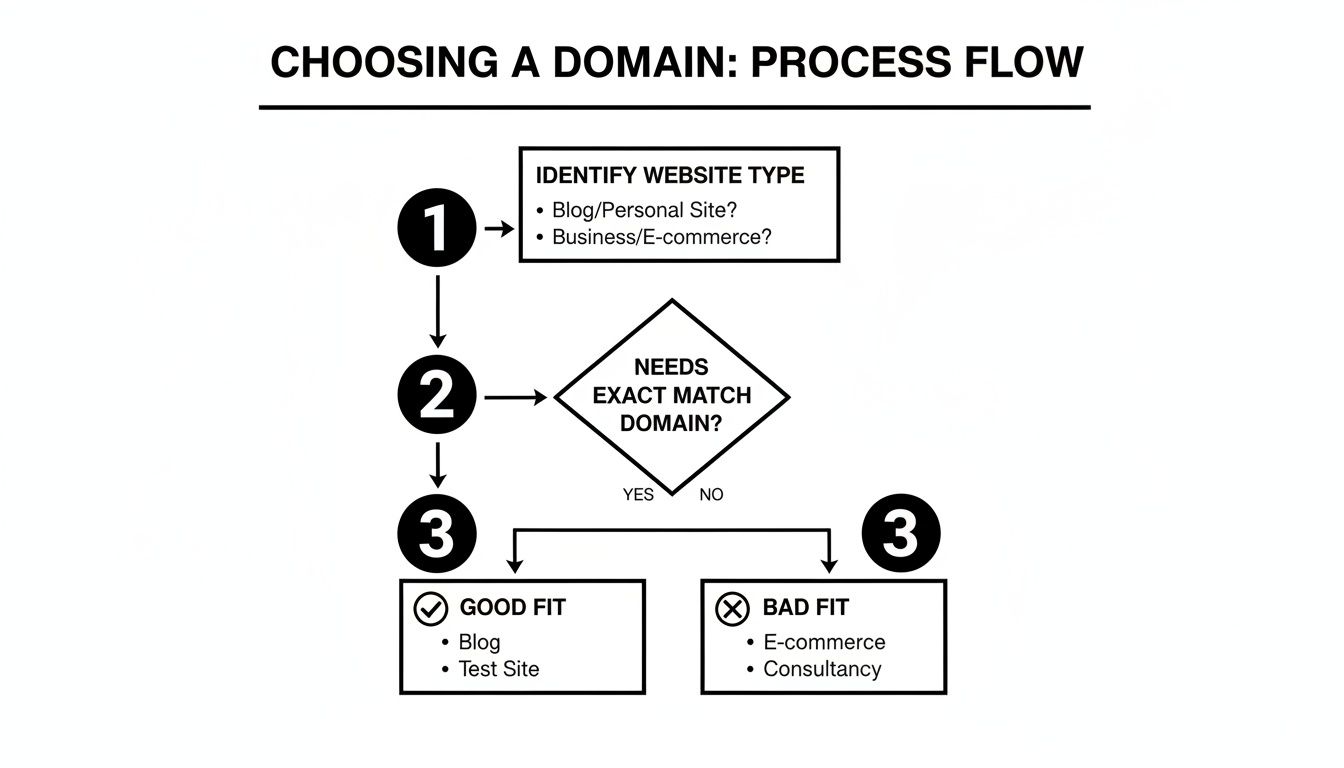
As you can see, for businesses built on professionalism and trust—like an e-commerce store or a consultancy—a proper, paid domain isn't just nice to have; it's essential.
The Australian Context: Why a .au Matters
For businesses here in Australia, this choice is even more important. The local market is savvy and competitive. An Aussie customer can spot a non-committal domain from a mile away, and something like a free subdomain or an obscure TLD like .tk immediately puts a barrier between you and them.
Investing in a premium domain, especially a .au or .com.au, is a direct signal to the local market. It shows you're a legitimate, registered Australian entity that's serious about serving your community. It builds instant trust. As Australia's digital identity grows, with registered .au domains projected to hit 2 million by 2026, a professional address is quickly becoming the standard. You can explore more on this trend by looking at the latest domain registration data.
Ultimately, if you're a local Melbourne cafe or a Sydney online shop just starting out, a promotional free domain bundled with a quality hosting plan can be a decent first step. But for any business where trust is currency—think e-commerce, financial services, or professional consultancies—a free subdomain is a non-starter. The small amount you save upfront is nothing compared to the long-term damage it can do to your brand's credibility.
Setting Up Your Free Domain With WordPress
Alright, you've settled on snagging a free domain as part of a hosting package for your new Aussie business. That’s a brilliant move—it gives you a professional address online without the initial outlay. Now for the fun part: getting it all connected and live with WordPress.
If that sounds a bit technical, don't worry. Modern web hosts have done a fantastic job of simplifying the whole affair. We’ll walk you through it, step-by-step, so you can get your site online correctly and securely right from the get-go.
Choose Your Host And Claim Your Domain
First things first: you need a reputable hosting provider that bundles a free domain name with its plans. Think of your host as the landlord for your website’s digital real estate. Choosing a good one is absolutely vital for your site's speed, security, and getting help when you need it.
As you go through the sign-up process, the host will guide you to claim your free domain. This is the moment your brand's online identity really starts to take shape.
- Select a Hosting Plan: Find a plan that fits what you need. For most new businesses, a shared hosting plan is more than powerful enough to start with.
- Search for Your Domain: Use the provider's search bar to check if your dream domain (like
yournewcafe.com.au) is available. It’s always smart to have a couple of backup ideas, just in case. - Claim and Register: Found one you love? Great! Just select it, and the host will automatically apply the discount, making it free for the first year.
Once you finish checking out, that domain name is officially yours. It’s a huge milestone.
Link Your Domain to WordPress
Here’s the best part: this step is almost always done for you. When you buy your hosting and domain from the same company, they handle all the technical plumbing behind the scenes. Most hosts even offer a "one-click" WordPress installation that sets up the software and points your domain to it all at once.
It’s like getting the keys to your new shop. The host connects the street address (your domain) to the physical building (your hosting server). Now, when people type in your URL, they land right at your front door.
If for some reason it isn’t automatic, the setup wizard will simply ask you to pick your new domain from a list. The entire process rarely takes more than five minutes.
Secure Your Site with an SSL Certificate
This last step isn’t just recommended; it’s essential. An SSL certificate is what puts the 's' in https and gives you that little padlock icon in the browser bar. It encrypts the data flowing between your site and your visitors, protecting their information and showing them your site is trustworthy.
Without an SSL, browsers like Google Chrome will bluntly label your site as "Not Secure." Nothing scares away potential customers faster.
- Why it's crucial: SSL protects user data, gives visitors peace of mind, and it's even a minor Google ranking signal.
- How to get it: Nearly all quality hosts now include a free SSL certificate (usually from Let's Encrypt) with their plans.
- Activation: This is often automated. If not, you can typically flick a switch inside your hosting control panel to turn it on.
With your SSL active, your WordPress site is now live, secure, and ready for you to start building. Down the track, if you ever decide to move your site, you might find our guide on the WordPress domain name transfer process helpful.
Growing Your Brand Beyond a Free Domain
Everyone has to start somewhere, and a free domain is a perfectly good place to begin. It's like the training wheels on your first bike—it gets you online and helps you find your balance without a big upfront cost. But for any business with serious ambitions, there comes a time to take those training wheels off.
Upgrading to your own custom domain isn't just a technical step; it’s a public declaration that you’re here to stay. It shows customers, partners, and even search engines that your business is established and ready for the long haul.
The Power of Owning Your Domain
When you buy a domain like yourbrand.com.au, you're not just getting a web address. You're acquiring a core business asset, every bit as important as your company name or logo. This is where you move from just having an online presence to truly owning your brand's digital home.
The difference is night and day.
- Real Brand Ownership: Your domain belongs to you, and only you. You control its destiny. No platform can suddenly change its rules and take it away from you. It becomes a permanent fixture of your brand.
- Better SEO Authority: Let's be frank, search engines tend to favour websites with custom domains. A proper
.com.auor.comaddress gives your site more credibility in their eyes, which is a huge help when you're trying to climb the rankings. - Stronger Customer Trust: Which would you trust more with your credit card details:
yourbrand.wixsite.comoryourbrand.com.au? A professional domain just feels more legitimate, building instant confidence with potential customers. - Professional Email Addresses: Nothing says "small-time" like a Gmail address on a business card. With your own domain, you can set up emails like
sales@yourbrand.com.au, which immediately boosts your professional image.
Shifting from a free to a paid domain is really a shift in mindset. You stop focusing on what you can get for free today and start investing in the long-term value of your brand. Your domain becomes one of your most powerful assets.
Exploring Creative Domain Opportunities
The options for domain names are also getting more exciting. We're no longer limited to the classic choices. The explosion of new generic top-level domains (ngTLDs) has opened up some brilliant avenues for creative branding. You could grab a .shop for your e-commerce store, a .design if you're a creative agency, or even a .melbourne to really hammer home your local roots.
This part of the industry is buzzing with activity. New generic TLDs saw a 13.5% year-over-year jump, with about 4.5 million new registrations. At the same time, trusted country-code domains (ccTLDs) like Australia's own .au are as popular as ever, growing by 2.4% to hit 142.9 million registrations worldwide. You can dive deeper into these domain name statistics and trends to see where things are headed.
This all goes to show that businesses are thinking more strategically about their web addresses. Whether you opt for a classic .com.au for its solid, local reputation or a creative ngTLD that makes a statement, the goal is the same: invest in a domain that will build and strengthen your brand for years to come.
Frequently Asked Questions About Free Domains
Even after weighing the pros and cons, you might still have a few lingering questions about free domain names. Let's tackle some of the most common ones we hear from Australian business owners to help you make the right call.
Can I Get a Free .com.au Domain Name?
Yes, you can—but there's always a catch. The most legitimate way to get a free .com.au or .au domain is through a promotional offer. Many trusted Australian web hosts will throw in the first year of your domain registration for free when you sign up for an annual hosting plan.
Just remember, it’s only free for that initial 12 months. After the first year, you'll need to pay the standard renewal fee to keep it. A completely free-for-life .com.au simply doesn't exist.
Do I Actually Own My Free Domain?
This is a huge one, and the answer comes down to how you got the domain in the first place.
- Hosting Bundle: Yes, absolutely. When a domain is part of a hosting package, it’s registered in your name. You have full ownership and control, meaning you can transfer it to another provider down the track if you want to.
- Subdomain: No. An address like
mybusiness.wixsite.comisn't yours. You're effectively just borrowing a room in someone else's house. The platform owns the primary domain, and you're just using a part of it. - Free TLDs (.tk, .ml): Almost never. With these, your claim to the name is shaky at best. The registrar can often revoke it with little to no notice, which is a massive risk for any serious business.
Will a Free Domain Hurt My SEO?
It definitely can. Think of it from Google's perspective: search engines want to show their users credible and authoritative results. A professional, custom domain is a strong signal that you’re serious about your business.
A free domain that comes with a hosting bundle is perfectly fine for SEO. However, a subdomain or a free TLD can be a red flag.
A subdomain like
yourname.wordpress.comstruggles to build its own search authority because it’s seen as part of the main platform, not an independent entity. Worse, many free TLDs have a reputation for being used for spam, which can tarnish your site's reputation before you even get started.
At the end of the day, investing in a proper paid domain gives your website the solid foundation it needs for long-term SEO success.
Choosing the right domain is just the first step; keeping your WordPress site secure, fast, and up-to-date is the ongoing journey. If you need a hand with proactive maintenance, security scans, or performance optimisation, Webby Website Optimisation offers expert WordPress help and support for businesses across Australia. Learn more about our flexible support plans.