
A good responsive search ad (RSA) is a pool of short, distinct headlines and descriptions that each stand on their own, and Google assembles them into the combination that best fits each search. Below are worked examples for a plumber, an accountant and an electrician, written to Google’s current limits. After them come the rules behind the examples, the tips that matter most, and a way to judge results without overreacting to early data.
The examples are illustrative drafts. Swap in your own suburbs, licences, prices and offers, and only say what you can prove.
TL;DR
- An RSA takes up to 15 headlines (30 characters each) and up to 4 descriptions (90 characters each). Google tests combinations and learns which ones work.
- Write each headline so it makes sense next to any other headline. Mix keyword headlines, benefit headlines, trust headlines and action headlines.
- Pin only what you must, such as a legal line. Every pin reduces the combinations Google can test.
- Judge assets after enough data, not after a few days. Google Ads now shows click and conversion data per asset.
- Every claim in an ad must be true. Australian consumer law applies to Google ads like any other advertising.
Table of Contents
- How an RSA works, in plain terms
- The limits your examples must fit
- Example 1: a Perth plumber
- Example 2: a Fremantle accountant
- Example 3: an electrician in the Melville area
- What the examples have in common
- Best practices that move the needle
- When to pin a headline or description
- Keep your claims honest
- A step-by-step way to build your first RSA
- Reading results without overreacting
- Perspective
- Where Webby can help
- FAQ
- Sources
How an RSA works, in plain terms
With a responsive search ad, you enter multiple headlines and descriptions. Over time, Google Ads tests different combinations and learns which perform best. It assembles the text in a way that avoids redundancy, and every ad shown includes at least one headline and one description.
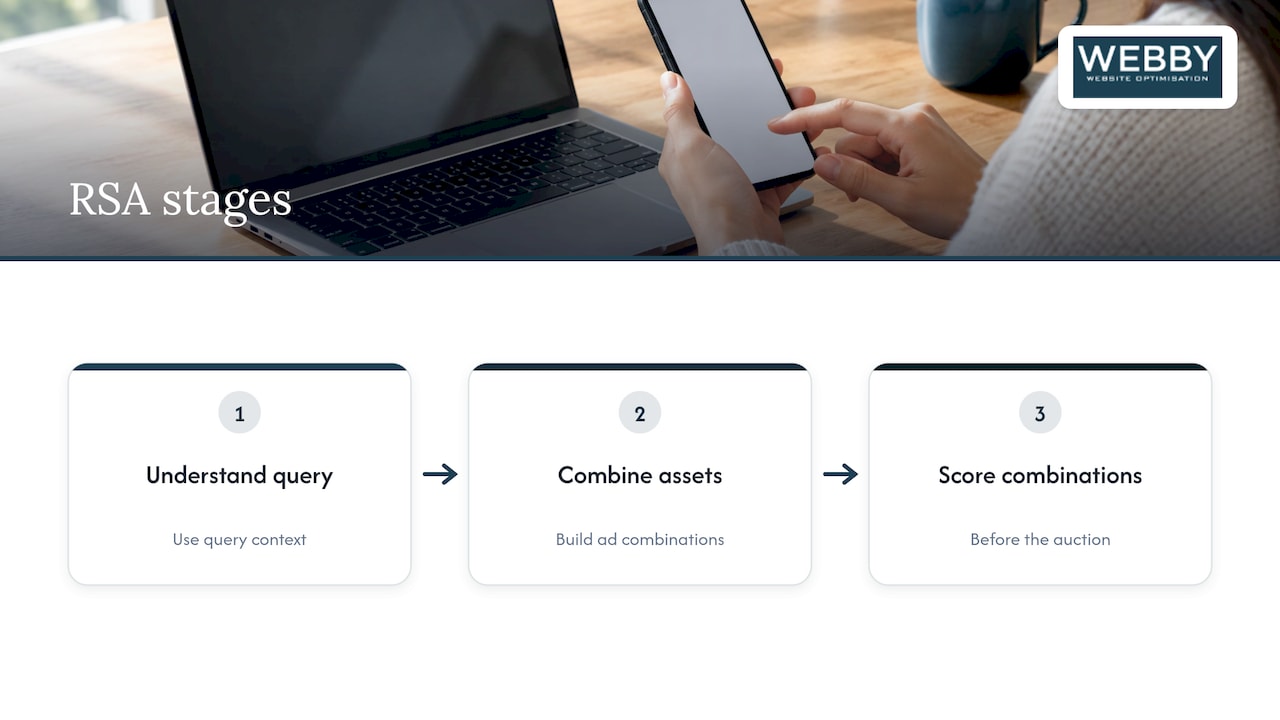
The ad can show up to three headlines in the headline position, and parts of the text may appear in bold when they match the searcher’s query. Google’s own guide describes the process as three steps: understanding the query context, assembling combinations from your assets, and scoring those combinations before the auction.
For a local service business this means you no longer write one perfect ad. You write a set of building blocks. Someone searching “blocked drain Perth” and someone searching “emergency plumber near me” can see different ads built from the same set.
The limits your examples must fit
Google’s specifications for RSAs are firm. Headlines allow up to 30 characters each, with up to 15 headlines; descriptions allow up to 90 characters each, with up to 4 descriptions. You need a minimum of 3 headlines and 2 descriptions to run the ad, and the two display path fields allow 15 characters each.
| Asset | Maximum | Minimum to run |
|---|---|---|
| Headlines | 15, up to 30 characters each | 3 |
| Descriptions | 4, up to 90 characters each | 2 |
| Display path fields | 2, up to 15 characters each | Optional |
| Final URL | Up to 2,048 characters | 1 |
Thirty characters is tight. “Licensed Perth Plumbers” fits at 23. “Licensed Plumbers Serving Perth and Surrounds” does not. Count every character, including spaces, before you paste.
Example 1: a Perth plumber
This set is built around urgent, high-intent searches. The reader is stressed and wants speed, a licensed person and a clear price.
Headlines (all 30 characters or fewer)
- Perth Emergency Plumber (23)
- Blocked Drain Repairs (21)
- Licensed Perth Plumbers (23)
- Upfront Quotes, No Surprises (28)
- Hot Water Systems Repaired (27)
- Book Online in 2 Minutes (24)
- Serving Perth Metro Suburbs (27)
- Get a Fixed-Price Quote (23)
Descriptions (90 characters or fewer)
- Blocked drain or burst pipe? A licensed Perth plumber can be on site today. (75)
- Clear pricing before work starts. Book online or call for your fixed-price quote. (81)
Why it works
- Headlines 1 and 2 carry the keywords people type. Headline 3 and 4 reassure. Headlines 6 and 8 give a next step.
- No headline depends on another, so Google can show any three in any order and the ad still reads sensibly.
- Only include “today” or “24/7” if your business really delivers it. If you cannot honour a promise at 2 am, do not write it.
Our article on Google Ads for trades and phone leads goes deeper on why call-driven campaigns suit this kind of business.
Example 2: a Fremantle accountant
Searches for professional services are slower and more considered. The reader compares, so trust and clarity carry more weight than urgency.
Headlines
- Fremantle Tax Accountant (24)
- Small Business Tax Returns (26)
- Registered Tax Agents (21)
- BAS and Bookkeeping Help (24)
- Free 15-Minute Intro Call (25)
- Local Fremantle Office (22)
- Clear Fixed-Fee Packages (25)
- Sole Traders Welcome (21)
Descriptions
- Tax returns, BAS and advice for Fremantle small businesses. Book a free intro call. (82)
- Plain-English advice from a local team. See our fixed-fee packages online. (74)
Why it works
- The ad speaks to specific customer types (sole traders, small businesses) so the right people self-select and the wrong clicks drop.
- “Registered Tax Agents” is only usable if it is true for the practice. Use your registration, not a general claim.
- The call to action is a low-commitment step (an intro call), which suits a considered decision.
Example 3: an electrician in the Melville area
This set demonstrates a keyword-light mix. Google recommends at least 8 to 10 headlines, at least 5 unique ones, a keyword in 2 headlines and at least 3 other headlines without keywords. The headlines below follow that pattern.
| Role | Headline | Characters |
|---|---|---|
| Keyword | Melville Electricians | 21 |
| Keyword | Switchboard Upgrades | 20 |
| Trust | Licensed and Insured | 20 |
| Trust | Local Family Business | 21 |
| Benefit | Safe, Tidy, On-Time Work | 24 |
| Offer | Free Quote on Larger Jobs | 25 |
| Action | Request a Callback Online | 25 |
| Location | Servicing Melville and Nearby | 29 |
Description 1: “Switchboards, lighting, power points and fault finding by licensed local electricians.” (84)
Description 2: “Tell us what you need and we will call back with a clear quote.” (63)
Note the “Local Family Business” line. It is an example only. Use it only if it describes you.
What the examples have in common
Put the three sets side by side and a pattern shows.
- Every headline stands alone. None needs the previous line to make sense.
- Different jobs for different headlines. Some match the search, some build trust, some prompt action.
- Specific over generic. Google advises avoiding generic sales language like “call us today” in favour of specific calls to action that give a reason to act.
- Local signals. A suburb or region name tells the searcher you work where they are.
- Nothing you cannot deliver. More on that below.
Best practices that move the needle
Google’s guidance can be boiled down to a handful of habits.
Use the space you are given
Google recommends adding as many unique headlines and descriptions as possible, so the system has more combinations to assemble. Fifteen headlines that repeat the same idea are worse than ten that each say something new.
Match the ad to the landing page
The same page recommends matching your ad to your landing page and trying headlines of varying lengths. If the ad promises “Switchboard Upgrades” and the page is a generic homepage, the click is wasted. Send each ad group to the page that answers that search. Our guides on service page structure and examples of optimised service pages show what that page should do once the visitor lands.
Include prices, promotions and exclusives
Google suggests including prices, promotions or exclusives in a headline or description. For service businesses, “fixed-price quote” or a published starting price often works better than a vague discount. Any price must be accurate (see the legal section below).
Watch Ad Strength, but do not worship it
Google reports that advertisers who lift Ad Strength from Poor to Excellent see 15% more clicks and conversions on average, and recommends at least two Good or Excellent RSAs per ad group. The same page says advertisers with one RSA who add a second see a 6.6% increase in conversions at a similar cost per conversion. Treat these as Google’s reported averages, not a promise for your account. Ad Strength is a diagnostic for variety and relevance. A well-written ad for your market matters more than the label.
Add the assets around the text
Google also recommends business names and logos, location and call assets, sitelinks and a unique final URL for each RSA. For a local business that needs phone calls, call and location assets are often the difference between a click and a call.
When to pin a headline or description
Pinning fixes an asset to a position. It is useful in one clear case: when text must always appear. If something must show in every ad, such as a legal disclaimer, Google says you must include it in Headline 1 or Description 1. Google’s guide notes that pinning is appropriate when an asset has to show to meet local regulatory requirements, and that it limits the combinations the system can test. It suggests pinning two or three options per position rather than one.
Updated advice reported in 2026 goes further: avoid pinning identical or near-identical text to one slot, pin only one or two essential keyword headlines and let the rest rotate.
A practical rule for a small business: pin a licence or regulatory line if your industry requires one, and leave everything else free.
Keep your claims honest
Ads are advertising, and Australian consumer law applies. The ACCC says that any claim a business makes about its products or services must be accurate, truthful and based on reasonable grounds. It names price claims as a particular risk, including sale prices that are not truly temporary and prices that leave out GST.
Two cases show how this plays out in search and shopping ads:
- In December 2024 the ACCC alleged that an NDIS provider made false or misleading claims in Google Shopping ads about usual prices, time-limited sales and “NDIS approved” products. The ACCC stated that the NDIS does not approve particular products.
- In 2021 the Full Federal Court found that Employsure’s Google ads conveyed a government affiliation in breach of the Australian Consumer Law.
The practical lesson for your headlines: do not imply a government link, an approval or an accreditation you do not hold. Do not run “50% off” unless it is a real, time-limited reduction. Show GST-inclusive prices where you quote consumer prices. Because RSAs mix and match lines, check that every possible combination is true, not just your favourite pairing.
A step-by-step way to build your first RSA
- List the searches. Write down the 10 to 20 phrases customers use, with suburbs.
- Group them. One ad group per service, such as hot water or blocked drains.
- Draft 12 to 15 headlines. Aim for keyword, trust, benefit, offer, location and action lines.
- Draft 4 descriptions. Two on the service and proof, two on the next step and what happens after contact.
- Check every line for length and truth. Read random triples aloud. If one combination sounds wrong, rewrite the line.
- Match the landing page. The headline’s promise should be the page’s first heading.
- Add assets. Sitelinks, call, location, business name and logo.
- Run two RSAs per ad group. Give each a slightly different angle, such as price against speed.
Reading results without overreacting
Google Ads now reports clicks and conversions for individual RSA assets. Practical Ecommerce notes that a weaker asset may reflect the combinations tested or audience differences, and suggests at least 50 clicks before deciding. A headline might do poorly with one group and well with another when paired with a particular description.
For a local business with a modest budget, 50 clicks can take weeks. Be patient. Replace assets that are clearly off-message, and add new angles rather than swapping everything at once.
The bigger question is what happens after the click. If clicks arrive but no calls follow, the cause is often the page or the targeting, not the ad. Our guide to diagnosing why a website gets no leads walks through that, and measuring your marketing covers tracking calls and form fills so you know which ads pay.
Perspective
In our work with local service businesses, the ad is rarely the weakest link. We see well-written RSAs sending people to slow, cluttered pages that do not answer the question the searcher just asked.
That is why we treat ads, the website and tracking as one system. We write the ad set, build or tune the landing page to match, and set up measurement so you can see which searches turn into calls. Google and Microsoft Ads management sit alongside our website and conversion work for exactly this reason.
If you take one thing from the examples above, make it this: write for the customer’s problem in their own words, keep every line true, and give the page the job of finishing what the ad started.
Steve Doig
Where Webby can help
If you would like a second pair of eyes on your site before you spend more on ads, our Website Audit is a one-off $1,250 AUD review. If you want a fuller improvement project, the Business Website Optimisation Campaign is a one-off $3,125 AUD.
Not sure where to start? You can also claim a free website audit and talk through how your ads and your pages work together.
FAQ
How many headlines and descriptions should my RSA have?
Aim for as many unique ones as you can write well, up to 15 headlines and 4 descriptions. Google’s minimum recommendation is 8 to 10 headlines, at least 5 of them unique, and at least 2 unique descriptions. More distinct lines give the system more to test, but repeating the same idea adds nothing.
Do I need to pin headlines?
Only when a line must always appear, such as a legal or regulatory statement, which belongs in Headline 1 or Description 1. Pinning narrows the combinations Google can test. For everything else, let the assets rotate.
How long before I know if an RSA works?
Google’s learning can start within hours of a new asset first serving, but judging results takes more data. Practical Ecommerce suggests at least 50 clicks per asset before making decisions. Review conversions, not only clicks.
Can I use a price or offer in my ad?
Yes, and Google recommends including prices and promotions. The ACCC expects price claims to be accurate and truthful, so make sure any sale is genuine and any price is correct, including GST where it applies.
Sources
- About responsive search ads (Google Ads Help)
- About responsive search ads, Australia (Google Ads Help)
- Responsive Search Ads: A Guide to Writing Ads that Perform (Google, 2023)
- Search campaigns specs and format requirements (Google Ads Help)
- Set up your ads for success (Google Ads Help)
- Write compelling, genuine ad copy (Google Ads Help)
- Best practices for creating effective responsive search ads (Google Ads Help)
- Google Ads Adds Tips for Pinning Headlines and Descriptions (PPC News Feed)
- False or misleading claims (ACCC)
- NDIS provider in court over alleged misleading representations (ACCC)
- ACCC v Employsure (Business Law Cases)
- Google Ads Unveils RSA Asset Stats (Practical Ecommerce)