

Google Maps ranks businesses using three pillars: relevance, distance, and prominence. You can meaningfully influence two of them starting today. Google’s own guidance confirms that local results come down to these three factors, and distance is set by wherever the searcher happens to be standing. That’s the one you can’t touch.
Relevance and prominence, though, respond directly to your effort. Here’s where to point that effort first:
- Verify your Google Business Profile and confirm every field is accurate, from hours to service list.
- Set the single most specific primary category available, not a broad catch-all.
- Gather recent reviews this week, not next quarter. Recency carries real weight.
Do those three things before you read another paragraph. Everything below explains why, and what comes next.
Key Takeaways
Google Maps ranking comes down to relevance and prominence, both controllable, layered on top of distance, which is not.
| Point | Details |
|---|---|
| Prioritize your GBP first | Complete every field and choose the most specific primary category before touching anything else. |
| Build steady review velocity | Aim for consistent weekly reviews and respond within 48 hours, since recency and response rate both carry weight. |
| Match your website to your GBP | Align landing page titles, schema, and NAP data exactly with what your profile already states. |
| Diagnose distance with a geo-grid test | Run a 9 to 25 point test quarterly to separate a proximity ceiling from a genuine signal problem. |
| Get professional support when needed | Webby Website Optimisation offers GBP setup, local landing pages, and speed fixes built for local service businesses. |
Table of Contents
- Google Maps Ranking Factors: The Three Pillars Explained
- Google Business Profile Optimization: A Prioritized Checklist
- Review Strategy: Building Volume, Velocity, And Recency Without Breaking The Rules
- Website Signals That Reinforce Your Google Business Profile
- Off-Site Prominence: Citations, Local Backlinks, And Earned Mentions
- Behavioral Signals And Geo-Grid Testing
- A Step-By-Step Local-Visibility Audit
- Do Google Posts Actually Help Rankings?
- How To Adapt When Google Updates The Maps Algorithm
- Service-Area Businesses Vs. Storefront Businesses: Different Rules, Different Strategy
- What The Data Actually Tells Us About Priorities
- How Webby Website Optimisation Can Help You Rank
- Frequently Asked Questions
- Sources
Google Maps Ranking Factors: The Three Pillars Explained
Relevance measures how well your business profile matches what someone typed. Distance measures how far you are from the searcher, or from the location they specified. Prominence measures how well known and well regarded your business is, based on signals from across the web, not just your Google Business Profile (GBP).
Each pillar draws from different inputs, and knowing which lever pulls which pillar is the difference between busywork and progress.
- Relevance comes primarily from your primary category, business description, services listed, and how closely your GBP content matches the search term. Practitioner testing consistently shows the primary category is the single strongest on-profile relevance signal, stronger than almost anything else you control on the profile itself.
- Distance comes from your registered address (or service area) relative to the searcher’s location or the location term in their query.
- Prominence comes from reviews, backlinks, citations, press mentions, and general web authority. Whitespark’s local ranking factors survey estimates GBP signals account for roughly 32% of local pack ranking weight, with review signals sitting around 20% and climbing.
Distance is where most business owners get frustrated, because it functions as a hard ceiling. If a searcher is three miles closer to a mediocre competitor, that competitor often wins the top spot regardless of how polished your profile is. You cannot out-optimize geography.
What you can do is work within it. Service-area businesses can expand their declared coverage zones strategically, storefront businesses can lean harder on prominence to compensate for a less central location, and everyone can target the specific neighborhood and suburb terms where they actually have a shot at ranking rather than chasing city-wide keywords a downtown competitor will always win.
Pro Tip: If you keep losing to a business three suburbs over, check whether they’ve simply saturated their proximity advantage with strong reviews. If their profile is thin and they’re still beating you, distance is probably the real story, not weak execution on your part.
Think of the three pillars less like independent switches and more like a triage system. Relevance gets you considered. Distance gets you into the local pool. Prominence decides where you land once you’re in it.
Google Business Profile Optimization: A Prioritized Checklist
Google trusts what you tell it directly more than almost anything it has to infer. Work through this list in order, because sequence matters here.
- Claim and verify ownership, if you haven’t already, and make sure the name, address, and phone number match your website exactly, character for character. Inconsistent NAP data across the web confuses Google’s entity matching and quietly caps your relevance.
- Select the most specific primary category your business qualifies for. “Plumber” beats “Contractor.” “Emergency Plumber” beats “Plumber,” if that’s genuinely your specialty. Add complementary secondary categories, but never at the expense of precision on the primary one.
- Write a complete business description using natural language that mirrors how customers actually search, not keyword-stuffed copy that reads like it was written for a robot.
- List every service and product you offer, individually, with pricing where practical. Google increasingly surfaces these as standalone search results.
- Fill in every attribute field: opening date, payment methods, accessibility features, and special hours for holidays. Half-empty profiles signal low effort to both users and the algorithm.
- Upload photos regularly, ideally weekly, and label them accurately. Businesses with active photo uploads tend to show stronger engagement metrics, and engagement feeds prominence.
- Monitor and answer the Questions & Answers section yourself before a stranger, or a competitor, answers it for you with bad information.
- Avoid common policy violations: stuffing keywords into your business name, using a P.O. box as a physical address, or creating duplicate listings for the same location. Any of these can get a profile suspended, which erases every ranking gain you’ve built.
For a full walkthrough of claiming and structuring a profile from scratch, Webby Website Optimisation’s guide to Google Business Profile setup covers the verification process step by step. And if you inherited a profile someone else built years ago, it’s worth a full audit of what’s already on your Google Business Profile before adding anything new.
Review Strategy: Building Volume, Velocity, And Recency Without Breaking The Rules
Review count matters, but recency and content matter more than most business owners assume. A profile with 40 reviews from three years ago reads as stale next to a competitor with 25 reviews, half of them from the last two months. Review text increasingly helps Google and AI-driven matching systems connect a business to specific services, because customers naturally describe what they hired you for inside the review itself. A review that says “fixed our burst pipe within an hour” does relevance work your business description never could.
Build a repeatable, compliant system rather than sporadic asks:
- Time the ask right after service completion, when satisfaction is highest and memory is freshest.
- Use a simple template or QR code at checkout or on the invoice, pointing directly to your review link.
- Never offer incentives for reviews. Google’s terms prohibit it, and it’s an easy way to lose your listing entirely.
- Respond to every review within 48 hours, positive or negative. Response rate and speed have grown as a trust signal in local search over the past few update cycles, and a thoughtful reply to a negative review often does more for conversion than five generic five-star ratings.
- Aim for steady weekly velocity rather than occasional bursts. A handful of new reviews every week reads as healthier to the algorithm than fifty in one month followed by silence.
Track this monthly. If your velocity drops for two consecutive months, that’s your signal to revisit the ask process before anything else slips.
Website Signals That Reinforce Your Google Business Profile
Your website and your GBP need to tell the same story, in the same words, or you’re fighting yourself. On-site elements like local landing pages, structured data, and page speed materially support Maps visibility, largely because they confirm what your profile already claims.
- Match your landing page titles and H1s to your GBP categories and services. If your primary category is “Emergency Plumber,” your homepage title shouldn’t just say “Plumbing Company.”
- Implement LocalBusiness schema markup with your exact address, phone number, and hours, written identically to what’s in your GBP.
- Build individual local landing pages for each service area you cover, rather than one generic “areas we serve” list buried in the footer.
- Fix mobile speed issues. Most Maps clicks happen on a phone, in the moment someone needs a service, and a slow-loading page loses that visitor before they see your phone number.
- Keep NAP identical everywhere, from your footer to your contact page to every directory listing.
Webby Website Optimisation’s collection of local SEO resources walks through landing page structure in more depth, and the guide to optimizing individual service pages is worth a look if your site currently has one page trying to cover five services.
Off-Site Prominence: Citations, Local Backlinks, And Earned Mentions
Citations and backlinks aren’t the same thing, and treating them as interchangeable wastes effort. A citation is a mention of your business name, address, and phone number on another site, usually a directory. A backlink is an actual hyperlink pointing to your site. Both feed prominence, but they don’t feed it equally.
- Prioritize local relevance over volume. A mention on your local chamber of commerce page or in a regional news article about a community event you sponsored outweighs a dozen generic directory listings.
- Target supplier, partner, and industry association pages where you’re already a legitimate member, not a stranger buying a link.
- Pursue local press coverage around openings, milestones, or community involvement. A single high-quality local mention tends to outperform many low-quality directory links for actual Map-pack movement.
- Audit your existing citations for consistency. Search your business name across major directories and fix any address or phone number mismatches, since a split entity confuses Google about which listing is authoritative.
If you’re running paid campaigns alongside organic work, a search-first approach to Google Ads for local business can put you above the map pack while your organic prominence signals build in the background.
Behavioral Signals And Geo-Grid Testing
Google likely weighs how people interact with your listing: clicks to your website, calls placed directly from the profile, and direction requests. None of these are published as confirmed ranking inputs, but they correlate strongly with prominence gains in practice, and they’re worth tracking in GBP Insights regardless.
- Pull your GBP Insights monthly and note trends in calls, direction requests, and website clicks.
- Run a geo-grid test by picking 9 to 25 points spread across your service area and checking your Map-pack position for your top three search terms from each point.
- Read the pattern. If you rank well near your address but disappear a few miles out, that’s a distance ceiling, not a weak profile.
- Decide your response. A distance ceiling calls for expanded service-area targeting and stronger prominence; a weak result even close to your address means the GBP or reviews need work first.
Pro Tip: Run your geo-grid test quarterly, not once. A single snapshot tells you where you stand today. A repeated test tells you whether your work is actually moving the needle.
A Step-By-Step Local-Visibility Audit
Run this sequence in order, since each step reveals whether the next one is worth doing.
- Check entity clarity first. Compare your GBP name, address, and category against your website. Mismatches here undermine everything downstream.
- Audit GBP completeness against the checklist above and note every missing field.
- Run a citation sweep across the major directories and flag inconsistencies.
- Review your last 90 days of reviews for velocity, recency, and response rate.
- Run a geo-grid test to separate distance problems from signal problems.
Expect low-effort fixes, like completing GBP fields, to show movement within 30 days. Citation cleanup and review velocity changes typically take 60 to 90 days to register in rankings.
Businesses we’ve audited at Webby Website Optimisation almost always have the same first problem: an inconsistent entity across the web, long before reviews or backlinks ever enter the conversation. Fix the entity, and the rest of the work finally has something solid to build on.
Do Google Posts Actually Help Rankings?
Google Posts don’t carry the same documented ranking weight as your primary category or review volume, but they earn their place in a maintenance routine for a different reason: engagement. A Post is a short update, an offer, an event, or a product highlight that appears directly on your profile, and it gives searchers a reason to click through rather than scroll past.
Profiles that post consistently tend to show higher engagement in Insights, more profile views, more website clicks, more direction requests, and those behavioral signals loop back into prominence even if Posts themselves aren’t a named pillar. Think of Posts less as a ranking hack and more as a way to keep your profile looking active, which matters both to Google’s crawlers and to a human scrolling through three similar-looking businesses in the map pack.
Post weekly if you can manage it. Highlight a seasonal service, a recent project, or a limited-time offer, and use a clear image every time, since Posts without images get buried. Stale profiles with no Posts in six months read as abandoned, and searchers scroll past abandoned-looking listings even when the underlying business is thriving.

The practical upside is conversion, not just visibility. A well-timed Post about emergency availability during a storm, for instance, can turn a browsing searcher into a phone call within minutes, and that call itself becomes another behavioral signal feeding back into your profile’s standing.
How To Adapt When Google Updates The Maps Algorithm
Google adjusts its local algorithm regularly, and most updates don’t come with an announcement. You’ll notice a shift in ranking before you ever read about it. The right response isn’t panic. It’s a return to fundamentals, because updates tend to recalibrate the weight given to existing pillars rather than invent new ones.
When Whitespark’s survey shows review signals climbing toward 20% of ranking weight over recent years, that’s a direct reflection of algorithm updates rewarding businesses that maintain review velocity and respond consistently. A business that was coasting on a strong profile from three years ago, with no review activity since, is exactly the kind of listing that loses ground during these shifts.
The practical adaptation strategy is monitoring, not guessing. Track your rankings for your priority keywords monthly, and if you see an unexplained drop, check three things first: has your review velocity slowed, has a competitor recently overhauled their profile, and has your citation consistency degraded anywhere. Most ranking losses trace back to one of those three, not to some mysterious algorithm shift nobody can diagnose.
Avoid chasing every rumored update with a fresh reactive tactic. The businesses that hold steady through algorithm churn are almost always the ones running the fundamentals consistently, not the ones scrambling to implement whatever tactic went viral on a marketing forum last week.
Service-Area Businesses Vs. Storefront Businesses: Different Rules, Different Strategy
A storefront business with a public address gets a distance advantage baked in in every search from nearby. A service-area business (SAB) that hides its address, because it works out of a home office or vehicle, inherits a real disadvantage on that same pillar, and no amount of GBP polish fully erases it.

That gap means SABs need to lean harder on the two controllable pillars to compensate. Reviews matter more for an SAB than for a storefront, because they’re doing double duty: building prominence and substituting for the physical presence a storefront provides for free. Local mentions and community involvement matter more too, since an SAB has no foot traffic generating organic word of mouth.
The tactical difference shows up in your GBP setup itself. Storefronts list a physical address and let distance work in their favor for nearby searches. SABs should define their service area precisely in the profile settings, listing the specific suburbs and regions actually served rather than a broad radius that dilutes relevance for any single area. A plumber who services six specific suburbs and says so explicitly will generally outperform a plumber who lists “50 mile radius” and hopes for the best.
Storefront businesses shouldn’t get complacent about their distance advantage, either. It only helps for searches near the storefront. The moment a customer searches from across town, a storefront business competes on the exact same prominence and relevance terms as any SAB, and the address advantage disappears entirely.
What The Data Actually Tells Us About Priorities
Most advice on this topic treats every ranking factor as equally urgent, which wastes a business owner’s limited time. It isn’t equally urgent. If Whitespark’s numbers hold, GBP signals and review signals together account for roughly half of local pack ranking weight, which means the other half, citations, backlinks, on-site content, behavioral data, is being fought over in a much smaller pool of influence.
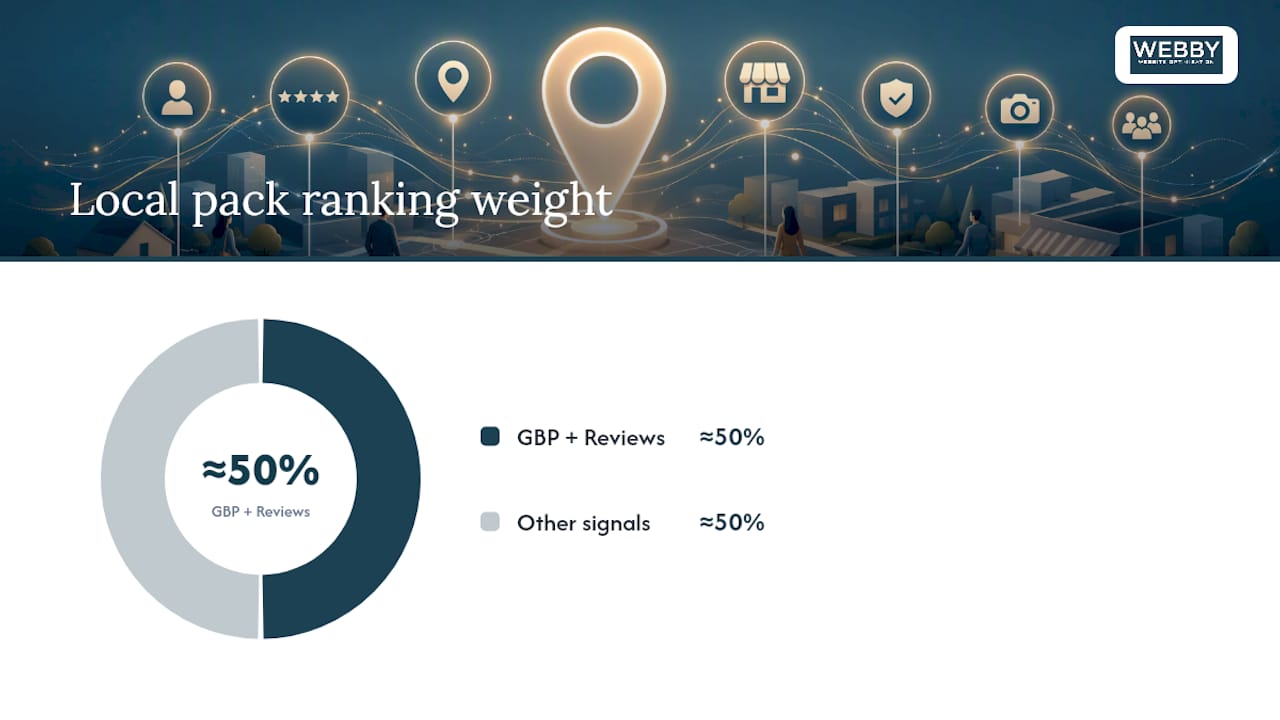
The businesses that get frustrated with Maps rankings are usually the ones pouring effort into backlink outreach while their GBP sits half-finished with a generic category and three-year-old reviews. That’s backward. Fix the profile first. Build review velocity second. Everything else is optimization at the margins until those two are solid.
The other overlooked point: distance frustration often masks a signal problem in disguise. Business owners blame proximity for a poor ranking when a geo-grid test would show they’re actually losing to a competitor with a sharper category selection and double the recent reviews, sitting at a comparable distance. Before writing off a location as a lost cause, run the test and find out what’s really happening.
How Webby Website Optimisation Can Help You Rank
Webby Website Optimisation is a straightforward alternative to hiring a full-service agency for local visibility work. Instead of a lengthy onboarding process and months before you see a landing page, you get a direct path: a Google Business Profile setup done right the first time, WordPress landing pages built specifically for the service areas you actually cover, and site speed fixes that stop mobile visitors from bouncing before they call.

If your website is the piece slowing down everything else in this article, from schema markup to mobile load times, that’s the website design and development work Webby Website Optimisation handles for local service businesses. Businesses that need something live faster can also look at a same-day website build as a lower-effort starting point. Get in touch for a free audit and find out exactly where your current setup is losing you rank.
Frequently Asked Questions
What are the three main Google Maps ranking factors?
Relevance, distance, and prominence, according to Google’s own local ranking guidance. Relevance measures profile-to-query match, distance measures physical proximity, and prominence measures overall reputation and web authority.
Can I improve my Google Maps ranking if I’m far from the searcher?
You can’t change distance directly, but you can compensate with stronger prominence and tighter relevance, or by defining a more precise service area that better matches where you actually rank competitively.
How many reviews do I need to rank well on Google Maps?
There’s no fixed threshold. Recency and steady velocity matter more than hitting a specific total, since a profile with consistent weekly reviews tends to outperform one with a large but stagnant count.
Does the primary category really matter that much?
Yes. It’s widely regarded as the strongest single on-profile relevance signal, ahead of business description or even most reviews, so it’s worth choosing with real precision rather than defaulting to the broadest option available.
What’s a geo-grid test and do I actually need one?
It’s a method of checking your Map-pack ranking from multiple points across your service area rather than just from your own address. It’s the clearest way to tell whether a ranking problem is about distance or about weak signals, and it’s worth running at least quarterly.
Sources
- Whitespark Local Search Ranking Factors
- Google Maps SEO: 5 Proven Strategies to Rank Higher (Ahrefs)
- Local Search Ranking Factors (Moz)
Recommended
- Local SEO Ranking Factors 2026: What Actually Moves the Needle
- Google Ranking Algorithm: How It Works in 2026
If this post raised some questions feel free to ask me a question