

If you’re running an Australian business and haven't seriously looked at selling on Amazon Australia, now is the time. It’s no longer just another option; it has become the country's most powerful online marketplace, offering a direct line to millions of active shoppers and a clear path to growing your brand.
Why Amazon Australia Is Your Next Big Opportunity
For a long time, the Australian e-commerce scene was dominated by just a couple of big names. But things have changed, and changed quickly. Amazon hasn't just joined the race; it's now leading it, pulling ahead of legacy platforms like eBay to become the go-to shopping destination for Aussies.
What’s really important here isn't just the traffic numbers, but the mindset of the shoppers. People go to Amazon with a purpose. They’re not just window shopping; they have their wallets out, ready to buy. This gives small and medium-sized businesses a golden opportunity to get their products in front of motivated customers at the perfect moment.
The Undeniable Market Shift
The numbers don't lie—they paint a very clear picture of Amazon's takeover. Projections show a fundamental change in how Australians shop, with Amazon's reach expected to climb to an incredible 60% of shoppers by 2026. That’s a massive jump from 52% in 2023.
In that same timeframe, its main rival, eBay, is forecast to slip from a 62% share down to 51%. This shift is happening because shopping on marketplaces is now standard practice, with 93% of Australian consumers buying from one in the last year. You can dive deeper into the trends by exploring the full report on this market shift.
This quick comparison highlights just how significant the change is:
Amazon Australia vs eBay Australia Market Snapshot 2026
| Metric | Amazon Australia | eBay Australia |
|---|---|---|
| Projected Shopper Penetration | 60% | 51% |
| 2023-2026 Trend | Growing | Declining |
What this table shows is a clear reversal of fortunes. Amazon's momentum is undeniable, making it a critical channel for any business looking for growth.
This isn't a temporary trend; it's a fundamental change in how Australians shop. Ignoring Amazon means leaving a massive and growing customer base on the table for your competitors to capture.
This momentum makes selling on Amazon less of an "if" and more of a "when." The platform gives you the tools and infrastructure to scale nationally without the huge costs and headaches that usually come with expansion.
Key Benefits for Your Business
Getting your business onto the Amazon platform is about more than just opening another sales channel. It’s about plugging into a ready-made growth engine.
Here are the biggest advantages you’ll see right away:
- Instant National Reach: Straight out of the gate, your products can be seen by millions of customers from Perth to Sydney. It completely removes the geographical limits that hold back so many businesses.
- Borrowed Credibility: By listing on Amazon, your brand instantly benefits from the trust shoppers already have in the platform. Every positive review you earn builds on that trust and strengthens your own reputation.
- Access to High-Intent Buyers: Amazon shoppers are on a mission. They know what they want and are ready to buy, which means you'll likely see higher conversion rates compared to other channels.
- Simplified Logistics: With Fulfilment by Amazon (FBA), you can hand off the heavy lifting. Amazon will handle your storage, packing, shipping, and even customer service, freeing you up to focus on strategy and growth.
So, the real question isn't whether you should be on Amazon Australia. It's how to get started the right way. The rest of this guide will walk you through exactly what you need to do, step by step.
Setting Up Your Amazon Australia Seller Account

Alright, you see the opportunity. Now it’s time to get your store up and running. This is the first hurdle where many aspiring sellers stumble, but honestly, setting up your Amazon Seller Central account is straightforward if you know what’s coming.
Let's walk through the decisions you need to make and the paperwork you should have on hand to make this process as painless as possible.
Individual vs Professional Account
First up, you have to choose your selling plan. This choice directly hits your bottom line and determines what tools you'll have access to, so it’s worth thinking about from day one.
The Individual plan is really for those just dipping a toe in the water. You pay $0.99 (AUD) per item sold, plus the usual selling fees. There’s no monthly subscription, which makes it a low-risk option if you plan to sell fewer than 50 items a month. But do the maths: if you sell exactly 50 items, that's $49.50 in per-item fees alone.
The Professional plan, however, is a flat $49.95 (AUD) per month, plus other selling fees. The key difference? You don't pay that $0.99 per-item fee. As soon as you sell more than 50 items a month, this plan pays for itself. More importantly, it unlocks the tools you actually need to grow, like advanced advertising, proper reporting, and the ability to apply for restricted product categories.
For any business that's serious about making a go of it on Amazon Australia, the Professional account is the only real choice. The access to advertising, brand-building features, and better inventory tools is absolutely essential for scaling up.
Think of it like this: the Individual plan is like hiring a trestle table at a weekend market. The Professional plan is like leasing a proper shopfront. One is for dabbling; the other is for building a business.
Your Pre-Registration Checklist
Amazon’s verification process is famously thorough—they do it to protect everyone on the platform. Having your documents in order before you start is the single best thing you can do to avoid getting stuck in verification limbo. Trust me, nearly every delay comes down to missing or mismatched information.
Before you even head to the registration page, get these things ready:
- Australian Business Number (ABN): This is non-negotiable for anyone operating as a business in Australia.
- Government-Issued Photo ID: A current passport or driver's licence. The name on this ID must be an exact match for the name you use on your application.
- Bank Account Details: You’ll need a recent bank statement (less than 90 days old) showing the business name (or your personal name for sole traders), address, and account number. Again, the address must match what you provide in your application.
- Credit Card: A valid, chargeable credit card for identity verification and to pay your subscription fees.
- Phone Number: You'll need a mobile number to set up two-factor authentication for security.
Pro Tip: Scan your documents and save them as clear, high-quality PDFs or JPEGs. The number one reason for registration being delayed is a mismatch between the name or address on a driver's licence versus a bank statement. Double-check every single detail.
Navigating the Registration Process
With your documents in a folder on your desktop, you’re ready to go. Head over to the Amazon Australia seller portal and start the process. The system walks you through entering your business and personal details, payment info, and finally, choosing a name for your Amazon store.
The most critical stage is identity verification, where you'll upload the documents from your checklist. If Amazon’s automated system can't perfectly match all your details, you might be asked to do a quick video call with an Amazon staff member to verify everything in person.
By preparing all your info correctly upfront, you drastically reduce the chance of any hold-ups. A little bit of prep work here can save you weeks of frustrating back-and-forth emails, getting you on the fast track to making your first sale.
Getting Your Products to Sell: How to Write a Killer Listing
Having a fantastic product is a great start, but it's not enough. On Amazon, your product listing does all the selling for you. If it's weak, even the best products can get lost in the crowd. Creating a listing that not only gets found but actually convinces people to buy is a skill every seller needs to master.
Let’s get into the nitty-gritty of building product pages that speak to Aussie shoppers, earn their trust, and ultimately, get them to click that "Add to Cart" button.
It All Starts with How Customers Search
Before you even think about writing, you have to understand what your potential customers are typing into the Amazon search bar. This is the bedrock of a successful listing.
Think about the difference between a broad search and a really specific one. Someone might start by looking for a "yoga mat," which is a "short-tail" keyword. But the people who are ready to buy are often using "long-tail" keywords, like "non-slip eco-friendly cork yoga mat." The broad term gets a lot of eyeballs, sure, but that super-specific phrase brings in shoppers who know exactly what they want.
A great way to start is by typing your main product term into the Amazon search bar and seeing what auto-suggestions pop up. Those are real searches from real people. For a deeper dive, our guide on how to do keyword research covers more advanced tactics.
Your mission is to gather a solid list of these search terms to weave naturally throughout your listing.
I see so many sellers fixate on high-traffic keywords. But the real money is often in those hyper-specific, long-tail terms. A search for "waterproof hiking boots for wide feet size 10" is from someone with their credit card practically in hand.
The Key Parts of a Listing That Converts
Once you've got your keywords, it's time to put them to work. Every single part of your listing has a job to do.
The Product Title: This is your prime real estate. You need to lead with your main keyword and your brand name, then pack in the most important details like colour, size, or material. "EcoFlow 5mm Natural Rubber Yoga Mat (Ocean Blue)" will always beat a simple "Blue Yoga Mat." Be clear and be relevant.
Bullet Points (Key Product Features): This is your sales pitch. Don't just list features; sell the benefits. Use your secondary keywords to explain what makes your product better. Instead of writing "Made of rubber," try something like, "Durable Natural Rubber: Get a better workout with superior grip and cushioning for a stable practice."
Product Description: Here's where you can tell a bit of a story. Go into more detail, explain how the product solves a problem, and answer questions before they're even asked. It’s your chance to expand on the promises you made in the bullet points.
Backend Keywords: Don’t sleep on this. In Seller Central, you'll find a field for "Generic Keywords." This is your secret weapon. Fill it with all the related terms, synonyms, and different spellings you couldn't fit into the public-facing parts of your listing. For a yoga mat, you might add "pilates mat," "exercise pad," or even common misspellings.
Why Great Photos and A+ Content Matter
Online shoppers can't pick up your product, so your photos and content have to do the heavy lifting. High-quality product images are absolutely essential. You need shots from every angle, close-ups of key features, and lifestyle photos that help customers see themselves using your product.
If you’ve gone through the Brand Registry process, A+ Content is a complete game-changer. It lets you swap out the plain text description for a rich, visual experience with custom images, comparison charts, and brand stories. The data is clear: using even Basic A+ Content can boost sales by up to 8%. To really make your products shine and drive conversions, getting good at Amazon Listing Optimization is a must.
Finding a Profitable Niche in Australia
Knowing where the money is flowing can give you a real advantage. In Australia, some Amazon categories are just bigger than others. Projections for 2026 show the electronics and appliances category is poised to generate billions, making it the dominant segment.
But that doesn't mean it's the only game in town. There are huge opportunities in other spaces. Categories like sports & outdoors (holding a 16% share), arts/crafts (14%), and books (14%) are also incredibly strong. These are fantastic areas for sellers looking to build a diverse range of products. You can discover more insights about Australian e-commerce categories on Statista.com to explore the trends.
When you bring together smart keyword research, compelling visuals, and a solid understanding of what Aussies are buying, you've got a formula for listings that don't just sit there—they sell.
Choosing Your Fulfilment Method FBA vs FBM
Alright, your account is ready to go, and you’re itching to start listing products. Now comes one of the most critical decisions you'll make for your Amazon Australia business: how do you actually get your products into customers' hands?
This isn’t just a question of postage. It's a strategic choice that directly impacts your workload, your costs, and, frankly, how many sales you're likely to make. You’ve got two main routes to go down: Fulfilment by Amazon (FBA) or Fulfilment by Merchant (FBM). Let's break them down.
The Power of FBA: Getting the Prime Badge
With Fulfilment by Amazon, you essentially outsource your logistics to Amazon. You send your products in bulk to one of their Australian fulfilment centres. From there, Amazon’s machine takes over. They pick, pack, and ship every order, and they even handle the customer service and returns.
The single biggest reason to choose FBA? Your products automatically get the coveted Amazon Prime badge.
Prime members are Amazon's best customers. They pay for the privilege of fast, free shipping and are conditioned to filter for Prime-eligible products. If your listing doesn't have that badge, many shoppers won't even see it. It's a massive advantage.
But the perks don't stop there:
- Hands-Off Logistics: Forget packing boxes and running to the post office. FBA frees up an enormous amount of your time to focus on growing your business.
- Trusted Customer Service: Amazon's 24/7 support team manages all inquiries for your FBA orders, which gives customers peace of mind and builds trust in your products.
- Speed Sells: By tapping into Amazon’s logistics network, your customers get their orders faster. In e-commerce, speed is everything.
Of course, this convenience isn't free. You'll pay FBA fees for handling and shipping, plus monthly storage fees for the space your inventory occupies. Be warned: if your stock doesn't sell quickly, those storage fees can eat into your profits. Sharp inventory management is non-negotiable.
Full Control with FBM: The DIY Approach
Fulfilment by Merchant is exactly what it sounds like—you do it all yourself. You store your own inventory, pack every order, arrange shipping, and handle all customer service and returns directly.
The main drawcard for FBM is complete control. It’s a great fit if you sell across multiple channels (like your own website or a physical shop) and need to manage one central pool of stock. It also means you can create a memorable unboxing experience with your own branded packaging and inserts, something that’s impossible with standard FBA.
By choosing FBM, you dodge FBA storage fees, which is a big win for sellers with large, bulky, or slow-moving products. However, the operational side is a heavy lift. You need the physical space, the people, and the right processes to ship orders quickly and reliably to meet Amazon's strict delivery promises.
FBA vs FBM Which Fulfilment Method Is Right for You?
Deciding between FBA and FBM comes down to your product, your business model, and how hands-on you want to be. This table breaks down the key differences to help you choose the right path for your Aussie business.
| Feature | Fulfilment by Amazon (FBA) | Fulfilment by Merchant (FBM) |
|---|---|---|
| Prime Eligibility | Automatic. Your products get the Prime badge. | No. Requires Seller Fulfilled Prime (not widely available in AU). |
| Logistics | Amazon handles picking, packing, and shipping. | You manage all storage, packing, and shipping. |
| Customer Service | Amazon manages customer service and returns. | You are responsible for all customer communication. |
| Control | Low. Standard Amazon packaging and process. | High. Full control over inventory, packaging, and branding. |
| Fees | FBA fees (per order) and monthly storage fees. | Only Amazon's referral fee. Shipping costs are your own. |
| Best For | Fast-moving products, sellers wanting to scale quickly. | Multi-channel sellers, large/slow-moving items, custom products. |
Ultimately, there's no single "best" answer. Many sellers find a hybrid model works wonders.
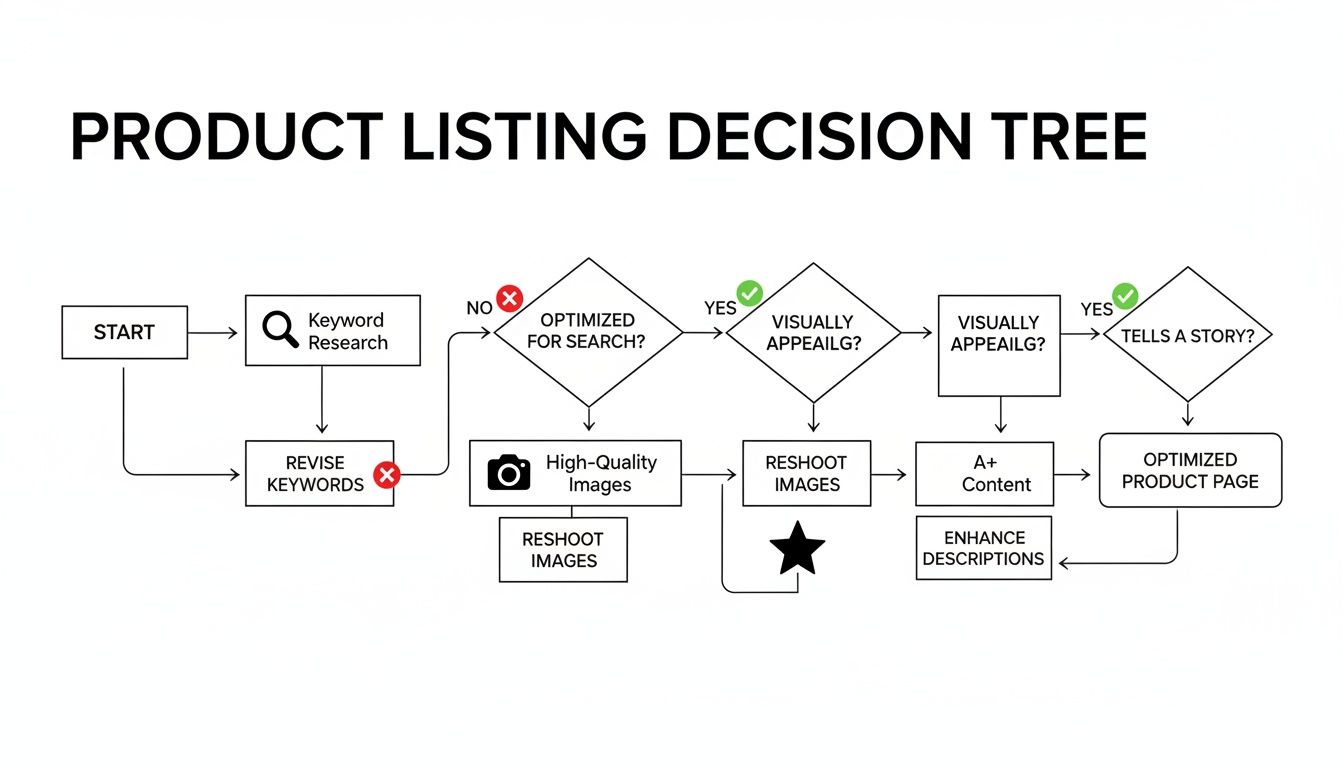
As this flowchart shows, your fulfilment choice is just one part of the puzzle. It works hand-in-hand with how you research keywords and present your products visually to capture customer attention.
A Hybrid Strategy: The Best of Both Worlds?
You don't have to be all in on one or the other. A hybrid approach is a smart, popular strategy.
Use FBA for your bestsellers to get the Prime badge and tap into Amazon’s powerful logistics. At the same time, fulfil your larger, slower-moving, or customisable items yourself via FBM to maintain control and avoid long-term storage fees. It’s a flexible way to maximise your strengths.
A word of warning on FBM: Don't underestimate the commitment. You’re not just competing with other sellers; you’re competing with Amazon's own delivery promise. If you can't dispatch orders within one business day and provide tracking, your seller metrics will take a hit, and you could risk your selling privileges.
If you’re still weighing the pros and cons, our definitive guide to Amazon FBA vs FBM offers an even deeper dive into the numbers and strategies behind each method.
Getting a Handle on Your Numbers: Costs and Profitability
It’s easy to get caught up in the excitement of watching your sales numbers climb on Amazon. But as any seasoned business owner knows, turnover is vanity, and profit is sanity. To build a sustainable business on Amazon Australia, you have to get a firm grip on your numbers from the very beginning.
Let's break down the real costs of selling on the platform, so you can price your products properly and ensure you’re actually making money on every sale.
First up are the fees you'll see most often. The referral fee is Amazon's commission on every item you sell. It’s a percentage of the total sale price (including shipping) and usually sits somewhere between 6% and 15%, depending on your product category.
This is charged on top of your seller account fee. As we mentioned earlier, the Professional plan is a flat $49.95 AUD per month. If you're just dipping your toes in the water with an Individual plan, you'll pay $0.99 AUD per item sold instead of a monthly subscription.
The "Other" Costs That Can Catch You Out
The referral and account fees are just the start. The real test of your profitability comes down to managing the other costs, especially if you’re using Fulfilment by Amazon (FBA). These can add up quickly if you’re not paying attention.
- FBA Fulfilment Fees: This is what Amazon charges you to pick, pack, and ship each order. The cost is based on your product’s size and weight, so smaller, lighter items are cheaper to fulfil.
- Monthly Inventory Storage Fees: You're essentially renting shelf space in Amazon's warehouses. This is charged per cubic metre, and the rates go up during the busy Q4 period (October to December).
- Long-Term Storage Fees: Amazon wants inventory to move, not sit. If your stock is gathering dust in a fulfilment centre for more than 365 days, you’ll get hit with hefty long-term storage fees. It's a strong incentive to manage your stock levels well.
- Advertising Costs: Running sponsored ads is almost essential for getting noticed, but it comes at a cost. You’ll need to set a budget and keep a close eye on your Advertising Cost of Sales (ACoS) to make sure your campaigns are actually profitable.
These kinds of variable fees are pretty standard in e-commerce. To put them in perspective, you might find it useful to read our guide on e-commerce merchant gateway rates for Australian businesses to see how they compare with other platform costs.
Sorting Out GST and Staying on the Right Side of the ATO
Now for the tax man. If your business is registered for GST, you are required to collect it on your Amazon sales. This means you’ll need to factor the 10% GST into your final selling price.
Amazon will also charge GST on all its seller fees. The good news is, as a GST-registered business, you can claim these charges back as a credit on your Business Activity Statement (BAS). To make this happen, it’s absolutely critical that you provide Amazon with your ABN during account setup.
Staying on top of your GST obligations is non-negotiable. Falling behind can lead to penalties and a huge financial headache down the track. Set up your accounting from day one to track GST on sales and fees separately.
Calculating Your True Profit Margin
So, are you actually making money? The only way to know for sure is to calculate your net profit on every single product. The formula is simple:
Net Profit = Sale Price – (Landed Cost of Goods + Amazon Fees + Advertising Spend + GST)
Let's run the numbers with a quick example. Say you're selling a reusable coffee cup.
| Metric | Amount (AUD) |
|---|---|
| Sale Price on Amazon | $25.00 |
| Your Landed Cost | -$7.00 |
| Amazon Referral Fee (15%) | -$3.75 |
| FBA Fulfilment Fee | -$4.50 |
| Net Profit (before ads/GST) | $9.75 |
In this scenario, you're left with a gross profit of $9.75 per cup. From this, you still need to deduct your average advertising spend per unit and account for your GST obligations.
Running this simple calculation for every product in your catalogue isn't just a good idea—it's the only way to price your products with confidence and build an Amazon business that's profitable for the long haul.
How to Scale Your Sales and Grow Your Brand
Getting your products live on Amazon is a great feeling, but that’s really just the starting gun. The real work is turning those initial listings into a thriving, scalable brand. This is where you pivot from the setup phase to pure strategy, focusing on the actions that will drive consistent growth over the long term.
On Amazon, that growth is powered by two engines working in tandem: paid advertising and organic optimisation. To make a real impact when selling on Amazon Australia, you need to get a handle on both. Let's start with the one that delivers instant visibility.
Your First Sponsored Products Campaign
Amazon Pay-Per-Click (PPC) is, without a doubt, the fastest way to get your products in front of motivated shoppers. The most common and effective ad format for new sellers is Sponsored Products. These are the ads you see popping up right in the search results and on competitors' product pages.
You don't need a massive budget or a complex strategy to get started. The key is to begin with a clear goal, like hitting a specific Advertising Cost of Sales (ACoS). This metric simply tells you how much you're spending on ads for every dollar you make in sales. For instance, a target ACoS of 25% means you're aiming to spend $0.25 to generate $1.00 in revenue.
When launching your first campaign, here’s a simple, effective approach:
- Set a daily budget you're comfortable with. Even $10-$20 a day is plenty to start collecting crucial performance data.
- Kick things off with an Automatic campaign. This lets Amazon’s algorithm do the heavy lifting, finding relevant customer search terms for you based on your product listing.
- Give it about a week, then dive into the data. Look for the actual search terms customers used that resulted in a sale. You can then take these proven keywords and create a Manual campaign, where you have much more control over your bids.
This method ensures you're not just guessing; you're using real data to make smarter decisions with your advertising spend.
Think of your initial ad spend not as a cost, but as an investment in data. Your first few campaigns might not be home runs in terms of profit, but the insights you’ll gain into keywords and customer behaviour are pure gold for long-term growth.
Powerful Organic Growth Strategies
Paid ads get you seen, but strong organic ranking is what builds a sustainable, long-term business on Amazon. It really boils down to two elements that customers value above all else: reviews and your reputation as a seller.
Positive product reviews provide the social proof that convinces a potential buyer to click "Add to Cart." To get the ball rolling, you can use the "Request a Review" button found in your Seller Central order details. For a more proactive approach, enrolling products in the Amazon Vine program can help you secure early, honest reviews from trusted voices.
Your Seller Feedback rating is equally critical. This score reflects your overall performance—things like shipping on time, answering customer questions promptly, and handling any issues professionally. You want to keep this score above 95% to maintain good account health, which is a key signal to Amazon’s algorithm.
Building Your Brand Beyond Amazon
The savviest sellers understand that a strong brand can't live on a single platform. Driving external traffic to your Amazon listings is a fantastic way to build authority, create a more defensible business, and send positive signals to the Amazon algorithm.
Think about running targeted social media campaigns or collaborating with Australian influencers in your niche. You could also explore setting up a partnership program. Our detailed guide on affiliate marketing in Australia walks you through how to team up with creators who can drive qualified traffic directly to your product pages. This off-Amazon buzz shows the algorithm that your brand has relevance and authority, which can lead to a nice bump in your organic rankings.
The opportunity for local Australian businesses is huge. Globally, independent third-party sellers now account for over 60% of all sales on Amazon. As the marketplace continues to grow Down Under, the 24,227 active Aussie sellers are perfectly positioned to capture a significant piece of that success. For more data on this trend, check out the rise of independent sellers on adnabu.com.
Answering Your Top Questions About Selling on Amazon Australia
When you're starting out on Amazon, a few questions pop up time and time again. Let's cut through the noise and get you the practical answers you need, based on what we see sellers struggle with every day.
First up, the big one: "Do I really need an ABN to sell?" Technically, you can open an Individual account without one, but if you're serious about building a business, it's a non-starter. For a Professional plan, claiming GST back on Amazon’s fees, and just operating above board, an Australian Business Number (ABN) is essential. Don't try to work around it.
Then there's the inevitable topic of returns. With Fulfilment by Amazon (FBA), it's completely hands-off for you; Amazon handles the customer service, the shipping, all of it. If you're managing your own orders (FBM), the responsibility is yours. You'll need to provide an Australian return address and handle refunds yourself, sticking strictly to Amazon's returns policy.
Why Can’t I List My Product? Navigating Gated Categories
"Amazon won't let me list my product!" This is a frustrating, but common, roadblock. The reason is usually that you're trying to sell in a "gated" or restricted category. Amazon does this to maintain quality and safety standards.
A few of the usual suspects include:
- Groceries & Gourmet Foods
- Jewellery
- Watches
- Automotive & Powersports
Getting the gate unlocked means applying for approval. You'll need to be ready with official supplier invoices and other business documents. It’s all about proving you’re a legitimate seller with authentic products.
My biggest piece of advice here is to do your homework before you buy a pallet of stock. Check if your product's category is restricted. Getting this wrong can lead to a suspended account right out of the gate.
Finally, can you use suppliers from overseas? Absolutely. Sourcing from international suppliers is a core strategy for countless successful sellers on Amazon Australia. The key is to be meticulous with your numbers. Make sure you've calculated every single cost—including import duties, taxes, and international shipping—to know if your product is actually profitable.
If you're focused on building a successful online business, whether on Amazon or your own website, ensuring your digital presence is fast, secure, and optimised is crucial. Webby Website Optimisation offers expert WordPress help and support to keep your site running flawlessly. Discover our WordPress maintenance plans.
If this post raised some questions feel free to ask me a question
Trackbacks/Pingbacks