
Website credibility is defined as the perceived trustworthiness and legitimacy a visitor assigns to your business based on what they see online. It is the single most important factor determining whether a visitor buys or leaves. Trust-first websites convert at more than double the rate of sites that treat credibility as an afterthought. That gap explains why website credibility drives sales more directly than ad spend, pricing, or product quality alone. Nearly 89% of shoppers have abandoned a purchase because a website raised doubts, with legitimacy concerns rising from 46% to 51% between 2024 and 2026. Your website is not just a brochure. It is the first sales conversation your business has with every potential customer.
Why website credibility drives sales faster than any other factor
Website credibility works because it removes the friction that stops people from buying. When a visitor lands on your site, their brain runs an instant risk assessment. If the site looks legitimate, familiar, and transparent, the brain lowers its guard and moves toward a decision. If anything feels off, the visitor leaves.
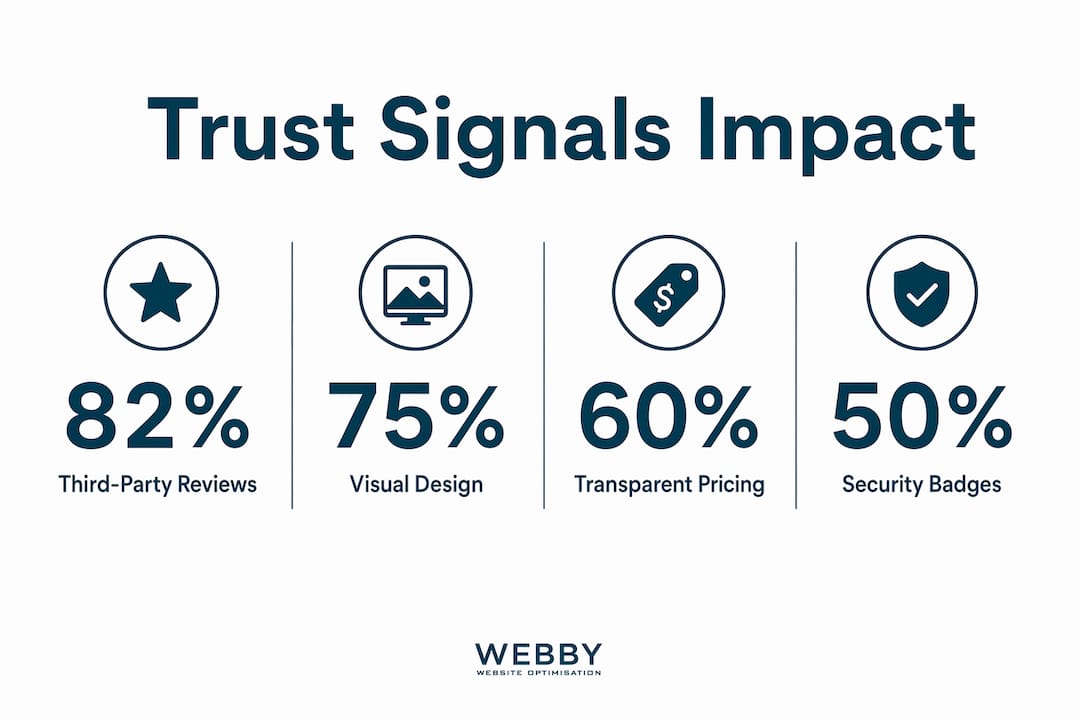
The industry term for this process is perceived credibility, a concept studied extensively by Stanford’s Web Credibility Research project. Perceived credibility combines two dimensions: trustworthiness (does this business have honest intentions?) and expertise (does this business know what it is doing?). Both must register quickly, because 75% of users judge credibility based on visual design alone before reading a single word of content.

That snap judgment happens in roughly 50 milliseconds. A visitor who decides your site looks untrustworthy will not stay long enough to read your value proposition. The design is not decoration. It is the first argument your business makes for why someone should trust you with their money.
Companies that ignore this pay a measurable price. Businesses without strong trust signals face sales cycles 29% longer than trusted competitors. Longer sales cycles mean higher acquisition costs and slower revenue growth. Credibility is not a soft marketing concept. It is a hard revenue variable.
How do trust signals on a website influence buyer behavior?
Trust signals are specific design elements, content pieces, and social proof indicators that tell a visitor your business is legitimate. They work by reducing what behavioral economists call decision friction, the mental effort required to feel safe enough to act.
Two psychological principles explain most of the effect. The first is zero-risk bias: people strongly prefer options that feel certain over options that feel risky, even when the risk is small. A visible refund policy, a clear contact phone number, or a recognizable security badge each reduce perceived risk. The second is social proof: people look to the behavior of others to decide what is safe. Verified reviews from third-party platforms carry far more weight than testimonials you write yourself and place on your own site.
The data on third-party verification is striking. 82% of shoppers are more likely to trust sites showing verified trust badges. That is not a marginal lift. It is the difference between a visitor who hesitates and one who buys.
The most effective trust signals include:
- Verified third-party reviews from platforms like Google Business Profile or industry-specific directories
- Transparent pricing with no hidden fees or vague “contact us for pricing” placeholders
- Visible refund and returns policies linked from product or service pages
- Clear contact information including a phone number, physical address, and response time commitment
- Security certificates displayed visibly, not buried in the footer
- Professional photography of real team members, not generic stock images
Pro Tip: Never rely on a single trust signal. Trust signals work cumulatively, meaning the combination of social proof, authority markers, and transparency creates far stronger buyer conviction than any one element alone. Stack them deliberately.
What website design elements most affect credibility and sales?
Design is the delivery mechanism for credibility. A site with strong trust signals buried in poor design still loses the credibility battle. The visual presentation must communicate professionalism before the visitor reads anything.
The 50-millisecond judgment window means your homepage layout, color palette, typography, and image quality all register as credibility signals before your headline does. Familiar design patterns, meaning layouts that match what visitors expect from a professional business in your category, reduce cognitive load. Unusual or cluttered layouts increase it. Increased cognitive load signals risk, and risk kills conversions.
One of the most damaging mistakes business owners make is placing trust signals below the fold. 60% of visitors never scroll past the initial viewport. If your reviews, security badges, or contact details only appear halfway down the page, the majority of your visitors never see them. The credibility case your site makes in the first screen is the only case most visitors will evaluate.
Common design pitfalls that undermine credibility include:
- Outdated visual design that signals neglect or financial instability
- Inconsistent branding across pages, which suggests a lack of attention to detail
- Missing or hard-to-find contact information, which raises immediate legitimacy questions
- Slow load times, which signal poor investment in the business’s digital presence
- Generic stock photography that makes the business feel anonymous
Consistency across channels matters as much as the site itself. If your website looks polished but your Google Business Profile has no photos and a 2.8-star rating, the gap destroys the credibility your site worked to build. Visitors cross-reference. They check your reviews, your social profiles, and your site in the same session. Professional web design for local services must account for that full picture, not just the homepage.
Pro Tip: Run a five-second test on your homepage. Show it to someone unfamiliar with your business for five seconds, then ask what the business does and whether they would trust it. The answers reveal what your design actually communicates, not what you intended.
How can businesses build credibility before the first sales conversation?
Pre-sale credibility building is the practice of establishing trust during the buyer’s independent research phase, before they ever contact you. This matters most in B2B, where buyers typically complete 60–70% of their decision-making process before speaking to a vendor. But it applies equally to service businesses of all types.
B2B credibility built before the first call shifts sales conversations from skepticism to implementation. When a prospect already trusts your expertise and legitimacy, the sales call becomes a discussion about how to work together, not whether to work together. That shift compresses sales cycles and raises close rates.
The most effective pre-sale credibility assets follow a clear sequence:
- Publish ungated case studies with specific, named outcomes. Vague success stories do not build credibility. Specific results with client names or industries do.
- Make your team visible. Public LinkedIn profiles linked from your website, real headshots, and professional bios signal that real people stand behind the business.
- Maintain consistent messaging across your website, Google reviews, social media, and any directory listings. Contradictions between channels create doubt.
- Create educational content that demonstrates expertise without requiring a sales interaction. Blog posts, guides, and FAQs that answer real buyer questions position your business as the knowledgeable choice.
- Respond publicly to reviews, both positive and negative. A business that engages professionally with criticism signals confidence and accountability.
The goal is to make every independent research touchpoint reinforce the same credibility message. A buyer who finds your website, checks your Google reviews, looks at your LinkedIn, and reads a case study should encounter a consistent, professional, trustworthy picture at every stop. Building trust online through this kind of consistency is not a one-time project. It requires ongoing attention.
Which trust signals have the biggest measurable impact on sales?
The evidence on trust signal impact is clear and consistent. The table below summarizes the signals with the strongest documented effect on buyer confidence and conversion rates.
| Trust signal | Impact on buyer behavior |
|---|---|
| Verified third-party reviews | 82% of shoppers more likely to trust sites with verified badges |
| Above-the-fold trust placement | Critical for the 60% of visitors who never scroll past the first screen |
| Transparent pricing and refund policy | Directly reduces zero-risk bias and purchase hesitation |
| Security certificates (SSL, payment badges) | Signals safe transaction environment; reduces cart abandonment |
| Consistent cross-channel messaging | Prevents credibility gaps that arise when channels contradict each other |
| Real team profiles and contact details | Confirms a real business exists behind the website |
The cumulative effect of aligning multiple signals is what separates high-converting sites from average ones. A single five-star review does not move the needle much. A site with 47 verified Google reviews, a visible refund policy, a real phone number above the fold, and a professional design creates a credibility environment that makes buying feel safe. That environment is what converts visitors into customers at rates that justify serious investment in getting it right.
As AI-generated content becomes more common, earned and verified trust through third-party badges and real social proof becomes the key differentiator. Any business can publish polished content. Fewer businesses have 200 verified reviews, a transparent pricing page, and a named team. The ones that do win the credibility comparison every time.
Key Takeaways
Website credibility drives sales by reducing perceived risk, accelerating trust, and converting hesitant visitors into buyers at more than double the rate of sites that neglect it.
| Point | Details |
|---|---|
| First impressions are design-driven | 75% of visitors judge credibility on visual design alone within 50 milliseconds of landing. |
| Trust signals must be above the fold | 60% of visitors never scroll, so reviews, badges, and contact details must appear immediately. |
| Third-party verification outperforms self-promotion | 82% of shoppers trust sites with verified third-party badges more than those without. |
| Pre-sale credibility shortens sales cycles | Businesses with trust deficits face sales cycles 29% longer than trusted competitors. |
| Cumulative signals beat single signals | Stacking social proof, transparency, and authority markers creates stronger buyer conviction than any one element alone. |
What I’ve learned after years of watching credibility win and lose deals
The most common mistake I see business owners make is treating credibility as a design problem. They invest in a new logo or a fresh color scheme and expect conversions to follow. They do not. Credibility is a system, not an aesthetic.
The businesses that consistently win online have figured out that trust is built in layers. The design creates the first impression. The reviews confirm it. The case studies deepen it. The team profiles make it personal. The refund policy removes the last objection. Remove any layer and the whole structure weakens.
What surprises most business owners is how much credibility work happens off their website. Your Google Business Profile, your LinkedIn company page, your responses to negative reviews, your consistency across directory listings. These are all credibility signals that buyers check before they ever click your homepage. A beautifully designed site sitting on top of a neglected Google profile is like a sharp suit worn to a job interview where your references all gave bad feedback.
The 2026 shift I am watching closely is the growing skepticism toward AI-generated content. Buyers are getting better at recognizing it, and they are discounting it. The businesses that will win the credibility battle over the next few years are the ones investing in real proof: real client names, real team faces, real outcomes with real numbers. Website design that builds trust is no longer just about looking good. It is about proving you are real.
My practical advice: audit your credibility stack every quarter. Check what a new visitor sees in the first five seconds. Check what they find when they search your business name. Check whether your reviews are growing. Credibility is not a one-time fix. It is a business practice.
How Webby Website Optimisation builds credibility that converts
Credibility gaps cost businesses real revenue every day. Webby Website Optimisation works with local service businesses in Perth, Fremantle, and Melville to identify and fix exactly those gaps.
The process starts with a full website audit that examines trust signal placement, design quality, page speed, and cross-channel consistency. From there, Webby Website Optimisation builds or rebuilds sites that place credibility signals where buyers actually look, above the fold, on service pages, and throughout the conversion path. The result is a website that generates leads rather than one that simply exists. If your site is not converting visitors at the rate your business deserves, a credibility audit is the right starting point.
FAQ
What is website credibility and why does it matter?
Website credibility is the degree to which visitors perceive your business as trustworthy and legitimate based on what they see online. It matters because trust-first websites convert at more than double the rate of sites that neglect it.
How quickly do visitors judge a website’s credibility?
Visitors form a credibility judgment in approximately 50 milliseconds, with 75% basing that judgment on visual design alone before reading any content.
What are the most effective trust signals for a website?
Verified third-party reviews, transparent pricing, visible contact information, security badges, and real team profiles are the most effective trust signals. They work best when combined, not used in isolation.
How does website credibility affect B2B sales specifically?
In B2B, buyers complete most of their research independently before contacting a vendor. Strong pre-sale credibility built through case studies, team profiles, and consistent messaging shifts sales calls from skepticism to implementation discussions, shortening the sales cycle.
Can poor website credibility really cause customers to abandon purchases?
Yes. Nearly 89% of shoppers have abandoned a purchase because a website raised doubts, with 51% citing concerns about the site’s legitimacy as the reason.