

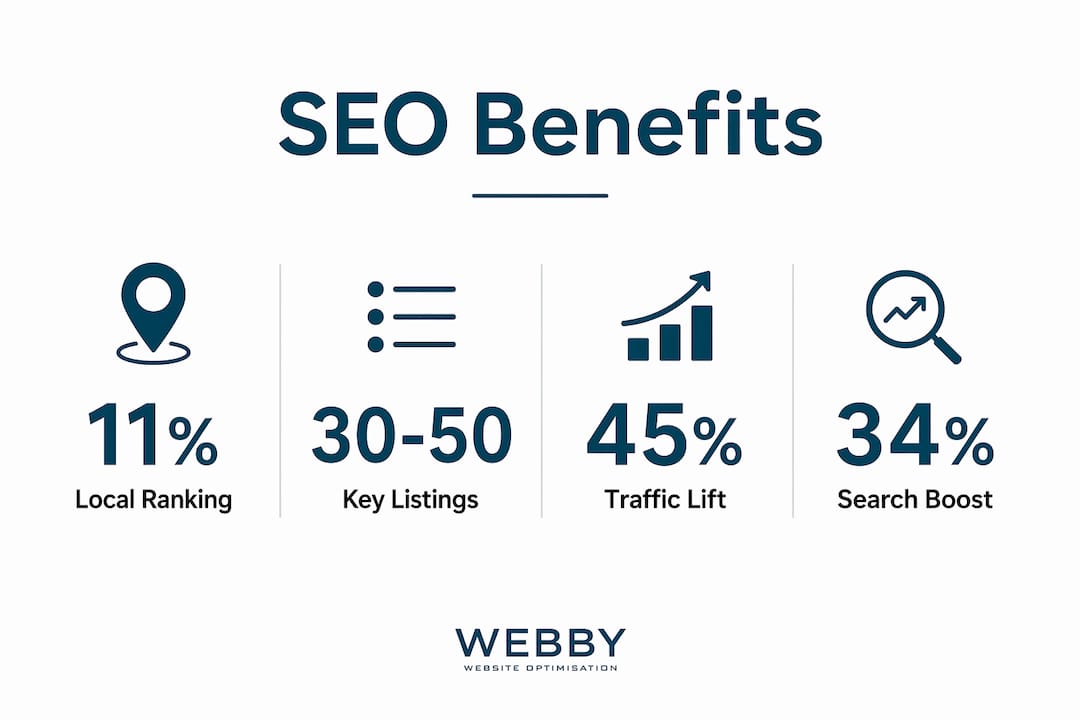
Directory listings are structured citations of your business name, address, phone number, and website across authoritative online platforms, and they directly improve your local search rankings by reinforcing trust signals Google uses to verify your business exists. For local service businesses in Perth, Fremantle, and Melville, understanding why directory listings help SEO is the difference between appearing on page one and being invisible to nearby customers. Citation signals account for approximately 11% of local ranking factors, making directories one of the most controllable levers in your local SEO strategy. The industry term for these citations is “NAP citations,” short for Name, Address, and Phone.
Why directory listings help SEO: the local ranking mechanism
Directory listings improve local search rankings through a process Google calls citation analysis. When your business appears consistently across authoritative directories, Google treats each mention as a vote of confidence that your business is real, established, and trustworthy. Optimized directory listings make businesses 4.8 times more likely to appear in the Google Local Pack, with directory signals influencing 28% of top 10 local results. That figure means nearly one in three top local results is shaped, at least in part, by how well a business manages its directory presence.

The Google Local Pack is the map-based block of three businesses that appears at the top of local search results. Appearing there drives a disproportionate share of clicks and calls. Businesses with 40 or more accurate directory citations rank 53% higher in local search results and achieve a 156% increase in Google Maps visibility within 90 days. That is not a marginal gain. It is the kind of visibility shift that changes how many calls you receive each week.
The mechanism works like this:
- Google’s algorithm cross-references your business details across multiple platforms.
- Consistent NAP data across those platforms confirms your business information is accurate.
- Confirmed accuracy raises your authority score in local search, pushing you higher in results.
- More directory citations mean more confirmation signals, compounding the ranking benefit.
Understanding local SEO fundamentals makes it clear why citation volume and accuracy work together. Neither alone is sufficient.
Pro Tip: Claim your Google Business Profile before submitting to any directory. Your profile is the anchor citation that all other directory listings should mirror exactly.
Why accuracy matters more than the number of listings
Quantity without accuracy is worse than having fewer listings. Inconsistent NAP data across directories actively dilutes your trust signals and reduces your local search rankings. Slight NAP variations such as “St.” versus “Street” or “Suite 4” versus “Ste 4” are enough to confuse Google’s citation analysis and weaken your local authority. The effect is measurable. NAP inconsistency correlates with a roughly 23% reduction in local visibility.
The most common accuracy problems local service businesses face include:
- Phone numbers that changed after a move or rebrand but were never updated in directories.
- Address formats that differ between listings (abbreviated versus spelled out).
- Business names that vary slightly, such as “Webby” versus “Webby Website Optimisation.”
- Old website URLs still listed in directories after a site migration.
Each variation sends a conflicting signal to Google. Google resolves conflicts by reducing confidence in all versions, which lowers your ranking. The fix is not complicated, but it requires discipline. Audit every directory listing you have, then standardize every detail to match your Google Business Profile exactly.
Inconsistent directory data reduces local search rankings regardless of how many listings you have. Volume does not compensate for inaccuracy.
Pro Tip: Create a master NAP document with your exact business name, address, phone, and website URL. Copy and paste from this document every time you submit to a new directory. Never type it from memory.
The SEO value of directories comes from maintaining 30–50 high-authority, niche-relevant listings rather than mass submissions to hundreds of low-quality directories. Submitting to 500 generic directories with thin editorial standards delivers almost no ranking benefit and can introduce inconsistencies that hurt you.
Do niche directories outperform general directories?
Niche-relevant directories consistently outperform general directories on every metric that matters for local service businesses. Niche directories increase organic traffic by 45% and branded search volume by 34% over six months compared to general directories. Branded search volume is the number of people searching specifically for your business name. A rise in branded searches signals to Google that your business has real-world recognition, which feeds back into your organic rankings.
The reason niche directories outperform is relevance. A plumber listed on a home services directory sits alongside other plumbers and home service providers. Google reads that context and assigns stronger topical relevance to the listing. A plumber listed on a generic business directory sits alongside accountants, florists, and restaurants. The topical signal is weaker.
| Directory type | Organic traffic lift | Branded search lift | Topical relevance signal |
|---|---|---|---|
| Niche-relevant | 45% over 6 months | 34% over 6 months | Strong |
| General/broad | Minimal | Minimal | Weak |
| Low-quality/spam | Negative | None | Harmful |
The trust signal from a respected industry directory also carries weight with potential customers, not just search engines. A roofing company listed on a recognized trade association directory builds brand credibility in a way that a generic business listing cannot replicate. Customers searching for a roofer who find you on an industry-specific platform are already primed to trust you before they visit your website.
Directories function as trust-signaling infrastructure in 2026, not link-building platforms. The SEO community spent years treating directories primarily as a source of backlinks. That framing is outdated. The real value is the trust and relevance signal, with the backlink as a secondary benefit.
How directories speed up indexing and help smaller businesses compete
Directory listings accelerate Google’s discovery of your website. Listings on frequently crawled directories index new sites in 1–3 days compared to 2–4 weeks for organic crawl. For a new local service business launching a website, that difference is significant. Waiting four weeks to appear in Google’s index means four weeks of zero organic visibility during your most critical growth phase.
The indexing mechanism works in steps:
- You submit your business to a high-authority directory that Google crawls daily or weekly.
- Google’s crawler visits the directory, finds your listing, and follows the link to your website.
- Google indexes your website pages, making them eligible to appear in search results.
- Your site gains early visibility before organic crawl would have discovered it.
Beyond indexing speed, directories serve as discovery entry points that let smaller businesses compete with larger, better-known brands. A well-established competitor may have years of domain authority and thousands of backlinks. A smaller business cannot close that gap quickly through content alone. But a smaller business can appear alongside that competitor in a niche directory, reaching the same audience at the same moment in the buying process.
The indirect SEO benefit of this discovery is often underestimated. When a potential customer finds your business in a directory and then searches for your business name directly, that branded search signals to Google that your business has real-world recognition. Branded searches triggered by directory discovery produce incremental organic ranking improvements that compound over time. The directory does not just send traffic. It creates a chain reaction that strengthens your overall search presence.
Pro Tip: Prioritize directories that are crawled frequently by Google, such as established industry associations, chamber of commerce sites, and government business registers. These deliver the fastest indexing benefit for new websites.
A professional web presence matters here too. When a directory visitor clicks through to your website, a slow or outdated site wastes the opportunity the directory created.
Key Takeaways
Directory listings improve local SEO by reinforcing consistent NAP citations across authoritative platforms, making businesses measurably more visible in Google’s Local Pack and map results.
| Point | Details |
|---|---|
| Citation signals drive rankings | Directory citations contribute ~11% of local ranking factors and make businesses 4.8x more likely to appear in the Local Pack. |
| Accuracy beats volume | NAP inconsistencies reduce local visibility by ~23%; standardize every listing to match your Google Business Profile exactly. |
| Niche directories outperform | Niche-relevant directories increase organic traffic by 45% and branded search volume by 34% over six months. |
| Directories speed up indexing | High-authority directories index new sites in 1–3 days versus 2–4 weeks for organic crawl. |
| Quality over quantity | Maintaining 30–50 high-authority listings delivers more SEO value than mass submissions to hundreds of low-quality directories. |
The misconception that costs local businesses the most
Most local service businesses I work with fall into one of two traps. The first is ignoring directories entirely, assuming they are a relic from the early 2000s. The second is submitting to every directory they can find and then never checking those listings again. Both approaches waste the real opportunity.
The businesses that get the most from directories treat them as living infrastructure, not a one-time task. They audit listings quarterly. They update details the moment a phone number or address changes. They prioritize directories where their actual customers spend time, not directories that simply offer a free listing form.
The link-building framing is the biggest misconception I see. Directories are not primarily about backlinks. They are about trust signals. Google is trying to verify that your business is real, located where you say it is, and reachable at the number you list. Every consistent citation across a credible platform answers that question with a yes. Every inconsistency introduces doubt.
My honest advice: pick 30 to 40 directories that matter in your industry and your city. Get those listings perfect. Then maintain them. That approach will outperform 500 sloppy submissions every time. A DIY SEO audit is a good starting point for identifying which of your current listings need attention.
— Steve Doig
Local SEO support from Webby Website Optimisation
Getting directory listings right requires more than a one-time submission. It requires ongoing accuracy checks, niche directory research, and coordination with your broader local SEO strategy.

Webby Website Optimisation works with local service businesses in Perth, Fremantle, and Melville to build and maintain citation profiles that improve Google Maps visibility and local search rankings. The team handles directory audits, NAP standardization, and niche directory placement as part of a complete local SEO service designed for small and medium service businesses. If your listings are inconsistent, incomplete, or simply missing from the directories your customers use, Webby Website Optimisation can identify the gaps and fix them. Reach out for a free audit and find out exactly where your citation profile stands.
FAQ
Why do directory listings help SEO for local businesses?
Directory listings reinforce consistent NAP data across authoritative platforms, which Google uses as trust signals to verify your business and rank it higher in local search results. Citation signals contribute approximately 11% of local ranking factors.
How many directory listings does a local business need?
Maintaining 30–50 high-authority, niche-relevant directory listings delivers more SEO value than mass submissions to hundreds of low-quality directories. Quality and accuracy matter more than volume.
What happens if my directory information is inconsistent?
Inconsistent NAP data, such as variations in your address format or phone number, dilutes your trust signals and reduces local search visibility. Even minor differences like “St.” versus “Street” can weaken your rankings.
Do niche directories perform better than general directories?
Niche-relevant directories increase organic traffic by 45% and branded search volume by 34% over six months compared to general directories. The topical relevance signal from an industry-specific directory is significantly stronger.
How quickly do directory listings affect Google indexing?
Listings on frequently crawled directories can get your site indexed in 1–3 days, compared to 2–4 weeks for organic crawl. This makes directory submission particularly valuable for new websites seeking early visibility.
Recommended
- What Is Local SEO? A 2026 Guide for Small Businesses
- Benefits of Professional Web Design for Local Services
- Types of Google Search Features: 2026 SEO Guide
If this post raised some questions feel free to ask me a question