
A slow website is the single most preventable cause of lost revenue for small and medium businesses online. Speed is the first filter between your marketing spend and an actual customer conversion. Research shows that a 1-second delay cuts conversion rates by about 7%, and sites that take 5 or more seconds to load lose over half their visitors before a single word is read. For business owners and marketers, understanding why slow websites lose customers is not a technical exercise. It is a revenue exercise.
Why slow websites lose customers: the numbers behind the exits
Page load speed is the industry term for how quickly a browser fully renders your site for a visitor. Most business owners think of it as a technical detail. Search engines and customers treat it as a quality signal.
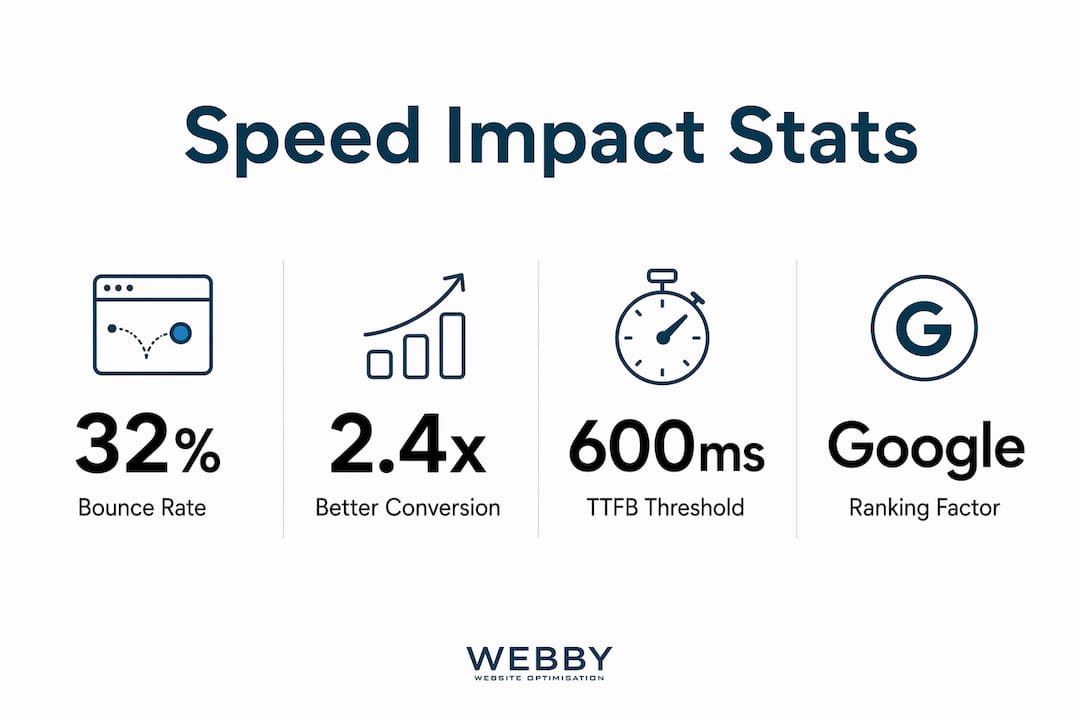
Mobile bounce probability jumps 32% when load time stretches from 1 second to 3 seconds. At 5 seconds, that probability hits 90%. That means nine out of ten mobile visitors leave before they see your offer, your phone number, or your call to action. Mobile traffic now accounts for 61% of all web traffic in 2026. A slow site is effectively invisible to the majority of your audience.

The conversion gap between fast and slow sites is stark. Sites loading under 2 seconds on mobile convert 2.4 times better than sites taking 5 or more seconds. That is not a marginal difference. It means a business generating 20 leads per month from a slow site could realistically generate 48 leads from the same traffic with a faster site.
Speed also shapes how customers perceive your brand. Slow or clunky websites signal weak investment in the customer experience, which directly reduces purchase confidence. Visitors do not consciously think “this site is slow, so the business is unprofessional.” They just feel uneasy and leave. The effect is real even when the reason is invisible to the customer.
| Load time | Bounce probability increase | Conversion impact |
|---|---|---|
| 1 second | Baseline | Best performance |
| 3 seconds | +32% bounce risk | Significant drop |
| 5 seconds | +90% bounce risk | 2.4x worse than 2s |
| 5+ seconds | Majority abandon | Over half lost before engagement |
Pro Tip: Do not rely on Google Analytics alone to measure bounce rates. Visitors who leave before your tracking scripts load are never recorded. Real User Monitoring tools give a far more accurate picture of how many people actually abandon your site due to speed.
How does site speed affect SEO and AI search rankings?
Slow websites do not just lose visitors directly. They lose the ability to attract visitors in the first place.
Google’s March 2026 core update weights Core Web Vitals heavily in its ranking algorithm. The three thresholds that matter are Largest Contentful Paint under 2.5 seconds, Interaction to Next Paint under 200 milliseconds, and Cumulative Layout Shift under 0.1. Sites that miss these benchmarks rank lower, receive less organic traffic, and lose ground to faster competitors even when their content is stronger.
The impact goes beyond Google’s traditional search results. AI search engines like ChatGPT and Google AI Overviews deprioritize slow or error-prone sites when generating answers and citations. A slow site that fails to render quickly during an AI crawler’s visit gets skipped. That creates a hidden layer of visibility loss that standard SEO reports do not capture.
Slow Time to First Byte and poor uptime also reduce how often Google’s crawlers visit your site. Less frequent crawling means new pages and updated content take longer to appear in search results. For local SEO in competitive markets like Perth or Fremantle, that delay can mean losing a top-three ranking to a faster local competitor.
Speed optimization is a prerequisite for SEO success in 2026, not an optional add-on. Every dollar spent on content, backlinks, or paid ads delivers less return when the site itself is too slow to rank or retain visitors.
Pro Tip: Check your Time to First Byte using Google Search Console’s Core Web Vitals report. A TTFB above 600 milliseconds is a crawl and ranking risk, not just a user experience issue.
What causes a slow website and how do you fix it?
Most slow websites share the same handful of root causes. Identifying them is the first step toward recovering lost customers and revenue.
The most common culprits are unoptimized images and videos, excessive third-party scripts, and low-quality shared hosting. Each added script or app can add 0.5 to 3 seconds of load time on its own. A site running five tracking pixels, a live chat widget, a cookie consent tool, and an embedded social feed can easily accumulate 8 to 10 extra seconds of load time from scripts alone.
The compounding effect is what catches most business owners off guard. No single issue looks catastrophic in isolation. Together, they create a site that drives away the majority of mobile visitors before engagement. Fixing common speed issues requires addressing the stack, not just one element.
Here are the highest-ROI fixes to prioritize:
- Compress and resize images before uploading. Use WebP format where possible. Images are the single largest contributor to page weight on most business websites.
- Enable browser caching so returning visitors load your site from local storage rather than re-downloading every asset.
- Audit and remove unnecessary scripts. Every tracking pixel and third-party widget adds load time. Keep only what you actively use and measure.
- Upgrade your hosting. Shared hosting plans often throttle server response times under traffic. A managed WordPress host or a VPS significantly reduces Time to First Byte.
- Use a Content Delivery Network (CDN). A CDN serves your site from servers geographically close to each visitor, cutting latency for customers outside your immediate area.
- Defer non-critical JavaScript. Scripts that do not need to run on page load should load after the main content renders.
Speed improvements also amplify the return on every other marketing investment. Faster sites convert more paid traffic, rank higher for organic searches, and retain more email subscribers who click through to your site. Performance optimization is a revenue strategy, not just technical maintenance.
Does the type of business change where speed matters most?
The impact of slow loading time is not uniform across all businesses. User intent shapes which speed metrics matter most and where on the site they matter.
eCommerce businesses and impulse-driven buyers are highly sensitive to Largest Contentful Paint, the time it takes for the main visible content to appear. A product image that loads slowly on a category page kills the purchase impulse before it forms. Impulse shoppers need fast LCP for conversion, and even a 1-second delay at the product or checkout page can eliminate a sale that was already in progress.
B2B businesses face a different version of the problem. Their visitors tend to be more patient with initial load times but are highly sensitive to interaction delays and layout instability. Interaction to Next Paint measures how quickly a page responds after a visitor clicks or taps. Cumulative Layout Shift measures whether page elements jump around as the page loads. Both metrics directly affect whether a B2B visitor trusts the site enough to fill out a contact form or request a quote.
The practical implication is that optimization priorities differ by business model:
- eCommerce: Prioritize LCP on product pages, category pages, and checkout. Speed at the point of purchase is where revenue is won or lost.
- Service businesses and B2B: Prioritize INP and CLS on contact pages, service pages, and any page with a form. Smooth interaction builds trust and drives inquiries.
- All businesses: The homepage is rarely where conversions happen. Optimize the pages where visitors make decisions, not just the front door.
Pro Tip: Use Google’s PageSpeed Insights to check LCP, INP, and CLS scores for your most important pages individually. Homepage scores often look better than the pages that actually drive revenue.
Key Takeaways
Slow websites lose customers because every additional second of load time reduces conversions, increases bounce rates, and lowers search rankings, compounding revenue losses across every traffic channel.
| Point | Details |
|---|---|
| Speed directly cuts conversions | A 1-second delay reduces conversion rates by about 7%; sites under 2 seconds convert 2.4x better. |
| Mobile visitors abandon fastest | Bounce probability reaches 90% at 5-second load times, and mobile is 61% of all web traffic. |
| Core Web Vitals affect rankings | Google’s 2026 algorithm weights LCP, INP, and CLS, penalizing slow sites in organic search. |
| AI search adds a new penalty | AI engines skip slow sites during crawls, reducing citations and visibility beyond standard SEO. |
| Fix the stack, not one element | Images, scripts, hosting, and caching each contribute; addressing all together delivers the highest ROI. |
Speed is a revenue lever, not a tech problem
I have worked with enough business owners to know that website speed gets treated as a background IT concern until the revenue numbers force a conversation. That is the wrong order of operations.
The hidden cost of a slow site is not just the visitors who bounce. It is the paid ad budget that converts at half the rate it should. It is the SEO campaign that cannot reach page one because the site fails Core Web Vitals. It is the customer who visited once, left frustrated, and chose a competitor whose site loaded in under two seconds. None of those losses show up as a line item in your accounts. They just look like underperformance.
The most common misconception I encounter is that speed optimization is a one-time fix. It is not. Every new plugin, image, or third-party integration adds weight. Sites that were fast 18 months ago are often slow today because the stack grew without anyone auditing it. Speed requires the same ongoing attention as your content or your ad campaigns.
The benefits of site speed optimization compound over time. A faster site ranks better, converts more paid traffic, retains more organic visitors, and builds the kind of brand trust that keeps customers coming back. Treating speed as a revenue lever rather than a technical checkbox is one of the highest-return decisions a business owner can make in 2026.
— Steve Doig
How Webby Website Optimisation can help your site perform
If your website is losing visitors before they ever see what you offer, the fix starts with knowing exactly where the problem is.

Webby Website Optimisation works with local service businesses in Perth, Fremantle, and Melville to identify and fix the speed issues that cost them leads and sales. From image compression and script audits to hosting upgrades and Core Web Vitals improvements, the team handles the technical work so you can focus on running your business. A faster site means better rankings, more conversions, and stronger returns from every marketing dollar you spend. Visit Webby Website Optimisation to request a free site speed review and find out exactly what is slowing your site down.
FAQ
Why do slow websites lose customers?
Slow websites lose customers because visitors abandon pages that take too long to load, often before seeing any content. A 5-second load time drives away over 90% of mobile visitors before engagement.
How does load time affect conversion rates?
A 1-second page load delay reduces conversion rates by about 7%. Sites loading under 2 seconds convert 2.4 times better than sites taking 5 or more seconds.
Does website speed affect Google rankings?
Google’s 2026 algorithm weights Core Web Vitals including LCP, INP, and CLS as ranking factors. Sites that miss these thresholds rank lower and receive less organic traffic regardless of content quality.
How do I know if my website is too slow?
Google’s PageSpeed Insights and Core Web Vitals report in Google Search Console show your LCP, INP, and CLS scores. Real User Monitoring tools give the most accurate view of actual visitor experience.
Does site speed matter more for mobile users?
Mobile users are significantly less tolerant of slow load times. Mobile traffic accounts for 61% of all web traffic in 2026, making mobile speed optimization one of the highest-priority improvements for any business website.