
Brand mentions are defined as any textual reference to your brand name across the web, with or without a hyperlink, and the role of brand mentions in SEO is to signal trust, relevance, and entity authority to both search engines and AI-powered systems. Unlike backlinks, which pass PageRank through structural links, brand mentions build what Google’s systems recognize as semantic credibility. As AI search tools like ChatGPT and Perplexity reshape how users find information, brand mentions and rankings are becoming inseparable. Digital marketers who treat mentions as a secondary signal are leaving measurable authority on the table.
How do brand mentions influence search engine rankings and AI visibility?
Brand mentions influence rankings through two distinct but related mechanisms: entity authority and semantic trust. Search engines process unlinked mentions to understand what a brand is, what it does, and who talks about it. That contextual web of associations feeds directly into how confidently Google surfaces a brand in competitive queries.

The distinction between backlinks and unlinked mentions is worth understanding precisely. Unlinked brand mentions do not pass PageRank the way backlinks do, but they build entity authority that search engines and large language models (LLMs) rely on to recommend brands. Backlinks improve page-level rankings. Mentions improve entity-level trust. Both are necessary, and neither replaces the other.
AI search visibility adds a new layer to this equation. LLMs prioritize brands that appear repeatedly across authoritative sources, and they use a technique called Reciprocal Rank Fusion (RRF) to surface frequently mentioned brands in generated answers. That means a brand cited across 20 credible publications outperforms a brand with 200 mentions concentrated on three sites.
“Brand mentions are a prerequisite for AI search visibility. LLMs prioritize brands appearing repeatedly in authoritative sources, using Reciprocal Rank Fusion to surface them in generated answers.”
The SEO benefits of brand awareness extend further when you consider Google’s E-E-A-T framework. Consistent brand mentions across authoritative sources reinforce Experience, Expertise, Authoritativeness, and Trustworthiness signals. They also improve a brand’s chances of appearing in featured snippets and knowledge panels, two placements that drive significant organic traffic without requiring a top-three ranking.
- Entity recognition: Repeated mentions teach search engines what your brand represents and which topics it owns.
- Semantic trust: Mentions in context-relevant publications signal that your brand belongs in a category.
- AI inclusion: Frequency and source diversity determine whether LLMs surface your brand in generated responses.
- E-E-A-T reinforcement: Unlinked mentions processed semantically strengthen contextual relevance even without a backlink.
What strategic practices can digital marketers apply to monitor brand mentions?
Monitoring brand mentions is not optional. It is the feedback loop that tells you whether your brand-building efforts are working and whether a reputation issue is quietly eroding your authority.
Start with volume and sentiment. Monitoring brand mention volume, reach, and sentiment weekly, or daily during active campaigns, helps detect and manage PR issues before they affect search rankings. Positive sentiment with fewer mentions consistently produces stronger authority than high-volume negative mentions. That finding reframes the goal: quality of context matters more than raw mention count.
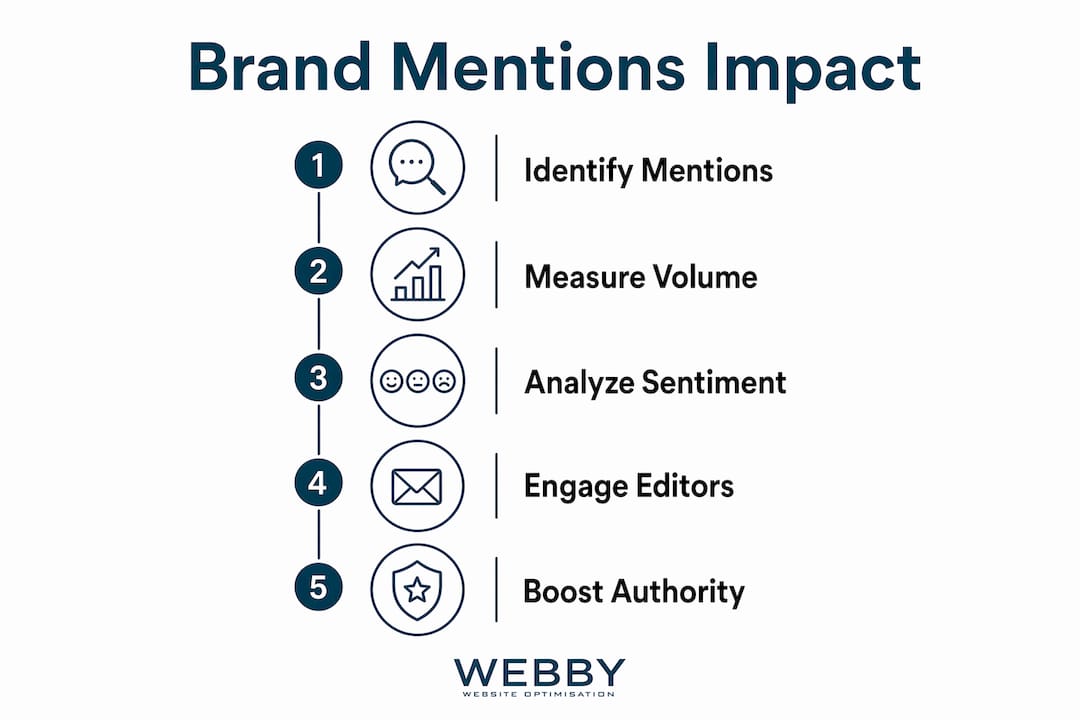
Tracking brand mentions in AI search requires a different approach than traditional monitoring. AI-generated answers combine multiple inputs, making it complex to monitor both presence and narrative. Specialized tools, prompt testing across platforms, and source analysis are now part of a complete monitoring workflow.
A practical monitoring process looks like this:
- Set up real-time alerts for your brand name, key products, and common misspellings using tools like Google Alerts or dedicated brand monitoring platforms.
- Track sentiment weekly by categorizing mentions as positive, neutral, or negative and noting which publications drive each category.
- Audit unlinked mentions monthly to identify opportunities where a site references your brand without a link, then conduct outreach to convert those mentions into backlinks.
- Test AI platforms directly by prompting ChatGPT, Perplexity, and similar tools with category queries to see whether your brand appears in generated answers.
- Measure AI Share of Voice by tracking how often your brand appears versus category competitors in AI-generated responses across multiple platforms.
Pro Tip: When you find an unlinked mention on a high-authority site, contact the editor with a specific, polite request to add a link. Conversion rates on these outreach efforts are significantly higher than cold link-building pitches because the editorial relationship already exists.
How do brand mentions interact with backlinks to drive long-term authority?
Backlinks and brand mentions operate at different layers of SEO authority, and understanding that distinction changes how you allocate resources. Backlinks focus on structural link validation while brand mentions build semantic trust and AI inclusion probabilities. Treating them as substitutes is a strategic error. They are complementary tools that reinforce different parts of the same authority structure.
Backlinks drive page-level ranking signals. A strong backlink from a relevant, high-authority domain tells Google that a specific page deserves to rank for a specific query. Brand mentions, by contrast, tell Google that a brand deserves to exist prominently within a topic category. One is transactional. The other is reputational.
The sequencing of these efforts matters. Prioritizing brand mentions after technical SEO fundamentals, such as crawlability and structured data, produces better results than pursuing mentions on a technically broken site. Brands lacking an existing citation footprint see little benefit from publishing large amounts of content, because LLMs do not surface content they cannot associate with a recognized entity.
| Signal | Primary function | SEO layer | AI visibility impact |
|---|---|---|---|
| Backlinks | Pass PageRank to specific pages | Page-level ranking | Low direct impact |
| Brand mentions | Build entity authority and semantic trust | Entity-level recognition | High direct impact |
| Combined effect | Reinforce E-E-A-T across all layers | Full-spectrum authority | Maximum AI inclusion |
SEO experts now treat brand mentions as trust signals feeding into Google’s E-E-A-T framework, which is why the most effective campaigns combine digital PR with technical SEO rather than running them as separate programs.
Pro Tip: Build your technical SEO foundation first. Structured data, clean crawlability, and fast page speed give search engines the infrastructure to process and credit the brand mentions you earn. Without that foundation, mentions accumulate without converting into ranking improvements.
What are effective methods for earning high-quality brand mentions?
Earning brand mentions at scale requires creating content and experiences that authoritative sources want to reference. Passive mention generation, where other sites cite you without any direct outreach, is the most durable form of brand citation relevance.
Original research and referenceable assets become disproportionately cited for both AI and traditional SEO visibility. A proprietary study, an industry benchmark report, or a definitive resource page gives journalists, bloggers, and forum contributors something concrete to reference. That reference pattern is exactly what LLMs scan when building their training data and generating answers.
- Publish original research: Commission or conduct studies specific to your industry. Data that does not exist elsewhere gets cited by default.
- Create definitive resource pages: Build the most thorough, accurate reference on a topic your audience searches. These pages attract passive mentions from writers who need a credible source.
- Participate in industry forums and communities: Authentic, expert contributions in visible forums generate organic mentions from other participants who reference your insights.
- Pursue editorial placements: Outreach to authoritative publications for guest contributions or expert quotes generates high-quality mentions in contexts that LLMs weight heavily.
- Diversify your source profile: A brand mentioned across multiple diverse authoritative sources is more reliably surfaced by AI than one with many mentions concentrated on fewer sites.
The importance of brand visibility across diverse sources cannot be overstated for AI search. When a user asks ChatGPT or Perplexity to recommend a service provider, the system draws on its training data. Brands that appear in trade publications, local news, industry blogs, and community forums simultaneously carry far more weight than brands that dominate a single channel.
Authenticity in brand building also plays a direct role in mention quality. Editors and community members reference brands they trust. Manufactured or incentivized mentions in low-authority contexts produce noise, not authority. For local service businesses, this means earning mentions in local news outlets, chamber of commerce publications, and industry-specific directories carries more weight than generic content syndication.
Pro Tip: Repurpose original research into multiple formats: a full report, a summary blog post, a data visualization, and a press release. Each format reaches a different publication type and multiplies the number of authoritative sources that reference the same underlying data.
Key Takeaways
Brand mentions build entity authority and AI visibility that backlinks alone cannot provide, making them a non-negotiable part of any complete SEO strategy in 2026.
| Point | Details |
|---|---|
| Mentions build entity authority | Unlinked mentions signal semantic trust to search engines and LLMs without passing PageRank. |
| AI visibility requires source diversity | Brands cited across multiple authoritative sources appear more reliably in AI-generated answers. |
| Sentiment quality beats volume | Positive mentions in fewer sources outperform high-volume negative mentions for authority building. |
| Technical SEO comes first | Crawlability and structured data must be in place before brand mention campaigns deliver results. |
| Backlinks and mentions are complementary | Backlinks drive page rankings; mentions drive entity recognition. Both are required for full-spectrum authority. |
Brand mentions in 2026: what the data is telling us to do differently
The SEO industry spent a decade treating backlinks as the primary currency of authority. That framing made sense when Google’s algorithm was primarily link-based. The shift to entity-based and AI-mediated search has changed the math in ways that most brands have not fully absorbed.
What I see consistently is brands investing heavily in content production while their citation footprint remains thin. Publishing 50 blog posts on a site that nobody references does not move the needle in AI search. The LLM has no reason to surface a brand it has never encountered in a trusted context. Content volume without citation diversity is a treadmill.
The more uncomfortable truth is that brand mentions require external validation, and that makes them harder to manufacture than backlinks. You cannot simply buy a mention in a credible editorial context. You have to earn it through genuine expertise, original data, or authentic community participation. That is a higher bar, and it is exactly why brands that clear it gain durable advantages.
AI search success now depends on being a trusted cited source rather than holding a traditional top-three ranking. That requires monitoring AI Share of Voice across platforms, not just tracking keyword positions in Google Search Console. The brands that adapt their measurement frameworks now will have a significant head start as AI-mediated search continues to grow.
My recommendation for 2026 is straightforward. Fix your technical foundation, build a handful of genuinely referenceable assets, pursue editorial placements in your category’s authoritative publications, and monitor your AI presence monthly. That sequence, executed consistently, compounds into lasting authority.
How Webby Website Optimisation builds your brand’s citation footprint
Building a brand mention strategy requires a technically sound website as its foundation. Without fast load times, clean structured data, and proper crawlability, the mentions you earn do not convert into ranking improvements.
Webby Website Optimisation works with local service businesses in Perth, Fremantle, and Melville to build that foundation through website design and development that supports both technical SEO and brand authority growth. From structured data implementation to small business SEO strategies that increase your citation footprint, the team connects the technical and reputational layers of search visibility. If your brand is not appearing in AI-generated answers or local search results, a free audit is the clearest starting point.
FAQ
What are brand mentions in SEO?
Brand mentions are any references to your brand name across the web, with or without a hyperlink. Search engines and AI systems process these references to build entity authority and assess a brand’s contextual relevance within a topic category.
Do unlinked brand mentions help SEO?
Yes. Unlinked mentions build entity authority and semantic trust even without passing PageRank. Search engines process them to understand what a brand represents and which topics it is associated with.
How do brand mentions affect AI search results?
AI systems use techniques like Reciprocal Rank Fusion to surface brands that appear frequently across authoritative sources. A brand cited in diverse, credible publications is significantly more likely to appear in AI-generated answers than one with mentions concentrated on a few sites.
How often should I monitor brand mentions?
Monitor brand mention volume and sentiment weekly during normal periods and daily during active campaigns. Audit unlinked mentions monthly to identify backlink conversion opportunities.
What is the difference between brand mentions and backlinks?
Backlinks pass PageRank and improve page-level rankings. Brand mentions build entity-level authority and AI inclusion probabilities. Both signals operate at different layers of SEO and work best when pursued together as part of a coordinated strategy.