
Service page structure is defined as the deliberate arrangement of content, trust signals, and calls to action on a webpage dedicated to a single service offering. For local service businesses, this structure is the primary factor separating pages that generate leads from pages that simply exist. The role of service page structure goes beyond aesthetics. It determines whether Google ranks your page and whether visitors trust you enough to call. A page built around buyer intent, clear deliverables, and social proof consistently outperforms a generic multi-service page. Webby Website Optimisation works with local businesses across Perth, Fremantle, and Melville to build exactly this kind of page.
What key elements make an effective service page structure?
A well-structured service page follows the problem-solution-proof-action framework. Pages using this framework convert at 3–8% compared to 2–3% for unstructured pages. That gap represents a doubling of leads from the same volume of traffic.
The framework breaks down into eight proven elements:
- Hero section: A clear headline stating what you do, who you serve, and where. Place your primary call to action here, above the fold.
- Problem statement: Two to three sentences that name the exact frustration your customer is experiencing. This signals relevance immediately.
- Solution section: Explain the service, what it includes, and what the customer receives. Be specific about deliverables.
- Social proof: Google reviews, star ratings, client testimonials, and case study snapshots. These reduce perceived risk.
- Pricing or next step: Transparent pricing or a clear explanation of how to get started. Ambiguity kills conversions.
- FAQ section: Address the top five objections a buyer has before calling. This is where most pages fail.
- Repeated CTAs: Place a call to action after the proof section and again at the bottom of the page.
- Trust indicators: Licenses, certifications, years in business, and local area references all reinforce credibility.
Pro Tip: Write your hero headline to answer the question “What do I get and why should I trust you?” in one sentence. If you cannot do that, your value proposition needs work before anything else.
The importance of service page content depth cannot be overstated. Each element above serves a specific job. Remove one and you create a gap that a competitor’s page will fill.
Why do dedicated pages outperform generic multi-service pages?
Generic pages that list five services in five paragraphs rank for nothing and convert poorly. Google needs content depth to understand what a page is about and to rank it for specific queries.
Google requires 800–1,500 words on a dedicated service page to properly rank it for that service keyword. A page covering five services in 600 words gives each service only 120 words. That is not enough for Google to establish topical authority, and it is not enough for a visitor to feel confident.
| Page type | Content depth | SEO authority | Lead quality |
|---|---|---|---|
| Generic multi-service page | Thin, fragmented | Weak, diluted | Low, unqualified |
| Dedicated single-service page | Deep, focused | Strong, specific | High, buyer-intent |
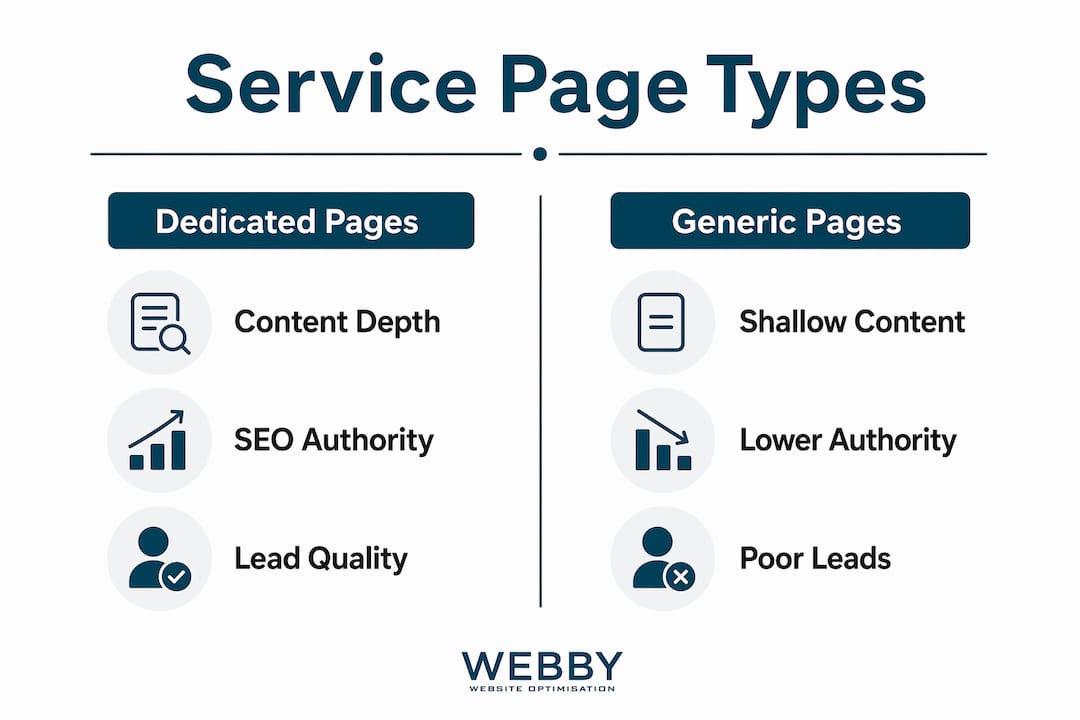
The performance difference is significant. Companies with dedicated pages per service generate up to 6 times more leads and 48% more organic traffic when managing 51–100 pages. That is not a marginal improvement. It is a structural advantage built page by page.
Each dedicated page also targets buyer intent keywords more precisely. A plumber in Perth can rank for “blocked drain repair Fremantle” on a dedicated drain page, while a generic plumbing page competes for nothing specific. The content quality for SEO principle here is simple: focused content on a single topic earns rankings that scattered content never will.
Pro Tip: Prioritize your highest-revenue service first. Build one dedicated page, get it ranking, then repeat the process for the next service. Do not try to restructure everything at once.
How do you optimize service page layout and CTAs to maximize conversion?
Layout decisions directly affect how many visitors take action. The placement of your primary call to action is the single highest-impact layout choice you can make.

Placing the primary CTA in the hero section increases conversion rates by approximately 17%. Visitors who arrive with buying intent should not have to scroll to find a way to contact you. The button or form needs to be visible the moment the page loads.
Beyond the hero, CTA placement follows a clear pattern:
- After social proof: Once a visitor reads reviews or case studies, their trust peaks. A CTA placed here captures that momentum.
- After the FAQ section: Visitors who read FAQs are actively evaluating. A CTA here converts the undecided.
- At the bottom of the page: Catch visitors who read everything before deciding.
Repeated CTAs across at least three page sections improve lead conversion significantly. The key is varying the CTA text to match the visitor’s mindset at each point. “Get a free quote” works in the hero. “See how we can help” works after proof. “Ready to get started?” works at the bottom.
CTA text must be benefit-driven and specific. “Submit” and “Click here” perform poorly. “Book your free inspection” and “Get your quote today” perform well because they name the outcome. The impact of service page design on conversion is most visible in CTA performance. A page with strong content but weak CTA placement consistently underperforms its potential.
Avoid burying trust signals deep in the page. Reviews and credentials placed below the fold lose most of their impact. Move them up, close to the first CTA, where they reinforce the decision to act.
How do structured service pages reduce visitor friction and objections?
Visitors leave pages when they have unanswered questions. This is the objection-handling vacuum that kills conversions. A structured page addresses this proactively rather than leaving visitors to search for answers elsewhere.
The most effective approach to reducing friction follows five steps:
- Name the concern directly. If customers worry about price, address it. If they worry about disruption to their home, address that too. Ignoring concerns does not make them disappear.
- Explain your process briefly. Two to three sentences on what happens after a customer contacts you sets expectations and reduces anxiety.
- Show transparent pricing or ranges. Exact prices are not always possible, but a starting price or price range removes the fear of the unknown.
- Use social proof at the friction point. Place a testimonial near the section where doubt is highest, typically near pricing or the CTA.
- Focus on outcomes, not steps. Visitors respond to outcome-focused messaging rather than detailed process descriptions. “Your lawn will be green and maintained weekly” outperforms “We mow, edge, and fertilize.”
Service pages that answer objections and include FAQs reduce visitor drop-off caused by unanswered questions. The FAQ section is not a formality. It is a conversion tool that handles the sales conversation your team would otherwise have on the phone.
Including FAQ schema markup also improves how your page appears in Google search results. Rich results with expanded FAQ answers increase click-through rates and signal relevance to AI-powered search tools.
Practical tips for implementing an effective service page
Start with an audit of your existing pages. Check each one against the eight-element framework from the first section. Most local service pages are missing at least three elements, typically the problem statement, transparent pricing, and a structured FAQ.
Write to buyer intent from the first sentence. Your page title and opening paragraph should include the specific service and location. “Roof restoration in Melville” is more useful to Google and to your visitor than “Our services.”
Use internal linking to connect related service pages. A customer reading your gutter cleaning page may also need roof restoration. A link between those pages keeps visitors on your site and signals content relationships to Google.
Conversion rate optimization on service pages is not a one-time task. Review your analytics every 90 days. Look at bounce rate, time on page, and form submissions. Pages with high traffic but low conversions have a structural problem, not a traffic problem.
Measurable improvements typically appear 60–90 days after restructuring, due to search re-indexing and shifts in visitor behavior. Set realistic expectations and track the right metrics from day one.
Pro Tip: Use Google Search Console to find the exact search queries driving traffic to each service page. If the queries do not match your service, your page title and opening content need to be rewritten to align with what buyers actually search.
The service page content strategy that works long term is one built on specificity. Specific service, specific location, specific outcome, specific next step. Vague pages produce vague results.
Key Takeaways
A well-structured service page is the single most effective digital asset a local service business can build, combining SEO depth with conversion mechanics to turn search traffic into qualified leads.
| Point | Details |
|---|---|
| Use the problem-solution-proof-action framework | Structured pages convert at 3–8% versus 2–3% for unstructured pages. |
| Build one dedicated page per service | Dedicated pages generate up to 6 times more leads than generic multi-service pages. |
| Place the primary CTA in the hero section | Above-the-fold CTAs increase conversion rates by approximately 17%. |
| Address objections with FAQs and transparent pricing | Unanswered questions are the leading cause of visitor drop-off on service pages. |
| Expect results within 60–90 days | SEO and conversion improvements take time to appear after restructuring. |
Why most local service pages are working against themselves
After working with local service businesses across Perth and Fremantle, the pattern is consistent. Business owners invest in a website, get a few pages built, and then wonder why the phone is not ringing. The pages look fine. They have photos, a contact form, and a list of services. But they are built like brochures, not conversion assets.
The uncomfortable truth is that a brochure-style page tells visitors what you do. A conversion-focused page tells visitors what they get, why you are trustworthy, and exactly what to do next. Those are fundamentally different documents. Most local businesses have the first kind and need the second.
The other mistake I see constantly is treating all services as equal on one page. A single “Services” page with five bullet points is not a service page. It is a menu. Google cannot rank a menu for anything specific, and a visitor cannot make a confident decision from a menu. Dedicated pages with real depth are the only structure that works for both search and conversion simultaneously.
The businesses that commit to this approach, building one focused page per service, adding genuine depth, and placing CTAs where buyers are ready to act, see consistent results. Not overnight. But within 60–90 days, the data shows up in rankings, traffic, and most importantly, in lead volume.
How Webby Website Optimisation builds service pages that rank and convert
Local service businesses in Perth, Fremantle, and Melville need more than a good-looking website. They need pages built to rank for specific service queries and convert visitors into paying customers.
Webby Website Optimisation specializes in website design and development built around the structure and content depth that drives real results. From dedicated service pages to full SEO campaigns, every engagement is focused on generating leads, not just traffic. If your current service pages are not producing the results your business needs, a free audit from Webby Website Optimisation will show you exactly where the gaps are and what to fix first.
FAQ
What is the role of service page structure in SEO?
Service page structure determines whether Google can identify the topic, depth, and relevance of a page for a specific search query. Pages with 800–1,500 words focused on a single service consistently rank higher than generic multi-service pages.
How many CTAs should a service page have?
A service page should include at least three CTAs placed in the hero section, after social proof, and at the bottom of the page. Varying the CTA text at each placement improves overall conversion rates.
Why do dedicated service pages generate more leads?
Dedicated pages allow deeper content on a single topic, which builds topical authority with Google and matches buyer intent more precisely. Companies with dedicated pages per service generate up to 6 times more leads than those using generic pages.
How long does it take to see results after restructuring a service page?
Measurable SEO and conversion improvements typically appear 60–90 days after restructuring, as Google re-indexes the updated content and visitor behavior data accumulates in analytics.
What is the most common reason service pages fail to convert?
The most common failure is the absence of objection-handling content. Visitors who cannot find answers to their concerns, such as pricing, process, or credentials, leave without contacting the business.