
Off-page SEO is defined as any activity performed outside your website that influences how search engines perceive its credibility, authority, and trustworthiness. While on-page SEO covers what you publish and how your site is structured, off-page SEO covers what the rest of the internet says about you. Backlinks remain a top ranking factor, but modern off-page signals now include E-E-A-T validation, brand mentions, and social amplification. Business owners and digital marketers who ignore these external signals leave significant ranking potential on the table, regardless of how well their site content is written.
What is off-page SEO and what signals does it include?
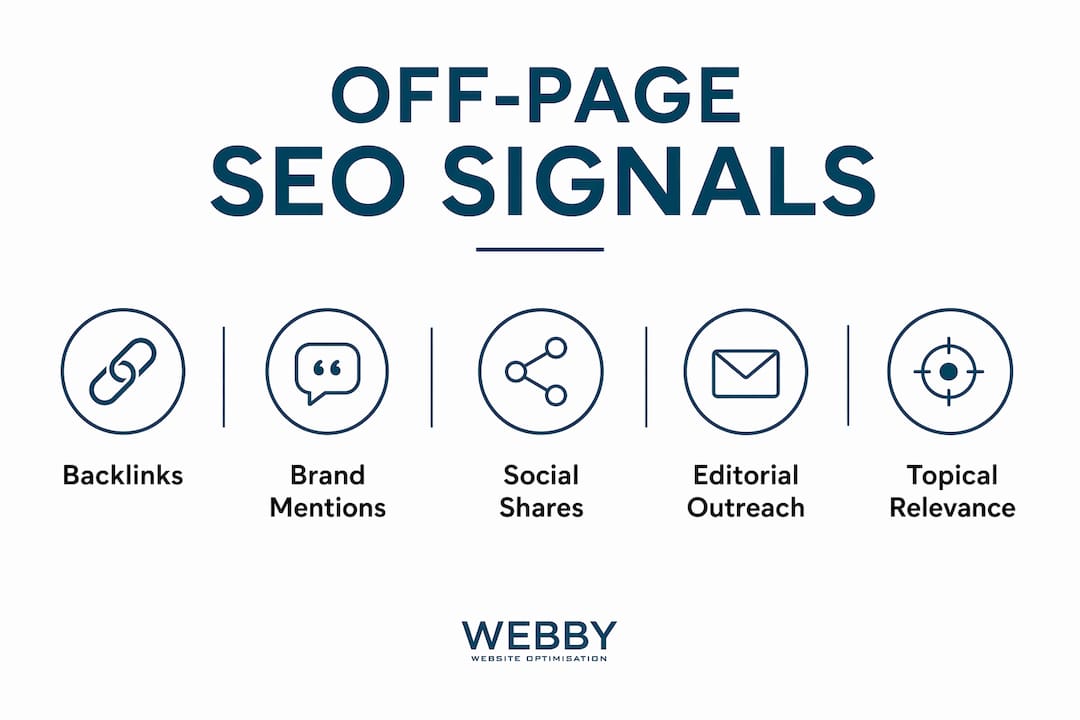
Off-page SEO is built on signals that originate outside your website but land directly in Google’s ranking calculations. These signals tell search engines that other people, publications, and platforms trust your site enough to reference it. The stronger and more credible those references, the higher your site climbs.
The core components of off-page SEO include:
- Backlinks. A backlink is a hyperlink from another website pointing to yours. Google treats each quality backlink as a vote of confidence. Not all votes carry equal weight; a link from a respected industry publication outranks a link from a low-traffic directory.
- Brand mentions. Google increasingly looks for co-occurrence of brand mentions with relevant industry keywords as part of E-E-A-T assessment. A mention without a hyperlink still registers as a reputation signal.
- E-E-A-T signals. Experience, Expertise, Authoritativeness, and Trustworthiness are Google’s quality framework. Off-page activity validates these qualities through external endorsements, author citations, and editorial coverage.
- Local citations. For service businesses, listings on Google Business Profile and platforms like Yelp with positive reviews drive “near me” search rankings. Consistent NAP data (Name, Address, Phone) across directories is a foundational local SEO requirement.
- Social media amplification. Social shares and engagement extend content reach and increase opportunities for earned links and brand mentions. They contribute indirectly to authority and visibility.
Pro Tip: Do not wait for links to appear naturally. Identify your top three industry publications and pitch them a data-driven story or expert commentary. One editorial placement in a credible outlet outperforms fifty directory submissions.
How has off-page SEO evolved in 2026?

The biggest shift in off-page SEO over the past few years is the move from volume to credibility. Buying bulk links or submitting to generic directories used to move rankings. Today, those tactics trigger penalties. Algorithms identify and devalue manipulated links, creating long-term damage that can take months to reverse.
The tactics that work in 2026 follow a different logic:
- Digital PR and editorial outreach. Pitching stories to journalists and editors earns authoritative, editorial mentions that act as genuine endorsements. This approach builds trustworthy placements and avoids spam risks.
- Linkable asset creation. Original research, industry surveys, free tools, and detailed guides attract natural citations. When your content is genuinely useful, other sites link to it without being asked.
- Strategic partnerships. Collaborating with complementary businesses and industry associations generates co-branded content and mutual links. Webby Website Optimisation highlights business partnerships as a direct path to credibility building for local service businesses.
- Reputation management campaigns. Proactively gathering reviews, responding to feedback, and maintaining consistent brand messaging across platforms builds the trust profile that Google’s E-E-A-T framework rewards.
- Answer-ready content positioning. Websites must become authoritative, fact-checked sources that generative AI systems can cite. Being answer-ready for AI-driven search is now an off-page SEO objective, not just a content strategy.
“Off-page SEO is no longer just link building. It is credibility building through trust signals that survive scrutiny. The sites that win in 2026 are the ones that have earned their reputation, not bought it.”
The shift toward publisher-first editorial outreach is particularly significant. Topical relevance now matters more than raw domain authority. A link from a niche trade publication that covers your exact industry carries more weight than a link from a high-traffic but unrelated website.
How does off-page SEO differ from on-page SEO?
On-page and off-page SEO are symbiotic: one builds relevance, the other builds credibility, and both together drive rankings. Treating them as separate strategies is a mistake most business owners make early in their SEO program.
| Factor | On-page SEO | Off-page SEO |
|---|---|---|
| Location of activity | Inside your website | Outside your website |
| Primary goal | Content relevance and site structure | Credibility and trustworthiness |
| Key signals | Keywords, meta tags, page speed, internal links | Backlinks, brand mentions, reviews, citations |
| Control level | Full control | Partial control |
| Time to impact | Faster, often within weeks | Slower, builds over months |
On-page SEO tells Google what your site is about. Off-page SEO tells Google whether your site deserves to rank for it. Sites lacking either struggle to achieve top rankings regardless of content quality. A perfectly optimized page with no external credibility signals will lose to a moderately optimized page with strong editorial endorsements. The reverse is also true: a site with hundreds of backlinks but thin, poorly structured content will plateau quickly.
The practical takeaway is straightforward. Fix your on-page foundation first, then build your off-page reputation. Trying to earn backlinks to a slow, poorly structured website wastes effort because Google’s quality signals work together.
What practical off-page SEO strategies actually work?
Effective off-page optimization strategies require consistency and a clear plan. The following approaches deliver results for business owners and digital marketers without exposing your site to penalty risk.
- Manual editorial outreach. Contact editors, journalists, and bloggers in your industry with specific, relevant story pitches. Generic “link exchange” emails fail. Personalized pitches tied to a news hook or original data succeed. Digital PR earns authoritative placements that generic link building cannot replicate.
- Create linkable assets. Publish original research, free calculators, detailed how-to guides, or industry benchmarks. These formats attract natural citations because they provide value that other writers want to reference. A single well-researched study can generate dozens of editorial links over its lifetime.
- Manage local citations with consistent NAP data. For local service businesses, consistent NAP data across platforms is a foundational off-page requirement. Audit your listings on Google Business Profile, Yelp, and industry directories at least twice a year. Inconsistent phone numbers or addresses confuse both search engines and potential customers.
- Build community and industry partnerships. Sponsor local events, contribute to industry associations, or co-author content with complementary businesses. These activities generate natural mentions and links while building genuine brand recognition. For Perth-based businesses, this kind of local presence directly supports small business SEO performance.
- Monitor and audit your link profile regularly. Use Google Search Console to review your inbound links. Disavow toxic or spammy links before they accumulate. A clean link profile is easier to build on than one cluttered with low-quality references.
Pro Tip: Prioritize topical relevance over domain authority when pursuing link placements. A link from a niche trade blog that covers your exact service area will outperform a link from a high-traffic lifestyle site with no industry connection.
Key Takeaways
Off-page SEO builds the external credibility that search engines require before ranking your site at the top, and no amount of on-page work fully compensates for its absence.
| Point | Details |
|---|---|
| Core definition | Off-page SEO is any external activity that signals credibility, authority, and trust to search engines. |
| Beyond link building | Brand mentions, E-E-A-T signals, reviews, and citations all count as off-page ranking factors. |
| Quality over volume | Editorial links from relevant sources outperform large numbers of low-quality directory links. |
| On-page and off-page work together | On-page SEO establishes relevance; off-page SEO establishes credibility. Both are required for top rankings. |
| Local businesses need citations | Consistent NAP data and positive reviews on Google Business Profile directly drive local search visibility. |
The reputation shift most business owners miss
I have worked with enough business owners to know that off-page SEO is the part of the strategy they most often underestimate. They spend months perfecting their website content, then wonder why their rankings stall. The answer is almost always the same: the site has relevance but no credibility in Google’s eyes.
What I find most interesting about the current state of off-page SEO is how much it now resembles traditional PR. The businesses that rank well are the ones that have genuinely earned their reputation through editorial coverage, community involvement, and consistent brand presence. The shortcut mentality, buying links, spinning articles, and submitting to hundreds of directories, does not just fail. It actively sets you back.
The AI search shift adds another layer. Generative AI tools pull answers from sources they consider authoritative and fact-checked. If your business is not being cited by credible external sources, you are invisible to these systems. That is a growing problem, not a future one.
My honest advice: treat off-page SEO as a long-term reputation program, not a one-time campaign. Set a quarterly goal to earn three to five editorial mentions in relevant publications. Build relationships with local industry groups. Keep your citations clean. The compounding effect of consistent reputation building is what separates businesses that dominate their local search results from those that stay stuck on page two.
How Webby Website Optimisation supports your off-page SEO foundation
A strong off-page SEO program starts with a website that is worth linking to. If your site is slow, poorly structured, or difficult to navigate, editorial contacts and potential partners will pass on linking to it.

Webby Website Optimisation builds SEO-friendly websites designed to support both on-page and off-page performance from day one. The team works with local service businesses in Perth, Fremantle, and Melville to create credible, fast-loading web presences that attract links, citations, and customer trust. Whether you need a full website build or a targeted SEO campaign, Webby Website Optimisation offers tailored solutions that match your growth goals and budget.
FAQ
What is off-page SEO in simple terms?
Off-page SEO is everything you do outside your website to improve its search engine rankings. It includes earning backlinks, building brand mentions, managing reviews, and securing local citations.
What is link building and why does it matter?
Link building is the process of earning hyperlinks from other websites to your own. Search engines treat quality backlinks as votes of confidence, which directly improves a site’s authority and ranking potential.
How do off-page SEO techniques differ from on-page tactics?
On-page tactics control content and site structure inside your website. Off-page techniques build credibility through external signals like backlinks, brand mentions, and reviews that originate on other platforms.
How long does off-page SEO take to show results?
Off-page SEO typically takes several months to produce measurable ranking improvements. Results build gradually as credibility signals accumulate, making consistency more important than short-term volume.
Can brand mentions without links help rankings?
Google recognizes brand mentions without hyperlinks as reputation signals, particularly as part of E-E-A-T assessment. Unlinked mentions from credible sources still contribute to your site’s authority profile.