
Short verdict: review gating, or filtering review requests by expected sentiment, is disallowed by major review platforms and is likely unlawful under consumer protection rules in several markets. Stop any process that hides your review link from unhappy customers and switch to a single, neutral request sent to everyone. Google, the FTC, and the ACCC all treat this practice as a compliance risk, not a growth tactic.
TL;DR:
- Review gating, where businesses filter who receives review requests based on satisfaction, is both illegal and a compliance risk in major markets and platforms.
- Enforcing rules means sending the same review link to all customers who complete a purchase, regardless of their satisfaction level, with no staff or survey decision-making involved.
- Automated audits can identify hidden gating through conditional logic, feedback routing, or survey branches tied to customer sentiment.
- Laws in the US and Australia impose strict penalties for review suppression, incentivized reviews, or altering reviews to influence overall impression, regardless of intent.
- Using Webby’s audit service helps businesses map, test, and fix review request flows to ensure legal compliance and maintain customer trust.
Table of Contents
- What counts as review gating versus a legitimate request
- Platform rules and what happens when you break them
- Where consumer protection law comes in
- Building a review request process that stays inside the rules
- How to audit your own review flow for hidden gating
- What enforcement actually looks like
- How Webby helps you fix a gated flow
- Why transparent review practices are worth the short-term discomfort
- Get a compliance-first review audit
- Sources
- FAQ
What counts as review gating versus a legitimate request
Review gating happens whenever a business decides who gets asked for a public review based on how satisfied that customer seems to be. The technical shape varies but the intent is always the same: steer negative sentiment away from the review link and toward a private channel, while positive sentiment gets pushed straight to Google or another platform.
Common patterns look harmless on the surface:
- A pre-screen survey that asks “How was your experience?” and only shows the public review link to customers who answer four or five stars.
- Staff manually deciding which customers to hand a review card to, based on how the interaction went.
- Email or SMS flows with conditional buttons that route unhappy responses to a feedback form instead of the review page.
Legitimate solicitation looks different: the same message, the same link, sent to every customer who qualifies, regardless of how the job went. The decision to leave a review, and what to say, stays entirely with the customer.
Platform rules and what happens when you break them
Google’s own contributor policy is explicit about this. The Maps User Generated Content Policy forbids discouraging negative reviews and selectively soliciting positive ones, and it bars businesses from offering incentives in exchange for posting or revising a review. That covers both sides of gating: hiding the link from unhappy customers and paying or rewarding happy ones to post.
Businesses “shouldn’t discourage negative reviews or selectively solicit positive reviews from customers.”
Yelp takes an even harder line, generally discouraging any business-solicited reviews at all, which means a compliant flow on Google can still run into trouble on Yelp if the request itself looks engineered.
The consequences are largely operational rather than criminal, but they bite fast:
- Individual reviews get removed once flagged or detected by automated systems.
- Business accounts can be suspended or restricted from collecting new reviews for a period.
- Star ratings and visibility can drop once suppressed negative reviews are found and reinstated, or once a pattern of selective solicitation is identified.
Platform action usually arrives faster than any regulator’s, which is why it deserves to be treated as the first line of risk.
Where consumer protection law comes in
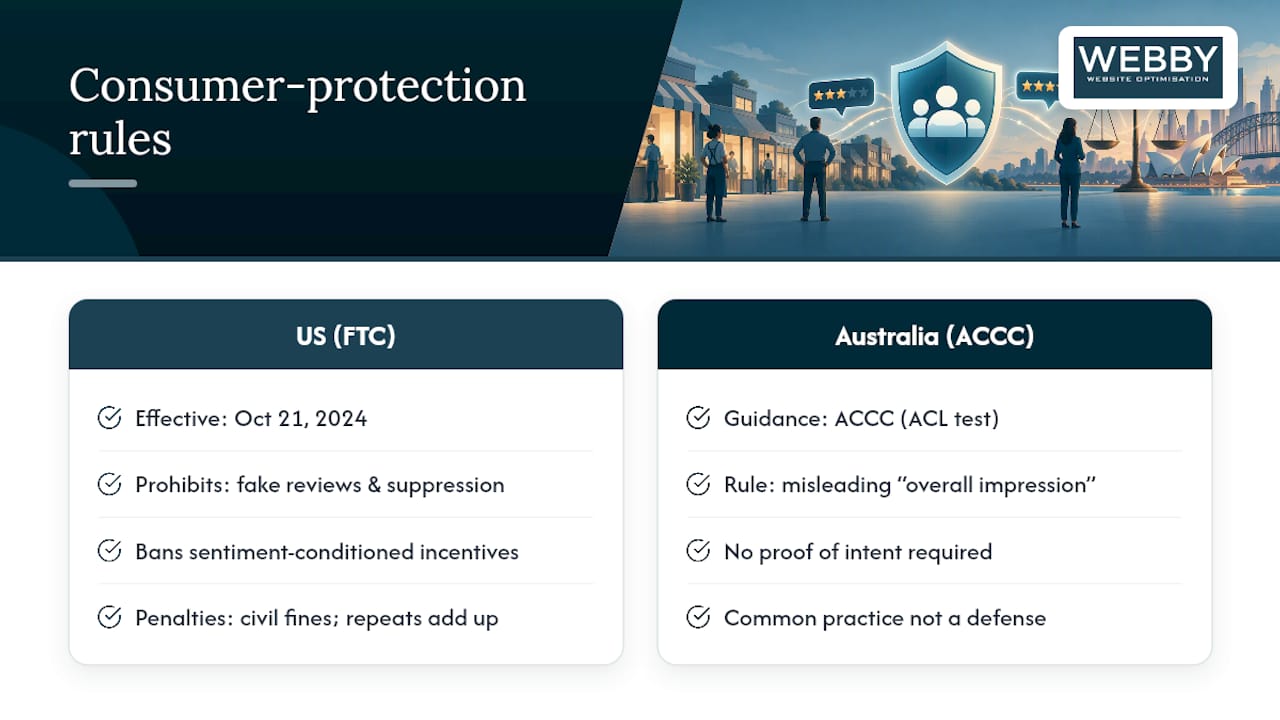
Platform rules are one layer of risk. Consumer protection law is the other, and it carries actual financial penalties. In the United States, the FTC’s Consumer Reviews and Testimonials Rule, effective October 21, 2024, prohibits buying or selling fake reviews, review suppression, and incentives conditioned on the sentiment of the review. Systematic suppression, including software that routes only negative feedback away from public view, can expose a business to civil penalties, and repeated instances can be treated as separate violations that add up quickly.
Repeated suppression can increase penalty exposure under the FTC rule, since each instance of suppressed review may be treated as a separate violation. Source
In the Australian market, the ACCC’s guidance on online reviews applies the Australian Consumer Law test of whether a practice creates a misleading “overall impression” for consumers. That test does not require proof that a business set out to deceive anyone. If the net effect of a review process is a display that looks more positive than the real spread of customer experience, it can contravene the ACL regardless of intent, though knowledge of the conduct affects how enforcement proceeds. Common practice is not a defense: plenty of businesses run gated flows without realizing they sit on the wrong side of this test.
Building a review request process that stays inside the rules
Replacing a gated flow does not require new software, only a different sequencing of the same steps.
- Send the identical review request, with the identical link, to every customer who completes a job or purchase.
- If you offer an incentive to leave a review, make it available regardless of star rating and disclose the incentive on the review itself.
- Keep staff out of the decision entirely: no verbal filtering at the counter, no “let me get someone to help you first” as a stall tactic before handing over the link.
- Document the request funnel from trigger to send, and remove any branch, survey question, or conditional link that changes what a customer sees based on their answer.
Pro Tip: Route all feedback, good or bad, into one inbox first, then decide internally how to act on it. The public review link never needs to know what that feedback said.
Training matters as much as the technology. A perfectly neutral automated email can still get undone by a team member at the front desk who quietly decides who is “worth” asking. Staff need the same instruction as the software: ask everyone, the same way, every time.
How to audit your own review flow for hidden gating
The fastest way to find gating is to run your own request as a customer would. Create two or three test scenarios with different simulated satisfaction levels and walk each one through the funnel to see what link, if any, appears at the end.
- Submit a low-satisfaction test response and confirm the same public review link appears as it would for a high-satisfaction response.
- Check survey tools for conditional logic branches tied to a star rating or sentiment score before the link is shown.
- Inspect webhook payloads and CRM automation rules for any step that routes based on a numeric score rather than sending every contact down the same path.
Keep a record of what you tested and what you changed, since that log becomes useful evidence of remediation if a platform or regulator ever asks.
| Check | What to look for | Red flag |
|---|---|---|
| Survey logic | Branching tied to a satisfaction score | Low scores never reach the public link |
| CRM automation | Rules based on sentiment or rating | Segment excludes recent complaints |
| Staff process | Verbal screening before handing out a link | Card or link only offered to “happy” customers |
What enforcement actually looks like
Regulators are already acting on this. In 2026, the ACCC issued infringement notices against PhotobookShop after the company paid influencers for undisclosed reviews and edited some reviews in ways that changed their overall impression, leading to financial penalties. The case turned on the same “overall impression” test that governs ordinary review displays, not just influencer campaigns.
Years earlier, the Federal Court ordered the franchisor behind Electrodry to pay $215,000 in penalties after it published fabricated customer testimonials, a conduct the court treated as a serious contravention of the Australian Consumer Law rather than a marketing gray area.
The pattern across both cases is consistent:
- Disclose any payment or incentive connected to a review, always.
- Never edit a review in a way that shifts its overall meaning.
- Never publish a testimonial that was not given by an actual customer.
How Webby helps you fix a gated flow
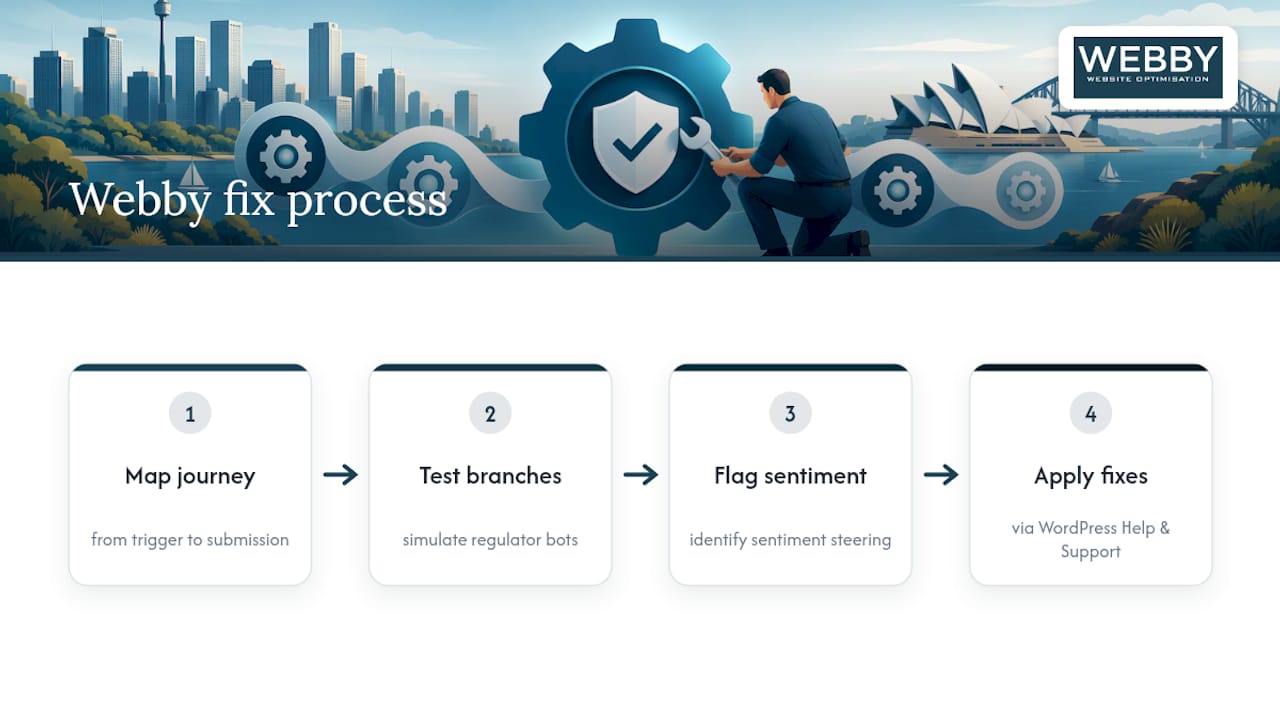
Untangling a review funnel that has grown conditional logic over several tools and a few well-meaning staff decisions takes more than a policy read-through. Webby’s Website Audit service maps the full customer journey from request trigger to review submission, tests each branch the way a regulator or platform bot might, and flags where sentiment is quietly steering customers toward different outcomes. For businesses running review widgets or CMS-based request tools, ongoing fixes are handled through WordPress Help & Support.
Why transparent review practices are worth the short-term discomfort
The businesses most tempted by gating are usually the ones with a handful of bad experiences they would rather bury. That instinct is understandable and also self-defeating: a review profile with no negative signal at all tends to read as manufactured, and customers notice. Documenting your fixes and publishing a consistent, honest request process builds the kind of trust that a curated five-star wall never will.
— Steve Doig
Get a compliance-first review audit
Fixing a gated review flow usually means untangling a handful of tools and a survey or two that grew conditional branches nobody remembers approving. Webby’s Website Audit service checks your review request paths as part of a broader technical review, and flags where a flow may be routing customers differently based on sentiment.
The audit is a one-off engagement, and it does not promise a specific legal or platform outcome, only a clear map of what your current setup actually does. For an ongoing partner that also handles website performance and search visibility, the End-to-End Growth Engine™ service folds review-flow remediation into a broader engagement. Request a website audit to understand what your review funnel may be showing customers.
Sources
This article draws on Google’s Maps contributor policy, the FTC’s Consumer Reviews and Testimonials Rule Q&A, the ACCC’s guidance on online reviews, and its enforcement releases on PhotobookShop and Electrodry. For broader reputation workflow guidance, see this step-by-step SMB reputation guide. These are the same sources cited throughout the sections above.
This article is general information, not a substitute for advice from a qualified lawyer. Consult a qualified legal professional about your own circumstances before acting on anything here.
- Prohibited & restricted content – Maps User Generated Content Policy Help
- The Consumer Reviews and Testimonials Rule: Questions and Answers | Federal Trade Commission
- Online reviews for product and services | Australian Competition & Consumer Commission
FAQ
Is review gating illegal?
It depends on the market and the specific conduct, but it carries real legal risk. In the United States, the FTC’s rule prohibits review suppression outright, and in Australia the ACCC applies the Australian Consumer Law’s “overall impression” test regardless of intent.
What is considered review gating?
Review gating is any process that decides who receives a public review request based on their expected sentiment, such as a survey that only shows the review link to satisfied customers. It differs from sending an identical review request to every customer, which platforms and regulators generally treat as acceptable solicitation.
Does Google have a review gating policy?
Yes. Google’s Maps User Generated Content Policy explicitly forbids discouraging negative reviews, selectively soliciting positive ones, and offering incentives in exchange for posting or revising a review.
How many 5 star reviews to cancel a 1 star Google review?
There is no such mechanism: additional five-star reviews do not remove or offset an existing one-star review on Google. Each review stands on its own, and the only way to address an unfair or fake review is to flag it through Google’s reporting tools or respond to it publicly.