
Generative engine optimization (GEO) is the practice of structuring content so AI systems like ChatGPT, Google’s AI Overviews, and Perplexity can extract, cite, and represent it accurately. The fastest first step is making your top passage extractable: a bottom-line answer, a sourced statistic, and a short citation in the first few sentences. Measurement comes next, and it is where most teams fall short.
TL;DR:
- Using clear answers, sourced statistics, and citations increases the likelihood of your content being extracted and embedded in AI-generated responses.
- Prioritizing the first few sentences with direct, BLUF-style statements significantly boosts citation prominence and answer impact.
- Technical SEO fundamentals like crawlability, site structure, and backlinks remain critical for enabling AI systems to access and cite your content.
- Small, incremental content changes, such as adding citations and quotations, can deliver measurable improvements in AI visibility without full page rewrites.
- Continuous monitoring and validation through sampling and structured data help ensure your content maintains influence as AI models and search behaviors evolve.
Table of Contents
- What generative engine optimization actually means
- How GEO differs from traditional SEO
- Practical GEO tactics you can apply today
- Measuring GEO performance: practical metrics and examples
- Implementation workflow: analyze, revise, evaluate, repeat
- Risks, attribution, and trust in generative content
- 10-step GEO launch checklist
- Examples of successful GEO campaigns or case studies
- How AI and large language models are reshaping GEO strategy
- Integrating GEO with the rest of your marketing channels
- Legal and ethical considerations in generative content
- Why most GEO advice oversells the win
- Getting GEO implemented without doing it all yourself
- Sources
- FAQ
What generative engine optimization actually means
Generative engines like ChatGPT, Gemini, and Perplexity mostly rely on retrieval-augmented generation, or RAG: a system pulls candidate passages from indexed pages, then a language model synthesizes an answer and decides what to cite. Your content never gets “read” the way a human reads it. It gets scored, ranked, and sometimes stitched into a few sentences alongside three other sources. GEO research from a KDD-affiliated study treats this as a black-box optimization problem: you’re not optimizing for one query and one ranking, you’re optimizing for visibility across a cluster of related queries and a probabilistic selection process.
That is why GEO matters now. Search behavior is shifting toward conversational answers that compress multiple sources into one response, and if your page isn’t one of the sources pulled into that response, the traffic and the credibility both go to a competitor’s passage.
A few terms come up constantly in this field:
- Citation prominence: how early and how centrally your source appears in a generated answer.
- Position-adjusted exposure: a weighted measure that values an early citation more than a buried one.
- Semantic contribution: how much of the actual answer content traces back to your passage, versus just being name-checked.
- BLUF: “bottom line up front,” meaning the direct answer appears in the first sentence, not after three paragraphs of context.
Each of these shows up again in the measurement section, but the short version is that being mentioned is not the same as being influential.
How GEO differs from traditional SEO
GEO does not replace SEO, it extends it. Crawlability, clean technical structure, and relevant backlinks still matter. The original GEO research is explicit on this point: a page that isn’t crawlable or indexable cannot be cited by a generative engine no matter how well-written it is.
What changes is the priority order. Traditional SEO optimizes for ranking a whole page against a keyword. GEO optimizes for individual passages being extracted and embedded in an answer across a cluster of related queries at once, which means one page might get pulled into responses for ten different phrasings of a question. Freshness also carries more weight, since generative engines weigh recency signals heavily when choosing between similar sources.
A few things to keep from your SEO playbook:
- Clean site architecture, fast load times, and mobile usability.
- Backlinks from relevant, authoritative domains.
- Keyword research to understand what your audience is actually asking.
A traditional SEO snippet might read: “Our agency offers comprehensive website optimization services for small businesses.” A GEO-ready passage reads: “Website speed improvements of even half a second can measurably affect conversion rates, which is why audits typically start with a technical performance check.” The second version gives a model something concrete to extract and attribute.
Practical GEO tactics you can apply today
Most of the lift in generative visibility comes from small, specific changes to existing pages rather than wholesale rewrites. The GEO benchmark study found that adding citations, quotations, and statistics improved citation prominence and position-adjusted metrics, and that fluency and readability improvements produced additional gains on top of that.
Here is a prioritized sequence for a single page or a small content cluster:
- Rewrite the opening passage as BLUF. Put the direct answer in sentence one, not the setup.
- Add one sourced statistic with a clear attribution and a link to the original data.
- Include a short, attributable quotation from a named source rather than a paraphrase.
- Add inline citations throughout the piece, not just in a references section at the bottom.
- Mark up the page with structured data (FAQ schema, Article schema) so engines can parse claims and context.
- Tighten metadata: title tags and meta descriptions should state the answer, not tease it.
- Build content clusters around long-tail variations of the core question instead of one page per broad keyword.
- Earn or create brand mentions on third-party sites, since generative engines weigh outside validation.
- Set a freshness cadence, updating key stats and examples on a fixed schedule rather than letting pages go stale.
- Run a crawl and indexability check to confirm the page is actually reachable by the engines you’re targeting.
Pro Tip: Rewrite your opening two sentences first and leave everything else alone. It is the single highest-leverage edit because passage-position matters: engines are more likely to embed claims from the first few passages of a page than from a conclusion buried at the bottom.
Structured data deserves a specific mention. FAQ schema and Article schema do not guarantee a citation, but they make your content easier for a retrieval system to parse into discrete, extractable claims. Pair that with a metadata pass: a meta description that previews the actual answer performs better than one written purely to generate a click.
Measuring GEO performance: practical metrics and examples
Citation presence alone is a weak signal. A page can be mentioned in a generated answer and still contribute almost nothing to the actual content a reader sees. The content-centric GEO framework known as CC-GSEO-Bench argues for measuring influence across five dimensions: citation prominence, attribution accuracy, semantic contribution, key-information coverage, and answer dominance, rather than relying on raw citation counts.
Two metrics are worth building into a reporting template:
- Position-adjusted word count: how many words of the generated answer trace back to your source, weighted by how early they appear.
- Semantic contribution: an approximate percentage of the answer’s core claims that originate from your passage, checked manually or with an LLM-assisted review.
A simple illustrative comparison, using hypothetical before-and-after numbers for a single page, makes the idea concrete:
| Metric | Before GEO edit | After GEO edit |
|---|---|---|
| Citation prominence | Low (mentioned near end of answer) | High (cited in first sentence) |
| Position-adjusted word count | Small share of answer | Larger share of answer |
| Semantic contribution | Minimal, name-check only | Substantial, core claim sourced to page |
Data sources for tracking this in practice include Search Console for traditional visibility, brand-mention tracking tools for third-party citations, and manual sampling: periodically running your target queries through the generative engines themselves and logging what gets cited. Manual sampling is labor-intensive and not perfectly repeatable, since generative answers can vary between runs, so treat any single sample as directional rather than definitive.
Implementation workflow: analyze, revise, evaluate, repeat
Run GEO work as a controlled experiment, not a one-time edit. The content-centric GEO research recommends treating changes like a content A/B test: isolate one passage, change one variable, and measure before and after with a fixed sampling method.
- Pick a hypothesis and a target query cluster. Decide which passage you think is under-cited and why.
- Assign roles. An analyst selects the queries and baseline data, an editor rewrites the passage, and an evaluator (human or LLM-assisted) checks the result for accuracy.
- Set an iteration cadence. Weekly or biweekly reviews work for most small teams; daily checks add noise without added insight.
- Validate before scaling. Confirm the change holds across repeated samples before rolling the same pattern out site-wide.
Scaling too fast is the most common mistake. A passage structure that works for one query cluster can underperform on another, so validate per cluster before templating a change across dozens of pages.
Risks, attribution, and trust in generative content
Being cited is not the same as being represented correctly. A generative engine can attribute a claim to your page while paraphrasing it in a way that changes the meaning, which is a faithfulness problem, not a visibility problem.
A few safeguards reduce that risk:
- Write claims as single, self-contained sentences that are hard to paraphrase into something inaccurate.
- Avoid burying qualifiers and conditions in a separate sentence from the claim itself.
- Respect copyright when quoting third parties, and attribute quotations explicitly rather than implying they’re your own analysis.
- Bring in a subject-matter expert for technical, legal, or medical claims where a misattributed paraphrase could cause real harm.
Evaluate attribution accuracy and semantic contribution alongside citation counts, since citation presence alone is an unreliable proxy for whether your content was represented fairly.
10-step GEO launch checklist
- Confirm the page is crawlable and indexable.
- Rewrite the opening passage as a direct, BLUF-style answer.
- Add one sourced statistic with a link to its origin.
- Insert a short, attributable quotation where relevant.
- Apply FAQ or Article structured data.
- Tighten the title tag and meta description to state the answer.
- Build a freshness schedule for updating stats and examples.
- Set a monitoring plan: Search Console, brand-mention tracking, manual sampling.
- Define an iteration cadence for reviewing results.
- Build a reporting template covering citation prominence, position-adjusted word count, and semantic contribution.
Small teams should prioritize steps 1 through 4 on their highest-traffic pages before touching structured data or scaling to a full cluster.
Examples of successful GEO campaigns or case studies
Public, detailed GEO case studies are still rare, since most teams running these experiments treat their findings as a competitive edge rather than something to publish. The clearest documented results come from the research benchmarks themselves rather than agency reports: the GEO benchmark study demonstrated that adding citations, statistics, and short quotations to existing content produced measurable gains in citation prominence and position-adjusted visibility across the domains it tested, without requiring a full content rebuild.
The practical pattern that recurs across practitioner write-ups, including industry analyses of AI marketing shifts, is incremental: a team picks a small set of high-traffic pages, applies BLUF restructuring and sourced statistics, then samples generative engine responses before and after to confirm the change held. The gains tend to be domain-specific. Because of this, a benchmark result for one industry does not transfer cleanly to another, which is part of why the original researchers frame GEO as a per-domain optimization problem rather than a universal formula.
The honest takeaway for marketers evaluating their own results: treat early wins as directional, re-test on a rolling basis, and resist the urge to generalize one page’s success into a site-wide rule without validating it on a second cluster first.
How AI and large language models are reshaping GEO strategy
Large language models are the retrieval and synthesis layer that makes GEO necessary in the first place, and they are evolving quickly enough that tactics built around one model’s quirks can age out within months. An industry analysis of AI marketing trends points to a surge in AI-generated content volume reshaping how platforms differentiate original, well-sourced material from synthetic filler, which raises the bar for what counts as citation-worthy.
The practical implication is that GEO work needs to stay platform-aware without becoming platform-dependent. A passage structured around clear claims, sourced statistics, and explicit attribution tends to perform reasonably across ChatGPT, Gemini, and Perplexity, because all three rely on some version of retrieval-augmented generation even though their ranking and synthesis details differ. Betting everything on one platform’s current behavior is risky when model updates can shift what gets surfaced.
Google’s own developer guidance on AI-driven features reinforces this: the foundational advice is still to create substantive, non-commodity content and maintain clean technical structure, rather than chase a specific model’s current preferences. As models improve at distinguishing genuinely useful sources from thin content written purely to game a citation, the gap between well-researched pages and padded ones is likely to widen rather than close.
Integrating GEO with the rest of your marketing channels
GEO is not a channel on its own, it’s a lens applied across content you’re probably already producing.
Social proof and PR efforts feed GEO directly, since practitioner analysis from Ahrefs has found that brand mentions on third-party sites correlate with AI Overview citations and broader visibility, meaning a digital PR placement does double duty for traditional backlinks and generative visibility. Email newsletters and owned-audience content can reinforce the same sourced statistics and quotations you’re using on-site, which builds the kind of consistent, citable presence that generative engines seem to reward.
Paid search and paid social sit a step removed from GEO directly, but the content they promote should follow the same BLUF-first structure, since a landing page that answers clearly also tends to convert better regardless of whether an AI system ever cites it. The practical move is treating GEO as a quality bar applied to your editorial calendar, not a separate workstream competing for budget against SEO, PR, and paid media.
Legal and ethical considerations in generative content
Quoting or statistically referencing third-party work carries the same copyright obligations in a GEO context as it does anywhere else: attribute clearly, link to the original, and avoid reproducing substantial portions of someone else’s writing verbatim without permission.
There’s also a faithfulness obligation that is specific to this space. If a generative engine paraphrases your content inaccurately and cites your page as the source, readers may associate the error with your brand even though you didn’t write the inaccurate version. Structuring claims as tight, self-contained sentences reduces how easily a system can distort them in paraphrase, but it doesn’t eliminate the risk entirely.
Transparency matters when you’re the one generating content, too. Readers and regulators increasingly expect disclosure when a page’s content is substantially AI-assisted, and overstating certainty in a sourced claim (turning “may reduce” into “proven to reduce”) is both a trust problem and, in regulated industries like health or finance, a potential compliance problem. When a claim touches legal, medical, or financial outcomes, the safer path is involving someone qualified to vet it before publishing, rather than relying on a generative draft and a quick edit pass.
Why most GEO advice oversells the win
The conventional pitch around generative engine optimization treats it like a new ranking factor you can game with the right checklist, and that framing undersells how much of this is still genuinely experimental. The GEO benchmark research itself describes its strongest results as an experimental upper bound, not a guarantee, and that distinction gets lost by the time the advice reaches a listicle.
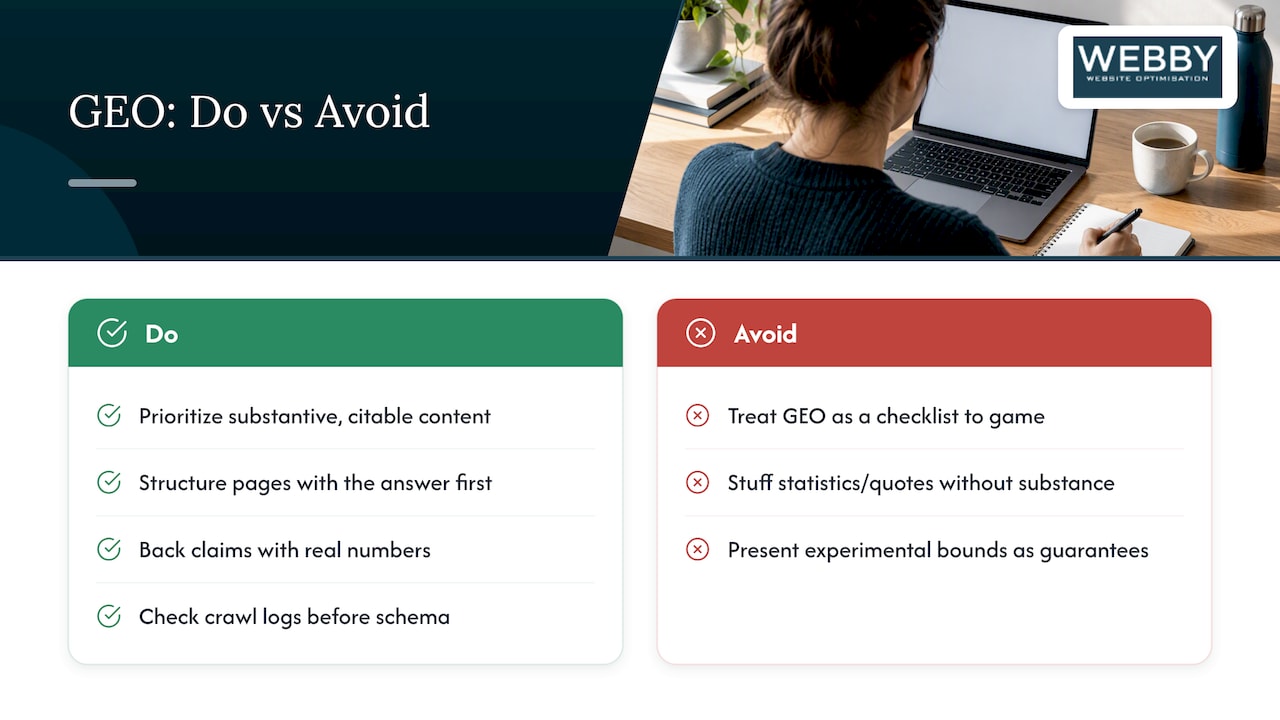
What I think gets underestimated is how much GEO success depends on having something genuinely worth citing in the first place. Teams that chase citation prominence by stuffing in statistics and quotations without improving the underlying substance of the page are optimizing a proxy, not the thing that actually matters: whether a generative engine’s answer, and the reader behind it, gets something accurate and useful. The tactics in this piece work because they make good content easier to extract, not because they make thin content look credible.
This approach commonly plays out in agency client work: structuring service pages and blog content so the answer comes first, backing claims with real numbers, and checking crawl logs before worrying about schema markup. One pattern that shows up repeatedly in client work, including the 777 Healthcare SEO case study, is that the pages with the clearest, most direct answers tend to hold up best as search behavior shifts toward generative formats.
— Steve Doig
Getting GEO implemented without doing it all yourself
Reading a GEO playbook is one thing, finding time to restructure a content library around it is another, especially for a small team already stretched across content, ads, and day-to-day site maintenance. Webby’s Website Audit checks crawlability, indexability, and passage structure on your existing pages, which covers the technical groundwork this playbook depends on before any rewriting starts.

For ongoing work, the End-to-End Growth Engine™ folds GEO-style content structuring into broader SEO and growth campaigns, so citations, statistics, and freshness updates get maintained on a schedule rather than as one-off edits. If your site just needs the fundamentals handled first, Search Engine Optimisation services cover the indexability and technical structure that both traditional search and generative engines depend on. Start with an audit to see where your pages stand today.
Sources
For deeper technical detail, read the original GEO benchmark paper and the content-centric GEO evaluation framework. Princeton’s public summary offers a more accessible overview, and Microsoft Ads’ guide to AEO and GEO covers discoverability from an advertiser’s perspective.
- GEO: Generative Engine Optimization (KDD/ArXiv)
FAQ
Is GEO replacing SEO?
No, GEO extends SEO rather than replacing it. Crawlability, site structure, and backlinks remain essential, since the original GEO research notes that a page which isn’t indexable cannot be cited by a generative engine regardless of how it’s written.
How do I learn SEO as a beginner?
Start with crawlability, keyword research, and on-page structure basics, then layer in GEO concepts like BLUF writing and citation placement once the fundamentals are solid. Reading Google’s developer guidance alongside hands-on practice on a real site is a practical starting point.
Is generative engine optimization a real, established practice?
Yes, GEO is an active research area with published academic benchmarks, including the original GEO study and newer evaluation frameworks like CC-GSEO-Bench. It’s still evolving quickly, so treat specific tactics as directional rather than fixed rules.
What is generative AI engine optimization?
It’s the same practice as generative engine optimization: structuring content so AI systems can extract, cite, and represent it accurately in generated answers. The term covers both on-page tactics like BLUF writing and sourced statistics, and measurement practices like tracking citation prominence.
What does GEO cost to implement with an agency?
Costs vary by scope. Webby’s Website Audit is a one-off service priced by the publisher, while ongoing GEO-style content and technical work is typically handled through recurring SEO or growth engine services priced on request.