
You don’t rank for “near me” by writing “near me” all over your website. Google treats the phrase as a signal that the searcher wants something close by, then picks businesses by relevance, distance and prominence. So the work is to make your business an obvious, trustworthy match for the suburb, and let the searcher’s location do the rest. This guide shows how, for a service business in Australia.
TL;DR
- “Near me” is a proximity signal, not a phrase to match. Google uses the searcher’s location, so you can’t stuff your way to the top.
- Google says local results come down to relevance, distance and prominence, and you can’t pay for a better local ranking.
- Your Google Business Profile does most of the heavy lifting. Your website backs it up with real service pages, clear suburb information and LocalBusiness markup.
- Use the phrase naturally, mostly through customer reviews, not forced into headings.
- Skip one thin page per suburb. Build a few useful area pages instead.
Table of Contents
- What “near me” actually means to Google
- Why the keyword has so little competition and so much value
- Where the work happens: Google Business Profile first
- Where “near me” belongs on your website (and where it doesn’t)
- Build service pages that prove you are local
- Add LocalBusiness structured data
- Reviews, links and mentions: the prominence side
- Perspective: what we see with Perth service businesses
- A 30-day plan you can run yourself
- How we can help
- FAQ
- Sources
What “near me” actually means to Google
When someone types “electrician near me” on a phone in Subiaco, they don’t want pages that contain those three words. They want the closest sensible option. Google reads the phrase as proximity intent and takes the location from the device.
That changes the job. You aren’t competing to match a phrase. You’re competing to be the business Google considers most relevant, closest and best known for that service. Google’s own guidance names exactly those three factors: relevance (how well your profile matches the search), distance (how far you are from the searcher) and prominence (how well known you are, shaped by reviews, links and web presence).
Two consequences follow:
- You can’t control distance. A searcher five kilometers from a competitor and fifteen from you will usually see the competitor first. What you can do is be stronger on relevance and prominence, and make sure every suburb you truly serve is visible to Google.
- Nobody can sell you the top spot. Google states there is no official way to pay or request a better local ranking. Be wary of anyone who promises one.
Why the keyword has so little competition and so much value
A keyword like this shows modest search volume because most people never search for the concept. They search for the service: “plumber near me”, “pool fencing near me”, “accountant near me”. Those are the queries that matter to you, and they are high intent. Search Engine Land describes them as proximity-driven searches from people ready to act.
The person typing it is often standing in a flooded laundry or looking at a dead hot water system. They call the first credible result. That is why a service business should care more about the three-pack of map results than about a blog post ranking for the phrase itself.
Where the work happens: Google Business Profile first
For most near me searches the first thing a reader sees is the map pack, not a website link. Your profile decides whether you appear there. Our guides cover the details: what a Google Business Profile is and how local owners should use it and what actually moves you up on Google Maps.
The essentials:
- Pick the right primary category. It’s the strongest relevance signal you control. “Plumber” beats a vague “Home improvement”.
- Make your name, address and phone number identical everywhere. Your website, profile and directories should match to the letter.
- Decide whether to show your address. If you work at customers’ premises and don’t serve people at your own, Google lets you hide the address and list a service area instead. Only do this if you’re genuinely a service-area business.
- List the suburbs you really serve. Be honest. An inflated service area doesn’t earn you rankings in places you can’t reach.
- Add real photos, services and hours. Keep them current, including public holidays.
If you suspect you’re missing from the map entirely, work through our 10-point checklist for getting found on Google Maps.
Where “near me” belongs on your website (and where it doesn’t)
The old advice was to put “near me” in title tags and headings. Some guides still say it. We don’t recommend it as a strategy, and here’s why: a heading reading “Plumber Near Me in Perth” is awkward to read, and it solves a problem Google already solved with location data.
What works better is plain, specific language a customer would say to a neighbor:
| Instead of | Write |
|---|---|
| “Best plumber near me Perth near me cheap” | “Emergency plumber in Fremantle, Hilton and South Fremantle” |
| “Near me electricians” | “Licensed electricians servicing Melville and surrounding suburbs” |
| A footer full of 40 suburbs | A short list of the suburbs you attend most, each linking to something useful |
Let customers say it for you
Search Engine Land’s guide makes a useful point: the most natural home for the phrase is customer-generated content such as reviews and testimonials. A customer who writes that you were the most reliable plumber near them is authentic, and it reinforces proximity without looking spammy.
So don’t write fake reviews, and don’t script them. Do make asking easy. Send a short follow-up with your review link the same day the job is done, while the experience is fresh. If chasing customers is the part that never gets done, a managed virtual assistant team can take on repetitive follow-up and admin so it happens consistently.
Build service pages that prove you are local
Your website’s job is to confirm what your profile claims. Three kinds of pages do that.
1. One strong page per core service. “Blocked drains”, “hot water repairs”, “switchboard upgrades”. Each should explain what you do, how you price or quote, how fast you respond and what areas you cover. Our write-up on three service pages that win service area business SEO lays out this approach with the profile first.
2. A few real area pages. If you serve Perth, Fremantle and Melville, those areas might each deserve a page. But each one must say something true about that place: the typical properties, access or parking quirks, response times from your base, jobs you’ve completed nearby. Google’s guidance on thin, duplicated pages is blunt about templated pages that only swap the suburb name, often called doorway pages. Creating forty of them is a classic way to waste a budget and attract a quality problem.
3. A contact page that matches your profile. Same name, address (if shown), phone and hours as your profile, with an embedded map if you have a shopfront.
A quick test for any area page
Cover the suburb name. Could the page be about any other suburb? If yes, it’s a doorway page waiting to happen. Add something only a local would know, or merge it into a broader page.
Add LocalBusiness structured data
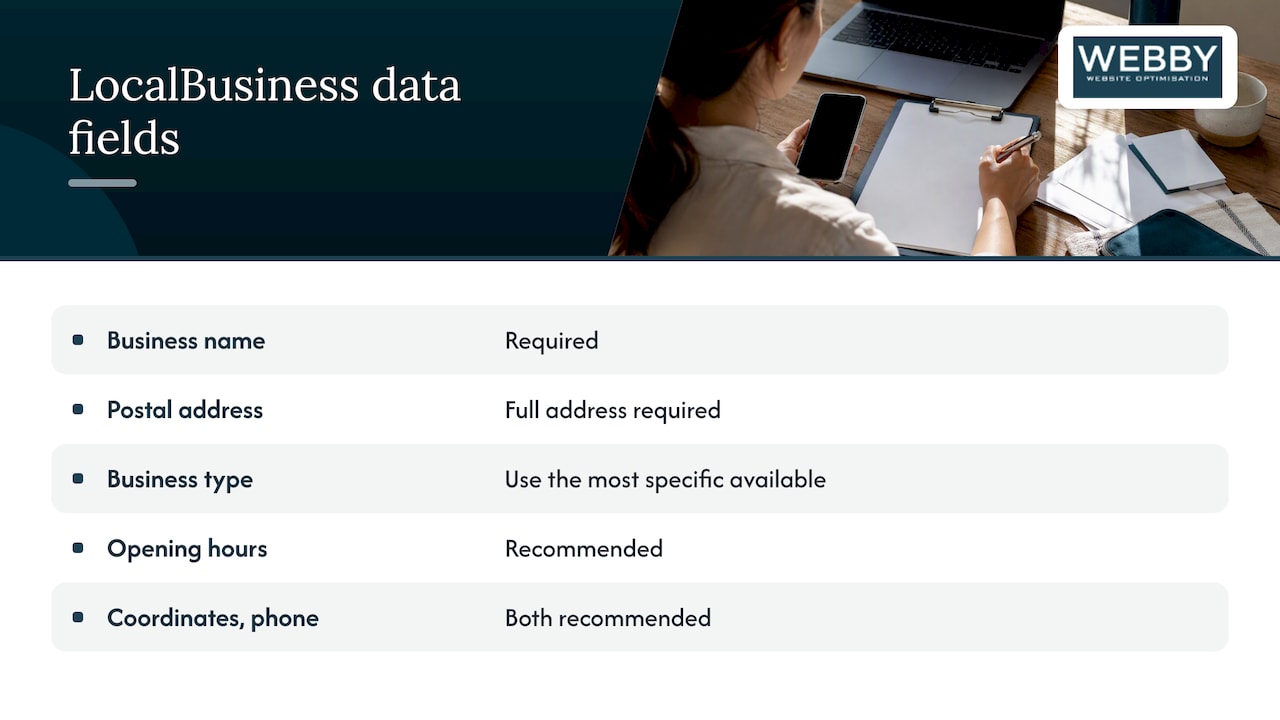
Structured data is code that tells Google, in a format it reads reliably, who you are and where you work. Google’s documentation requires a business name and a full postal address, and recommends opening hours, geographic coordinates and phone numbers. It also advises using the most specific business type available (for example Electrician or Plumber) rather than a generic organization.
For a WordPress site, this is typically a plugin setting or a small snippet in the header. Check it after you publish with Google’s Rich Results Test, and make sure the details match your profile exactly. Mismatches are a common reason the effort goes nowhere.
Reviews, links and mentions: the prominence side
Prominence is the slow-burning factor. Google says it is shaped by how well known you are across the web, including review count and rating. In practice for a local trade or professional firm:
- Aim for a steady stream of reviews, not a burst of twenty in a week followed by silence.
- Reply to every review, good or bad, in a calm and specific way.
- Earn links from places that know you: your suppliers, local business associations, community sponsorships, industry bodies.
- Keep directory listings accurate rather than chasing hundreds of them.
Our overview of local SEO ranking factors in 2026 ranks these by impact if you want to decide what to do first.
Perspective: what we see with Perth service businesses
We work with local service businesses around Perth, Fremantle and Melville, and the same pattern turns up in almost every audit. The owner has been told to “rank for near me”, so the site has a clumsy heading or two with the phrase jammed in. Meanwhile the Google Business Profile has the wrong primary category, three photos from 2019 and no reply to a single review.
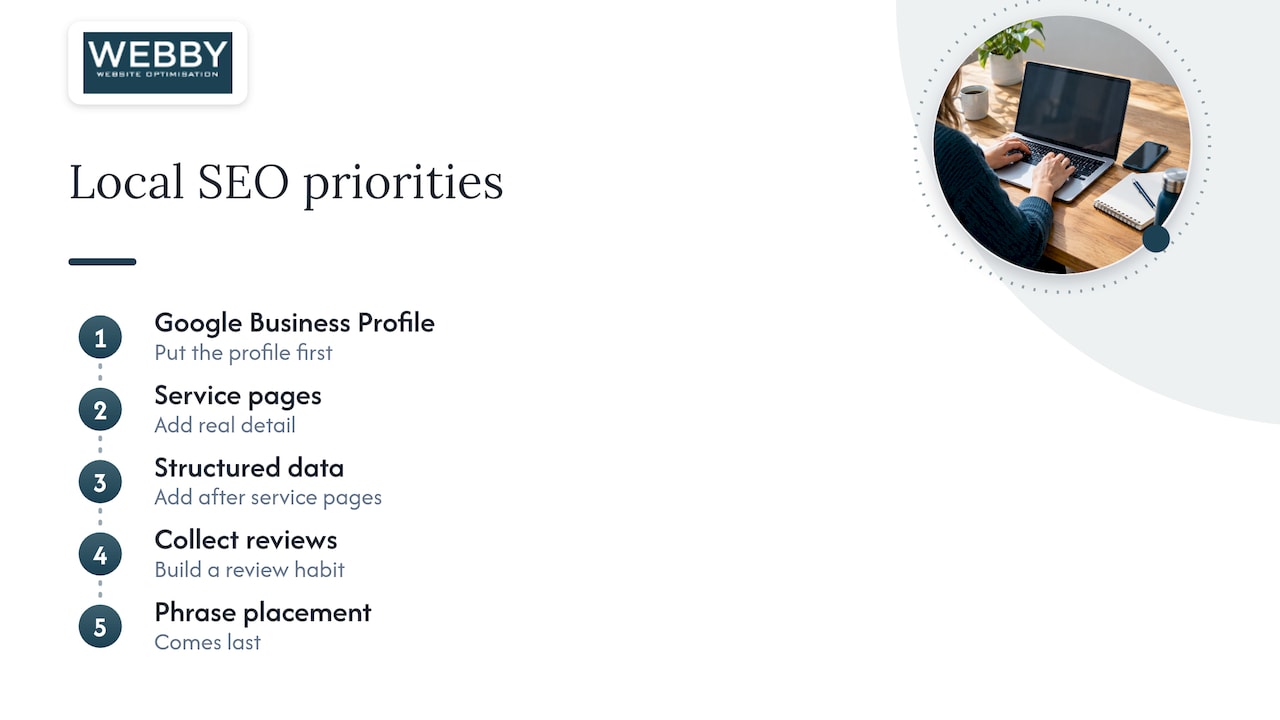
Fixing that order of priorities moves results faster than any keyword tweak. Profile first, then service pages with real detail, then structured data, then a habit of collecting reviews. Phrase placement comes last, and mostly takes care of itself.
The other pattern is speed. A tradie on a phone, on mobile data, won’t wait for a slow page. A tidy, fast WordPress site with a visible phone number and a clear quote button usually converts better than a flashy one. Rankings bring the visit, but the page has to turn it into a call.
— Steve Doig
A 30-day plan you can run yourself
- Week 1: Profile. Confirm your primary category, service list, service area and hours. Upload ten current photos of real work.
- Week 2: Consistency. Check your name, address and phone number on your site, profile and the five directories customers actually use. Fix mismatches.
- Week 3: Pages. Rewrite your top three service pages with concrete detail. Add or improve one genuine area page.
- Week 4: Markup and reviews. Add LocalBusiness schema with the most specific type. Set up a review request that goes out after every job.
Then leave it alone for a couple of months and watch your profile’s search and call data. Local results shift gradually.
How we can help
If you’d rather have someone check this properly, our Website Audit is a one-off $1,250 AUD review of your site’s technical health, content and local signals, with a clear list of what to fix first. If you want a free first look, you can claim a free website audit. For ongoing local work, see our SEO services in Perth, or our WordPress help and support plans if the site itself needs looking after: Monthly Maintenance is $59 AUD per month.
FAQ
Should I put “near me” in my page titles?
Not as a rule. Google works out proximity from the searcher’s location, so the phrase adds little in titles and can read as stuffing. Use the service and the suburb in plain language, and let reviews carry the phrase naturally.
Do I need a separate page for every suburb?
No. Pages that only swap the suburb name are what Google treats as thin doorway content. Build pages for the main areas you serve, and give each real local detail, such as typical jobs, response times and examples.
Can I pay Google to rank higher in near me results?
Not in the local map results. Google states there is no official way to pay for or request a better local ranking. Ads are separate, and appear labeled alongside organic results.
Do I need a shopfront to appear in near me searches?
No. Service-area businesses can appear, and Google allows you to hide your address and show a service area instead. You should only do this if you don’t serve customers at your address.
Sources
- Tips to improve your local ranking on Google, Google Business Profile Help
- Manage your business address, Google Business Profile Help
- Local Business structured data, Google Search Central
- “Near Me” SEO: Optimize for Local Searches That Convert, Search Engine Land