
Removalist SEO is the work of making your business show up when someone types “removalists near me” or “furniture removalists Fremantle” into Google. For most owner-operators it comes down to four things: a properly built Google Business Profile, a website with real pages for the suburbs you serve, a steady flow of genuine reviews, and a site that loads fast and makes it easy to request a quote. Do those well and you get quote requests that do not cost you a commission.
This guide is written for removalist owners and managers in Australia. It covers what Google looks at, what to build first, the mistakes that quietly hold small movers back, and what it realistically costs.
TL;DR
- Google ranks local businesses on relevance, distance and prominence. You cannot pay to improve those rankings, but you can influence all three.
- Your Google Business Profile does most of the work for “near me” searches. Choose the right categories and list only the suburbs you really service.
- Build one useful page per major route or suburb group, with real job detail, not 40 copies of the same text.
- Marketplaces fill gaps, but your own site builds an asset you keep. Track cost per booked job on both.
- Expect early movement in weeks and a solid position in months, not days.
Table of Contents
- Why removalists should care about SEO
- How Google decides who appears for “removalists near me”
- Step 1: Get your Google Business Profile right
- Step 2: Build a website that matches how people search
- Step 3: Make reviews your ranking engine
- Step 4: Technical basics that cost you jobs when ignored
- Step 5: Measure the right things
- What the tradie world can teach removalists
- Our perspective
- What removalist SEO costs and how long it takes
- Questions to ask before hiring an SEO provider
- Where we can help
- FAQ
- Sources
Why removalists should care about SEO
A move is a high-value, one-off purchase, and people usually research it on their phone while standing in a half-packed lounge room. They search, look at the map results, check the stars, and ring two or three companies. If you are not in those first results, you are not in the conversation.
Many removalists fill the diary through lead marketplaces. They work, but the economics are different. Consumer research from Choice on find-a-tradie websites describes how these platforms operate: the customer posts a job, several tradies pitch, and the customer picks. That means you are often one of several quotes competing largely on price, and the platform typically takes a commission or charges per lead. Your own search presence works differently. Rankings and site traffic stay with you, so the cost of each enquiry tends to fall over time instead of staying flat.
The practical answer is not either/or. Keep marketplaces for quiet weeks if they pay, and build your own rankings so you depend on them less each year.
How Google decides who appears for “removalists near me”
Google’s own guidance says local results are based mainly on relevance, distance and prominence, and that business owners cannot pay to improve their local ranking. Here is what each one means for a mover.
Relevance is how well your profile matches what the person searched. A profile categorised as a removalist or moving company, with services described clearly, matches “removalists” better than a vague “transport service” listing.
Distance is how close you are to the searcher or the location they typed. You cannot move your depot, but you can make sure your address and service areas are accurate.
Prominence is how well known you are. Review count, review scores, mentions around the web and the authority of your website all feed into it.
The takeaway: two of the three factors (relevance and prominence) are things you control. Distance is mostly fixed, so do not waste effort fighting it. Win the suburbs around your depot first, then expand outward as your reviews and site grow.
Step 1: Get your Google Business Profile right
This is the highest-return task in removalist SEO, and it costs nothing but time. Our Google Business Profile articles go deeper, but here is the removalist checklist.
- Claim and verify the profile. Use your real business name as it appears on your signage and vehicles. Stuffing keywords into the name can get a profile suspended.
- Pick the primary category carefully. Google’s guidance for removalists is to use accurate categories such as Mover or Moving company, with clear, verified service areas. Add secondary categories only if they are true, for example storage or packing services.
- Describe each service. Local moves, interstate moves, piano moving, office relocations, packing, storage: list only what you actually do.
- Add real photos. Trucks, crew in uniform, a wrapped lounge, a loaded van. Fresh photos signal an active business and help people choose you.
- Keep hours, phone number and website link correct. Use a tracked phone number or a UTM-tagged website link so you can see which enquiries came from the profile.
List only the suburbs you really service
It is tempting to add every suburb within 80 km. Resist it. According to Move First’s guide to local SEO for removalists, Google uses signals such as review content and booking activity to confirm your service area, so suburbs you list but never work in are likely to hurt your rankings there rather than help. A tight list of places you truly service, backed by reviews that name those places, beats a long list of hopeful guesses.
Step 2: Build a website that matches how people search
Your Google Business Profile gets you into the map pack. Your website decides whether Google trusts you enough to put you there and whether the visitor rings you once they arrive.
The pages every removalist site needs
| Page | What it should do |
|---|---|
| Home | State who you are, where you work and how to get a quote in one screen |
| Service pages | One page per service: house removals, office relocations, interstate, storage, packing |
| Suburb or region pages | One page per area you genuinely serve, with real local detail |
| Quote page | A short form plus a click-to-call number |
| About and reviews | Your team, vehicles, insurance and customer feedback |
| Blog or guides | Answers to questions movers ask before booking |
Suburb pages that are not spam
A suburb page earns its place only if it says something true about moving in that area. Think about what a customer in that location would want to know:
- Parking and truck access in the area, such as narrow streets, strata loading zones or apartment lift bookings
- Typical jobs you do there: two-bedroom units, family homes, student moves
- Common routes from that suburb, for example a Perth metro move versus a long-haul to the regions
- A real job example or review from a customer in that suburb
- Your travel arrangements, if they affect the quote
Copying the same paragraph and swapping the suburb name is the quickest way to create pages Google ignores and customers distrust. Five strong pages beat fifty thin ones.
Write like your customers talk
Australians search “removalists”, “furniture removals”, “house movers” and “man with a van” interchangeably. Use the plain words in headings and body text, include your suburbs naturally, and answer practical questions: how is the price worked out, what is covered by insurance, how far ahead should I book, what do you not move.
Step 3: Make reviews your ranking engine
Reviews are part of prominence and they are also what convinces the customer. A profile with 150 recent reviews mentioning the actual suburbs and the crew’s care with furniture looks far stronger than one with 12 reviews from three years ago.
A simple routine works:
- Send a review link by SMS the same afternoon the job finishes
- Ask the crew leader to mention it at hand-over, while the customer is happy
- Reply to every review, including the poor ones, calmly and with specifics
- Never offer discounts or gifts in exchange for reviews, and never write your own
Review text that mentions “moved from Fremantle to Bibra Lake” gives Google the kind of geographic confirmation that supports your service area claim. You cannot script it, but a friendly request such as “it would help if you mentioned where we moved you from and to” is fair.
Step 4: Technical basics that cost you jobs when ignored
Most removalist searches happen on mobile, often with patchy connections during a stressful week. A slow or awkward site loses the enquiry to the next result.
- Speed: compress images (truck photos are often huge), use caching and avoid heavy sliders.
- Mobile layout: the phone number should be a tap-to-call button visible without scrolling.
- Quote form: ask for the minimum: name, phone, pickup and drop-off suburbs, move date, size of home. Every extra field costs submissions.
- Structured data: local business markup helps Google read your name, address, services and area. Move First notes this in its removalist guide, and most WordPress SEO plugins can add it.
- Security and uptime: keep WordPress, themes and plugins updated. A hacked or broken site during peak season, such as the end of the month or school holidays, is expensive.
Step 5: Measure the right things
Rankings are a vanity number if the phone does not ring. Track:
- Calls from your Google Business Profile
- Quote form submissions, and the source of each
- Booked jobs and revenue per source (organic search, map pack, marketplace, repeat or referral)
- Cost per booked job on marketplaces compared with your cost to run SEO
This is the comparison that settles the marketplace question for your business. Cheap leads can be poor value if few turn into booked jobs, so count conversions, not leads.
What the tradie world can teach removalists
We often see owners search for “best tradie websites” or “tradie website examples” before a rebuild. Removalists have a lot in common with plumbers, electricians and cleaners: urgent or high-trust purchases, local searches, and customers who want proof before they ring. The patterns that work are consistent:
- A headline that names the service and the area
- A phone number and quote button always in reach
- Real photos of your own crew and vehicles, not stock images
- Licences, insurance and memberships stated plainly
- Reviews and a few short job stories on the home page
- Pages for each service and each major area
Our guide to tradie SEO in Australia walks through the same approach for trades, and most of it transfers directly to a moving company.
Our perspective
We work with local service businesses around Perth, Fremantle and Melville, and the same pattern appears again and again. The owner is good at the job, the website is an afterthought built years ago, and the phone depends on whoever is buying leads this month. SEO fixes that, but only when it is treated as a business system and not a list of tricks.
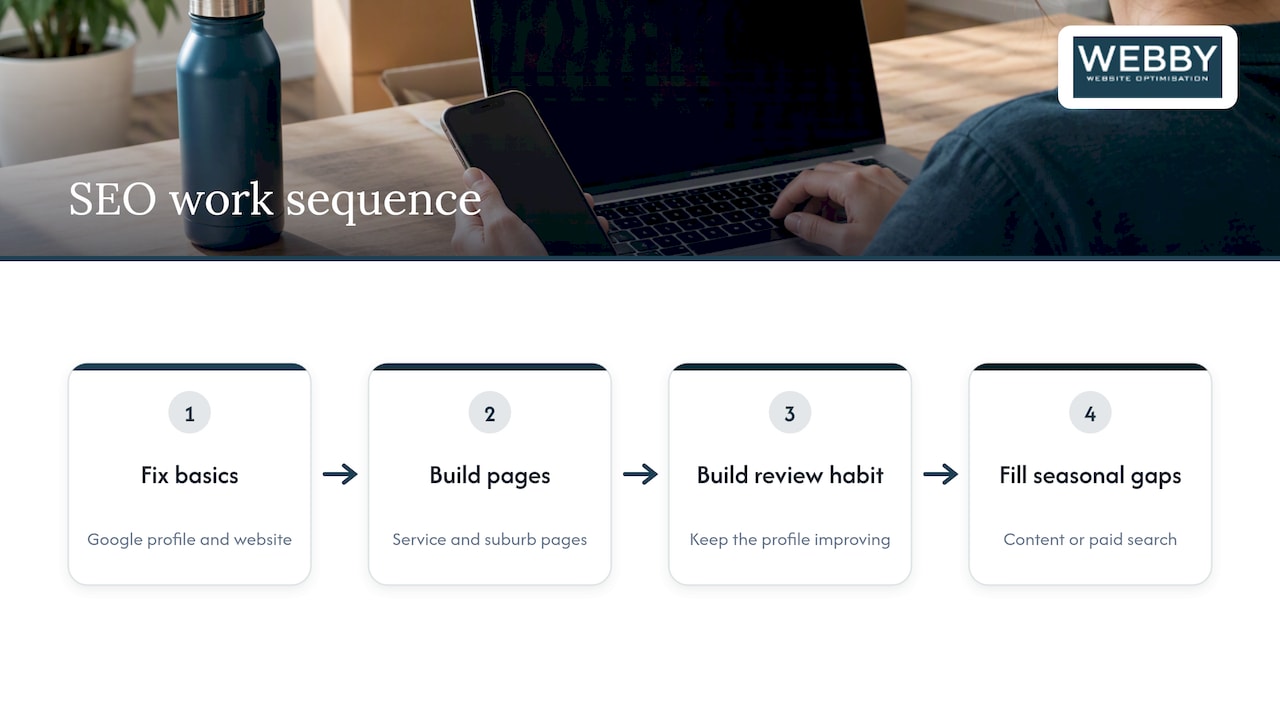
For a removalist, we would sequence the work like this. First, fix the Google Business Profile and the basics of the website, because that is where fast wins sit. Second, build a small number of properly written service and suburb pages. Third, set up a review habit so the profile keeps improving without effort. Only then do we think about content or paid search to fill gaps in the season.
The mistake we see most is chasing volume. A search like this one has modest monthly volume, which is normal for a local trade. What matters is that each person searching is close to booking. A handful of well-ranked pages in the right suburbs can fill more of the calendar than a flashy site ranking for broad terms nobody near you is typing.
— Steve Doig
What removalist SEO costs and how long it takes
Costs vary widely by agency, market and scope, so treat any figure you see online as a starting point and ask for a written scope. Instead of quoting averages, here is how we structure the work and what we publish.
| Option | Price | Best for |
|---|---|---|
| Website Audit | 1,250 AUD one-off | Finding out what is holding your current site back |
| Website Built in a Day | 750 AUD one-off | A clean, fast site when you have nothing decent online |
| Business Website Optimisation Campaign | 3,125 AUD one-off | Fixing structure, speed and conversion on an existing site |
| WordPress Help & Support | Monthly Maintenance 59 AUD per month; Monthly Updates 123 AUD per month; Monthly Development 600 AUD per month | Keeping the site secure, current and improving |
Ongoing SEO is scoped to your area, competition and goals, so we do not publish a fixed price for it. If you want to compare approaches, our article on SEO services for small business explains what a sensible scope includes.
On timing, the honest answer is that Google Business Profile fixes can move you within weeks, new pages take a few months to settle, and competitive suburbs take longer. Be wary of anyone who guarantees a number one position by a set date.
Questions to ask before hiring an SEO provider
- Will you show me work for a local service business, with results I can verify?
- Who writes the suburb and service pages, and will they be unique?
- Do I own my Google Business Profile, website and analytics accounts?
- How will we measure success: calls, quotes and booked jobs, or just rankings?
- What happens if I stop paying? You should still own the content you have paid for.
- Do you explain the risks, such as listing suburbs I do not service?
An agency that answers these plainly is worth talking to. One that relies on jargon or promises instant results is not. Our overview of what to look for in a local search engine optimisation agency goes into more detail.
Where we can help
If your site is slow, dated or does not bring in quote requests, start with a clear picture of what is wrong. You can claim a free website audit for a first look, or choose our paid Website Audit at 1,250 AUD for a full review with a prioritised plan. If you are in Perth and want help with rankings, see our SEO Perth service, or read about our wider search engine optimisation service.
FAQ
Do removalists really need SEO if they already get work from marketplaces?
Marketplaces rent you an audience for as long as you keep paying, and customers often compare several quotes there. SEO builds rankings and traffic you keep. Most movers do best with a mix, then shift effort towards their own site as it starts producing booked jobs.
How long does removalist SEO take to work?
Profile improvements can show results within weeks, while new pages and rankings for competitive suburbs typically need a few months. Results depend on your area, your competitors and how many genuine reviews you collect. Treat guaranteed timelines with caution.
Should I create a page for every suburb?
Only for suburbs you genuinely serve and can write something useful about. Group nearby suburbs into a regional page if you have little to say about each one. Thin, copied pages add little and can weaken trust in your site.
Can I pay Google to rank higher in the map results?
No. Google states that local ranking cannot be improved by paying, and it is based on relevance, distance and prominence. Paid ads appear separately, and you can run them alongside your organic work if the numbers make sense.
What should a removalist website include to turn visitors into quotes?
A visible phone number, a short quote form, clear service and area information, real photos of your crew and trucks, and reviews. Keep the page fast on mobile, because most people searching are on their phone.
Sources
- Tips to improve your local ranking on Google, Google Business Profile Help
- Local SEO for Removalists: How to Rank in Google for the Suburbs You Actually Serve, Move First
- Find-a-tradie websites, Choice