
A good Google Ads account structure for a local service business is simple: one account, a handful of campaigns split by the things that genuinely need their own budget or location, and tightly themed ad groups beneath them. Every extra layer should earn its place by supporting a budget decision, a report you actually read, or a real difference in how you operate. If you run a plumbing, electrical, accounting or cleaning business in Perth or anywhere in Australia, this guide shows how to lay that out. We manage Google and Microsoft Ads for local service businesses at Webby, and the structure below is the one we would sketch on a whiteboard for a new owner.
TL;DR
- Google Ads has three layers: the account, campaigns (budget, locations, settings) and ad groups (keywords and ads on one theme).
- Make a separate campaign only when you need a different budget, location target or setting. Otherwise keep things together.
- Split by service or by area only when the work, margin or travel zone really differs.
- Google’s own guidance now favours consolidation, as long as each campaign gets enough conversions to learn from.
- A small, clean structure is easier to report on, easier to budget and cheaper to fix when something breaks.
Table of Contents
- The three layers and what each one controls
- The one rule for splitting campaigns
- Structuring by service, by location or by goal
- Building tightly themed ad groups
- Why simpler is now often better
- Common structure mistakes
- One account or several?
- How structure affects budget and leads
- Where we can help
- Our perspective
- FAQ
- Sources
The three layers and what each one controls
Google describes its accounts as three layers: account, campaigns and ad groups. Each layer controls something different, and knowing which is which stops most structural mistakes.
Account. This is the top level. It is tied to one email address, a password and your billing information. Think of it as the login and the credit card, nothing more. If you have never set one up, our walkthrough on creating a Google Ads account covers it.
Campaign. This is where budget and settings live. Each campaign has its own daily budget and its own settings, which decide where and when your ads appear. Locations, languages, bidding approach and schedule are all campaign-level choices.
Ad group. This holds a set of similar ads and the keywords that trigger them. It is the place where relevance is built: the search, the keyword and the ad should all talk about the same thing.
Ads. Inside each ad group sit the ads themselves. Google’s developer documentation describes the same hierarchy: a customer account contains campaigns, campaigns contain ad groups, and ad groups contain ads. It also notes that Performance Max campaigns work differently, using asset groups instead of ad groups, which is one reason a search-focused local business should treat Performance Max as a separate decision rather than part of the core structure.
A simple way to remember it: the account pays, the campaign decides how much and where, the ad group decides what is being said.
The one rule for splitting campaigns
Google’s guidance on organising ad groups gives a rule you can apply to any business: create a separate campaign whenever you need different settings such as budget or location targeting, and keep one campaign when all the ads share a budget and the same locations.
That sentence replaces a lot of agency jargon. Before you create a campaign, ask:
- Do I want to spend a different amount on this than on the rest?
- Do I want it shown in different places?
- Do I need a different setting, such as a schedule or a bidding strategy?
If the answer to all three is no, it belongs in an existing campaign as an ad group.
Structuring by service, by location or by goal
Local service businesses usually face the same three choices. Here is how to think through each.
By service
Split campaigns by service when services differ in margin, urgency or demand. An electrician might run “emergency callouts” separately from “solar and battery installs” because the first needs a high daily budget for a few hours, while the second is a considered purchase with a longer research phase. If every service is similar in value, one campaign with an ad group per service is cleaner.
By location
Location is a campaign setting, so different areas with different budgets need different campaigns. Google lets you target countries, regions, cities or postcodes, or a radius of at least 1 km around a point. The same page notes that location targeting is a best effort based on user settings, devices and behaviour, so it is never 100% exact.
A Fremantle business that also serves Melville and Rockingham might use one campaign for the core suburbs where it wants most of its jobs, and another for outer suburbs where travel eats margin and the budget is smaller. Do not create one campaign per suburb unless each has its own budget and its own enough volume. Our local geo targeting setup guide goes deeper on radius and postcode choices.
By goal
If you want both phone calls and form enquiries, or you also advertise a seasonal offer, a separate campaign lets you set a separate budget and judge each on its own result. Do not split by goal just to feel organised. Split because you would spend differently.
A worked example
Take a Perth air conditioning company with a $2,000 monthly budget.
| Campaign | Budget share | Ad groups | Why it is separate |
|---|---|---|---|
| Installation, core suburbs | 60% | Split system install, ducted install, commercial | Highest-value jobs, tight location |
| Repairs and servicing | 30% | Repairs, regas, annual service | Different intent, faster decisions |
| Outer suburbs, all services | 10% | Install, repair | Different location and smaller budget |
Three campaigns, eight ad groups. That is plenty for this spend. The sums matter: a budget spread across ten campaigns leaves each one too little data to learn from.
Building tightly themed ad groups
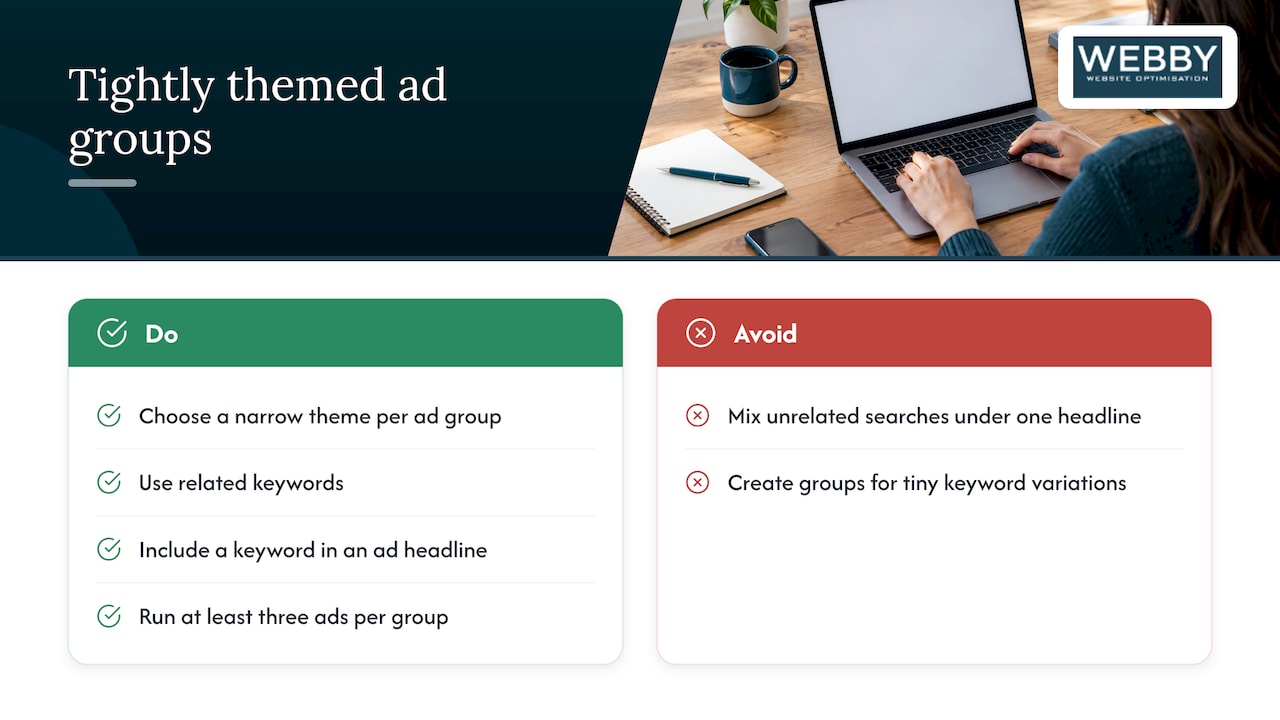
Once campaigns are set, the ad group is where you win or lose relevance. Google’s advice is to pick a narrow theme for each ad group, use related keywords, mention at least one keyword in an ad headline, and run at least three ads per ad group with optimised ad rotation.
Its own example for an online bicycle shop is separate ad groups for children’s bikes, racing bikes, mountain bikes, helmets and locks, each with ad copy directly related to its keywords. Translate that to your trade: “blocked drain”, “hot water system repair” and “bathroom renovation plumbing” are three different searches with three different promises, so they are three ad groups.
A practical test: read the keywords in the ad group, then read the headline. If one headline could not honestly suit every keyword, the group is too broad. If you have a different ad group for each tiny keyword variation, it is too narrow.
Match types affect how tight a group feels. Broad keywords pull in a wider set of searches, so they need more careful monitoring than phrase or exact. Our comparison of broad match and phrase match helps you decide which to put in each group.
Why simpler is now often better
For years, the textbook said: more control through more granular campaigns. That has shifted. In February 2026, Search Engine Journal reported on Google’s stance, in which a Google executive said consolidation is not the goal, equal or better performance with less granularity is. The same report says segmentation still makes sense for distinct product lines with separate budgets, different business objectives, or regional splits that mirror how you operate.
The benchmark quoted there for enough data is 15 conversions over 30 days. Conversions here are the actions you count as a result, such as a call or a completed enquiry form. If a campaign is not reaching that, Smart Bidding, the automated bidding Google runs, has little to learn from. The fix is usually to merge campaigns, or to share a budget and portfolio bidding across them, rather than to add more.
For a local service business, this reads as permission to keep it lean:
- Two to four campaigns is a normal, healthy size for most small accounts.
- Merge any campaign that gets only a few conversions a month into a related one.
- Keep a split only if you can name the budget decision, report or operational difference behind it.
If you want to see how budgets shape what is possible, a guide to PPC marketing for Australian small businesses lays out how spend, clicks and leads relate.
Common structure mistakes
One campaign for everything. A single campaign with every service and every suburb means one budget, one location setting and no way to see what pays. You cannot move money to the winners.
A campaign for every keyword. The opposite problem. Budgets are too thin to produce conversions, and reporting becomes a spreadsheet exercise.
Ad groups that mix themes. “Plumber”, “hot water” and “blocked drain” under one headline produce generic ads and lower relevance.
Fewer than three ads in a group. Google recommends at least three so it can compare performance, and many small accounts run just one.
Locations set too wide. A radius or region that covers areas you do not serve spends budget on enquiries you cannot take. Check the location settings first when leads look poor.
No conversion tracking. Structure only helps if you can see which campaign produced the call or form. Set up tracking before you judge any layout.
One account or several?
Most local businesses need exactly one Google Ads account. Multiple accounts make sense for genuinely separate businesses, with separate billing and separate brands. If you or an agency run several, Google’s manager account lets you view and manage linked accounts from one sign-in, compare performance across them and use monthly invoicing. A single business that splits its services across accounts only splits its data, which works against the learning described above.
How structure affects budget and leads
Structure is what lets you answer “where did the money go?” Because budget sits at campaign level, each campaign is a line in your marketing budget. Because keywords and ads sit in ad groups, each group is evidence of what customers actually search for. When the layout mirrors how you run the business, you can say “emergency callouts cost this much per lead, installs cost that”, and decide what to push.
Budget size shapes the layout too. Smaller budgets favour fewer campaigns, because each needs enough clicks to produce those 15 or so conversions a month. If your monthly spend is modest, start with one campaign for your best-paying service and add more as results come in.
Where we can help
A clean structure is the foundation, but your website decides whether clicks turn into enquiries. We manage Google and Microsoft Ads for local service businesses and build and optimise the websites those ads send people to. If you are not sure how your current account is organised, our Website Audit is a one-off $1,250 AUD review, and our Business Website Optimisation Campaign is a one-off $3,125 AUD. For organic and paid working together, see our SEO service and the End-to-End Growth Engine™.

To talk through your account, start at webby.net.au.
Our perspective
Most small accounts we look at suffer from too much structure, not too little. Owners are told that more campaigns mean more control, then end up with budgets spread so thinly that nothing learns.
Our view is that structure should follow decisions. If you would not spend a different amount, target a different area or measure a different result, you do not need a separate campaign. Keep the account small, make every ad group about one thing, and make sure the page behind the ad says the same thing.
That last point is where we put our effort. Webby is built around local service businesses, from search visibility to website design and conversion optimisation, so the ad, the keyword and the landing page can be planned as one piece. A well-organised account sending people to a slow or unclear page still loses the lead.
Steve Doig
FAQ
How are Google Ads structured?
Google Ads has three main layers: the account, campaigns and ad groups. The account holds your login and billing, campaigns hold budgets and settings such as location, and ad groups hold the related keywords and ads. Ads sit inside ad groups.
Can I have multiple Google Ads accounts?
Yes, and agencies or multi-brand businesses often do. A manager account lets you sign in once and oversee all the linked accounts. For a single local business, one account is normally best, because it keeps your data and learning in one place.
Is $500 a month enough for Google Ads?
It can work for a narrow start, but it limits how much you can split. At that level, one or two campaigns with a few tightly themed ad groups is realistic, focused on your most profitable service and a tight service area. What you can afford per click and per lead depends on your trade and suburb, so test with conversion tracking running from day one.
Is $20 a day good for Google Ads?
It is a sensible daily budget for one focused campaign, roughly $600 a month. Splitting it across several campaigns would leave each with too little to learn from, so keep the structure small and put the budget behind your best service.
How many campaigns does a local service business need?
Two to four is typical. Separate them by services or areas only where you want a different budget, location or setting, and merge any that rarely produce conversions.
Sources
- About your account organization, Google Ads Help
- API structure, Google for Developers
- Organize your account with ad groups, Google Ads Help
- Target ads to geographic locations, Google Ads Help
- Set up your campaign for success, Google Ads Help
- Google Clarifies Its Stance On Campaign Consolidation, Search Engine Journal
- Manager accounts (MCC), Google Ads Help