
Social media does not directly influence Google search rankings, but its indirect role in SEO is significant enough that ignoring it costs you real organic traffic. The role of social media for SEO sits in a category most marketers misunderstand: it is not a ranking signal, but it drives the conditions that produce ranking improvements. Platforms like Twitter/X, LinkedIn, and Facebook amplify content, generate branded searches, and attract backlinks from journalists and creators. Understanding this distinction separates businesses that get results from those that waste budget chasing follower counts.
How social media indirectly benefits SEO
Social media’s connection to SEO runs through four mechanisms: referral traffic, link acquisition, content indexing speed, and branded search volume. None of these are direct ranking inputs. All of them influence the factors Google does measure.
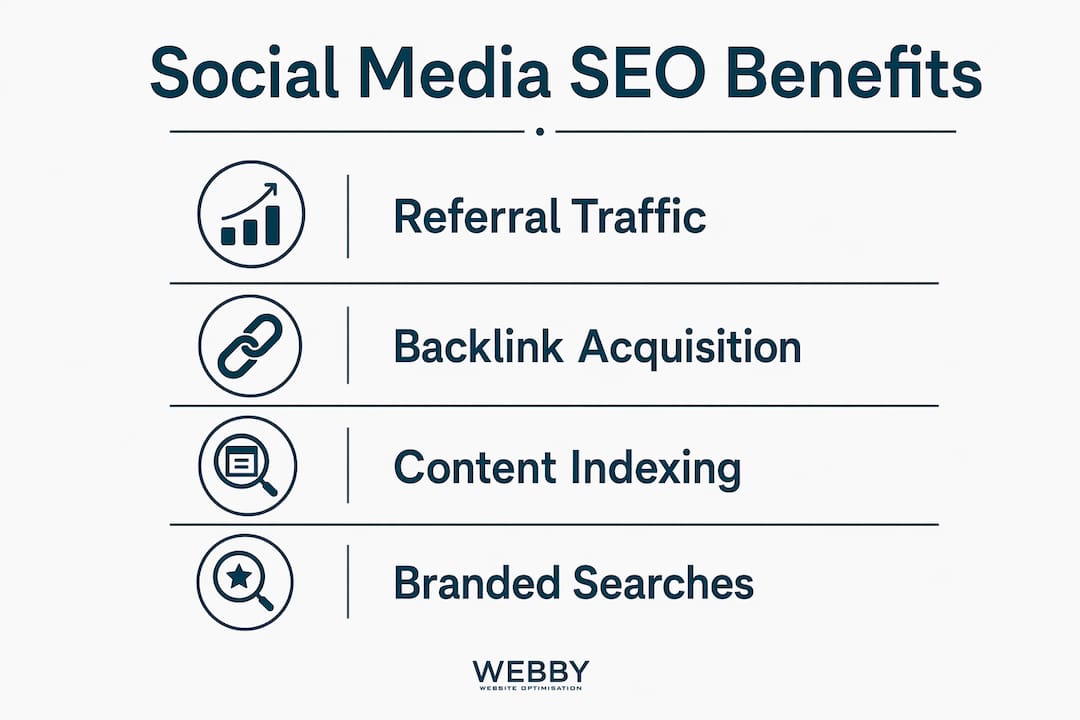
Referral traffic and engagement signals. When a post on LinkedIn or Facebook drives readers to your website, Google observes how those visitors behave. Social traffic improves engagement metrics like time on page and bounce rate, and those behavioral signals contribute indirectly to search visibility. A plumbing company in Perth that shares a genuinely useful “how to fix a leaking tap” article on Facebook and earns 400 visits in a week sends Google a clear message: people find this page worth reading.
Backlink acquisition. Backlinks remain one of the strongest SEO ranking signals, and social media is one of the most reliable ways to earn them. Social shares attract journalists and bloggers who may link to your content from authoritative domains. A single well-timed post on Twitter/X that reaches the right editor can generate a link worth more than a dozen directory submissions.

Faster content indexing. Google’s crawlers discover new pages partly by following links shared publicly online. Shared content on Twitter/X allows Google to find new pages faster, which matters when you publish time-sensitive content. A new service page or blog post shared immediately on social can be indexed within hours rather than days.
Branded search volume. Repeated exposure on social platforms leads users to search for your business by name on Google. Brand exposure on social leads to more branded searches, which Google interprets as a trust and authority signal. For local service businesses in Fremantle or Melville, this effect compounds quickly when consistent social activity builds neighborhood recognition.
Pro Tip: Track branded search volume in Google Search Console under the “Queries” filter. A rising trend in searches for your business name is a measurable sign that your social presence is feeding your SEO.
What social media does NOT do for your Google rankings
The most persistent myth in digital marketing is that likes, shares, and follower counts improve your position in Google search results. They do not. Matt Cutts and John Mueller have both confirmed that social engagement metrics do not directly influence Google Search ranking. This is not a technicality. It reflects real structural limitations in how Google processes social data.
Here is why Google excludes social signals from its ranking algorithm:
- Crawling limitations. Many social platforms restrict Google’s access to their data. Facebook’s privacy settings alone make a large portion of social activity invisible to Google’s crawlers.
- Manipulation risk. Social metrics are easy to fake. Google recognizes that buying followers or engagement does not reflect genuine authority, so it excludes these signals to prevent gaming.
- Correlation vs. causation. High-ranking pages often have many social shares, but the shares do not cause the rankings. Both are products of quality content. The content earns the rank; the shares follow.
- Data instability. Social platforms change their APIs, restrict access, and alter algorithms constantly. Building a ranking system on that foundation would make Google’s results unreliable.
“Social signals like likes, shares, and followers are not used as direct ranking factors in Google’s algorithm.” — Confirmed by both Matt Cutts and John Mueller, Google Search representatives.
The practical implication is direct: spending money on follower growth campaigns or engagement pods produces no SEO return. That budget belongs in content creation, technical SEO, and on-page optimization instead.
How to use social media in your SEO strategy
Integrating social media with SEO requires treating social platforms as distribution channels for content that earns links and traffic, not as ranking levers in themselves. The following framework applies whether you run a solo consultancy or a 20-person service business.
Optimize your social profiles for search
Every social profile is a potential search result. Fill out your LinkedIn company page, Facebook business profile, and Google Business Profile with your target keywords, website URL, and service descriptions. Google indexes these profiles, and a well-optimized LinkedIn page often ranks on page one for branded searches. This is free real estate most small businesses leave blank.
Match content to platform and audience intent
LinkedIn audiences respond to industry analysis and case studies. Facebook users in local service markets engage with before-and-after results, community questions, and practical tips. Twitter/X rewards brevity and timeliness. Creating one piece of content and posting it identically across all platforms wastes the opportunity each platform offers. Repurpose the same core idea in the format each audience expects.
| Platform | Best content type | Primary SEO benefit |
|---|---|---|
| Twitter/X | Short insights, links to articles | Fastest indexing, journalist outreach |
| Case studies, industry analysis | B2B link acquisition, branded search | |
| Local tips, community engagement | Referral traffic, branded awareness | |
| Visual results, behind-the-scenes | Brand recognition, indirect traffic |
Prioritize platforms where links get earned
Twitter/X and LinkedIn drive the most organic link-earning opportunities relevant to SEO because journalists, editors, and content creators actively use both platforms to find sources and stories. If your goal is backlinks, these two platforms deserve the most attention. Instagram and TikTok build brand awareness but rarely produce the editorial links that move search rankings.
Pro Tip: When you publish a new article or service page, share it on LinkedIn with a direct observation or question rather than just a link. Posts with genuine commentary earn significantly more reach and reach the people most likely to link to your content.
Track the right metrics
Measure social SEO effectiveness using traffic, backlinks, and branded search volume rather than likes or follower counts. In Google Analytics 4, segment your traffic by source to isolate social referrals. In Google Search Console, monitor branded query growth month over month. These numbers tell you whether your social activity is producing SEO outcomes. Vanity metrics tell you nothing useful. For a structured approach to measuring these outcomes, reviewing real SEO case studies shows how traffic and ranking improvements correlate with consistent content promotion.
Social media, AI search, and what changes in 2026
Google’s generative AI search features are reshaping how content gets discovered and cited, and social media plays a role in this shift. Google’s 2026 generative AI optimization guide confirms that core ranking systems focus on quality content and that generative AI features depend on the same quality and spam safeguards as traditional search. This means the fundamentals have not changed. What has changed is the visibility ecosystem around them.
AI-generated answers in Google Search draw from content that is well-cited, widely referenced, and clearly authoritative. Social media supports SEO by enhancing the discoverability of content, which increases opportunities for authoritative citations and link building. A piece of content that earns shares on LinkedIn, gets referenced in a newsletter, and attracts three editorial backlinks is far more likely to appear in an AI-generated answer than one that sits unshared on your blog.
The practical guidance from Google’s 2026 resource is clear: produce high-quality, unique content aligned with SEO fundamentals, then use social media to amplify that content for citation and reference. Authenticity and depth matter more than volume. One genuinely useful article promoted well on social beats ten thin posts optimized for clicks. For businesses wondering how their current website holds up against these standards, a DIY SEO audit is a practical starting point before investing in social promotion.
| Signal type | Direct ranking factor? | Social media influence |
|---|---|---|
| Backlinks | Yes | Social amplification increases earning opportunities |
| Branded search volume | Indirect | Social presence drives more brand name searches |
| Engagement metrics | Indirect | Social referral traffic improves on-site behavior |
| Social shares/likes | No | No direct ranking value |
| Content indexing speed | Indirect | Public social shares accelerate crawl discovery |
Key takeaways
Social media improves SEO by driving the conditions that produce ranking gains: referral traffic, backlinks, branded search volume, and faster indexing, not by directly influencing Google’s algorithm.
| Point | Details |
|---|---|
| Social signals are not ranking factors | Google confirmed social likes, shares, and followers do not directly affect search rankings. |
| Backlinks are the real prize | Social amplification increases the chance journalists and bloggers link to your content. |
| Branded search builds authority | Consistent social presence drives more Google searches for your business name. |
| Track traffic and links, not likes | Measure social SEO impact through Google Analytics 4 and Search Console, not follower counts. |
| AI search rewards quality content | Google’s 2026 generative AI features rely on the same quality signals as traditional SEO. |
Why most businesses get this backwards
Most small business owners I work with arrive believing that more Instagram followers will help them rank higher on Google. They have spent money on follower campaigns and feel frustrated when their search traffic does not move. The frustration is understandable. The logic seems reasonable on the surface. But the mechanism simply does not work that way.
What I have found actually produces results is treating social media as a content distribution system with a specific goal: get your best content in front of people who have websites and audiences. A single share from a local industry blogger or a mention in a Perth business newsletter can generate a backlink that moves rankings for months. That outcome is worth more than 10,000 followers who never visit your website.
The other mistake I see constantly is measuring the wrong things. Business owners celebrate a post that gets 200 likes and ignore the fact that it sent zero visitors to their website. The question to ask after every piece of social content is: did this drive traffic, earn a link, or increase branded searches? If the answer is no three times in a row, the content strategy needs to change, not the posting frequency.
Patience matters here too. The indirect path from social activity to search ranking improvement takes weeks to months, not days. Businesses that stick with quality content promotion for six months consistently outperform those chasing short-term engagement spikes. The SEO fundamentals and social media efforts reinforce each other when both are done well.
— Steve Doig
How Webby Website Optimisation can help
If you are a local service business in Perth, Fremantle, or Melville trying to connect your social media activity to real SEO results, Webby Website Optimisation builds the strategy that makes both work together.
Webby’s team specializes in tailored SEO campaigns for small and medium businesses, combining technical SEO, content strategy, and conversion-focused web design. Whether you need help auditing your current online presence, building a content plan that earns backlinks, or redesigning a website that converts social traffic into leads, Webby delivers measurable outcomes. Contact Webby Website Optimisation for a free consultation and find out exactly where your search visibility stands today.
FAQ
Does social media directly affect Google rankings?
No. Google’s official position is that social signals like likes, shares, and followers are not used as direct ranking factors in its search algorithm.
How does social media help SEO if it’s not a ranking factor?
Social media improves SEO indirectly by driving referral traffic, accelerating content indexing, increasing branded search volume, and creating opportunities to earn backlinks from journalists and content creators.
Which social platforms are best for SEO benefits?
Twitter/X and LinkedIn produce the strongest SEO outcomes because journalists and editors actively use both platforms to find sources, making them the most effective channels for earning editorial backlinks.
Should I buy followers or engagement to improve my SEO?
No. Buying social engagement wastes budget and produces no SEO return. Google excludes social signals from ranking specifically to prevent this type of manipulation from influencing results.
How does social media fit into AI-powered Google search in 2026?
Google’s generative AI search features rely on the same quality and authority signals as traditional SEO. Social media supports visibility in AI search by amplifying content that earns citations and backlinks, which are the signals AI-generated answers draw from.