
Outbound links are defined as hyperlinks on your website that point to external domains, and their role in SEO is to signal content credibility, topical relevance, and editorial care to both users and search engines. Digital marketers and small business owners often overlook external linking, treating it as a minor detail or even a risk. That’s a mistake. Outbound links strengthen E-E-A-T signals and improve how Google classifies your content, making them an indirect but measurable part of any serious SEO strategy. They don’t replace backlinks, but they do work alongside them.
How do outbound links affect SEO credibility and user experience?
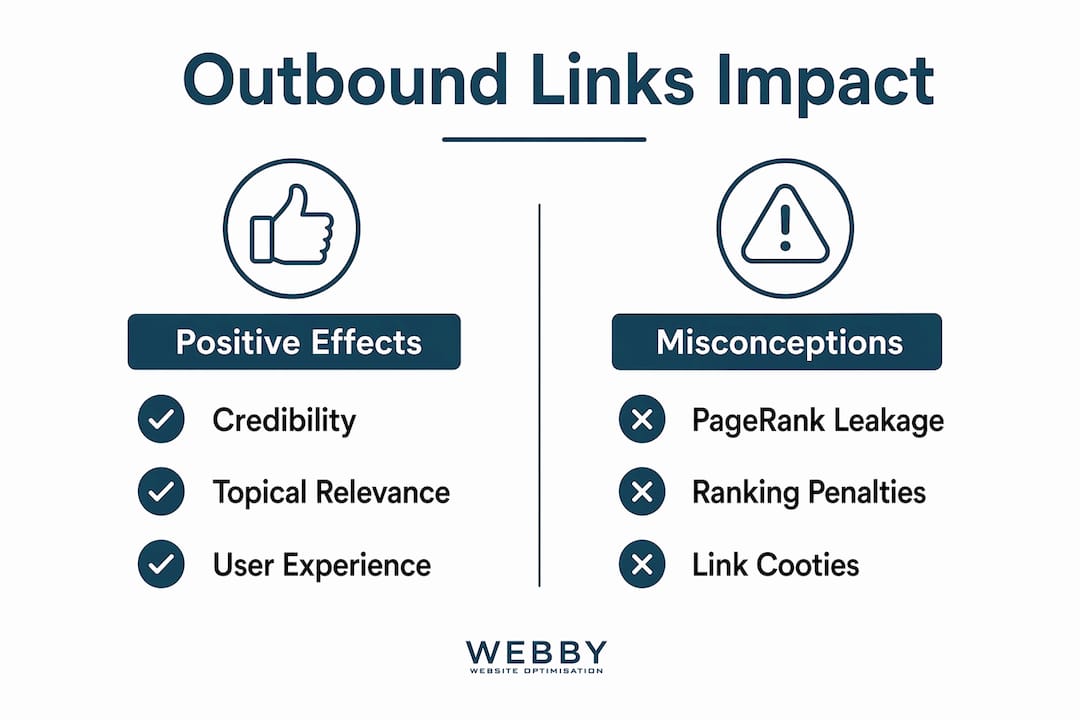
Outbound links act as proof points. When you cite a government study, a Google developer document, or a recognized industry source, you tell both users and search engines that your content is grounded in real evidence. Users read at most 28% of text on any given page, which means your links need to do credibility work fast, before most readers stop scanning.
Linking to authoritative, topic-relevant sources directly supports Google’s E-E-A-T framework, which stands for Experience, Expertise, Authoritativeness, and Trustworthiness. A page about tax compliance that links to the IRS reads as more authoritative than one that cites nothing. That trust signal feeds back into how Google evaluates your content’s quality.

Outbound links also improve time on site by guiding readers to relevant next steps. When a user finds a useful reference link, they return to your page with more confidence in your content. Links to official reviews, government pages, and studies increase engagement and reduce the kind of bounce behavior that signals low-quality content to search engines.
Pro Tip: Link to primary sources whenever possible. A link to a published study or official government page carries far more credibility weight than a link to a blog summarizing that same study.
The importance of outbound links becomes clearest when you compare pages with zero external references to those with well-chosen citations. The cited pages consistently read as more trustworthy, and that perception matters to both users and Google’s quality evaluators.
What does Google actually do with outbound links?
Google treats outbound links as topical classification signals. They help Google’s systems understand what your page is about by seeing which authoritative sources you associate with. Quality outbound links provide a measurable boost in topical classification, while low-quality links cause measurable suppression.
The fear that linking out will hurt your rankings is largely a myth. Google neutralizes unhelpful outbound links rather than using them to penalize your site. Google’s systems effectively remove low-quality nodes from the link graph, a process sometimes called the Reduced Link Graph. Your site does not absorb a penalty just because you linked to a poor-quality page.
John Mueller of Google has addressed this directly, clarifying that the concept of “link cooties,” where bad links contaminate your site, does not reflect how Google actually works. The concern about outbound link quality is real, but the mechanism is different from what most marketers assume. Poor outbound links are simply ignored. They don’t pass value, and they don’t pass harm.
| Outbound link type | Google’s treatment | SEO effect |
|---|---|---|
| High-authority, relevant source | Used as topical classification signal | Positive: strengthens E-E-A-T |
| Low-quality or spammy site | Neutralized, excluded from link graph | Neutral: no penalty passed |
| Paid link without sponsored tag | Treated as a policy violation | Negative: manual action risk |
| Nofollow on trusted editorial link | Signal ignored by Google | Missed opportunity for context |
PageRank leakage is another concern that gets overstated. A page with 5 external links leaks about 5% of PageRank externally. That figure is minimal compared to the trust and topical clarity benefits you gain from linking to authoritative sources.
Pro Tip: Don’t obsess over PageRank leakage. The trust signals you gain from linking to credible sources outweigh the negligible PageRank you pass outward.
Best practices for outbound linking in 2026
Effective outbound linking follows a clear set of rules. These are not theoretical guidelines. They reflect how Google’s systems actually evaluate link quality and how real users respond to external references.
Use dofollow for trusted editorial links. Dofollow for trusted editorial links and nofollow for paid or untrusted links is the current best practice. Nofollowing every outbound link by default is outdated and wastes the topical context signal those links provide.
Link only to high-authority, topic-relevant sources. A local plumbing business linking to a Harvard Medical School study on an unrelated topic adds nothing. Link to sources that directly support the claim you are making on that page.
Avoid excessive outbound links. Excessive outbound links create semantic scattering and confuse users, hurting both engagement and conversions. A page with 40 external links reads as cluttered and unfocused.
Place links where they support specific claims. Anchor your outbound links to the exact sentence making a factual claim, a statistic, or a recommendation. This placement pattern mirrors how academic citations work and reads as more credible than links dropped at the end of paragraphs.
Use descriptive anchor text. Anchor text like “read more here” tells Google nothing. Anchor text like “CDC vaccination guidelines” tells Google exactly what the linked page covers and reinforces your page’s topical context.
Audit outbound links regularly. External pages change, get deleted, or decline in quality. A broken or redirected outbound link to a now-low-quality page is a missed credibility signal. Set a quarterly reminder to check your most important outbound links using tools like Screaming Frog or Ahrefs.
Pro Tip: When writing a new article, identify your top three factual claims and find a primary source for each one before you publish. This habit builds your outbound link quality from the start rather than retrofitting links later.
For local service businesses, outbound links for content strategy mean citing local government pages, industry associations, and recognized trade bodies. A Perth-based electrician citing Energy Safe Victoria or the Australian Building Codes Board immediately signals topical authority to both users and Google.
Common misconceptions about outbound links and SEO
Several persistent myths cause digital marketers and small business owners to mismanage their outbound linking. Clearing these up changes how you approach the practice.
Myth: Outbound links leak too much PageRank and damage your rankings.
The actual PageRank leakage from a typical page is negligible, around 5% for a page with five external links. The trust and topical context you gain from linking to authoritative sources far outweighs that loss.
Myth: Linking to a low-quality site will hurt your rankings.
Google ignores poor outbound links rather than penalizing your site for them. The risk is not a ranking penalty. The risk is wasting a credibility signal on a source that adds no value to your readers.
Myth: You should nofollow all outbound links to stay safe.
This approach is outdated. The selective use of dofollow on trusted editorial links and nofollow on paid or untrusted links is the correct modern practice. Blanket nofollowing strips the topical context signal from every external reference on your site.
Myth: You need to manually clean up outbound links from penalized sites.
Google’s Reduced Link Graph already neutralizes those connections. Manual cleanup of outbound links from penalized sites is generally not worth the effort, because Google has already discounted those links algorithmically.
“Outbound links function as a meaning bridge, helping search engines and users understand page topical scope by connecting to trusted external resources.” — Nizam SEO War Room
The real risk with outbound links is not linking too much to good sources. The real risk is linking to irrelevant or low-quality pages, or using so many links that your page loses focus. Both errors hurt user experience, which is the metric that actually connects outbound linking to SEO performance.
Key takeaways
Outbound links improve SEO indirectly by strengthening topical relevance, supporting E-E-A-T signals, and building user trust through credible external references.
| Point | Details |
|---|---|
| Outbound links signal credibility | Linking to authoritative sources tells Google and users your content is well-researched. |
| Google ignores bad outbound links | Poor-quality external links are neutralized, not used to penalize your site. |
| PageRank leakage is negligible | A typical page leaks around 5% PageRank externally, which is outweighed by trust benefits. |
| Use dofollow for trusted links | Reserve nofollow for paid or untrusted links only, not all outbound links by default. |
| Excessive linking harms UX | Too many outbound links create semantic scattering and reduce page focus and conversions. |
Why I think most businesses get outbound linking completely wrong
Most of the small business websites I review treat outbound links as either a threat or an afterthought. Owners either nofollow everything out of fear, or they link randomly to whatever they happen to mention. Neither approach reflects how outbound links actually work in 2026.
The businesses I’ve seen get real SEO traction from their content are the ones who treat outbound links as a measure of editorial quality. They ask one question before adding any external link: does this source make my reader’s experience better? If the answer is yes, the link belongs. If the answer is no, it doesn’t matter how authoritative the source is.
The other mistake I see constantly is ignoring outbound links while obsessing over backlinks. Backlinks are more powerful as direct ranking signals, that’s true. But a page with strong inbound links and zero credible outbound references still reads as thin to Google’s quality evaluators. The SEO case studies that actually work consistently show that content quality, including how well a page cites its sources, matters alongside link building.
Outbound linking is also one of the few SEO practices you can improve today without waiting for external validation. You don’t need another website to link to you. You just need to write better, more credible content and back it up with real sources. That’s a competitive advantage most local service businesses leave on the table.
How Webby Website Optimisation can strengthen your SEO strategy
Building a credible, well-linked website takes more than knowing the rules. It takes consistent execution across every page, every article, and every update.

Webby Website Optimisation works with local service businesses in Perth, Fremantle, and Melville to build SEO strategies that go beyond keyword placement. That includes site architecture, content quality, and the kind of linking structure that signals authority to Google. If your website is underperforming in search despite solid content, the issue is often in the details, including how your pages reference and connect to authoritative sources. Contact Webby Website Optimisation for a free audit and find out exactly where your site stands.
FAQ
What is the role of outbound links in SEO?
Outbound links serve as credibility and topical relevance signals that help search engines classify your content and demonstrate editorial quality. They support E-E-A-T indirectly rather than acting as direct ranking factors like backlinks.
Do outbound links hurt your Google rankings?
Outbound links to low-quality sites do not penalize your rankings. Google neutralizes unhelpful outbound links rather than passing negative signals to your site.
Should I nofollow all outbound links?
No. Use dofollow for trusted editorial references and nofollow only for paid, sponsored, or untrusted links. Blanket nofollowing removes the topical context signal those links provide to Google.
How many outbound links should a page have?
There is no fixed number, but excessive outbound links cause semantic scattering and reduce user focus. Link only where a reference directly supports a specific claim or improves the reader’s experience.
Do outbound links improve user experience?
Yes. Links to authoritative sources like government pages, published studies, and recognized industry bodies increase reader trust and engagement, which feeds back into SEO performance indirectly.