
Local SEO is defined as the practice of optimizing a business’s online presence to appear in location-based search results on platforms like Google Search, Google Maps, and AI-powered answer engines. 46% of all Google searches carry local intent. That means nearly half of every search happening right now is someone looking for a business, service, or product nearby. If your business isn’t showing up in those results, you’re invisible to the customers most likely to walk through your door. This guide covers what local SEO is, how it differs from traditional SEO, the key ranking factors, and what you need to do in 2026 to stay competitive.
What is local SEO and why does it matter?
Local SEO is the process of improving your business’s visibility in geographically targeted search results. The industry also refers to this as “local search optimization.” It covers everything from your Google Business Profile (GBP) to your website’s location pages to the reviews customers leave on Google.
Google’s local algorithm ranks businesses based on three core factors: relevance, distance, and prominence. Relevance measures how well your business matches a search query. Distance measures how close your business is to the searcher. Prominence measures how well-known and trusted your business is online, based on reviews, citations, and links.

The benefits of local SEO are direct and measurable. A plumber in Perth who ranks in the Local Pack gets calls from people who are ready to hire right now, not people browsing for general information. That purchase intent is what separates local search from almost every other marketing channel.
How does local SEO differ from traditional SEO?
Local SEO focuses on geographic proximity and business location metadata, while traditional SEO targets broader organic rankings through content authority and backlinks. The two share some overlap, but their priorities are fundamentally different.
| Factor | Local SEO | Traditional SEO |
|---|---|---|
| Primary goal | Rank in Local Pack, Maps, and local organic results | Rank in national or global organic results |
| Key ranking signals | GBP, NAP citations, reviews, proximity | Backlinks, content quality, domain authority |
| Search result type | Local Pack, Google Maps, local organic listings | Standard organic blue links |
| Searcher intent | Ready to visit, call, or buy locally | Researching, comparing, or browsing broadly |
| Target audience | Nearby customers | Wide or global audience |
The search result types also differ in a critical way. Traditional SEO competes for the standard organic results below the Local Pack. Local SEO targets the Local Pack itself, the map listings, and the local organic results just below them. Businesses appearing in both the Local Pack and organic local results can capture up to three times the clicks. That dual visibility is the single biggest reason local SEO for small businesses deserves its own dedicated strategy.
Key differences in approach include:
- GBP optimization is central to local SEO and irrelevant to traditional SEO
- NAP consistency (Name, Address, Phone number) across directories is a local ranking signal with no equivalent in traditional SEO
- Review management directly influences local rankings; it has minimal impact on traditional organic results
- Location-specific pages signal local relevance to Google in ways that generic content cannot
What are the key local SEO ranking factors in 2026?
Google Business Profile is the cornerstone asset for local SEO visibility. It feeds data into Google Maps, the Local Pack, and AI-powered search results. An incomplete or unverified GBP profile is the fastest way to lose ground to competitors.
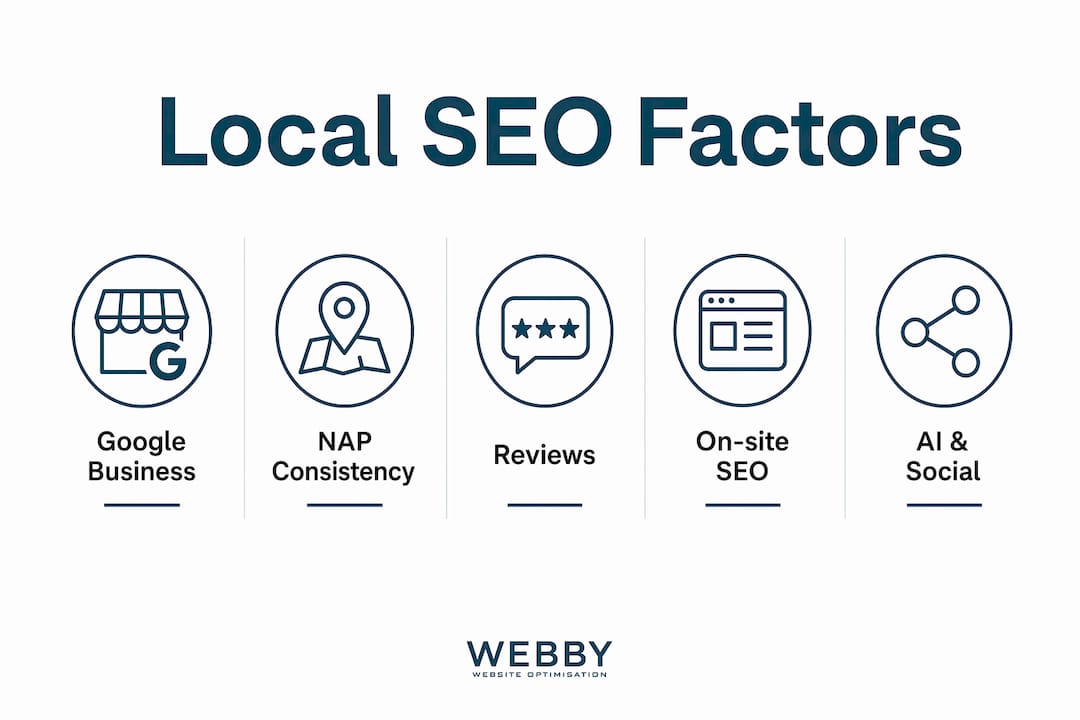
Optimizing your Google Business Profile
A fully optimized GBP includes accurate business categories, a detailed description, current hours, high-quality photos, and regular posts. The category you choose is one of the most influential signals Google uses to match your business to relevant queries. Choosing the wrong primary category is a common mistake that costs rankings.
Learn how to set up your GBP listing correctly from the start, including the 2026 updates that affect verification and category selection.
NAP consistency and citations
Consistent and accurate NAP data across online directories signals legitimacy to Google and improves ranking. NAP stands for Name, Address, and Phone number. Every time your business appears in a directory, review site, or local listing, that information must match exactly what’s on your website and GBP.
Discrepancies confuse search engines and degrade ranking potential. A business listed as “Webby Website Optimisation” in one directory and “Webby Optimisation” in another sends conflicting signals. Run a citation audit using tools like BrightLocal or Moz Local to find and fix inconsistencies.
Reviews: quantity, quality, and recency
Review quantity, quality, and management directly influence local search rankings and consumer choice. Google rewards businesses that actively earn and respond to reviews. Recency matters too. A business with 200 reviews but none in the past six months will underperform against a competitor with 80 reviews and a steady stream of recent feedback.
Pro Tip: Ask for reviews at the moment of highest satisfaction, right after a job is completed or a service is delivered. A simple text message with a direct link to your Google review page converts far better than a follow-up email sent days later.
On-site local SEO signals
Your website must reinforce your local relevance. Location-specific pages, schema markup (LocalBusiness schema in particular), and geo-tagged content all tell Google exactly where you operate and what you offer. A single generic “Contact Us” page is not enough for a business serving multiple suburbs or service areas.
How is AI changing local SEO in 2026?
AI-powered search tools like ChatGPT, Google AI Overviews, and Perplexity are changing how people discover local businesses. Instead of clicking through a list of results, users ask a question and get a direct answer. If your business isn’t structured to be cited by these tools, you miss a growing share of discovery traffic.
Answer Engine Optimization (AEO) is the practice of structuring website content so AI models can easily extract and cite your business information. AEO complements local SEO rather than replacing it. The businesses that rank well in traditional local search also tend to perform well in AI-generated answers, because both reward the same signals: authority, accuracy, and completeness.
“Successful local SEO in 2026 requires a unified approach that works across traditional Google platforms and emerging AI-powered search and answer engines.” — Surfer Stack, 2026
Local SEO now demands comprehensive entity modeling so AI can parse deeper relationships in your content. That means structured schema markup, semantic content that connects your services to your location, and citations that go beyond traditional backlinks. Practical steps to align your local SEO with AI search include:
- Add LocalBusiness schema markup to every location page on your website
- Write FAQ content that answers specific questions your customers ask
- Keep your GBP data synchronized with your website and social profiles
- Build mentions on local news sites, industry directories, and community platforms
- Use clear, direct language that AI can extract without interpretation
Social media also plays a supporting role. Consistent mentions of your business name, location, and services across platforms like Facebook and Instagram reinforce the entity signals that AI tools use to verify and recommend businesses. The role of social media in SEO has grown significantly as AI search engines factor in broader online presence.
What practical steps can you take to improve local SEO today?
Local SEO is a continuous process, not a one-time setup. Ongoing maintenance including GBP updates, review management, and content refreshes is critical for sustained visibility. Start with these steps:
- Claim and fully optimize your Google Business Profile. Verify your listing, choose accurate categories, add photos, and write a complete business description. Read the full GBP optimization guide for local service owners.
- Audit your NAP data. Check your business name, address, and phone number across Google, Facebook, Yelp, and major local directories. Fix any mismatches immediately.
- Build a review acquisition system. Don’t wait for reviews to arrive organically. Create a repeatable process for asking satisfied customers to leave feedback on Google.
- Create location-specific website pages. If you serve multiple areas, each area deserves its own page with unique content, not a copy-paste with the suburb name swapped out.
- Earn local backlinks. Sponsor a local event, partner with a complementary business, or get listed in a local chamber of commerce directory. These links carry strong local relevance signals.
- Monitor your performance. Use Google Search Console and Google Business Profile Insights to track which queries drive traffic and where you rank. Adjust your strategy based on what the data shows.
Pro Tip: Multi-location businesses should create a unique GBP listing for each physical location and build localized content tailored to each site. Generic, centralized content does not compete effectively at the suburb or neighborhood level.
Key takeaways
Local SEO is the most direct path for a local business to connect with nearby customers who are ready to buy, and it requires consistent effort across your GBP, website, citations, and reviews.
| Point | Details |
|---|---|
| Define your foundation | Local SEO targets nearby searchers through GBP, citations, and location-specific content. |
| Three ranking factors | Google ranks local results by relevance, distance, and prominence. |
| Reviews drive rankings | Actively earning and responding to reviews improves both rankings and consumer trust. |
| AEO is now part of the job | Structure content with schema and clear language so AI tools can cite your business. |
| Consistency is non-negotiable | NAP mismatches across directories confuse Google and reduce your ranking potential. |
Why local SEO fundamentals still win, even as AI changes everything
The businesses I see struggle most with local SEO are not the ones ignoring AI. They’re the ones who never got the basics right in the first place. An unclaimed GBP, inconsistent NAP data, and zero reviews will sink you in traditional search and in AI-generated answers. The fundamentals have not changed. They’ve become more consequential.
What has changed is the surface area. In 2026, your business needs to be findable and credible across Google Search, Google Maps, AI Overviews, ChatGPT, and Perplexity. That sounds overwhelming, but the same core actions drive visibility across all of them: a complete and accurate GBP, a well-structured website, consistent citations, and a steady flow of genuine reviews.
The businesses that treat local SEO as a one-time task are the ones losing ground. The ones investing in ongoing optimization, even modestly, are pulling ahead. The gap between a business with a maintained local presence and one that set it up three years ago and forgot about it is widening every month. That gap is now measurable in leads, calls, and revenue.
My advice: stop waiting for the perfect strategy and start with what you can control today. Fix your GBP. Audit your citations. Ask your last five customers for a review. Those three actions alone will move the needle faster than any advanced tactic applied to a broken foundation.
— Steve Doig
How Webby Website Optimisation can help you rank locally
Webby Website Optimisation works with local service businesses in Perth, Fremantle, and Melville to build and maintain the kind of local SEO presence that generates real leads.
The team at Webby Website Optimisation handles GBP setup and optimization, NAP audits, citation building, review strategy, and location-specific website content. Every engagement starts with a free audit so you know exactly where your local search presence stands before any work begins. If you’re ready to attract more nearby customers and stop losing ground to competitors, get your free local SEO audit today.
FAQ
What is local SEO in simple terms?
Local SEO is the process of making your business visible to people searching for your services nearby. It focuses on platforms like Google Search and Google Maps, where purchase-ready customers look for local businesses.
How much does local SEO cost?
Local SEO services range from $300 to over $3,000 per month depending on scope. Small business packages typically start around $300–$500 per month.
How long does local SEO take to show results?
Most businesses see measurable improvements in local rankings within 3–6 months of consistent optimization. Results depend on competition level, starting point, and how actively the strategy is maintained.
What is the difference between local SEO and regular SEO?
Local SEO targets geo-specific queries and map listings, while regular SEO targets broader organic rankings. Local SEO relies heavily on GBP, citations, and reviews rather than backlinks and content authority alone.
Do I need a website for local SEO?
A website is not strictly required to appear in Google Maps, but it significantly strengthens your rankings. Location pages, schema markup, and on-site content all reinforce the signals that push your business higher in local results.