

User signals are behavioral indicators that tell Google how well a webpage satisfies a visitor’s search query, making them one of the most direct inputs into modern ranking systems. The role of user signals in SEO has become impossible to ignore since Google’s 2024 antitrust proceedings and API leak confirmed that proprietary behavioral data actively shapes search rankings. Google’s NavBoost system processes aggregated click behavior over a 13-month rolling window to re-rank results after the initial algorithm pass. For SEO practitioners and digital marketers, this means that content quality and technical optimization alone are no longer enough. How real users interact with your pages now feeds directly back into where those pages rank.
What user signals does Google actually track?
Google measures user signals through its own Search and Chrome infrastructure, not through third-party analytics platforms like GA4. This distinction matters because engagement signals are inferred from behavior on the search results page and within the Chrome browser, which is fundamentally different from what you see in your onsite analytics dashboard.
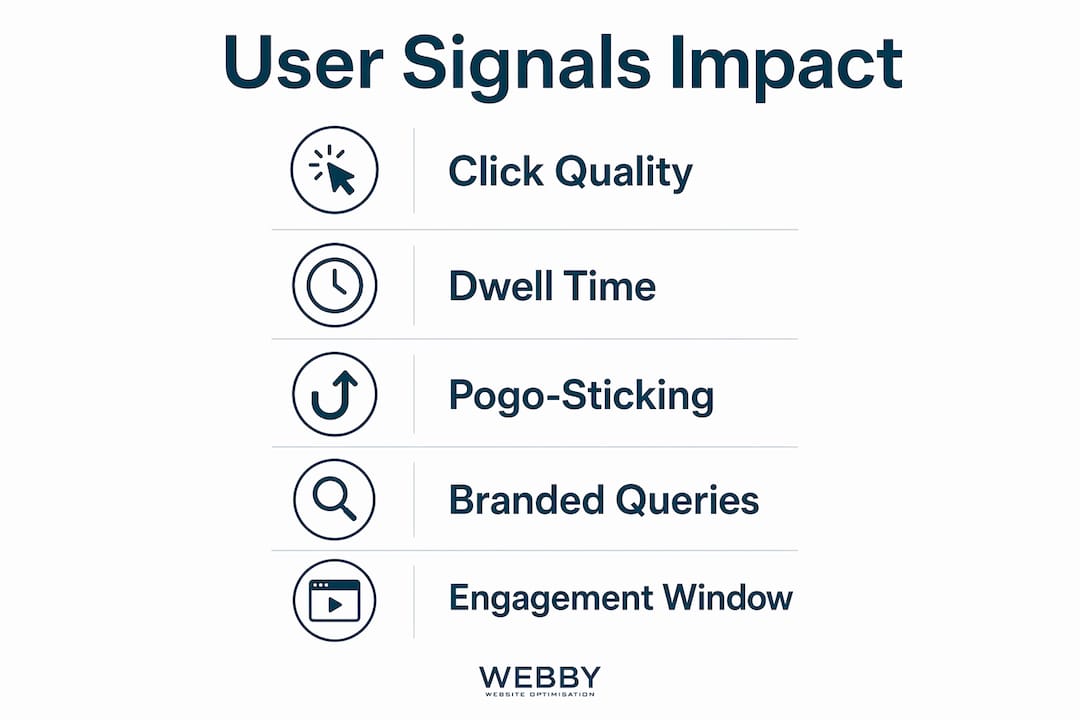
The specific signals NavBoost tracks include:
- goodClicks: Clicks that lead to a satisfying session, where the user does not return to the SERP quickly.
- badClicks: Clicks followed by an immediate return to the SERP, signaling the page failed to answer the query.
- lastLongestClicks: The final and longest click in a search session, indicating the user found what they were looking for and stopped searching.
- Dwell time: The duration a user spends on a page before returning to search results, inferred from browser behavior.
- Pogo-sticking: The pattern of a user clicking a result, bouncing back, and clicking a different result instead.
NavBoost aggregates these signals over a 13-month rolling window. That means a single bad week of user behavior will not tank your rankings, but a sustained pattern of poor engagement will compound over time and drag your visibility down.
Pro Tip: Google Search Console is not NavBoost. The CTR data in Search Console reflects raw clicks, not the quality-weighted signals NavBoost processes. Use Search Console to spot patterns, but do not treat its numbers as a direct proxy for how NavBoost scores your pages.
The branded query dimension is also worth noting. Navigational branded searches that result in direct clicks to a brand’s site count as strong positive signals. Google Search Console added a branded queries filter in 2025 specifically because branded demand now plays a recognized role in ranking authority.
How do different user signals impact SEO rankings?
Not all user signals carry equal weight. LastLongestClick is the strongest positive engagement signal in NavBoost’s model. It tells Google that a user’s search session ended on your page, meaning your content fully resolved their query. Pages that consistently earn lastLongestClicks receive a measurable ranking boost.

NavBoost also applies a Clicks Over Expected Clicks (COEC) model, which weighs your actual clicks against the clicks expected for your ranking position. A page ranking in position 5 that earns clicks at a position 2 rate sends a strong positive signal. A page ranking in position 2 that earns clicks at a position 8 rate sends a strong negative one.
| Signal | Type | Ranking Effect |
|---|---|---|
| LastLongestClick | Positive | Substantial boost; signals full query satisfaction |
| GoodClick | Positive | Moderate boost; signals satisfying but not final result |
| Pogo-sticking | Negative | Ranking penalty; signals content mismatch |
| BadClick | Negative | Penalty; signals immediate dissatisfaction |
| Branded navigational query | Positive | Boosts authority and ranking for branded terms |
| High COEC ratio | Positive | Boosts ranking when clicks exceed position expectations |
Pogo-sticking generates ranking penalties because it is the clearest behavioral signal that a page failed to satisfy the query. The user returned to the SERP and clicked something else. Google interprets that as a direct vote against your page.
Pro Tip: A high raw CTR does not guarantee ranking improvement. If users click your result and immediately bounce back, the badClick signal cancels out the CTR gain. Focus on what happens after the click, not just on getting the click.
The context of the query also matters. Dwell time thresholds vary by query type. A user spending 45 seconds on a quick factual query may signal full satisfaction. The same 45 seconds on a complex research query may register as a badClick. Google’s systems calibrate expectations based on query intent, not absolute time values.
What strategies actually improve user signals?
Improving user engagement in SEO starts with one principle: match your page content precisely to the search intent behind the query. Pogo-sticking almost always traces back to a mismatch between what the title promises and what the page delivers. Fix the mismatch, and the signal improves.
Align content depth with query complexity. Comprehensive pages that answer the full scope of a question earn lastLongestClicks. Thin pages that answer only part of the query push users back to the SERP to find the rest. For small business SEO services, this means going beyond surface-level service descriptions and addressing the specific questions your customers actually search.
Improve page speed and Core Web Vitals. Slow pages increase bounce rates before users even read your content. Google’s Core Web Vitals framework, including Largest Contentful Paint (LCP) and Interaction to Next Paint (INP), directly affects whether users stay or leave. A page that loads in under 2.5 seconds retains far more users than one that loads in 5 seconds.
Write titles and meta descriptions that set accurate expectations. Clickbait titles that overpromise generate high CTR and high pogo-sticking. That combination actively hurts rankings. Write titles that describe exactly what the page delivers, so the users who click are the ones who want what you have.
Build brand recognition to generate navigational queries. Branded searches are among the strongest positive signals in NavBoost. Consistent content marketing, social presence, and offline reputation all drive users to search for your brand by name. That branded search demand then feeds back into your organic rankings.
Use internal linking to extend sessions. When a user finishes reading one page and clicks to another on your site, that extended session reduces the chance of a badClick being recorded. SEO website design that incorporates logical internal linking keeps users engaged longer and signals broader query satisfaction.
Pro Tip: Audit your highest-traffic pages in Google Search Console and filter for queries with high impressions but below-average CTR. Rewrite the title and meta description for those pages first. That is where a small copy change produces the fastest signal improvement.
Genuine user satisfaction is the most sustainable path to improving rankings through behavioral signals. Practitioners who chase metrics without fixing the underlying content experience see short-term gains that erode quickly.
What are the limits of user signals in SEO?
User signals are powerful, but they are not the whole picture. Google Analytics bounce rate and average time on site are not direct ranking factors. Google has confirmed this explicitly. These metrics are useful for your own analysis, but they do not feed into NavBoost or any other Google ranking system.
Several other boundaries define what user signals can and cannot do:
- Artificial manipulation fails. Click fraud and fake engagement do not generate lasting ranking improvements. Google filters inauthentic behavior as noise. NavBoost records only genuine human engagement patterns, and its detection systems are sophisticated enough to distinguish real sessions from bot traffic.
- The 13-month window creates delayed feedback. Improvements to your content take time to register as ranking changes because NavBoost aggregates data over a long period. Do not expect a page redesign to produce ranking gains within days.
- User signals are one factor among many. Backlinks, technical SEO, E-E-A-T, and content quality all remain active ranking inputs. User signals amplify or diminish the effect of those factors. They do not replace them.
- AI-driven search is changing the equation. Google’s AI Overviews and generative search features may reduce direct clicks to some pages. Clicks remain the foundation of Google’s ranking advantage, but the nature of what constitutes a valuable click is evolving as AI summaries intercept more queries.
The impact of user metrics on SEO is real and measurable, but practitioners who treat behavioral signals as a shortcut to rankings will be disappointed. The signal system rewards content that genuinely satisfies users, and it is designed to resist gaming.
Key Takeaways
User signals function as a direct feedback loop between real visitor behavior and Google’s ranking decisions, making genuine content quality the most reliable long-term SEO strategy.
| Point | Details |
|---|---|
| NavBoost drives re-ranking | Google’s NavBoost uses a 13-month rolling window of goodClicks, badClicks, and lastLongestClicks to adjust rankings. |
| LastLongestClick matters most | Pages that end a user’s search session earn the strongest positive signal in NavBoost’s model. |
| GA4 metrics are not ranking inputs | Google Analytics bounce rate and time on site are not direct ranking factors; NavBoost uses Chrome and Search data. |
| Intent matching reduces pogo-sticking | Aligning page content with search intent is the most direct way to eliminate negative engagement signals. |
| Artificial signals are filtered out | Click fraud and fake engagement do not improve rankings; only authentic human behavior registers in NavBoost. |
What I’ve learned from watching user signals reshape SEO
The 2024 Google antitrust disclosures changed how I think about SEO fundamentally. Before those proceedings, user signals were a theory that practitioners debated. After them, NavBoost became a confirmed system with named metrics. That shift matters because it moved the conversation from speculation to engineering.
What I find most practitioners still get wrong is treating user signals as a separate optimization track from content quality. They are the same thing. When you write a page that fully answers a complex query, you earn lastLongestClicks automatically. When you fix a slow-loading page, you reduce badClicks automatically. The signal improves because the experience improved, not because you targeted the signal directly.
The other lesson I keep returning to is patience. The 13-month rolling window means that a site with a history of poor engagement carries that weight for over a year, even after the content is fixed. I have seen sites with genuinely excellent new content underperform for months because the historical signal data was dragging them down. The fix is not to panic and change the content again. The fix is to wait, keep producing quality, and let the new behavioral data accumulate.
My practical advice: treat your Google Search Console CTR data as a diagnostic tool, not a performance target. Low CTR on a high-impression query tells you the title is wrong. High CTR with poor rankings tells you the content is not satisfying users after the click. Both are fixable, but only if you diagnose them correctly.
— Steve Doig
How Webby Website Optimisation supports better user signals
Improving user engagement in SEO requires more than content tweaks. It requires a website that loads fast, communicates clearly, and keeps visitors reading.
Webby Website Optimisation works with local service businesses in Perth, Fremantle, and Melville to build websites that generate the behavioral signals Google rewards. From website design and development that meets Core Web Vitals standards to SEO strategies built around genuine search intent, Webby’s work targets the metrics that actually move rankings. If your site is losing users before they read your content, or if your pages rank but fail to convert, a free audit with Webby Website Optimisation is the right starting point.
FAQ
What are user signals in SEO?
User signals are behavioral metrics that search engines collect to assess how well a webpage satisfies a query. Google tracks signals like clicks, dwell time, pogo-sticking, and lastLongestClicks through its Search and Chrome infrastructure.
Does Google use bounce rate as a ranking factor?
Google has confirmed that Google Analytics bounce rate is not a direct ranking factor. NavBoost uses its own engagement metrics captured from Chrome and Search, not data from third-party analytics platforms.
What is pogo-sticking and why does it hurt rankings?
Pogo-sticking occurs when a user clicks a search result, returns to the SERP quickly, and clicks a different result. Google interprets this as a signal that the page failed to satisfy the query, which generates a badClick and can reduce the page’s ranking.
How long does it take for user signal improvements to affect rankings?
NavBoost aggregates engagement data over a 13-month rolling window, so ranking changes from improved user signals can take weeks to months to fully register. Sustained improvement in content quality and user experience produces the most reliable long-term gains.
Can you manipulate user signals to improve rankings?
Click fraud and artificial engagement do not produce lasting ranking improvements. Google filters inauthentic behavior as noise, and only genuine human engagement patterns register as valid signals in NavBoost.
Recommended
If this post raised some questions feel free to ask me a question