
AI Overviews SEO is mostly good SEO with sharper content. Google says there is no separate ranking system and no special markup for AI Overviews. A page needs to be indexed, rank well in normal search, follow Google’s Search policies and offer helpful, people-first content. What changes is how you write and structure that content, because an AI answer quotes a few sources instead of listing ten links.
This guide is for owners of local service businesses in Australia: trades, clinics, accountants, builders, cleaners, consultants. It covers what to fix first, how to measure results, and which advice to ignore.
TL;DR
- There is no AI Overviews trick. Eligibility depends on being indexed and ranking in organic search, so technical health and helpful content still come first.
- Write answer-first: a direct one or two sentence answer under each heading, then the detail.
- Measure with the new generative AI reports in Google Search Console, and treat them as a guide to which pages match AI intent, not a leaderboard.
- Leave the AI features switched on unless you have a strong reason. Opting out removes both the appearance and the traffic.
- Fix your site speed, service pages and local signals before paying anyone for “GEO” packages.
Table of Contents
- What AI Overviews change for a local business
- What Google actually says you need
- Write for extraction, not just for reading
- Measure it in Search Console
- Making sense of GEO, AEO and LLM SEO
- A practical plan for a Perth service business
- Our perspective
- Where we can help
- What not to waste money on
- FAQ
- Sources
What AI Overviews change for a local business
An AI Overview is the generated summary that sits above the regular results for many searches. It pulls from several pages and links to some of them. For a plumber in Fremantle or an accountant in Melville, the question is whether your business is one of the sources it names or links.
The shift is real. Ahrefs research, summarised by Leland, found that when an AI Overview appears, the click-through rate for the top-ranking page drops by about 58%, based on a December 2025 analysis. Treat that figure as a sign of direction, not a promise about your own site. It does mean that position one is worth less on searches where an overview appears.
The practical consequence is that you are now competing for a quote as well as a blue link. A brand that is structured to be quoted can still be seen when the click does not happen.
Not every search triggers one
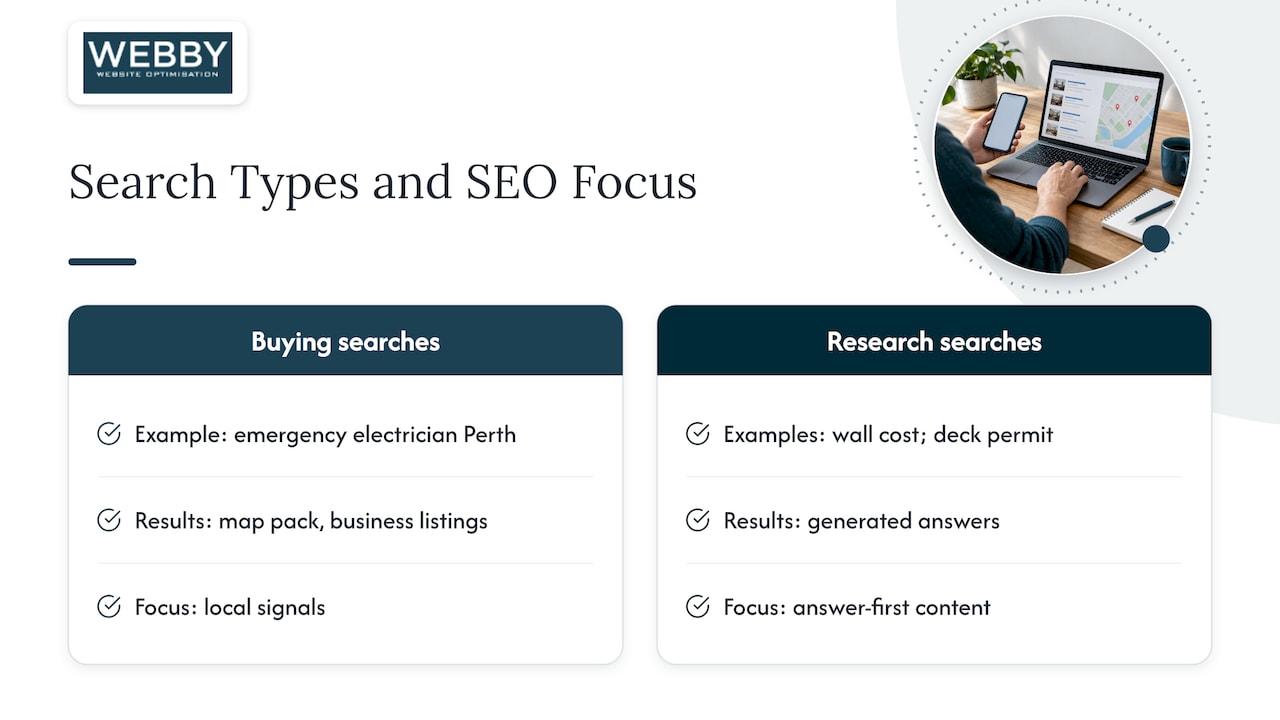
Local commercial searches such as “emergency electrician Perth” often lean on the map pack and business listings, while informational searches (“how much does a retaining wall cost”, “do I need a building permit for a deck”) are more likely to produce a generated answer. That is why service businesses should handle both: local signals for buying searches and answer-first content for research searches. Our guide to Google search features explains how the map pack, featured snippets and AI answers differ.
What Google actually says you need
Google’s own documentation is blunt: the foundations of SEO still apply. According to its guide to optimizing for generative AI features, there is no separate system for AI Overviews and no specialised schema. Its AI features documentation says the same from a site owner’s view: best practices for SEO remain relevant.
That gives you a short checklist of things that are in your control:
- Your pages can be crawled and indexed. Check that important service pages are not blocked by robots.txt or a stray noindex tag.
- Your content is helpful and written for people. Pages stuffed with suburb names and keywords do not qualify.
- Your site follows Google’s Search policies. No thin doorway pages, no hidden text, no spam.
- Your page can show a normal snippet. If you have restricted snippets, you restrict what AI features can use.
If you want to confirm any of this, the Search Console URL Inspection tool shows whether Google has indexed a given page.
Write for extraction, not just for reading
AI systems lift passages. A page that buries its answer in the fourth paragraph is harder to quote than one that states it at the top. Guidance aimed at Australian businesses describes AI answer engines selecting sources through retrieval, authority signals and structured content, and recommends leading with a direct answer.
Here is how that looks on a service page.
Lead each section with the answer
Before:
Many homeowners wonder about pricing, and there are lots of factors to think about when planning a bathroom renovation…
After:
A standard bathroom renovation in Perth takes two to three weeks once work starts. Delays usually come from waterproofing cure times and tile delivery.
(Use your own real figures there, not ours. Only publish numbers you can stand behind.)
The second version gives a model a clean, self-contained fact to quote, and gives a human what they wanted in five seconds.
Use headings that match real questions
Use plain, sequential headings (H2, then H3) that name the topic the way a customer would say it. A section titled “What does a switchboard upgrade involve?” is easier to match to a search than “Our process”. Keep the question and answer together, with no marketing preamble in between.
Add specifics only you can supply
Generic text is replaceable. Local detail is not: the suburbs you serve, the council rules you deal with, the brands you install, your licence numbers, photos of finished jobs, and the names and credentials of the people doing the work. The Leland guide argues that original, expert-led content is the very thing AI systems favour when citing, and that human judgment should stay in charge of strategy and brand voice.
Structured data helps, but it is not magic
Schema such as Article, FAQ or HowTo can make a page’s structure clearer to machines, and some guides say AI engines favour it. Google itself says there is no special schema for AI Overviews, so treat markup as good housekeeping rather than a switch. Use LocalBusiness markup with accurate details, and make sure it matches what is visible on the page.
Our article on how to optimize a service page for Google walks through the page-level basics, and how to structure your website for SEO success covers the architecture behind it.
Measure it in Search Console
Until mid-2026, you could suspect AI answers were affecting you but could not isolate them. According to Google’s announcement, generative AI performance reports began rolling out on 3 June 2026, letting site owners see impressions and clicks from AI Overviews and AI Mode separately from traditional organic traffic.
How to use it sensibly:
- Look for patterns by page. Which service pages and guides appear in AI features? Which do not, despite ranking well?
- Compare clicks to impressions. A page with many AI impressions and few clicks is being read but not visited. That may be fine for brand awareness, but check whether your phone calls and enquiry forms agree.
- Do not chase it as a ranking. It tells you where your content aligns with AI intent. It is not a leaderboard.
- Track the real outcome. Calls, form submissions and booked jobs matter more than impressions. Make sure your analytics records them.
The opt-out control
Google has also added a Search generative AI control in Search Console for managing your site’s inclusion in AI Overviews, AI Mode and generative features in Discover. As of 31 August 2026, it had rolled out worldwide. The default includes your site. Google’s guidance notes that excluding your site prevents both the appearance in those features and the traffic from them.
For most local service businesses that want enquiries, leaving it on is the sensible choice. Opting out suits publishers with a particular reason, such as paywalled content, not a tradie after more calls.
Making sense of GEO, AEO and LLM SEO
You will see a pile of acronyms. Here is what they mean in plain terms, drawing on Search Engine Land’s report on how marketers talk about this:
| Label | What it refers to | What you do about it |
|---|---|---|
| GEO (Generative Engine Optimization) | Broad efforts to get your content into generative AI answers | Strong content, authority, consistent business information |
| AEO (Answer Engine Optimization) | Winning a direct-answer slot | Answer-first writing, clear headings, FAQs |
| LLM SEO | Getting cited by large language models such as those behind ChatGPT or Claude | Be crawlable, be mentioned across reputable sites |
The same research found that 81% of marketers still prefer the plain term SEO for their overall strategy, and that 36% see excessive, unexplained buzzword use as a top vendor red flag. Take that as a hint when you are shopping around: if a proposal is mostly acronyms and no plan, ask what they will actually change on your site.
It is also worth separating two things people confuse. Using AI tools to speed up SEO work (audits, data analysis, drafting schema) is one thing. Optimizing so AI systems cite you is another. The Leland guide suggests letting AI handle the grunt work while humans keep control of strategy, voice and originality.
A practical plan for a Perth service business
Here is the order we would work in. Each step helps your normal rankings and your chances in AI answers.
Step 1: Check the foundations
Confirm that your key pages are indexed, load fast on a mobile connection, and are not hiding behind broken scripts or pop-ups. A slow, outdated site undermines everything else. Speed and technical fixes are usually the cheapest wins.
Step 2: Check AI crawler access
Some guides, such as this Sydney-focused one, list AI crawler access in robots.txt as a requirement for being cited by tools like ChatGPT, Claude and Gemini. Review your robots.txt and any security plugin that may block bots by default, and decide deliberately which crawlers you allow. Google’s AI Overviews rely on Google’s normal search index, so this step is mostly about the other assistants.
Step 3: Rewrite your top service pages
Pick the three pages that earn you the most money. For each one:
- Open with a two-sentence answer to the main question a customer has.
- Add a short pricing or timeframe section with honest ranges.
- Add an FAQ with real questions from your phone calls and emails.
- Show proof: licences, reviews, project photos, named staff.
- Link to related pages so the topic cluster is obvious.
Step 4: Tighten your local signals
Keep your name, address and phone number identical across your site, your Google Business Profile and directories. Ask happy customers for reviews and respond to them. Local businesses that appear consistently across the web are easier for any system to trust. Our home builder SEO guide shows how this works in one trade, and the same approach applies to others.
Step 5: Publish content only you can write
A guide on “what a Perth sandy-soil site means for your slab” will beat a generic national article, because it carries local knowledge. Use your own photos, numbers and lessons from real jobs.

Step 6: Review monthly
Open the Search Console generative AI report once a month. Note which pages gain impressions, update those pages, and compare enquiries. Fix what is slipping before adding anything new.
Our perspective
We work with local service businesses in Perth, Fremantle and Melville, and our view is less dramatic than the headlines. Owners are being told they need a new discipline with a new acronym. Mostly, they need the old discipline done properly: a fast WordPress site, clear service pages, honest content, and a Google Business Profile that is up to date.
What we do see is that outdated websites lose twice. They rank poorly, and when they do rank, they give an AI system nothing clean to quote. The businesses that gain most are the ones that fix technical problems first, then rewrite pages so the answer comes first, and then measure enquiries, not impressions.
We would also warn against paying for anything that promises guaranteed AI citations. Nobody controls what a generative system says. What you control is how easy, accurate and credible your content is to use. That is also what wins real customers, so the effort is never wasted.
— Steve Doig
Where we can help
If you are not sure where your site stands, start with a diagnosis. Our Website Audit is a one-off $1,250 AUD and covers the technical and content issues that hold back both organic rankings and AI visibility. If you already know the site needs work across the board, the Business Website Optimisation Campaign is a one-off $3,125 AUD. For ongoing rankings, see our Search Engine Optimisation service, and for keeping your WordPress site fast, secure and current, our WordPress help and support plans include Monthly Maintenance at $59 AUD per month.
What not to waste money on
- llms.txt files and AI-only pages. Google’s documentation does not call for them, and a page built only for machines is not helpful content.
- Mass-produced AI articles. They are replaceable, and they put your site at risk under Google’s spam policies.
- Guarantees. Be wary of any vendor that promises a place in AI answers.
- Dropping classic SEO. Organic ranking is still the way into AI Overviews, so cutting it is cutting the root.
For a broader refresher on the ranking basics, see how to rank higher in Google search results.
FAQ
What is an AI Overview in SEO?
It is the generated summary Google shows above many results, built from several web pages with links to some sources. In SEO terms, it is a new place where your content can be quoted or linked. Google says there is no separate ranking system for it, so ordinary SEO and helpful content are the route in.
Is there an AI that can do SEO for me?
AI tools can speed up audits, data analysis and drafting, but they do not replace judgment. Strategy, brand voice and original expertise still need a person. For a local business, the safest approach is to use AI for routine tasks and keep an experienced human in charge of what is published.
What is AI SEO called now?
There are several labels: GEO, AEO and LLM SEO. Many marketers still just say SEO, according to Search Engine Land. The names matter less than the work, which is making your content easy to find, trust and quote.
Should I opt out of AI Overviews?
Most local service businesses should not. Google’s Search Console control is on by default, and excluding your site stops both the appearance and the traffic from those features. Only consider opting out if you have a specific reason, and check the Search Console help page first.
How do I see if my site appears in AI Overviews?
Use the generative AI performance reports in Google Search Console, which Google began rolling out on 3 June 2026. They show impressions and clicks from AI features separately from regular organic traffic. Use them to see which pages match AI intent, then check whether that translates into calls and enquiries.
Sources
- Google’s Guide to Optimizing for Generative AI Features on Google Search
- AI Features and Your Website, Google Search Central
- New opportunities, control and insights for website owners, Google
- Search generative AI control, Search Console Help
- Search Engine Land: AI search, marketers call it SEO
- AI & Agents for SEO, Leland
- How to get your Australian business cited by AI answers
- How to Do AI SEO, GEO, and LLM SEO for Your Sydney Business in 2026