
Cleaning company SEO is the work of making your business show up when people nearby search for a cleaner, in the map results and in the normal listings. For most Australian cleaners it comes down to four things: a well-built Google Business Profile, one strong page for each service and each main suburb, a steady flow of genuine reviews, and a website that turns visitors into enquiries. This guide walks through each one in the order we would tackle it.
TL;DR
- Local searches for cleaners are won on relevance, distance and prominence, so your profile, your pages and your reviews all matter.
- Build one page per service (end of lease, office, carpet, domestic) and one per main suburb, each with real local detail.
- Set up your Google Business Profile properly as a service area business, then ask every happy customer for a review.
- Make it easy to enquire: a visible phone number, a short quote form and clear service descriptions.
- Track calls, form leads and quote requests, not just rankings. Expect SEO to build over months, not days.
Table of Contents
- What SEO does for a cleaning company
- How Google decides who appears locally
- Start with your Google Business Profile
- Choose keywords the way customers search
- Build the right pages
- Write content that answers real questions
- Reviews: the most underused lever
- Turn visitors into enquiries
- What to measure
- Common mistakes cleaning companies make
- A simple 90-day plan
- Our perspective
- How we can help
- FAQ
- Sources
What SEO does for a cleaning company
A cleaning customer rarely browses. They search “end of lease cleaning Fremantle” or “office cleaners near me”, look at the first few results, and ring one or two. SEO is how you get into those few results without paying for every click.
There are two places to win:
- The map pack. The three or so businesses Google shows on a map above the normal results. This is where most local cleaning enquiries come from.
- The organic listings. Your own website pages, ranking for searches such as “bond cleaning Perth” or “commercial cleaning Melville”.
The two feed each other. A good website supports your map ranking, and a strong profile sends people to the website. Paid ads can fill the gap while you build, but ads stop the moment you stop paying. A page that ranks keeps working.
How long does it take? It depends on competition in your suburbs, the age of your site and how much you publish. Expect to spend several months building foundations before leads climb steadily. Anyone promising page one in a fortnight is guessing.
How Google decides who appears locally
Google states that local results are mainly based on relevance, distance and prominence. Here is what each means for a cleaner.
- Relevance: how well your profile and website match what the person typed. A profile that lists “carpet cleaning” as a service and a site with a carpet cleaning page is more relevant to that search than a vague “cleaning services” listing.
- Distance: how close your business, or your service area, is to the searcher. You can’t change geography, but you can make sure your service area is set accurately.
- Prominence: how well known you are. Google says this includes how many websites link to you and how many reviews you have, and that more reviews and positive ratings can help your local ranking.
The practical lesson is that you control two of the three in a big way. Relevance comes from how you describe your services. Prominence comes from reviews and links. If you want the deeper detail, our guides on Google Maps ranking factors and local SEO ranking factors cover what moves the needle.
Start with your Google Business Profile
If you do only one thing this week, fix your profile. It is free, and for a cleaner it often matters more than the website.
Set it up as a service area business
Most cleaners travel to the customer and don’t welcome people at a shopfront. Google’s guidelines treat businesses like this as service area businesses and ask that they represent the business consistently with how it is known in the real world. In practice:
- Use your real trading name, exactly as it appears on your van, invoices and website. No keywords stuffed into the name.
- List the suburbs or regions you genuinely service, rather than every postcode in the state.
- If customers don’t visit you, don’t publish a home address that you don’t want shown. Set the profile up as a service area business and follow the current guidance on address visibility.
- Keep your phone number and website address identical everywhere they appear online.
Our guide to service area business SEO explains the profile-first approach and the three pages that support it.
Fill in everything
Choose the most accurate primary category, add secondary categories that truly apply, then list each service you offer with a short description. Add opening hours, a booking or enquiry link, and real photos: your team, your equipment, before-and-after shots with the customer’s permission. Photos of actual jobs build more trust than stock images.
Keep it alive
Post an update now and then, answer questions, and reply to every review. A profile that is active looks like a business that is open and responsive, which is what a stressed tenant or office manager wants to see.
Choose keywords the way customers search
People describe cleaning in a service plus a place. Build your list in those two parts.
Services Australians commonly look for:
- End of lease or bond cleaning
- Regular home cleaning and house cleaning
- Deep cleaning and spring cleaning
- Office and commercial cleaning
- Carpet and upholstery cleaning
- Window cleaning
- Builders’ clean or post-construction cleaning
- NDIS or aged care home cleaning, if you offer it
Places: the suburbs, council areas and regions you actually work in. A Perth cleaner might think in terms of Fremantle, Melville, Applecross or the northern suburbs. Use the names locals use.
Combine them: “bond cleaning Fremantle”, “office cleaners Melville”. Don’t chase every combination. Pick the services that make you the most money and the suburbs where you can reliably turn up, then prioritise those.
A note on wording: Australians say “end of lease” and “bond clean”, not “move-out clean”. Writing in the words your customers use is both better SEO and better selling.
Check the demand before you commit
Many cleaning searches are small. A phrase may be searched only a handful of times a month in your area. That is fine: a cleaning job is worth hundreds of dollars, so a few well-matched visitors can pay for the whole effort. Don’t skip a niche term because the volume looks low.
Build the right pages
Google can only rank pages you have written. The most common mistake we see is a single “Services” page that lists everything in a paragraph. It can’t rank for a dozen different searches.
One page per service
Give each core service its own page. Each page should answer one kind of search well:
- What is included (and what isn’t)
- How pricing works, with a typical range if you are comfortable sharing one
- How long a job takes
- What the customer needs to do before you arrive
- A clear way to ask for a quote
An end of lease page might include a checklist that matches what property managers expect, and a note that you can return to fix anything missed. A commercial page might explain after-hours access, insurance and supervision.
One page per main suburb
If you work across several suburbs, create a page for each main one. The trap is the copy-and-paste page, where only the suburb name changes. These add almost nothing and can look thin. Instead, put something genuinely local on each:
- Types of homes or buildings you clean there (older character homes, new apartments, strata complexes, light industrial units)
- Local landmarks or streets you regularly service
- Reviews from customers in that suburb
- Travel or scheduling details specific to the area
If you can’t write something real about a suburb, group it into a regional page instead. Three strong pages beat thirty weak ones. Our article on service area business pages shows the three-page structure we recommend as a starting point.
Pages that build trust
Add an About page with your real story and team, a page for reviews and testimonials, a short FAQ, and a gallery of work. If you hold relevant insurance or accreditations, say so plainly. These pages rarely rank on their own, but they decide whether a visitor rings you or hits the back button.
Write content that answers real questions
After your service and suburb pages are solid, add useful articles. Good topics come from what customers ask you on the phone:
- What do property managers check at an end of lease inspection?
- How often should an office be cleaned?
- How do you prepare a house for a deep clean?
- How much should regular home cleaning cost?
Write from experience. You have walked thousands of kitchens. Checklists, mistakes you see often, and the order you clean a bathroom are things a generic content farm can’t offer. Include a link from each article to the relevant service page so a reader knows what to do next.
Reviews: the most underused lever
Since Google names review volume and ratings as part of prominence, reviews are not just social proof, they are ranking input. A steady habit beats a burst.
- Ask at the right moment. Straight after a job, when the customer is pleased with the result.
- Make it one tap. Send the direct review link by text or email. Don’t send people to search for you.
- Ask every customer. Not only the ones you think will say yes.
- Reply to all of them. Thank positive reviewers and answer criticism calmly and professionally.
- Never buy or fake reviews. It breaks Google’s rules and customers can usually tell.
Reviews that mention the service and suburb in the customer’s own words, such as a bond clean in a particular suburb, also reinforce relevance naturally. Don’t script customers, just make it easy for them to be specific.
Turn visitors into enquiries
Ranking gets people to your site. Conversion decides whether they become customers. For cleaners, the visitor is usually comparing two or three businesses in a few minutes, often on a phone.
- Make calling easy. A tap-to-call number at the top of every page.
- Keep the quote form short. Name, phone, suburb, service, preferred date. Every extra field loses leads.
- Show proof near the button. A few reviews, your insurance details and your service area next to the form.
- Be specific about what you do. “Bond cleaning with a re-clean guarantee” beats “quality cleaning”, provided you can honestly stand behind the guarantee.
- Load fast on mobile. A slow site loses people before they read a word.
- Respond quickly. A cleaner who replies within the hour often wins the job over a cheaper quote that arrives tomorrow.
Small changes here can lift enquiries without any extra traffic, which is why we treat conversion as part of SEO rather than an afterthought.
What to measure
Rankings are a vanity number if the phone doesn’t ring. Track the things that lead to revenue:
| Metric | What it tells you | Where to find it |
|---|---|---|
| Calls from your profile | Map pack performance | Google Business Profile |
| Website enquiries | Whether pages convert | Form submissions, call tracking |
| Organic visits to service pages | Which pages attract searchers | Google Analytics |
| Search impressions and clicks | Which queries you appear for | Google Search Console |
| Review count and average rating | Prominence and trust | Google Business Profile |
| Quotes won | Real return on the work | Your own job records |
Ask every new customer how they found you and write it down. It is the simplest way to connect SEO to income. Review the numbers monthly, not daily, because local rankings move around from day to day.
Common mistakes cleaning companies make
- Using a single page for everything. One page can’t rank for end of lease, commercial and carpet cleaning at once.
- Duplicate suburb pages. Near-identical pages add little value.
- Inconsistent details. A different phone number or business name on directories confuses both Google and customers.
- Ignoring reviews. Competitors with more recent reviews will often outrank you.
- An outdated or slow website. If it looks neglected, visitors assume the service is too.
- Giving up too early. SEO compounds. The first few months often look quiet, then enquiries build.
A simple 90-day plan
Month 1: foundations. Tidy your Google Business Profile, fix business details across the web, list your services, and set up call and form tracking. Fix any obvious website problems such as slow loading or a broken mobile layout.
Month 2: pages. Write or rewrite your three or four most profitable service pages. Add a page for your top suburb or region. Start a simple review request routine.
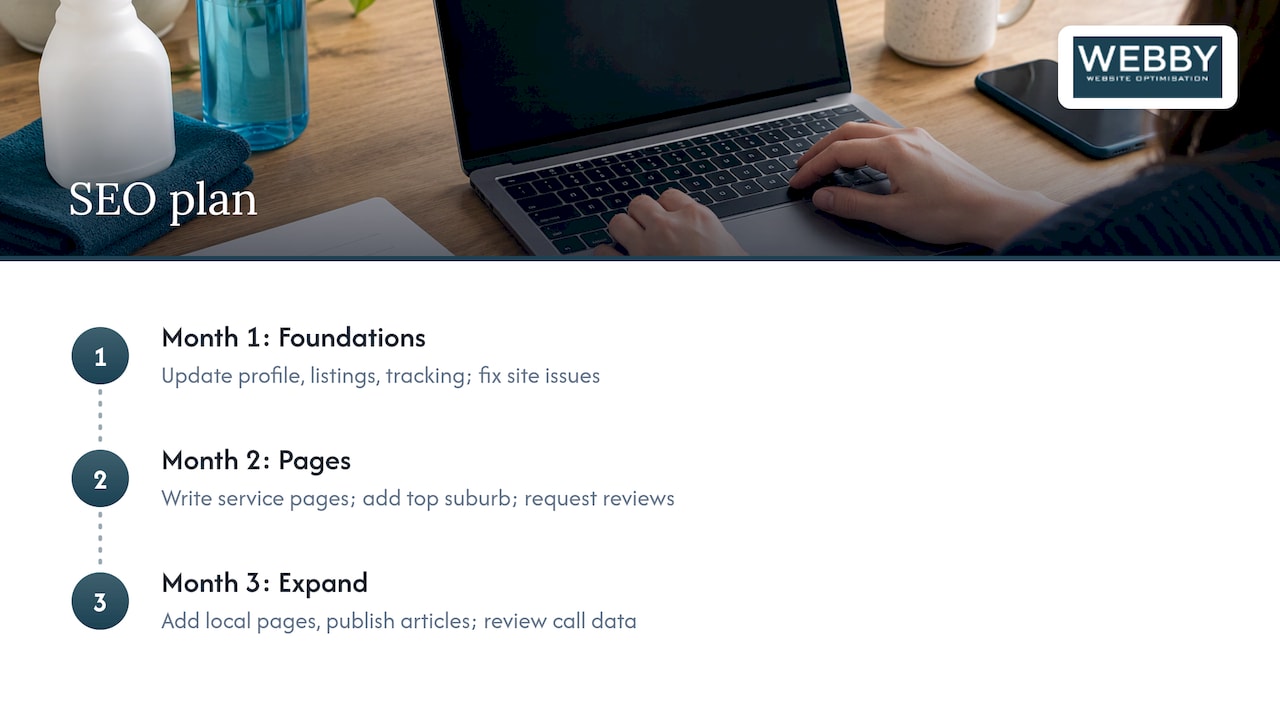
Month 3: expand. Add further suburb pages with real local detail, publish one or two helpful articles, and look at your first set of numbers. Double down on what is bringing calls.
Our perspective
We work with local service businesses across Perth, Fremantle and Melville, and the pattern with cleaners is consistent. The businesses that do the work well are often invisible online, while a competitor with an average service and a tidier website collects the enquiries.
Our view is that cleaning SEO should be treated as a lead system rather than a ranking exercise. The profile, the pages, the reviews and the enquiry form all have to work together, and if one is weak it holds back the rest. That is why we look at the whole path from search to signed job instead of selling rankings in isolation.
We also believe in being practical about cost. A cleaner shouldn’t need a huge retainer to get the basics right. A proper audit shows what to fix first, and a fast, well-built WordPress site gives every other effort something solid to stand on.
Steve Doig
How we can help
If you would rather hand this to a specialist, we offer options at a few levels, depending on where your site is today.
- A Website Audit at A$1,250 one-off shows what is holding your site back in search and what to fix first.
- The Business Website Optimisation Campaign at A$3,125 one-off is for businesses that want the fixes carried out.
- A new site? Website Built in a Day is A$750 one-off.
- Ongoing WordPress help and support starts with Monthly Maintenance at A$59 per month.
- Our Search Engine Optimisation service is tailored to your suburbs and services.
Not sure where to start? Claim a free website audit and we will point out the quickest wins for your cleaning business.
FAQ
How long does SEO take to work for a cleaning company?
Most cleaners see early movement within a few months, with steadier lead flow after that. The timing depends on how competitive your suburbs are, the state of your current website and how consistently you add pages and reviews. Treat it as a long-term asset rather than a quick fix.
Do I need a website if I have a Google Business Profile?
Yes. Your profile helps you appear on the map, but your website lets you rank for each service and suburb, explain your pricing and build trust. Google also considers website links as part of how prominent a business is, so the two support each other.
Should I create a page for every suburb I service?
Only for the main ones, and only if you can add genuine local detail. Near-identical pages with a swapped suburb name add little. For smaller areas, a regional page that lists them is a better choice.
Is house cleaning SEO different from commercial cleaning SEO?
The foundations are the same, but the buyer differs. Home customers search by suburb and want quick quotes, reviews and a simple booking. Commercial buyers want details on insurance, supervision, after-hours access and references, so give each its own page.
How much should a cleaning business spend on SEO?
That depends on your goals and competition. A one-off audit is a sensible first step because it shows where the biggest gaps are before you commit to a larger project or an ongoing service.