

If you run a service-area business, the fastest way to build local visibility is to optimize your Google Business Profile and publish a handful of genuinely useful service area pages that prove you actually work in each town you claim. Everything else in local SEO supports those two assets. Start there: verify your GBP settings this week, then build one detailed service area page for your highest-revenue territory before you touch anything else.
TL;DR:
- Matching your Google Business Profile service area list with your website’s service area pages is critical, and discrepancies can harm your rankings.
- Build three to four unique service area pages with real proof, local testimonials, and distinct content for each suburb to avoid being flagged as spam.
- Implement structured data with precise
areaServedandGeoShapecoordinates, and maintain consistency of your NAP details across all platforms.- Focus on securing local backlinks from neighborhood blogs, sponsorships, and community pages that directly relate to your target areas.
- Use geo-grid rank tracking and monitor GBP Insights to evaluate your efforts, with noticeable improvements typically appearing within 3 to 6 months.
Table of Contents
- What Is a Service Area Business, and Why Does Local SEO Work Differently?
- How Do You Set Up Google Business Profile for a Service-Area Business?
- How Do You Build Service Area Pages That Actually Rank?
- What Technical Signals Tell Google Where You Actually Work?
- How Do You Prove You Actually Serve Each Area You Claim?
- Which Local Backlinks Actually Move the Needle?
- How Do You Measure Whether Your Service Area SEO Is Working?
- What Mistakes Get Service-Area Businesses Suspended or Penalized?
- Publisher Perspective and Field Notes From Webby
- How a digital marketing agency can help you execute this
- Sources
What Is a Service Area Business, and Why Does Local SEO Work Differently?
A service-area business, or SAB, is any company that travels to customers rather than serving them at a fixed storefront. Plumbers, mobile detailers, pest control operators, electricians, and landscapers all fall into this category. Google treats them differently on Google Business Profile: instead of dropping a map pin at your address, GBP hides your exact location and instead displays a shaded service area, or a list of the cities and postal codes you cover.
That distinction changes how ranking works. Google still leans on the same three local ranking factors, proximity, relevance, and prominence, but proximity gets complicated for an SAB because there’s no storefront to measure distance from. Google approximates using the searcher’s location and whatever service-area data you’ve provided.
This is exactly why a website has to pick up slack that a storefront business doesn’t need to worry about. BrightLocal’s guidance on GBP for service-area businesses points out that dedicated service area pages back up what you’ve told Google in your profile, giving search engines corroborating evidence that you actually work in a given town, not just that you’ve listed it.
A few things follow from that setup:
- Your GBP service area list and your website’s service area pages need to match, city for city.
- Relevance signals (categories, services, descriptions) matter more for SABs since proximity is fuzzier.
- A generic “we serve everywhere” homepage does almost nothing to help you rank in any specific suburb.
How Do You Set Up Google Business Profile for a Service-Area Business?
Get the profile right first. Everything downstream, reviews, citations, rankings, depends on this foundation being accurate.
- Claim and verify your listing. Use your real business name, and complete Google’s verification process (typically a postcard, phone call, or video verification for SABs without a public storefront).
- Hide your address if you don’t accept walk-in customers. Under business settings, toggle “I deliver goods and services to my customers” so your street address stays private while your service area still displays.
- Set your service area with real limits, not wishful thinking. Google lets you define coverage by city, postal code, or county, and its own guidance discourages going much beyond roughly a two-hour drive from your base, according to BrightLocal. Claiming many suburbs you rarely visit dilutes relevance instead of expanding it.
- Pick the most specific primary category available. “Residential Plumber” beats “Plumber,” which beats “Contractor.” Specificity here directly affects which searches you surface for.
- Add every service you offer with a short description, upload real photos of completed jobs and your crew, and keep hours and attributes (licensed, insured, free quotes) current.
- Link your GBP profile to the right page, not automatically your homepage. If a customer searching in Fremantle clicks through from your profile’s service area, send them to a Fremantle-specific page instead of a generic contact page. This single change often lifts conversion more than any ranking tweak.
- Build a review request flow that fires automatically after each completed job, timed for when the customer is happiest, usually within 24 to 48 hours of finishing.
Pro Tip: Set your GBP service areas to match your website’s service area pages exactly, down to the town name. A mismatch between what you claim in GBP and what your site backs up is one of the quieter reasons SABs stall out in the map pack.
How Do You Build Service Area Pages That Actually Rank?
A service area page, or SAP, is a dedicated URL built around one city or neighborhood you serve. Done right, it’s the single strongest piece of on-site evidence you have that you work where you say you work. Done wrong, it’s a template with a city name swapped in, and Google recognizes that pattern instantly.
Every effective SAP needs the same core elements:
- A headline naming the specific city or suburb, not a generic service term.
- A description of the exact services offered there, written for that audience’s likely concerns (a Fremantle waterfront property has different pest issues than an inland suburb, for example).
- Realistic response times or availability for that area.
- A local testimonial or two, ideally naming the neighborhood.
- Photos from actual completed jobs in that town, not stock imagery.
- An embedded Google Map centered on that service area.
- One clear call to action, a phone number or quote form, above the fold.
The uniqueness question is where most SABs get this wrong. Industry guidance from Search Engine Land’s breakdown of service area pages recommends that roughly 30 to 60% of each page’s content be genuinely unique to that location, local testimonials, finished-project photos, neighborhood-specific details, rather than boilerplate service copy repeated across every city page with only the town name changed.
Ten near-identical pages differing only by find-and-replaced city names is the textbook definition of a doorway page, and Google’s algorithms are built specifically to catch that pattern.
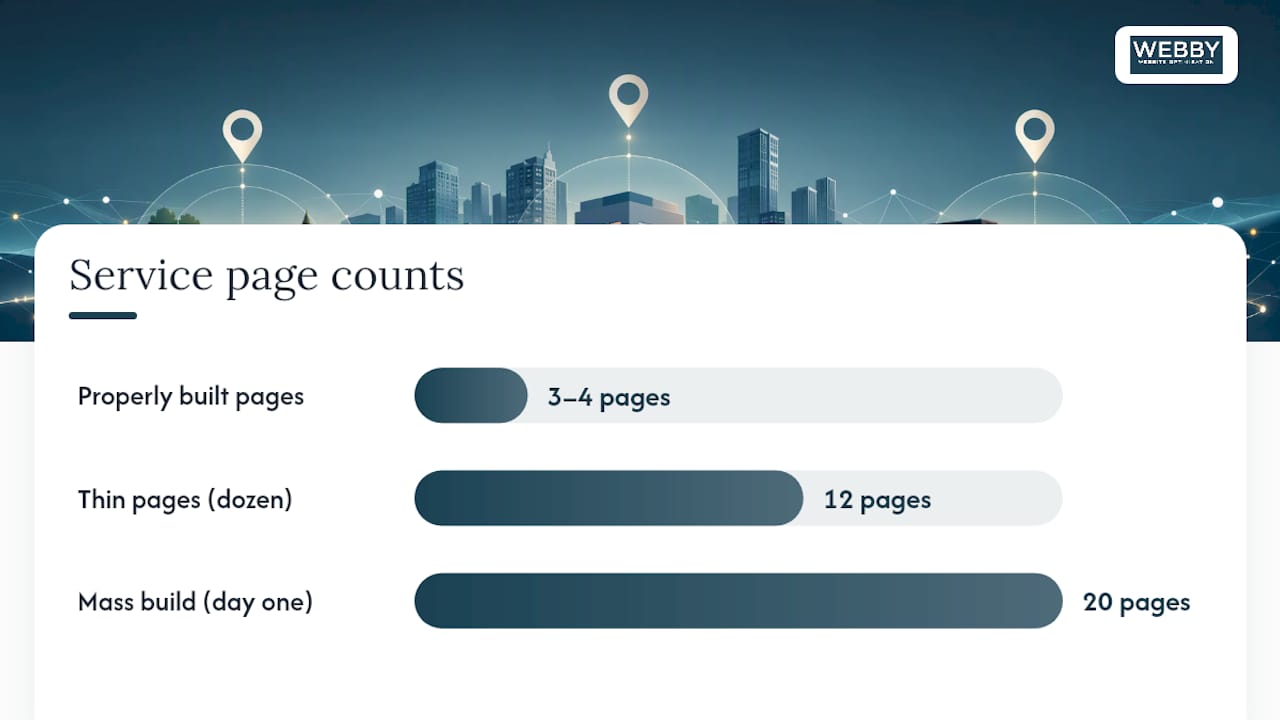
Practically, that means you probably shouldn’t build twenty SAPs on day one. Three or four pages built properly, with real local proof and distinct content, outperform a dozen thin ones every time. Each page also needs its own URL (not a filtered version of one master page), internal links pointing to it from your homepage and relevant service pages, and LocalBusiness schema identifying which area it covers. Webby Website Optimisation’s breakdown of what makes a service page convert is worth studying if you want to see this structure applied to a working page rather than described in the abstract.
One insight that gets missed constantly: a service area page only earns rankings if a real local visitor would find it useful. If the page reads like it was written for a search engine instead of a homeowner in that suburb, it usually won’t hold a position even if it briefly ranks.
What Technical Signals Tell Google Where You Actually Work?
Structured data does the heavy lifting of translating your service area into something crawlers can parse without guessing. The current standard, per Schema, is to implement LocalBusiness JSON-LD with an areaServed property listing each city or region you cover, and to add GeoShape coordinates when your territory doesn’t map cleanly to named places.
Consistency matters just as much as the schema itself. A LocalSearchForum discussion on best practices for designating service areas lays out why keeping your business name, phone number, and primary city (often shortened to NP+C) identical across your website, GBP, and every citation matters: inconsistency creates ambiguity, and ambiguous businesses rank worse than clear ones.
A few technical habits worth locking in:
- Put your NAP (name, address or service area, phone) in your site footer and repeat it on every SAP.
- Submit an XML sitemap that includes every service area page, and link to each one from at least two other pages on your site so crawlers find them easily.
- Run mobile speed checks specifically for your SAPs. Emergency-service searches (“burst pipe near me,” “locked out”) happen overwhelmingly on phones, often at odd hours, and a slow-loading page loses that customer to the next result.
Pro Tip: If your service area spans an irregular shape, like a coastal strip or a river-bound suburb, GeoShape coordinates communicate your territory far more precisely than a list of city names ever will.
How Do You Prove You Actually Serve Each Area You Claim?
Reviews and citations are your evidence file. Anyone can claim to cover twelve suburbs; proof comes from real customers, in real neighborhoods, saying so in their own words.
- Automate review requests, timed well. Send the request within a day or two of job completion, when satisfaction is highest and the work is still fresh in the customer’s mind.
- Prompt customers, gently, to mention their neighborhood. A simple line in your request template, “let people know which suburb we helped you in”, nudges reviewers toward language that reinforces your area coverage without feeling scripted.
- Audit your citations for NAP consistency, starting with the directories that carry the most weight (Google Business Profile itself, Apple Maps, Bing Places, and major industry-specific directories). Fix mismatched addresses or phone numbers first; they’re the most common cause of confused rankings.
- Mark up reviews with schema on your SAPs and pair them with real photos from completed jobs in that specific area. A written testimonial next to a photo of the actual driveway or backyard you worked on carries more weight than either alone. As Search Engine Land notes, embedding this kind of location-tagged proof of work is one of the most effective ways to demonstrate genuine presence in a target city.
Which Local Backlinks Actually Move the Needle?
Not all links carry equal geographic weight, and this is where a lot of SABs waste outreach effort chasing the wrong targets. A single mention from a neighborhood blog or a local sponsorship page often does more for your service area page’s ranking than a generic industry directory link with a higher domain authority score, because it signals genuine local relevance rather than raw popularity.
Worth pursuing:
- Write-ups on local news sites or neighborhood blogs covering a completed job.
- Sponsorship pages for local sports teams, school events, or community fundraisers.
- Partner or supplier pages that list you as a preferred local contractor.
- Council or community event listings, especially recurring ones that renew each year.
Pro Tip: Prioritize link opportunities by how tightly they map to a specific suburb, not by domain authority alone. A hyperlocal link from a town you’re actively trying to rank in usually outperforms a broader, higher-authority link with no geographic tie at all.
How Do You Measure Whether Your Service Area SEO Is Working?
Checking your rank for one keyword from your office chair tells you almost nothing about how you’re actually performing across a service area that might span fifteen suburbs. You need a geo-grid rank tracker, a tool that checks your rankings from multiple simulated points across your coverage zone, to see where you’re strong and where you’re invisible.
Pair that with GBP Insights, which shows calls, direction requests, and website clicks generated directly from your profile. Where possible, tie those actions back to actual booked revenue so you know which service areas are worth the investment and which aren’t.
- Track rank by neighborhood grid point, not a single citywide average.
- Monitor GBP actions weekly and connect them to your booking or CRM system if you can.
- Set expectations early: initial movement typically appears within 2 to 8 weeks, with meaningful ranking gains taking 3 to 6 months depending on competition.
- Run paid local ads alongside your organic push to capture immediate demand in a new territory while your SAPs mature, and track cost-per-booked-job by area so you know when to scale back the spend with expert help from Sun State Digital’s local SEO services.
What Mistakes Get Service-Area Businesses Suspended or Penalized?
Google suspends GBP listings for SABs more often than for storefront businesses, largely because SABs are more prone to the mistakes that trigger review.
- Never use a virtual office or PO box as your business address, even a hidden one. Google’s verification process checks for this, and getting caught means suspension, sometimes permanent.
- Don’t publish templated doorway pages. Ten pages that differ only by city name read as manipulation, not coverage.
- Don’t overclaim your service radius. Listing forty suburbs when you realistically serve ten dilutes relevance and looks suspicious to Google’s spam systems.
- Don’t let NAP details drift out of sync across your website, GBP, and citations, it creates the ambiguity that hurts every ranking signal downstream.
- Don’t ignore review requests. A profile with three reviews from 2023 signals inactivity, not trustworthiness.
| First quarter | Action |
|---|---|
| Week 1 | Verify GBP, correct service area limits, hide address if applicable |
| Weeks 2 to 4 | Build 3 priority service area pages with local proof |
| Weeks 3 to 5 | Add LocalBusiness schema with areaServed to each page |
| Ongoing | Launch automated review requests after every job |
| Weeks 4 to 8 | Secure 3 hyperlocal backlinks (sponsorship, local blog, partner page) |
Publisher Perspective and Field Notes From Webby
Most SAB owners treat their website like a brochure and their GBP like an afterthought. Flip that. Some clients hold flat rankings for months on generic “areas we serve” lists, then see the map pack shift within weeks of publishing three well-built, locally specific pages backed by real reviews. The pattern holds across trades: proof beats volume. Build fewer pages, make each one true, and keep your profile current. Owners who treat this as ongoing maintenance, not a one-time setup, consistently outlast competitors who set it and forget it.
— Steve Doig
How a digital marketing agency can help you execute this
Building this out properly, GBP audit, three priority service area pages, schema, and a review system that actually fires, takes real hours most owners don’t have between jobs. A specialist agency can run exactly this kind of audit: checking your current GBP settings, flagging service area mismatches, and identifying which one or two towns deserve a dedicated page first based on where your revenue actually comes from.
If your website is dated or was never built with service area pages in mind, Webby’s website design and development service covers the technical build, schema markup, and page structure this guide describes, done for you instead of pieced together between jobs. Some qualifying local businesses may also be eligible for Webby’s pro bono website design program. Reach out for a free audit and Webby will tell you exactly which three suburbs to target first.
Sources
For deeper reading: BrightLocal’s guide to GBP for service-area businesses covers profile setup; Search Engine Land’s service area page guide covers content uniqueness; Ahrefs’ local SEO guide covers measurement.
- Service Area Pages: Boost Local SEO Across Locations
- Local SEO for Service-area Businesses
- LocalSearchForum thread: best practice for designating service area
Recommended
- The Role of Service Page Structure in Getting Leads
- SEO Services Small Business a Guide to Local Growth
- Examples of Optimized Service Pages That Actually Convert
If this post raised some questions feel free to ask me a question