

Conversion rate optimization (CRO) is defined as the systematic, data-driven process of increasing the percentage of website visitors who complete a desired action, such as making a purchase, submitting a form, or booking a service. The industry term is CRO, though “conversion optimisation” is widely used interchangeably. Companies running formal CRO programs report an average ROI of 223% in 2026, which means every dollar invested in optimization returns more than three dollars in measurable business value. CRO is distinct from SEO, which drives traffic, and from UX design, which focuses on usability. CRO targets one specific outcome: turning more of your existing visitors into customers, leads, or subscribers.
What is conversion optimisation and why does it matter?
Conversion optimisation is the practice of removing friction between a visitor’s arrival and the action you want them to take. It is not about guessing what looks better. It is about using behavioral data, user research, and controlled experiments to make decisions that directly increase revenue.
The numbers make the case clearly. Average e-commerce sites convert at 1.7 to 2.0% of visitors, while top performers hit 4.7% or higher through systematic optimization. That gap represents doubled or tripled revenue from the same traffic budget, which is why CRO outperforms paid acquisition as a growth lever for most established businesses.

CRO also differs meaningfully from UX design. Good UX is a foundation for CRO but does not automatically guarantee high conversion rates. A site can be beautiful, easy to navigate, and still fail to convert because the offer is unclear, the call to action is buried, or the checkout process adds unexpected costs. CRO addresses those structural gaps directly.
Businesses that ignore optimization pay a real price. Sites not actively running CRO programs have seen a 6.1% drop in conversions recently, as competitors raise the bar and visitor expectations increase. Standing still is not neutral. It is a slow decline.
How does conversion optimisation improve business outcomes?
CRO works across two levels of user behavior: macro conversions and micro conversions. Macro conversions are the primary goals, such as a completed purchase or a signed contract. Micro conversions are the smaller steps that lead there, including email sign-ups, product page views, and add-to-cart actions. Optimizing micro conversions compounds into macro results.
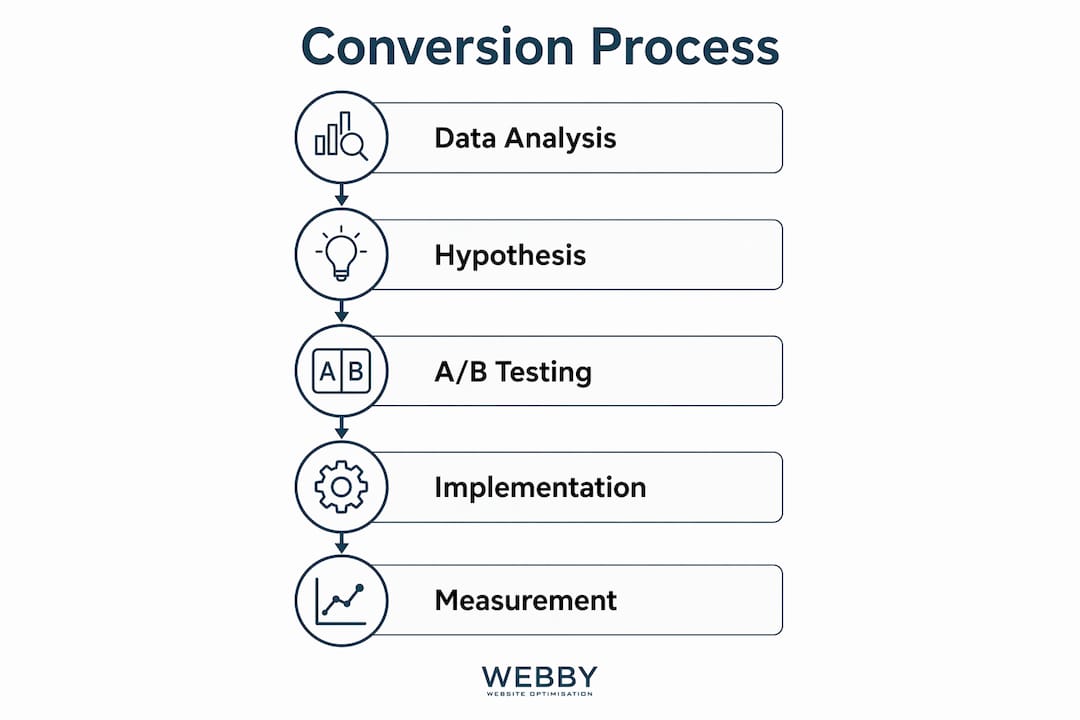
The most direct business impact comes from fixing funnel leaks. A funnel leak is any point where visitors drop off before completing the next step. Identifying the steepest drop in your funnel and fixing it first delivers more impact than any cosmetic redesign. Prioritizing funnel drop fixes over surface-level changes is the single most important principle in practical CRO.
Consider the cart abandonment problem. Cart abandonment averages 70% across e-commerce, driven primarily by surprise costs and complicated checkout flows. Showing total cost upfront and reducing form fields to the minimum required can recover a significant share of that lost revenue without spending a cent on additional traffic.
The financial math is compelling for any business owner:
- A service business generating 100 leads per month at a 2% conversion rate produces 2 customers.
- Raising that rate to 3% produces 3 customers, a 50% revenue increase with zero additional ad spend.
- Focusing on traffic instead of conversion is a costly mistake. Optimizing existing visitors drives more sustainable growth.
What are the best practices for effective conversion optimisation?
The most reliable conversion optimization techniques share one characteristic: they target structural problems, not cosmetic ones. Here are the highest-impact tactics, ranked by return on effort.
- Rewrite your calls to action. Generic CTAs like “Submit” or “Learn More” underperform specific, outcome-focused alternatives. Specific CTA text can increase conversions by up to 371%. “Get My Free Quote” outperforms “Contact Us” every time.
- Reduce form fields. The optimal range for lead generation forms is 3 to 5 fields. Every additional field you add reduces completion rates. Ask only for what you need to start the conversation.
- Fix your page speed first. A one-second load delay reduces conversions by 7 to 20%. Speed is not a technical nicety. It is a conversion variable. Review your mobile load speed before running any other experiment.
- Run structured A/B tests. Test one variable at a time with a clear hypothesis. Multivariate testing is useful for high-traffic pages where you need to evaluate multiple elements simultaneously.
- Audit your funnel with data. Use Google Analytics 4 or Microsoft Clarity to identify where visitors exit. Fix the biggest drop first.
Pro Tip: Never run a CRO experiment on a page that has not passed Core Web Vitals. Slow, unstable pages produce unreliable test data and skew your results toward false negatives.
A common mistake is treating CRO as a design project. Changing button colors or hero images without a data-backed hypothesis wastes testing cycles. The design of your site affects trust and therefore conversion, but only when changes are grounded in what your specific visitors actually respond to.
| Tactic | Impact level | Best for |
|---|---|---|
| Specific CTA copy | Very high | All pages |
| Reducing form fields | High | Lead gen pages |
| Page speed improvement | High | All pages |
| A/B testing headlines | Medium | Landing pages |
| Social proof addition | Medium | Product and service pages |
How does AI transform conversion optimisation in 2026?
AI has shifted CRO from a slow, manual discipline into a near-real-time feedback system. Where traditional A/B testing once required weeks to reach statistical significance, AI-powered tools analyze millions of behavioral interactions and surface winning variants in hours.
AI-driven CRO strategies yield 25 to 40% improvements by personalizing experiences in real time based on device type, traffic source, location, and on-site behavior. That level of personalization was previously available only to enterprise brands with large engineering teams. In 2026, it is accessible through platforms that integrate directly with WordPress and standard e-commerce stacks.
The key capabilities AI brings to conversion rate improvement include:
- Multi-armed bandit testing: Instead of splitting traffic 50/50 and waiting, bandit algorithms continuously shift traffic toward the better-performing variant, reducing revenue lost during the test period.
- Behavioral prediction: AI models identify which visitor segments are most likely to convert and serve them tailored content or offers before they show exit intent.
- Automated experiment deployment: AI reduces testing costs by 60 to 70% by automating hypothesis generation, variant creation, and result analysis.
- Emotion AI: Emerging tools analyze facial expressions and micro-interactions to measure emotional response to page elements, adding a layer of qualitative data that click tracking cannot capture.
“AI speeds up CRO from weeks to hours by analyzing complex interaction patterns, but it requires strong site speed and usability to be effective.” — How AI Transforms CRO in 2026
The critical caveat is that AI amplifies what already works. If your site is slow, your forms are broken on mobile, or your value proposition is unclear, AI tools will optimize a broken experience faster. A sales-ready website with solid technical foundations is the prerequisite, not the afterthought.
How to measure and sustain conversion optimisation success over time
A one-time CRO audit is not a strategy. Sustained conversion rate improvement requires a repeatable system with clear metrics, a regular testing cadence, and organizational commitment to acting on data.
- Set specific conversion goals before you test anything. Define what counts as a conversion for each page. A blog post might target email sign-ups. A service page targets phone calls or form submissions. Vague goals produce vague results.
- Use multi-dimensional attribution. Last-click attribution misrepresents which touchpoints actually drive conversions. Google Analytics 4’s data-driven attribution model distributes credit across the full customer journey, giving you an accurate picture of what is working.
- Maintain a high test cadence. About 87.5% of A/B tests produce no statistically significant result, but the tests that do succeed deliver 30 to 60% conversion lifts. Volume is the strategy. Running 50 tests per year and winning 6 of them compounds into substantial annual growth.
- Integrate CRO with your broader marketing calendar. Seasonal campaigns, product launches, and ad campaigns all affect baseline conversion rates. Isolate test periods from major traffic changes to keep your data clean.
- Document every test, win, and loss. A CRO knowledge base prevents your team from repeating failed experiments and builds institutional understanding of what your specific audience responds to.
Pro Tip: Segment your conversion data by traffic source. Organic visitors, paid visitors, and referral visitors often behave differently on the same page. A tactic that lifts conversions for paid traffic may have no effect on organic visitors.
Building a culture of experimentation means treating every failed test as useful data rather than wasted effort. The businesses that sustain CRO gains over years are the ones that institutionalize testing as a standard operating procedure, not a one-quarter initiative.
Key takeaways
Conversion optimisation delivers compounding revenue growth by fixing the structural gaps between visitor arrival and desired action, making it the highest-ROI investment for most established websites.
| Point | Details |
|---|---|
| CRO definition | CRO is the data-driven process of increasing the percentage of visitors who complete a goal action. |
| Business impact | Top-performing sites convert at 4.7%+ versus the 1.7-2.0% average, doubling revenue on the same traffic. |
| Highest-impact tactics | Specific CTA copy, reduced form fields, and page speed fixes deliver the fastest measurable lifts. |
| AI advantage | AI-driven tools yield 25-40% conversion improvements but require a solid technical foundation to work. |
| Sustained success | High test cadence and documented learnings compound CRO gains into long-term revenue growth. |
Why most businesses are still leaving money on the table
After working with local service businesses across Perth and Fremantle, the pattern I see most often is not a lack of traffic. It is a leaking funnel that nobody has bothered to measure. Business owners invest in Google Ads, SEO, and social media, then send that hard-won traffic to a page that loads slowly on mobile, buries the phone number, and asks for seven form fields before offering anything in return.
The uncomfortable truth about CRO is that most businesses treat it as a one-time project. They redesign the website, declare victory, and move on. Six months later, conversion rates drift back down because visitor behavior changes, competitors improve, and the market shifts. CRO is not a project. It is an ongoing operating discipline, the same way financial reporting or customer service is ongoing.
What I have found actually works is starting with the data before touching anything. Pull your funnel report, find the single biggest drop-off point, form a specific hypothesis about why visitors are leaving, and test one change. That process, repeated consistently, builds the kind of compounding growth that no ad campaign can match. The businesses I have seen achieve the strongest results are not the ones with the biggest budgets. They are the ones that commit to the process.
How Webby Website Optimisation can help you convert more visitors
Webby Website Optimisation works with local service businesses in Perth, Fremantle, and Melville to build websites that are technically sound and designed to convert. The approach starts with a thorough audit of your current site’s speed, mobile usability, and funnel performance, because fixing those foundations is what makes every other optimization effort work. From there, Webby implements data-driven changes to your calls to action, page structure, and lead capture forms. If your website is sending visitors away before they contact you, explore Webby’s conversion-focused web design services or request a free audit at webby.net.au to see exactly where your site is losing leads.
FAQ
What is the difference between CRO and SEO?
SEO increases the volume of visitors arriving at your site through organic search. CRO increases the percentage of those visitors who take a desired action once they arrive. Both are necessary, but CRO delivers more revenue from traffic you are already paying to acquire.
What is a good conversion rate for a website?
Average e-commerce conversion rates sit between 1.7% and 2.0%, while top-performing sites reach 4.7% or higher. For service-based businesses, lead form conversion rates above 3% are considered strong, though benchmarks vary by industry and traffic source.
How long does it take to see results from conversion optimisation?
Quick wins from CTA rewrites, speed fixes, and form simplification can show measurable results within two to four weeks. Statistically significant A/B test results typically require two to four weeks of data collection depending on traffic volume.
What tools are used for conversion optimisation?
Common CRO tools include Google Analytics 4 for funnel analysis, Microsoft Clarity for session recordings and heatmaps, Optimizely and VWO for A/B testing, and Hotjar for user behavior research. AI-powered platforms like Dynamic Yield add real-time personalization on top of these foundations.
Why do most A/B tests fail to show improvement?
Roughly 87.5% of A/B tests produce no statistically significant result, usually because the change tested is too small, the sample size is insufficient, or the hypothesis was not grounded in behavioral data. The solution is higher test volume and hypothesis-driven experimentation rather than random design changes.
Recommended
- What Is On-Page Optimisation? Your 2026 SEO Guide
- SME Website Design Best Practices That Convert
- What Is a Sales-Ready Website? Your 2026 Guide
- Examples of SEO Case Studies That Actually Work
If this post raised some questions feel free to ask me a question
Trackbacks/Pingbacks