
The big question: what does a website actually cost? In Australia, you can expect to pay anywhere from $3,000 for a simple 'brochure' style website to upwards of $25,000 for a fully-fledged eCommerce store. The final price tag really comes down to what you need your website to do for your business – the features, the level of custom design, and the overall complexity.
What Is the Real Cost of Web Design in Australia?
Trying to pin down the exact cost of a website is a bit like asking, "How much for a car?" There’s no single answer. Are you after a reliable sedan to get you from A to B, or do you need a custom-built truck kitted out for heavy-duty work?
A simple brochure site is your dependable sedan. It looks professional, clearly explains what you do, and makes it easy for customers to contact you. It’s a fantastic, cost-effective way to get your business online and establish that all-important credibility.
An advanced eCommerce store, on the other hand, is that purpose-built truck. It’s a sophisticated machine designed from the ground up to generate revenue, with a powerful sales engine, secure payment gateways, and inventory management all working in sync. Naturally, this requires a bigger investment because it’s a tool built for a much bigger job.
Australian Website Design Cost at a Glance
For small to medium businesses in Australia, figuring out which category you fall into is the first step to setting a realistic budget. A professionally built website isn't just an expense; it's a critical investment in your online presence.
To give you a clearer picture, here’s a quick summary of what you can typically expect to pay for different types of websites. This should help you get a ballpark idea of where your project might land.
| Website Type | Typical Page Count | Average Cost Range (AUD) |
|---|---|---|
| Basic Brochure Website | 5-10 pages | $3,000 – $7,000+ |
| Small eCommerce Store | 10-50 products | $8,000 – $15,000+ |
| Custom Feature-Rich Site | 15+ pages | $15,000 – $25,000+ |
| High-Converting Landing Page | 1 page | $1,500 – $4,000+ |
Most small businesses find their needs are met within the $5,000 to $10,000 range for a standard 6-10 page site, with the sweet spot often landing between $5,000 and $8,000. Simpler projects, of course, can start from around $3,500.
The real key is matching your investment to your business goals. Overspending on flashy features you'll never use is just as risky as under-investing in a site that can't keep up with your growth.
Our Transparent Approach for Perth Businesses
Here at Webby, we believe in being completely upfront with our Perth clients about costs, right from the get-go. Our focus is always on delivering tangible value, making sure every dollar you spend is directly linked to achieving your business goals.
We’ve put together a more detailed guide on how much a website costs if you want to dig deeper. It's also worth understanding the real cost to build an online shop, as this goes far beyond just the initial design and build.
The Core Factors That Shape Your Final Price
Ever wondered why one website quote comes in at $5,000 and another at $25,000? It’s a huge gap, but the difference isn't just a number pulled out of thin air. The final price tag for a website is a direct reflection of the time, skill, and resources needed to get the job done right.
Think of it like building a house. You can go with a standard project home design—it's efficient, affordable, and gets you a solid roof over your head. Or, you can hire an architect to create a completely custom home with unique features and high-end finishes. Both are houses, but the investment level speaks to the complexity and craftsmanship involved. It's the same deal with websites.
By understanding what goes into the cost, you can make smarter decisions that align your budget with what your business actually needs.
Template Design vs. Custom Creation
One of the first big forks in the road is deciding between a pre-made template and a fully custom design. This is basically the difference between buying a suit off the rack versus getting one tailor-made.
Template-Based Websites: We start with a professionally designed, pre-built layout. We then customise it with your branding—your colours, fonts, and content—to make it feel like yours. This approach is much faster and more budget-friendly, making it a brilliant choice for businesses that need a sharp, professional online presence without reinventing the wheel.
Custom-Designed Websites: Here, we start with a completely blank canvas. Every single element, from the menu navigation down to the style of the buttons, is designed and coded from scratch, purely for your business and your customers. It’s a deeper process involving strategy, user experience (UX) research, and unique development, which naturally means a higher investment. The payoff? A website that fits your brand like a glove.
A template gives you a fantastic foundation, but a custom design gives you the freedom to create a truly one-of-a-kind experience that can give you a real edge over your competition. The right choice really just comes down to your specific goals.
The Scope of Your Website
Putting the design approach aside for a moment, the sheer size and functionality of your site are massive cost drivers. Simply put, the more pages you have and the more you need your website to do, the more complex the build becomes.
A straightforward five-page brochure website is going to take far less time to build than a 50-page site with multiple service sections, a blog, and a library of case studies. Every extra page adds design, development, and content work to the project, which all adds up.
A common trap is thinking more pages equals a better website. It’s not about quantity. A great website has pages that each serve a clear purpose—whether that’s to capture a lead, make a sale, or answer a customer’s question.
Advanced Features and Functionality
This is where the costs can really start to climb. A basic website is there to present information. An advanced website is built to perform complex tasks, and each special feature needs expert development, integration, and a whole lot of testing to make sure it runs smoothly.
Here are a few common examples that add to the price:
- eCommerce Functionality: It’s not just about listing products. You need a full system with shopping carts, secure payment gateways like Stripe, and shipping calculators. It’s a mini-engine running inside your website.
- Booking and Appointment Systems: Need customers to book a time with you? Integrating a live calendar that syncs with your own schedule and takes payments requires some pretty careful technical work.
- Client Portals or Membership Areas: If you want to offer a secure, password-protected area for clients to log in and see exclusive content, you're looking at a sophisticated and custom feature.
- Custom Calculators or Quoting Tools: Building interactive tools—like an instant quote generator for your services—is a fantastic way to add value for your visitors, but it requires custom coding from the ground up.
Think of these features as specialised extensions. Each one needs an expert to install and configure it properly.
Content Creation and SEO Foundation
Finally, what you actually put on your website is just as important as how it looks. High-quality content and a solid foundation for Search Engine Optimisation (SEO) aren't optional extras; they're essential ingredients for a website that actually works for your business.
Writing clear, engaging copy that connects with your ideal customer and gets you noticed by Google is a real skill. You can absolutely supply your own content to keep costs down, but many of our clients find that professional copywriting makes a world of difference in getting their message across.
Likewise, good SEO is baked in from the beginning, not sprinkled on at the end. It’s about structuring the site logically, making sure it’s lightning-fast, works perfectly on mobile, and has all the right technical signals for Google. Investing in SEO from day one means your shiny new website won't just look great—it will actually get found by the people who matter.
Breaking Down Costs for Different Website Types
It’s a simple truth: not all websites are created equal, and neither are their price tags. The web page design cost is a direct reflection of what you need the site to do. Think of it like a tool – you wouldn't use a hammer to saw a plank of wood. The same logic applies here; you need to choose the right digital tool for the job.
Let's unpack the most common types of websites we build for small to medium businesses. Getting your head around these categories is the first step to matching your budget with a solution that will actually deliver a return.
The Foundational Brochure Website
Think of a brochure website as your digital business card, but better. It’s your virtual storefront, open 24/7, working tirelessly to build your credibility, show off what you do, and give potential customers an easy way to get in touch.
These sites are all about being clean, professional, and informative. They don't need all the bells and whistles like payment systems or customer logins. For most service-based businesses in Perth—consultants, tradies, local professionals—this is the perfect starting point. It gets the job done brilliantly.
- Key Pages: Home, About, Services, Contact, and maybe a Blog.
- Primary Goal: To generate leads and stamp your professional mark online.
- Typical Cost Range: $3,000 - $7,000+
This flowchart breaks down how the core elements like design, page count, and special features all stack up to influence the final cost.
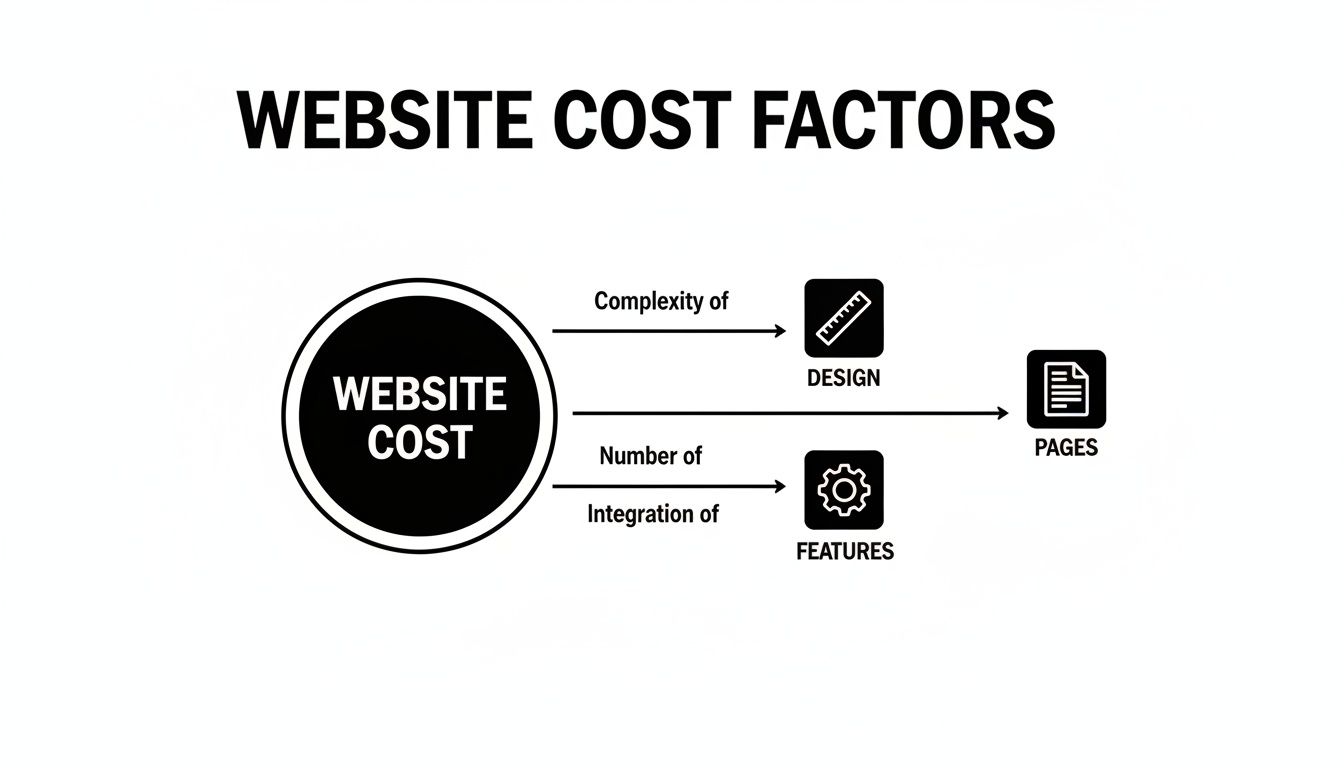
As you can see, every component adds another layer of work and complexity, which naturally scales the overall investment.
The Complex eCommerce Store
Now, an eCommerce website is a different beast altogether. This isn't just an online pamphlet; it’s a dynamic, round-the-clock sales machine. The entire point is to sell products directly to customers, which brings a whole new world of technical must-haves to the table.
Things like secure payment gateways, inventory management, customer accounts, and slick shipping integrations aren't optional—they're essential. Each piece of this puzzle needs careful development and serious testing to make sure your customers have a shopping experience that’s both smooth and secure.
Building an eCommerce store is less like designing a brochure and more like constructing a full retail outlet, complete with a cash register, stockroom, and customer service desk.
The investment is higher simply because the potential for direct, measurable revenue is built right into its DNA. For any business looking to sell online, a properly built eCommerce site is the engine for growth.
Lean and Mean Landing Pages
Finally, we have the landing page. Unlike a full website built for browsing and discovery, a landing page is a sniper rifle. It's a highly focused tool designed for one specific goal, usually as the destination for a marketing campaign like a Google Ad or social media promo.
The design is lean, persuasive, and ruthlessly efficient. It strips away all distractions—like navigation menus or sidebars—to guide the visitor towards one single, clear action. That could be filling out a form, downloading a guide, or clicking "Buy Now." The web page design cost is much lower than a full site, but its real value is its power to convert, making it an incredible tool for getting the most out of your advertising spend.
The Perth Advantage in Web Design
Here’s a little secret for businesses in Western Australia: you have a local advantage. Perth's web design market often delivers much better value compared to the eastern state capitals. A professional website here might cost between $4,000 and $8,000, which can be 30-35% less than what you'd pay for the same quality in Sydney.
This local market reality allows an agency like us to deliver exceptional, high-quality WordPress solutions at more accessible prices, without ever cutting corners on quality.
At Webby, we specialise in creating all three types of websites. Our job is to make sure the solution we build is a perfect match for your business goals and your budget. You can learn more about our website design and development services to see exactly how we help Perth businesses win online.
Budgeting for Your Australian eCommerce Store
Moving from a simple brochure website to a full-blown eCommerce store is a massive leap. It’s not just about adding a "buy now" button; it's about building an entire digital retail operation. Think of it as the difference between handing out a flyer and opening a physical shop—one informs, the other sells.
An online store is your 24/7 salesperson, your automated cashier, and your virtual stockroom, all working in perfect harmony. This complexity means a much deeper level of planning and technical know-how is needed, which naturally shapes the overall web page design cost. It's an investment in an asset designed to generate real revenue.
Core Components of an eCommerce Build
So, what are you actually paying for? The cost of an online store comes down to the essential machinery working behind the scenes. These aren't optional extras; they're the non-negotiable parts that ensure a customer can securely buy from you.
A professional eCommerce project will always include these critical components:
- Secure Payment Gateway Integration: This is how you get paid. It means correctly setting up trusted services like Stripe or PayPal to handle credit card transactions safely and securely.
- Inventory Management System: Your website needs to track what you have in stock, in real-time. This system automatically deducts items as they're sold, stopping you from accidentally selling a product you don't have.
- Shipping and Logistics Setup: This is where you configure shipping rates based on customer location, order weight, or value. It often involves connecting directly to services like Australia Post to streamline the whole process.
- Product Variations and Attributes: Selling a t-shirt in five colours and six sizes? Each of those combinations needs to be set up so customers can easily select exactly what they want.
It's easy to see how the scope can grow. A shop with 10 basic products is far simpler to build than one with 500 products, each with its own set of colours, sizes, and materials.
Typical eCommerce Investment in Australia
Given its complexity, building a quality eCommerce site in Australia requires a serious budget. Recent figures show the web page design cost for a small-to-medium online store typically falls between $8,000 to over $20,000. This price reflects the growing need for rock-solid security, flawless mobile experiences, and dependable back-end systems. You can always check out more detailed Australian cost breakdowns to see how custom features can influence the final price.
To give you a clearer picture, here’s a sample budget that shows how the costs might be allocated for a small Australian online store.
Sample eCommerce Website Cost Breakdown
| Feature/Service | Example Cost Allocation (AUD) | Why It's Important |
|---|---|---|
| Strategy & Planning | $1,500 | Maps out user journeys, goals, and technical needs to prevent costly mistakes later on. |
| Custom Design & UX/UI | $3,500 | Creates a unique, trustworthy brand look and ensures the site is easy and intuitive to navigate. |
| eCommerce Platform Setup | $4,000 | Configures the core shop functionality, including products, payments, and inventory. |
| Shipping & Tax Configuration | $1,000 | Automates complex calculations for different regions and product types, ensuring compliance. |
| Content & Product Entry | $1,200 | Professionally loads initial product data and writes compelling descriptions to drive sales. |
| Testing & Launch | $800 | A final check to find and fix bugs across all devices before going live to the public. |
| Total Estimated Cost | $12,000 | A realistic starting point for a professional, sales-ready eCommerce website. |
This table is just an example, but it highlights that building a successful store is about much more than just the design—it's about creating a reliable business tool.
Building an eCommerce store is like constructing a physical retail shop. You need a secure cash register (payment gateway), a well-organised stockroom (inventory management), and a reliable delivery system (shipping integration). Cutting corners on any of these can put your entire operation at risk.
At Webby, we specialise in building powerful, scalable eCommerce stores using WooCommerce, the world's most popular eCommerce platform for WordPress. We focus on creating a solid foundation that’s secure, easy for you to manage, and optimised to turn visitors into loyal customers.
What About the Ongoing Costs of Running a Website?
It’s a great feeling to finally launch your new website, but it’s a mistake to see that as the finish line. In reality, it’s just the beginning. The initial web page design cost is your upfront investment, but a bit like owning a car, there are running costs you need to plan for to keep it performing at its best.
Ignoring these ongoing costs is like buying a shiny new car and never taking it for a service. Sure, it’ll run great for a while. But sooner or later, small rattles turn into major, expensive breakdowns. Taking a proactive approach to your website protects your investment and makes sure it keeps working hard for your business.
The Bare Essentials: Your Annual Running Costs
Before we even touch on maintenance, a few fundamental costs are just part of the deal when you own a website. Think of these as the non-negotiable yearly bills that keep your site live and accessible to the world.
Domain Name: This is your unique address on the internet (ours is
webby.net.au). You rent it, you don't own it outright. It's a small but vital fee, usually between $15 and $30 per year, to keep it registered to you.Website Hosting: If the domain is your street address, hosting is the actual block of land your website sits on. It's the physical server space where all your files, images, and pages are stored. Hosting quality varies massively, with costs for reliable service anywhere from $10 to $60+ per month.
SSL Certificate: This is what gives you the little padlock in the browser bar, encrypting data between your site and your visitors. It’s a huge trust signal. Some hosts bundle this in, but a dedicated certificate can cost $20 to $100+ annually. It's an absolute must-have.
Why You Can’t Afford to Skip Website Maintenance
Beyond the basics, the most important ongoing cost is proper website maintenance. This isn't just about calling someone when things break; it's about actively keeping your site healthy, secure, and fast. The web is constantly evolving, with new software updates and security threats popping up every single week.
Neglecting website maintenance is a false economy. The cost of an emergency fix after your site gets hacked or crashes is always far greater than the small, regular investment in proactive care.
Regular maintenance is your first line of defence. It mainly involves keeping your website’s core software (like WordPress), themes, and plugins up to date. These updates aren’t just for new features; they often contain critical security patches that close loopholes before hackers can exploit them.
On top of that, maintenance ensures all the different software components of your site continue to play nicely together. An update to one plugin can easily cause a conflict with another, breaking something important like your contact form or checkout process. Regular checks catch these little dramas before they affect your customers.
Think of it as an insurance policy for your most valuable marketing asset. For a predictable monthly fee, you get peace of mind knowing your website is protected, backed up, and running smoothly. This frees you up to focus on your business, confident that your online presence is in safe hands. At Webby, our WordPress support and maintenance plans are designed to take all this off your plate so you never have to worry about the technical side of things.
How to Get an Accurate Quote for Your Website
Trying to nail down the cost of a new website can feel like you're chasing a moving target. But getting a clear, accurate quote isn't about guesswork; it's about preparation. The clearer you are about what you need, the more precise a web design agency can be with their estimate.
Think of it like getting a quote for a home renovation. You wouldn't just tell a builder, "I want a new kitchen." You'd talk about benchtops, cabinet styles, appliances, and the new layout. A website project brief does the exact same thing—it’s the blueprint for your digital home.
When you come prepared, you not only get a fair price but also show that you're an organised and serious client. It sets the stage for a great working relationship right from the start.
Crafting a Clear Project Brief
To get a quote you can rely on, your project brief needs to answer all the big questions upfront. This is your chance to get your vision out of your head and onto paper.
A strong brief doesn't need to be a novel, but it does need to be thorough.
Here’s what you should aim to include:
- Your Business Goals: What’s the number one job of this website? Is it to sell products directly, get people to fill out a contact form, or to act as a digital business card?
- Your Target Audience: Who are you actually trying to talk to? Describe your ideal customer—what problems are they trying to solve when they find you online?
- Must-Have Features: List the absolute non-negotiables. This could be anything from a blog and a booking calendar to a members-only area or a photo gallery.
- Competitor Examples: Pull together 2-3 examples of competitor websites you like. More importantly, explain what you like about them. Do the same for sites you dislike, explaining what you want to avoid.
A detailed brief is the single most effective tool for managing your web page design cost. It forces you to clarify your own needs and provides a solid foundation for every conversation with a potential design agency.
Smart Ways to Maximise Your Budget
Beyond writing a great brief, there are a few other things you can do to get more bang for your buck. These tips can reduce the hours an agency needs to put in, which often translates directly into savings for you. It also helps to know the right questions to ask, and this guide on 44 questions to ask before hiring a web design company is a fantastic starting point.
One of the best things you can do is prepare your content—all the text and images for the site—before the project kicks off. Having everything ready to go means the design and build process can flow smoothly without expensive delays.
Another smart move is to launch with a Minimum Viable Product (MVP). This just means starting with the absolute essential features you need to go live. You can always add the fancy bells and whistles in a second phase, once your website starts bringing in revenue.
Taking these steps means you're not just passively asking for a price; you're actively steering your project toward success. When you feel ready to start the conversation, you can use our simple tool to get an estimate for your Perth business.
Answering Your Top Questions About Web Design Costs
Thinking about building a new website naturally brings up a lot of questions, especially when it comes to the budget. It's a big investment, and you want to get it right. To help clear things up, we've tackled some of the most common questions we hear from business owners just like you.
How Long Does a Website Project Usually Take?
Honestly, it all comes down to the size and complexity of the job. For a straightforward brochure-style website with about 5-10 pages, we can usually get it designed, built, and live in around 4 to 6 weeks. The key here is having all your content ready to go and providing timely feedback along the way.
But if you're looking at something more involved, like an e-commerce store with unique features, you'll need to allow for a longer timeline. These projects can take anywhere from 8 to 16 weeks, sometimes more. There’s just more to it—setting up secure payment systems, configuring shipping rules, and running extensive tests to make sure every click is flawless for your customers.
Is It Cheaper to Hire a Freelancer or an Agency?
On the surface, a freelancer often looks like the cheaper option, and for a tiny, one-off project, they might be a good fit. But when you partner with an agency, you're not just hiring one person; you're getting an entire team of specialists—strategists, designers, developers, and project managers—all working together on your site.
An agency gives you a single point of contact, which makes communication a breeze, and a much higher level of accountability. While the initial quote might be higher, the comprehensive support, broad expertise, and long-term reliability you get from an agency often deliver far better value in the long run. It really just gives you peace of mind.
The choice between a freelancer and an agency isn't just about the initial cost. It's about how much risk you're comfortable with and the depth of skill your project truly needs.
Are DIY Website Builders a Good Alternative?
Platforms like Squarespace or Wix are great at marketing themselves as cheap and easy solutions. And for a hobbyist or a business on a shoestring budget, they can be a starting point. The problem is, they come with some serious limitations that can really hold a growing business back.
The main issues we see are:
- Limited Customisation: You're stuck with their templates. This makes it tough to build a truly unique brand identity or add the specific features you need to stand out.
- Poor SEO Performance: They’ve gotten better, but most DIY platforms just don't have the sophisticated SEO tools required to get you ranking well in Google searches.
- Ownership and Scalability: You never truly own your website. If your business grows and you need to move to a more robust platform like WordPress, you can't just take your site with you. You have to start all over again, which means that initial "saving" is lost.
While the initial web page design cost seems low, a DIY site often ends up being more expensive over time through missed opportunities and the inevitable cost of a professional rebuild. A professionally built WordPress site gives you 100% ownership, unlimited customisation, and the power to grow without limits.
At Webby Website Optimisation, we’re here to give you the expert support needed to keep your WordPress site secure, lightning-fast, and working hard for your business. Let us worry about the tech so you can focus on what you do best. Check out our WordPress Help & Support plans to see how we can help.