

Affiliate marketing is one of the most effective, performance-based channels you can add to your marketing mix. For Australian businesses, it’s a brilliant way to tap into new audiences by partnering with content creators, bloggers, and influencers who get paid a commission for driving real results, like sales or leads.
Laying the Groundwork for Your Australian Affiliate Program

Before you even think about reaching out to your first potential partner, you need to build a solid foundation. This is where you get everything straight—the strategy, the numbers, and the rules. A well-planned program is what separates the successes from the failures; it’s what attracts high-quality affiliates and keeps them motivated.
It all starts with deciding how you're going to pay them. This single decision shapes the appeal and profitability of your entire program.
Choosing Your Commission Model
So, how will you reward your partners for their efforts? The most popular model, especially for e-commerce, is Cost Per Acquisition (CPA). Here, you pay affiliates a set percentage or a flat fee for every sale they send your way. It’s simple, low-risk, and directly ties your spending to actual revenue.
If you’re a service-based business or have a longer sales funnel, Cost Per Lead (CPL) might be a better fit. With CPL, you pay for qualified leads, like someone filling out a contact form or signing up for a free trial. You'll also see Cost Per Click (CPC) models, but I'd advise caution—they can be prone to low-quality traffic and fraud.
You have to get your numbers right. A 10% commission on a high-margin software subscription is a world away from 10% on a low-margin physical product. You need to properly analyse your Customer Acquisition Cost (CAC) and profit margins to land on a commission rate that’s both sustainable for you and attractive to affiliates.
Your commission structure isn't just a number; it's a statement about how much you value your partners. A competitive yet sustainable rate is your best tool for attracting and retaining top-performing affiliates who will become true advocates for your brand.
At its core, affiliate marketing is a type of performance marketing, a field where you only pay for tangible outcomes. Understanding what is performance marketing can give you a great strategic perspective as you build out your program.
Navigating Australian Legal and Tax Obligations
Getting the legal and tax side right in Australia isn't just good practice—it's essential for building trust and protecting your business. You need to be crystal clear on disclosure, GST, and ABNs from day one.
The Australian Competition and Consumer Commission (ACCC) is very clear about this: your affiliates must disclose their commercial relationship with you. There’s no grey area here.
- Disclosure Rules: Guidelines from industry bodies like the Australian Association of National Advertisers (AANA) require affiliates to clearly label promotional content. Simple, obvious markers like #ad or #sponsored, or a clear statement like, "This post contains affiliate links," are the standard. Vague terms like "collab" or "thanks to" just don't cut it.
- GST and ABNs: You need a clear process for managing Goods and Services Tax (GST). If your affiliate is an Aussie business registered for GST, they must provide a tax invoice that includes GST on their commission, which you can then claim as a GST credit. For partners who aren't registered (like hobbyists earning below the $75,000 threshold), no GST applies. It is vital to collect and verify each partner's ABN and GST status when they join.
Ignoring these rules can lead to hefty fines and do serious damage to your brand’s reputation. The best approach is to create a comprehensive affiliate agreement that spells all this out. This, combined with smart keyword research to find the right partners, sets your program up for success. If you need a refresher, check out our guide on how to do keyword research. This groundwork ensures your program starts on a solid, professional footing, ready for growth.
Selecting Your WordPress Affiliate Technology
You've got your strategy sorted. Now for the crucial part: choosing the engine that will actually run your affiliate program. For Australian businesses on WordPress, this really comes down to two main paths. You can either use a self-hosted plugin that lives inside your website, or you can join an established third-party affiliate network.
This isn't just a technical choice. It's a fundamental decision that pits control against convenience, and upfront cost against ongoing fees. Getting this right from the start will save you a world of headaches later, letting you focus on building great partner relationships instead of fighting with your tech stack.
Self-Hosted Affiliate Plugins
Think of a self-hosted plugin as building your own affiliate program right inside your WordPress dashboard. A tool like the very popular AffiliateWP is a perfect example. You purchase and install the plugin, and suddenly you’re in the driver's seat, managing everything from within your own site.
The biggest win here is total ownership. You set the rules, the branding is entirely yours, and all the data belongs to you. You're not beholden to a network's changing terms or paying them a cut of every single sale. The cost is typically a one-off or annual fee for the plugin itself, and that’s it.
Of course, with great power comes great responsibility. This hands-on approach means you’re on the hook for everything:
- Recruitment: It's entirely up to you to find and convince affiliates to join your program.
- Payments: You're responsible for tracking every commission and making sure affiliates get paid on time.
- Support: When a partner has a question or a technical issue, you're the one they'll call.
- Creatives: All the banners, swipe copy, and unique links? That's on your to-do list to create and provide.
This option is a fantastic fit for businesses that already have a strong community or want to build a small, highly-engaged group of brand advocates. If you have the internal resources to handle the admin, it's an incredibly cost-effective way to go.
Third-Party Affiliate Networks
On the flip side, you have the big third-party affiliate networks. In Australia, the major players you’ll hear about are Commission Factory (which is part of the global Awin network) and Rakuten Advertising. These platforms are essentially giant marketplaces connecting businesses like yours with thousands of professional affiliates.
The main drawcard is immediate access and convenience. You plug into a massive, ready-made pool of partners who are actively searching for new products to promote. The network also handles all the heavy lifting—tracking, detailed reporting, and, crucially, payments. This alone can be a massive time-saver.
For many businesses, the real magic of a network is outsourcing the payment process. Networks consolidate payments from hundreds of merchants, paying affiliates one lump sum. This simplifies life for everyone and ensures partners see you as a reliable, trustworthy program.
This convenience, however, comes at a price. You'll typically face a setup fee, a monthly platform fee, and a "network override"—a percentage they take on top of the commissions you pay your affiliates. You also give up a lot of control; the affiliate dashboard is standardised, and you must play by the network's rules.
While you can still create custom-branded assets and dedicated landing pages (check out our guide to the best WordPress landing page plugins for great tools), the core affiliate experience is dictated by the network.
Making Your Decision
So, which way should you lean for your affiliate marketing in Australia? The right answer really hinges on your budget, your resources, and how fast you want to scale.
To make it clearer, let's compare the two options side-by-side.
Self-Hosted Plugin vs Affiliate Network Comparison
| Feature | Self-Hosted Plugin (e.g., AffiliateWP) | Affiliate Network (e.g., Commission Factory) |
|---|---|---|
| Control & Customisation | High. Full control over branding, terms, and user experience. | Low. Standardised dashboard and bound by network rules. |
| Cost Structure | Lower. One-time or annual plugin fee. No commission overrides. | Higher. Setup fees, monthly fees, and network commission overrides. |
| Affiliate Recruitment | Manual. You must find and onboard all partners yourself. | Easier. Access to a large, pre-existing pool of affiliates. |
| Admin & Payments | High Effort. You are responsible for tracking and executing all payments. | Low Effort. The network handles all tracking, reporting, and payments. |
| Technical Setup | Requires plugin installation and configuration within WordPress. | Requires placing a tracking script on your site. |
Ultimately, if you're just starting out with a tight budget and want to grow a close-knit community of partners, a self-hosted plugin is a brilliant, cost-effective choice.
But if your goal is rapid growth, you want to tap into a wide pool of professional affiliates from day one, and you'd rather outsource the admin burden, then investing in an affiliate network is a powerful move.
Getting Your Tracking and Reporting Dialled In
Once you’ve picked your affiliate platform, the real work begins. It’s an old saying, but it holds true: if you can't track it, you can't measure it. And if you can't measure it, you're just throwing money into the wind hoping something sticks. Solid, reliable tracking is what turns your affiliate program from a line item on your expense sheet into a predictable revenue stream.
This is where you graduate from simply watching link clicks to making genuinely data-driven decisions. The aim here is to make sure every single sale or lead from an affiliate is correctly tracked and attributed. It’s not just about paying the right commission; it’s about figuring out who your best partners are so you can double down on what’s working.
Laying the Foundation with Google’s Toolkit
For most Aussie businesses on WordPress, the go-to combination for tracking is Google Analytics 4 (GA4) and Google Tag Manager (GTM). Think of GA4 as your central data warehouse and GTM as the smart, flexible delivery system that sends all your tracking data to it—without needing a developer to tweak your site code every five minutes.
First things first, you need to get both GA4 and GTM installed correctly. GTM works like a container that holds all your other tracking scripts (or 'tags'), like your main GA4 tag and any specific conversion tags from your affiliate plugin or network. If you’re not yet familiar with GTM, our guide on what is Google Tag Manager is a great place to get your head around the basics.
With those two connected, you can start setting up custom events in GA4 that match your business goals. For an e-commerce store, the big one is obviously a purchase event. But don’t stop there. You can get much deeper insights by tracking micro-conversions, such as:
sign_up: When an affiliate sends you a new newsletter subscriber.generate_lead: For tracking contact form submissions from a B2B partner.add_to_cart: This helps you spot affiliates who drive high-intent traffic, even if those users don't buy on their first visit.
This kind of granular detail paints a much clearer picture of an affiliate's total value. You might find some partners are brilliant at introducing your brand to new audiences, even if they aren't the ones who close the final sale.
A Pro Tip: Get your UTM parameters right from day one. This is non-negotiable. Properly tagging your affiliate links with source, medium, and campaign details gives GA4 everything it needs to show you exactly which partners are driving traffic and—most importantly—revenue.
The flowchart below shows how your choice of technology (a self-hosted plugin vs. a network) sets the stage for how you'll approach this tracking setup.
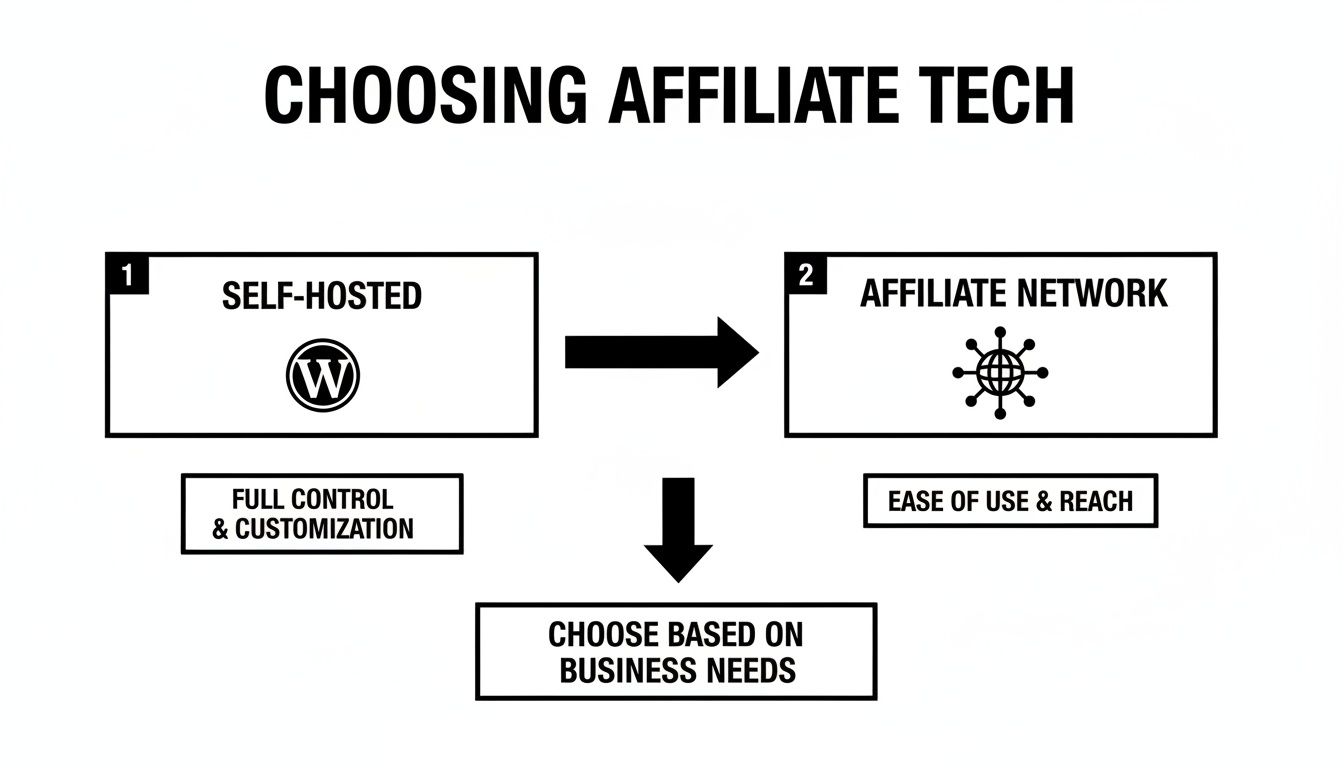
As you can see, both paths lead to the same destination: a robust tracking system. The only real difference is whether you're building it from scratch or integrating with a network's pre-built infrastructure.
Turning Data Into Dashboards and Payouts
With data flowing in, the next step is to make it useful. The built-in reporting in your affiliate plugin or network is a good starting point, but the real magic happens when you build your own dashboard in GA4 or a tool like Looker Studio.
This is where you can pull your affiliate performance data into the same view as other crucial business metrics, like average order value (AOV), customer lifetime value (LTV), and return on ad spend (ROAS). Suddenly, you can answer the questions that really matter, like, "Which affiliates send us customers who spend more over their lifetime?"
Getting this right is more important than ever. Affiliate marketing is booming in Australia, with the local market valued at $930 million AUD and global spending projected to hit $15 billion USD by 2026. With that much money in play, precise tracking is the only way to manage your budget effectively and stay ahead.
Finally, you have to get your affiliates paid. On time. Accurately. Nothing sours a great affiliate relationship faster than messing up payments.
- Self-Hosted Plugins: Most good plugins, like AffiliateWP, have direct integrations with payment gateways. You can often set up one-click or even fully automated payouts through Stripe or PayPal.
- Affiliate Networks: This is one of the biggest perks of using a network like Commission Factory. They handle all the admin, consolidating payments from all their merchants and paying affiliates on your behalf. It takes a huge weight off your shoulders.
Automating your payouts lets you get out of the weeds and focus on what you should be doing: nurturing your affiliate relationships and strategically growing your program.
Recruiting and Empowering Your Affiliate Partners

You've got the tech sorted and the tracking is ready to go. Now comes the part that truly makes or breaks your program: the people. An affiliate program is just a bit of software until you fill it with passionate, high-quality partners who genuinely believe in your brand.
This is where the real art of affiliate marketing in Australia comes into play. It’s not about chasing the biggest followings; it's about finding the right people and setting them up to win.
Identifying Your Ideal Affiliate Partners
Forget casting a wide, impersonal net. Your most powerful advocates are often already in your orbit. Before you look elsewhere, start close to home.
Dig into these groups first:
- Your Existing Customers: Who better to promote your products than the people who already love and use them? A simple email blast to your customer list announcing the new program can bring in some of your most authentic and effective partners right from the start.
- Industry Bloggers and Content Creators: Search for Australian bloggers, YouTubers, and podcasters who are already talking to your ideal customer. If you’re a Perth-based fashion label, for instance, you should be building relationships with Perth and Sydney fashion bloggers, not just faceless global influencers.
- Complementary Businesses: Think about non-competing businesses that serve the same audience. A local artisan coffee roaster could team up with a business selling high-end espresso machines. It’s a natural fit, allowing each of you to tap into a highly relevant customer base.
Interestingly, many Australian businesses think globally from day one. It's fascinating that over 70% of Aussie companies with affiliate programs target overseas markets, and a whopping 60% specifically focus on the US. You can find more on these global affiliate statistics on fintelconnect.com, but it highlights a bold, outward-looking mindset.
Mastering Your Outreach and Onboarding
Once you have a list of potential partners, the outreach has to be personal. A generic, copy-paste email is a one-way ticket to their trash folder. Show them you've done your homework.
Your outreach email isn't a sales pitch; it's an invitation to a partnership. Reference a specific blog post or video they created, explain the value your product brings to their audience, and make it clear what’s in it for them.
When they say yes, the onboarding process needs to be absolutely seamless. Don't just fire off a link and wish them luck. A big part of scaling your program is mastering the art of recruitment, and there are entire strategies on How to Recruit Affiliate Marketers that can set you up for long-term growth.
Your main goal here is to make it incredibly easy for them to get started. That means having a comprehensive affiliate toolkit ready to go.
Equipping Your Partners for Success
A well-equipped affiliate is a motivated one. Your job is to remove all the friction by giving them a "marketing-in-a-box" of high-quality, conversion-focused assets.
Here’s what every good affiliate toolkit should contain:
- A Welcome Guide: A simple PDF walking them through program rules, commission structures, payment schedules, and key contacts. Keep it clear and concise.
- High-Quality Creatives: This is non-negotiable. Provide a library of professional product photos, branded banners in all the standard sizes, and authentic lifestyle images.
- Swipe Copy: Give them pre-written copy for emails, social media posts, and product descriptions. This saves them a ton of time and ensures your core messaging stays on point, while still allowing them to adapt it to their own voice.
- Dedicated Landing Pages: This is a pro-level move that many businesses overlook. Instead of sending affiliate traffic to your homepage, create optimised landing pages just for them. A page with a clear call-to-action and tailored messaging can dramatically improve your conversion rates.
By providing these resources from day one, you’re not just giving them links; you're empowering them to become genuine brand ambassadors who can drive real, sustainable growth.
Managing and Optimizing for Long-Term Growth
Getting your affiliate program live is a huge milestone, but it's really just the beginning. The programs that truly deliver long-term value are the ones that are actively managed. Affiliate marketing in Australia is far too competitive for a 'set-and-forget' approach.
If you just let it run on autopilot, you'll see a slow, steady decline. The real work—and the real rewards—come from turning your program into an active revenue channel through constant optimisation and relationship building. This is what separates the top-tier programs from the rest.
Monitoring Program Health and Affiliate Performance
Once you're up and running, the first habit to build is a regular health check of your program. This isn't about micromanaging partners; it's about keeping a finger on the pulse to see what's working and, more importantly, what isn't. Get comfortable diving into your affiliate dashboard, whether that's inside a plugin like AffiliateWP or a network like Commission Factory.
Look for the outliers and the trends. Are sales overwhelmingly coming from just one or two partners? Has a previously high-performing affiliate suddenly gone quiet? These are the threads to pull on to uncover deeper insights.
At the same time, you need to be vigilant about fraud. It’s a reality of the channel, but you can protect yourself by watching for red flags:
- Unusually high click-through rates paired with almost no conversions.
- A sudden, massive spike in sales from a brand-new affiliate you've never heard of.
- Referral traffic coming from strange, irrelevant, or low-quality websites.
Catching and removing bad actors early on is essential. It protects your budget, maintains the integrity of your data, and ensures you're rewarding genuine partners.
Keeping Your Affiliates Engaged and Motivated
Think of your affiliates as a volunteer sales force—they need to be kept motivated. A competitive commission is your foundation, but the real magic happens when you introduce dynamic incentives that build loyalty and spark performance.
Tiered commission structures are one of the most effective ways to do this. For example, you could set a base rate of 10% commission, but automatically bump it to 12% for any partner who generates over $2,000 in monthly sales. For your top performers hitting $5,000 or more, you could offer a premium 15% rate.
This tiered approach gives your affiliates a clear roadmap to earning more. It gamifies performance and perfectly aligns their financial goals with your business growth.
Beyond static tiers, think about short-term performance bonuses. Offering a $200 cash bonus for the month's top affiliate or a prize for the partner who brings in the most new customers can ignite some friendly competition. And never underestimate the power of communication. A simple monthly newsletter with upcoming sales, new banners, and product highlights keeps your brand top of mind.
Diving Into Data for Optimization Opportunities
The data you collect is a goldmine for growth, but only if you know what you're looking for. By analysing performance, you can find clear opportunities to refine your approach and boost your conversion rates. This is standard practice in a competitive market; in fact, 68% of Australian retailers now actively use affiliate partnerships to find new customers. If you want to dig deeper, you can find more detail on Australian affiliate marketing trends on buzzinly.com.
Start digging into your dashboard and ask a few key questions:
- Who is sending the best traffic? Look past raw sales numbers. An affiliate whose traffic results in a higher average order value (AOV) or customer lifetime value (LTV) is incredibly valuable, even if their sales volume is lower.
- What products are affiliates promoting successfully? If you notice your top partners are all getting traction with a specific product, that's a huge signal. It might be time to create a dedicated landing page or new creative assets specifically for it.
- How are my creative assets performing? If one set of banners has a dramatically better click-through rate, get it in front of all your affiliates. Use it as a template to inform your future designs.
This constant feedback loop—analyse, refine, repeat—is how a good affiliate program becomes a great one. You're ensuring the valuable traffic your partners are working hard to send has the absolute best chance of converting. It’s how you build a scalable, predictable, and highly profitable part of your business.
A Few Common Questions About Affiliate Marketing in Australia
Once you start planning your affiliate program, a few big questions almost always pop up, especially around the local rules and financial details here in Australia. Getting these right from the beginning is key to building a compliant, trustworthy program that top affiliates will want to join. Let's clear up some of the most common uncertainties.
What Are the Legal Disclosure Requirements for Affiliates in Australia?
This is a big one. In Australia, you can't be subtle about commercial relationships. The rules, set out by watchdogs like the Australian Competition and Consumer Commission (ACCC) and industry bodies like the AANA, are crystal clear: if there's a commercial connection, it must be obvious to the average person.
This means your affiliates have to be upfront about the fact they might earn money from their recommendations. Ambiguous terms like "collab" or "thanks to [your brand]" just don't cut it. To stay compliant, they need clear, unmissable disclosures like:
- Hashtags: Simple and direct tags like #ad or #sponsored placed right at the start of a social media caption.
- Plain English Statements: A straightforward sentence on their blog or in a video description, such as, "This post contains affiliate links, which means I may earn a commission if you make a purchase, at no extra cost to you."
The core principle here is that the disclosure has to be impossible to miss. It can't be hidden in a footer or tucked away on a separate page. If a reasonable person could overlook it, you risk being seen as engaging in misleading conduct under Australian Consumer Law, which can cause serious problems for both you and your affiliate.
Do I Need to Handle GST on Affiliate Commissions?
Yes, you do, and how you handle it all comes down to whether your affiliate is registered for Goods and Services Tax (GST). This is something you absolutely need to confirm when you onboard a new partner.
Here’s the breakdown:
- If your affiliate is a GST-registered Australian business: The commission you owe them is considered a taxable supply. This means they must provide you with a tax invoice that includes 10% GST on top of their commission fee. Your business can then typically claim that GST amount back as a credit.
- If your affiliate is NOT registered for GST: This is common for smaller creators or anyone earning under the $75,000 annual GST registration threshold. In this situation, they simply invoice you for their commission amount, and no GST is involved.
- For overseas affiliates: As a general rule, GST doesn't apply to commissions paid to partners who are not based in Australia.
Make sure your onboarding process includes a step to collect and verify each affiliate's ABN and GST registration status. It's always a good idea to run your payment workflow past your accountant to ensure you're fully compliant with ATO requirements.
How Much Should I Pay My Affiliates in Commission?
Figuring out the right commission rate feels more like an art than a science because there isn't a single magic number. The goal is to offer a rate that's competitive enough to attract quality partners, but also sustainable for your own profit margins.
Commission rates vary wildly between industries. For digital products like online courses or software, where margins are high, it’s not uncommon to see commissions in the 20-50% range. In contrast, physical goods usually have tighter margins, so affiliate rates typically fall between 5-15%.
To find your own sweet spot, start by doing a bit of recon. See what competitors in your niche are offering in their affiliate programs. Then, run your own numbers. What's your average customer acquisition cost (CAC) right now? How much can you truly afford to pay for each new sale and still remain profitable?
A great strategy is to consider a tiered commission structure. You could, for instance, start everyone at a 10% base rate, but automatically bump them to 12% once they drive a certain number of sales per month. This directly rewards your top performers and gives everyone a clear incentive to promote you more.
Managing a WordPress site, optimising for conversions, and navigating technical setups like GA4 can be a huge drain on your time. Webby Website Optimisation offers expert WordPress help and support, handling everything from security and maintenance to performance and conversion rate optimisation so you can focus on growing your business. Let us keep your website fast, secure, and ready to convert your affiliate traffic. Learn more about our WordPress support services.
If this post raised some questions feel free to ask me a question
Trackbacks/Pingbacks