
To get cited in AI answers, make your pages easy to fetch, easy to quote and easy to trust. Let the right crawlers in. Put a direct answer at the top of each section. Keep your business details identical everywhere they appear. Then earn mentions on the third-party pages AI engines already pull from. None of this replaces SEO. It sits on top of it.
This guide is written for owners of Australian service businesses: plumbers, accountants, clinics, builders, trades and consultants. It covers what you can control, what you can’t, and what to do first.
TL;DR
- A citation is a link or attribution inside an AI-generated answer. Nobody can guarantee one, so treat it as a result of good fundamentals, not a switch you flip.
- Check that your site is crawlable by the bots that feed AI search, and that your key content is visible without JavaScript.
- Write each section as a self-contained block of roughly 150 to 300 words, with the answer in the first two sentences and the business name, claim and figure together.
- Fix inconsistent name, address and phone details across directories before you publish anything new, then get onto the “best of” and local lists engines already cite.
- Keep doing traditional SEO. Rankings and AI citations tend to rise together.
Table of Contents
- What a citation is, and why it isn’t a ranking
- Step 1: Let the right crawlers reach your site
- Step 2: Write passages an engine can lift
- Step 3: Fix your listings and entity details first
- Step 4: Get onto the pages engines already cite
- Step 5: Treat Google’s AI Overviews as part of SEO
- A 30-day plan for a local service business
- Our perspective: AI visibility is local SEO with the lights on
- Where we can help
- What not to expect
- FAQ
- Sources
What a citation is, and why it isn’t a ranking
A search engine ranks pages in a list. An AI answer engine reads several sources, writes one answer and sometimes attributes parts of it. That attribution is the citation. Semrush notes that AI systems don’t always cite sources at all: when a model answers purely from its pre-trained knowledge, there may be no citation to earn.
That changes what you are optimising for. You are no longer fighting for position three on a results page. You are trying to become the passage that an engine finds clean, accurate and low-risk to repeat.
Two more things matter for a small business.
Mentions and citations are different. A mention names your business. A citation links to your content. Both help, but a mention on someone else’s page often does more work for a local business than a link to your own.
Engines disagree with each other. In an analysis of 7,960 cited pages, 86.8% were cited by only one engine. Being cited in ChatGPT tells you little about Gemini or Google’s AI Overviews. Check each one separately instead of assuming a win in one carries over.
Step 1: Let the right crawlers reach your site
The cheapest fix is often the most overlooked. If a bot can’t fetch your page, it can’t cite it.
OpenAI publishes its crawler documentation and separates the bots by job. OAI-SearchBot is the one that surfaces sites in ChatGPT search answers. GPTBot is for training future models. You can allow one and block the other. For example, to appear in search answers while opting out of training, your robots.txt would include:
User-agent: OAI-SearchBot
Allow: /

User-agent: GPTBot
Disallow: /
OpenAI says changes can take about 24 hours to take effect. Whether you opt out of training is your decision. The point is to make it deliberately, because a blanket “block all AI bots” rule copied from a forum can quietly remove you from ChatGPT search.
Three checks to run this week:
- Open yourdomain.com.au/robots.txt and read every rule. Look for broad disallows left over from a site rebuild or a security plugin.
- View your key pages with JavaScript off. INITE points out that an assistant fetches the page and reads what it receives, so content that only appears after scripts run may not exist for it. Service descriptions, prices, hours and service areas should sit in plain HTML.
- Check your firewall and CDN. Some security settings block unfamiliar bots by default. If your host or a plugin is challenging every non-browser visitor, your content never reaches the engine.
Site speed and clean code help here too. A fast, stable WordPress site is simply easier for any crawler to read.
Step 2: Write passages an engine can lift
An engine doesn’t read your page the way a customer does. It pulls out passages. Practitioners describe these as chunks of roughly 150 to 300 words that answer one specific question. If the useful part of your answer only makes sense with the paragraph before it, the chunk loses its meaning when lifted.
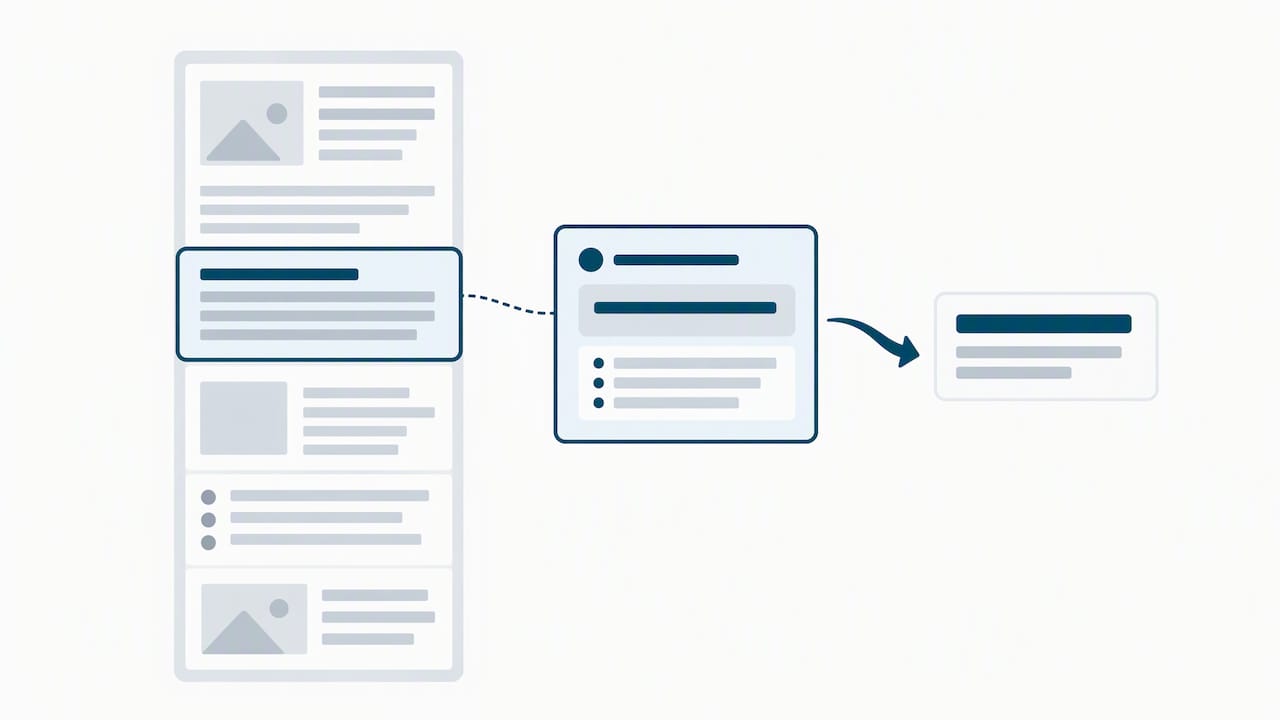
That suggests a simple writing habit.
Answer first, then explain
Put the direct answer in the first two sentences under each heading, then add the detail. Strategy guidance on getting cited in AI answers recommends this, along with headings that mirror the questions people actually ask.
Compare two openings for a page about blocked drains.
Weak: “We have been serving the community for many years and pride ourselves on quality.”
Stronger: “A blocked drain in Perth usually costs less to clear if you call before water backs up into the house. Here is how to tell whether it is a surface blockage or a root problem, and what each fix involves.”
The second version states a claim, names a place and promises a specific answer. An engine can lift it. A customer can act on it.
Keep the claim, the name and the proof together
Each block should contain the business name, the claim and the supporting detail (a date, a figure, a suburb) in the same passage. Don’t write “we” in one paragraph and put the business name two screens away. Don’t scatter your service area across a footer.
A useful test: copy any single section into a blank document. Can a stranger tell who is speaking, about what, and where? If not, rewrite it.
Help, don’t sell
People ask AI tools for solutions. Pages that identify a problem and solve it directly are easier to quote than pages built around a sales pitch. Put the offer in a clearly separate block after the useful content, not threaded through it.
Structure that costs little
- One question or topic per heading, in plain words.
- Short paragraphs and lists where the content is a list.
- A table for comparisons, such as service tiers or typical timeframes.
- Structured data (schema) for your business, services and FAQs, so the facts are machine-readable.
If your site architecture is messy, our guide on how to structure your website for SEO success is a good place to start before you rewrite anything.
Step 3: Fix your listings and entity details first
AI engines hedge when facts conflict. If your phone number differs between your website, Google Business Profile, a trade directory and a social page, an engine has less reason to trust any of them. INITE describes this as a lack of entity coherence and says engines prefer to cite brands whose third-party surfaces align. On this view, repairing old or disconnected listings can beat publishing new content.
For a local business this is good news, because it is dull, finite work you can finish.
Build a single source of truth. Write down the exact business name, address, phone number, opening hours, service areas, ABN and a one-line description. Decide on formats: “Pty Ltd” or not, “Street” or “St”, a landline or a mobile.
Audit where it appears. Check Google Business Profile, Bing Places, Apple Business Connect, Facebook, LinkedIn, industry associations, local chamber pages and the free directories that scraped your details years ago. Fix or remove anything that disagrees.
Then add new listings. Our walkthrough on how to build local citations for Australian businesses covers the order we’d work in.
The same logic applies to your own site. Use the same business description in your About page, your footer and your schema. Mention the suburbs and cities you serve in plain text, not only in a map embed.
Step 4: Get onto the pages engines already cite
This is where small businesses can gain the most ground. On “best X” questions, 61.8% of the cited pages in that same 7,960-page study were listicles. Engines lean on pre-vetted lists rather than judging every business from scratch.
For a Perth service business, that points to a concrete task:
- Ask ChatGPT, Gemini, Perplexity and Google the questions your customers type, such as “best electrician in Fremantle” or “who can fix a leaking roof in Melville”.
- Note which pages each tool cites. These are often local lists, association directories, review roundups and news features, not business websites.
- Work out how those pages choose who to include. Some take applications. Some pick by reviews. Some are editorial.
- Earn your place: join the association, apply to the directory, collect genuine reviews, offer a local journalist or blogger something useful and true.
This is the same idea we cover in the role of brand mentions in SEO: being named in credible places builds the signals that both search engines and AI engines pick up.
A caution. Pay-to-play lists that exist only to sell badges rarely help and can look spammy. Prioritise lists with a real editorial or membership standard.
Step 5: Treat Google’s AI Overviews as part of SEO
Google’s own guidance for site owners, AI features and your website, explains how AI Overviews and AI Mode work from a publisher’s perspective. The practical takeaway is that they draw on the same Search foundations: pages that are indexable, helpful and well-maintained. There is no separate hidden formula to buy.
That matches what multi-platform research suggests. Semrush’s analysis reports that ranking keywords and AI citations rise together. So don’t split your budget into “SEO” and “AI”. Strengthen the one site and the one brand.
For a local service business, the foundations look like this:
- A Google Business Profile that is complete and active.
- Service pages for each service and each area you actually serve.
- Genuine reviews that mention the service and the suburb.
- Fast pages that work on a phone.
- Content that answers real customer questions in full.
We go deeper in our guide to AI Overviews SEO and getting your business cited.
A 30-day plan for a local service business
Week 1: access and baseline
- Read your robots.txt and decide your position on OAI-SearchBot and GPTBot.
- View your top five pages with JavaScript disabled.
- Record a baseline: ask four or five customer questions in each AI tool and note whether you are mentioned, cited or absent. Save the date and the exact wording.
Week 2: entity clean-up
- Write your single source of truth for name, address, phone and description.
- Fix your website, Google Business Profile and the top ten directories.
- Add or correct LocalBusiness schema.
Week 3: content
- Pick the five questions customers ask most.
- Rewrite or create one page for each, with the answer in the first two sentences and a 150 to 300 word block per section.
- Add a short FAQ with real questions, and put dates on anything that can change, such as prices and timeframes.
Week 4: third-party presence
- List the pages the AI tools cited in week 1.
- Pick the three that are realistic to get onto and start the application or outreach.
- Ask recent customers for reviews that name the service and the suburb.
Then repeat the baseline test. Check monthly, and expect movement to be gradual and uneven. Citations change from one engine to the next and from one week to the next.
Our perspective: AI visibility is local SEO with the lights on
We work with service businesses in Perth, Fremantle and Melville, and what we see is that most owners ask about AI citations as if it were a new discipline. We don’t think it is. It is the old problem of being the clearest, most trustworthy answer to a customer’s question, now with a stricter reader.
Three things follow from how we work.
Start with the technical layer. Our strength is troubleshooting: finding why a page is slow, blocked, duplicated or unreadable. In our experience, a surprising share of visibility problems turn out to be plain access and consistency problems, not a lack of content. Fix those and everything you publish afterwards works harder.
Don’t buy a guarantee. Nobody controls what ChatGPT or Gemini says. Guidance from Rework is blunt on this point: anyone promising a citation is selling certainty they don’t have. If an agency, including us, promises placement, walk away. What we can promise is a clearer site, tidier data and a measurable plan.
Keep the customer in the room. A page written to be cited but not to convert wastes the visit. The person who clicks through from an AI answer is already well-informed and wants the next step: a quote, a booking, a phone call. Make that step obvious.
— Steve Doig
Where we can help
If you’d rather have a specialist check the foundations, a Website Audit is a one-off 1,250 AUD review of your site. It is a sensible first step for finding crawl, speed and structure problems before you invest in content.
If you already know the site needs work, our Business Website Optimisation Campaign is a one-off 3,125 AUD project. For ongoing search work, see our Search Engine Optimisation service. You can also start with a free website audit.
What not to expect
Be realistic about three things.
Results aren’t guaranteed or stable. AI answers vary by engine, by wording and over time. Track trends across several prompts, not single screenshots.
Not every query shows a citation. Some answers draw only on model knowledge, so there is nothing to cite.
Traffic may not match visibility. An AI answer can satisfy the question without a click. That is why being named and being the obvious next step matter as much as the link itself.
FAQ
Can I pay to be cited in ChatGPT or Gemini?
No, not directly. There is no legitimate placement product for organic AI answers, and anyone selling a guaranteed citation is promising something they can’t control. You can pay for the work that makes a citation more likely: a technical clean-up, better content and listings, and genuine third-party coverage.
Do I need to block or allow GPTBot?
That depends on whether you want your content used for training. OpenAI says OAI-SearchBot is the crawler for ChatGPT search results and GPTBot is for training, so you can allow the first and disallow the second. If you block both, you may disappear from ChatGPT search.
Is this different from normal SEO?
Mostly it isn’t. Google says AI Overviews and AI Mode build on Search, and research shows ranking keywords and AI citations rising together. The extra steps are crawler access for non-Google bots, passage-level writing and attention to third-party mentions.
How long does it take to get cited?
There is no reliable timeline. Crawler changes can take effect within about a day, but earning a place in answers depends on authority, listings and content, which build over months. Measure monthly against your baseline.
Where should a small local business start?
Start with access and consistency: robots.txt, visible HTML content and matching business details across directories. They cost little and they underpin everything else. Then write answer-first pages for your five most common customer questions.
Sources
- AI features and your website, Google Search Central
- Overview of OpenAI Crawlers
- How to Get Cited in AI Answers: What 7,960 Cited Pages Show
- What Are AI Citations & How Do I Get Them?, Semrush
- How to Get Cited by ChatGPT, Claude, Perplexity and Gemini, INITE
- How to Get Cited in AI Answers, Rework