
Carpet cleaning SEO is the work of making your business appear when someone in your service area searches for carpet, steam, rug or end of lease cleaning, and making that search end in a phone call or a booking. It comes down to four things done properly and kept up: a complete Google Business Profile, a website with a page for each service and each area you want work from, a steady flow of genuine reviews, and tracking that shows which searches turn into paid jobs. If you want those handled for you, our Search Engine Optimisation service is built for local service businesses like yours.
TL;DR
- Carpet cleaning is a local, urgent, high-intent search. Most of the work is winning the map results and the first page of Google for “near me” and suburb searches.
- Fully optimise your Google Business Profile, then build one strong page per service and per suburb you genuinely serve.
- Ask every customer for a review the moment the job is done and reply to each one.
- Track calls and form enquiries by source. Rankings matter only if the phone rings.
- Expect a few months before enquiries move, and fix the website or phone manner if traffic rises but jobs do not.
Table of Contents
- Why SEO suits carpet cleaning so well
- How people actually search for carpet cleaning
- Step 1: Claim and complete your Google Business Profile
- Step 2: Build a website that tells Google what you do and where
- Step 3: Publish content that answers real questions
- Step 4: Earn reviews and local links
- Step 5: Measure what matters
- What does carpet cleaning SEO cost?
- Paid search as a fast complement
- Common mistakes cleaners make
- Get a clear starting point
- FAQ
- Sources
Why SEO suits carpet cleaning so well
Most people do not shop around for a carpet cleaner for weeks. A red wine spill, a pet accident, a rental inspection or a pending sale creates a need today or this week. They pick up a phone, type something like “carpet cleaning near me” and call one of the first businesses they see.
That is why the search is valuable. Government guidance for small businesses describes SEO as the way search engines find and rank your content, so the right customers reach you when they are already looking. For a trade where demand is local and the buying decision is quick, being visible at that moment beats almost any other form of marketing.
The keyword also tells you something about competition. Plenty of cleaning businesses have an out-of-date website, an unclaimed Google listing or one generic “Services” page. A business that does the basics well can stand out quickly, and it does not need a large budget to do so.
How people actually search for carpet cleaning
Searches fall into a few patterns, and each deserves its own page or section on your site:
- Service searches: carpet steam cleaning, carpet stain removal, rug cleaning, upholstery and couch cleaning, mattress cleaning.
- Location searches: “carpet cleaning near me”, or the service plus a suburb or city name.
- Urgent searches: same day carpet cleaning, emergency water damage drying.
- Price searches: carpet cleaning quote, cheap carpet cleaning, carpet cleaning cost.
- Situation searches: end of lease or bond cleaning, pre-sale cleaning, commercial office carpet cleaning.
The situation searches are worth special attention in Australia. A tenant leaving a rental often needs a carpet clean with a receipt for the agent, and they search for exactly that. A page written for that need converts far better than a general carpet page.
Residential and commercial work also behave differently. Homeowners respond to price clarity, availability and reviews. Office managers and property managers look for reliability, after-hours slots and invoicing. If you want both, give each its own page rather than blending them.
Step 1: Claim and complete your Google Business Profile
For a local trade, your Google Business Profile (the free listing that shows your business in Google Search and Maps) does more work than your homepage. It is what appears in the map results above the ordinary listings.
The Australian trade magazine INCLEAN advises claiming the profile and filling in everything: categories, services, service area, opening hours, photos, FAQs and a booking link. It also recommends posting weekly with fresh job photos.
In practice, that means:
- Choose the right primary category. Pick the one that describes your main service, then add secondary categories for related work such as upholstery cleaning.
- List every service by name. Carpet steam cleaning, stain and odour treatment, rug cleaning and end of lease cleaning should each appear.
- Set your service area honestly. List the suburbs you actually travel to.
- Add real photos. Before and after shots of real jobs, your van and your team, not stock images.
- Answer common questions in the Q&A and FAQ fields: drying time, pet stains, how bookings work.
- Keep your hours accurate, including after-hours availability if you offer it.
Our guide to Google Business Profile topics goes deeper on setup for local service businesses.
Step 2: Build a website that tells Google what you do and where
Your website supports the profile. If it is vague, slow or hard to use on a phone, you lose both ranking and enquiries.
One page per service
A single “Services” page cannot rank for five different searches. Create a separate page for each main service: carpet cleaning, rug cleaning, upholstery cleaning, end of lease carpet cleaning, commercial carpet cleaning. Each page should explain the method, what it suits, how long it takes, what affects the price and how to book.
Suburb or city pages, built carefully
INCLEAN recommends separate service pages and city location pages. The risk is overdoing it: fifty near-identical pages with only the suburb name swapped is thin content, and it does not help. Build a page for an area when you really work there, when people search for it, and when you have something local to say: a job you completed, a review that names the suburb, a photo from a site nearby. Use a plain pattern such as “Carpet Cleaning in [Suburb]” in the URL, title and heading, and write most of the page specifically for that area.
Consistent business details
Your business name, address and phone number should match everywhere: your website footer, your Google profile, your social profiles and directories. Inconsistent details confuse search engines and customers alike. Put a tracking phone number or tagged contact form on the site so you can see where calls originate.
Speed, mobile and clear calls to action
Most carpet cleaning searches happen on a phone, often in a hurry. The page needs a tap-to-call button near the top, a short quote form and text that loads fast. A site that takes several seconds to appear loses the customer to the next result. Fixing speed and layout is the quickest improvement on many small business sites, and a Website Audit shows what is holding yours back.
Step 3: Publish content that answers real questions
business.gov.au recommends refreshing website content regularly and reviewing existing content at least every six months. For a carpet cleaner, useful content is practical and local:
- How long carpet takes to dry after steam cleaning.
- What a rental agent expects from an end of lease clean.
- How to treat common stains before the cleaner arrives.
- Pricing guides that explain what affects a quote, such as room count, stain level and carpet type.
- A case page with before and after photos from recent jobs.
Write as you would explain it to a customer on the phone. Then link these pages to your service pages so a reader who learns something can book in one click.
Google’s newer features are changing what gets clicked. Structured Data’s 2026 analysis of search results found local map results appearing on more searches year over year, while AI-generated answers took over more informational queries. The practical lesson: general how-to articles will earn fewer visits than before, whereas the local, commercial searches that lead to bookings are where your effort pays most. Put your best work into profile, service pages and reviews first, and treat articles as support.
Step 4: Earn reviews and local links
Reviews are the strongest trust signal for a local trade. Customers read them, and Google uses them. A business with a steady trickle of recent reviews looks like one that is trading and pleasing customers now.
The Australian Small Business Guide suggests asking every customer the moment the job is done, by SMS link or a QR code on the invoice, and replying to every review. Do not script what customers should write, and never offer rewards for reviews or post fake ones. Both break Google’s rules and risk getting your listing penalised.
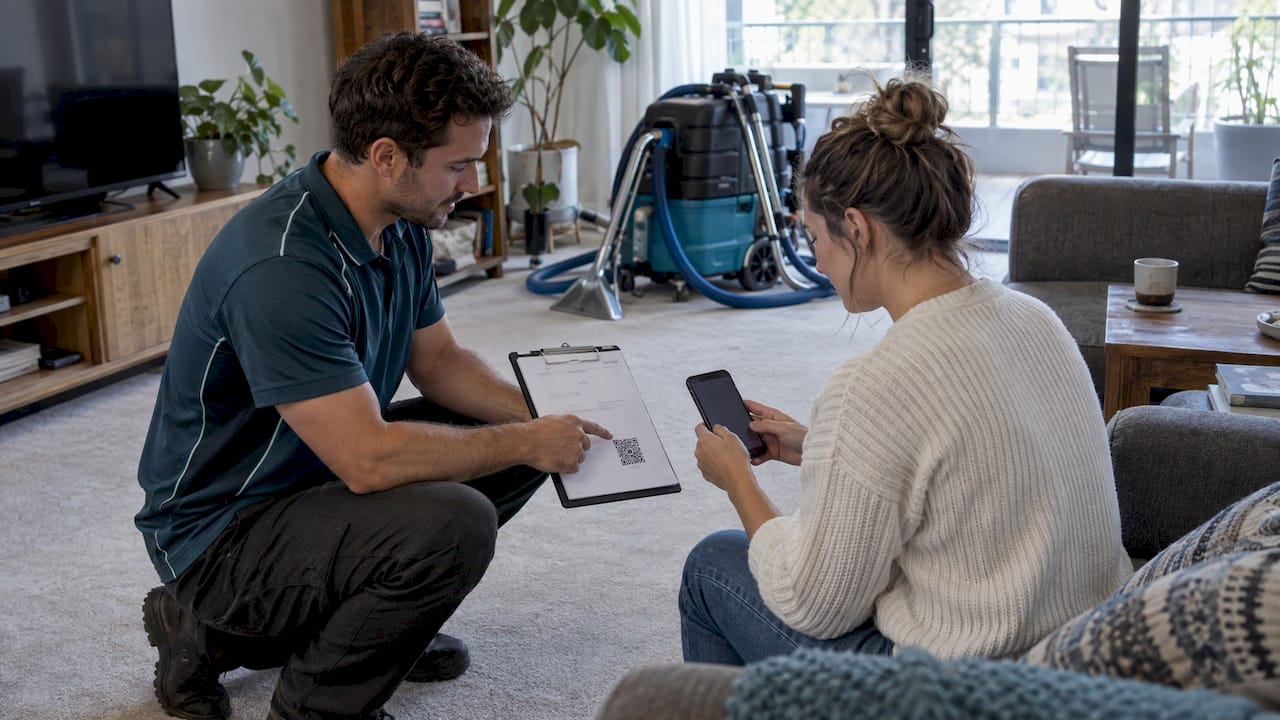
Links work the same way. business.gov.au explains that search engines treat links from other websites as votes of confidence, and that links from highly reputable sites carry more weight. For a local cleaner, good links are realistic and local: your chamber of commerce, a sporting club you sponsor, a supplier’s “where to find us” page, a local news mention, a real estate agency that recommends you. A handful of those beats hundreds of bought or directory-spam links, which can do harm.
Step 5: Measure what matters
SEO is easy to misjudge if you only watch rankings. A number-one position that produces no calls is worth nothing. INCLEAN suggests two core measures: your local map ranking for target terms, and the conversion rate of calls and forms from organic traffic. It also suggests that if either stalls, you publish another service or suburb page and add around ten new before and after photos within the month.
A simple monthly routine:
- Check your Google Business Profile performance report for calls, direction requests and website clicks.
- Use Google Search Console (a free Google tool showing which searches bring people to your site) and filter for suburb names.
- Log every enquiry with how the person found you. Ask them on the phone.
- Compare enquiries with booked and paid jobs, then work out what each job cost you to win.
INCLEAN puts a target of keeping customer acquisition cost under $25 to $35 per job, a useful reference point for working out whether your marketing is earning its keep.
On timing, the Australian Small Business Guide says that if traffic and visibility improve for around three months but enquiries do not, the problem is usually the website or how the phone is answered, not the SEO. That is a good reason to check your page layout, your quote form and your response speed early.
What does carpet cleaning SEO cost?
Any sensible price depends on how many service areas you cover, how competitive your city is and how much work your website needs first. Rather than guess, start with a diagnosis. Our one-off Website Audit is $1,250 and shows where your site, speed and local visibility stand before you commit to a monthly program. If the site itself needs work, our Business Website Optimisation Campaign is $3,125 one-off, and a new Website Built in a Day is $750 one-off. For ongoing care, WordPress Monthly Maintenance is $59 per month.
For a wider view of what small businesses need and what it costs, see our guides on essential SEO services for small businesses in Australia and cleaning company SEO in Australia.
Paid search as a fast complement
SEO builds over months. If you need calls sooner, paid search can fill the gap. INCLEAN describes Local Services Ads as pay-per-lead and says they often convert well for home services. It advises answering leads within 60 seconds and keeping a tight negative keyword list, so you are not paying for clicks from people searching “how to clean carpet yourself”. We also manage Google and Microsoft Ads for local service businesses, which can run alongside your SEO.
Common mistakes cleaners make
- Leaving the Google profile half-filled. Missing services, no photos and out-of-date hours cost you map visibility.
- Building dozens of copy-and-paste suburb pages. Pages need real local content or they add nothing.
- Using one page for every service. Each type of job deserves its own page.
- Ignoring reviews. Unanswered or stale reviews suggest an inactive business.
- Tracking visits instead of jobs. Measure calls and bookings.
- Slow, hard-to-use mobile sites. An urgent searcher will not wait.
- Buying links. Fast, cheap and risky.
What we tell cleaning business owners
A carpet cleaning business is one of the best fits for local SEO, because the customer is nearby, the need is urgent and the decision is made in minutes. The owners who win are not the ones with the cleverest tricks. They are the ones whose profile is complete, whose website loads fast on a phone and says plainly what they do and where, and whose reviews keep arriving.
The trouble is that you are busy cleaning carpets. The profile, the pages, the speed fixes and the tracking all need regular attention, and they stall when the diary fills up. That is where we step in. We work with local service businesses on SEO, WordPress website design, speed optimisation and conversion, with the aim of turning more searches into leads and sales.
Start by knowing where you stand. A proper audit of your site and local visibility turns a vague feeling that your marketing is not working into a short list of fixes in the right order.
Steve Doig
Get a clear starting point
If you run a local service business and want to know why your phone is not ringing more, start with a free website audit. We will look at how your site performs and where the local search opportunities are. When you are ready to put the work in our hands, our Search Engine Optimisation service covers the ongoing work, and you can also run a quick check with the SEO Inspector.
FAQ
How long does carpet cleaning SEO take to work?
Plan on a few months before enquiries clearly move. Profile and website fixes can help sooner, but rankings build gradually. If visibility improves for around three months and jobs do not, look at your website layout and how quickly calls are answered.
Do I need a website if I have a Google Business Profile?
Yes. The profile gets you into the map results, but the website explains your services, proves your work and ranks for service and suburb searches. The two support each other, and a fast, clear site turns profile clicks into calls.
How many suburb pages should I create?
Only as many as you can fill with real local content. Build a page for an area you serve, where people search, and where you can add a local job, review or photo. A few strong pages outperform dozens of near-identical ones.
How do I know if my SEO is working?
Track calls and form enquiries by source, then match them to booked jobs. Check your Google Business Profile report and Search Console each month. Rankings alone do not tell you whether the work is paying for itself.
Sources
- The lead machine: 5 steps to success, INCLEAN
- Improve your search engine rankings, business.gov.au
- Local SEO for Small Business: The Complete Guide, Australian Small Business Guide
- How AI Overviews Are Reshaping SERP Features in 2026, Structured Data