
Air conditioning SEO is the work of making your business show up when a local customer searches for an install, repair or service, and making that visit turn into a phone call. For an Australian aircon, HVAC or solar business, it comes down to three things: a complete Google Business Profile, a website with one clear page per job and per area, and a steady flow of real reviews. We build this for local service businesses, and the fastest way to see where you stand is a Website Audit.
TL;DR
- Most aircon and solar enquiries are won in the Google map results, so your Business Profile, reviews and service areas come first.
- Your website needs a page for each service and each area you cover, with a tap-to-call number, licence details and a short quote form.
- Google says local results rest on relevance, distance and prominence. You can influence relevance and prominence, not distance.
- Budget for SEO as an ongoing investment. Australian agency pricing commonly runs from $750 to $3,000+ per month.
- Solar installers follow the same playbook, with accreditation details and pre-purchase questions (cost, system size, rebates) added.
Table of Contents
- What air conditioning SEO actually means
- How Google decides who appears locally
- Step 1: Complete your Google Business Profile
- Step 2: Build a review habit
- Step 3: Give every job and every area its own page
- Step 4: Make the site convert on a phone
- Step 5: Answer enquiries quickly
- What it costs and how long it takes
- How search is changing
- Where to start this week
- Promo: a clear picture before you spend on SEO
- Our view
- FAQ
- Sources
What air conditioning SEO actually means
Someone’s system dies on a hot January afternoon. They pick up a phone and search “air conditioning repair” plus their suburb. Google shows a map with three businesses, then ads, then ordinary website results. The business that appears in that map, with a phone number one tap away, usually gets the call.
SEO is how you earn those spots without paying per click. It has three parts:
- Local presence. Your Google Business Profile, reviews and consistent business details.
- Website relevance. Pages that match what people type, such as “ducted air conditioning installation” or “split system repair”, for the places you serve.
- Conversion. A site that loads fast on a phone and makes it easy to ring or request a quote.
The search term “hvac seo” and “air conditioning seo” describe the same job. HVAC is the industry term for heating, ventilation and air conditioning. Australian customers rarely type it. They type “aircon”, “air conditioning” or “split system”, so your pages should use those words.
Solar installers face the same situation. The customer searches for an installer near them, sees the map results and compares reviews before calling. The sections below note where solar differs.
How Google decides who appears locally
Google states that local results are mainly based on relevance, distance and prominence. Relevance is how well your listing matches the search. Distance is how far you are from the searcher, or the location they named. Prominence is how well known you are, which Google says reflects signals such as links to your website and the number of reviews. Google also notes that more reviews and positive ratings can improve local ranking, and that complete, accurate profile information makes a business more likely to appear.
That gives you a practical split:
| Factor | Can you change it? | What to do |
|---|---|---|
| Relevance | Yes | Choose the right categories, list every service, write matching website pages |
| Distance | Mostly no | Set accurate service areas, use a real business address |
| Prominence | Yes, over time | Collect reviews, earn links, keep your profile active |
Because distance is largely out of your hands, the two levers that matter are relevance and prominence. Both reward patience and consistency.
Step 1: Complete your Google Business Profile
This is the highest-value hour you can spend. Work through it in this order:
- Primary category. Pick the one that matches your main revenue, for example air conditioning contractor or solar energy contractor, then add secondary categories for other services.
- Services. List each job separately: split system installation, ducted installation, repairs, servicing, commercial refrigeration if you do it.
- Service areas. Name the suburbs and regions you actually travel to. Listing places you do not serve invites poor-fit enquiries.
- Contact details. Use the same business name, address and phone number you use on your website and elsewhere online.
- Photos. Add real photos of your installs, your vans and your team. Add new ones regularly.
- Licence details. Mention your licence and insurance where the profile allows, since customers want reassurance before letting someone into their home. Solar installers can add their accreditation details the same way.
Businesses often set a profile up once and leave it. A profile that is complete and kept up to date gives Google more to match against searches, which is the point Google itself makes about complete information.
Step 2: Build a review habit
Reviews feed prominence directly, and they also decide whether a customer picks you once you appear. The routine is simple:
- Ask every customer, every job, shortly after it is finished.
- Send a direct link by text message so leaving a review takes under a minute.
- Reply to every review, good or bad, in a polite and specific way.
- Do not buy reviews or offer rewards for them. It breaks platform rules and puts your listing at risk.
The system matters more than any single review. A technician who mentions the link at the end of a job and a text that goes out the same day will outperform a once-a-year push.
For a deeper look at profile tactics, see our notes on Google Business Profile.
Step 3: Give every job and every area its own page
A single “Services” page that lists everything in one paragraph rarely ranks for anything. Instead, build a small set of focused pages:
- One page per core job: split system installation, ducted installation, repair, servicing, and so on.
- One page per main area: “Air conditioning installation in [suburb or region]”, written with real local detail such as the types of homes, climate and common problems.
- Brand pages if you install or service specific brands, written around the questions owners of those brands actually ask.
- Seasonal pages for cooling before summer and heating before winter, published and indexed ahead of the peak rather than during it.
Each page should say what the job involves, who it suits, how long it takes, a realistic price range where you can give one, and a clear way to book. Price ranges help customers qualify themselves, which means fewer time-wasting calls.
A common mistake is copying the same suburb page and swapping the place name. Google can see thin, repeated pages, and customers can too. Fewer, better pages beat dozens of clones.
Solar installers add a content layer here. Buyers research before they call, so pages that answer cost, payback, system size and rebate questions bring in people earlier in the decision. Keep rebate details tied to the official government pages and avoid stating figures that change without a source.
Step 4: Make the site convert on a phone
Most aircon searches happen on a phone, often under pressure. Check your own site on a handset and ask whether a stressed homeowner can act within a few seconds.
- A large tap-to-call number at the top of every page.
- Licence and insurance details near the top, not buried in an About page.
- A plain list of the suburbs you cover.
- Three or four real reviews with first name and suburb.
- Real install photos, not generic stock images.
- Fast loading on mobile data.
- A short quote form: name, suburb, phone and a box for “what is going on”, ideally with photo upload of the existing unit.
The form should be short. Every extra field loses some people. This is conversion optimisation, and it often delivers more extra enquiries than another round of ranking work, because it lifts the result from the traffic you already have.
A homepage that shifts emphasis between cooling and heating through the year is a nice touch for a business that services both.
Step 5: Answer enquiries quickly
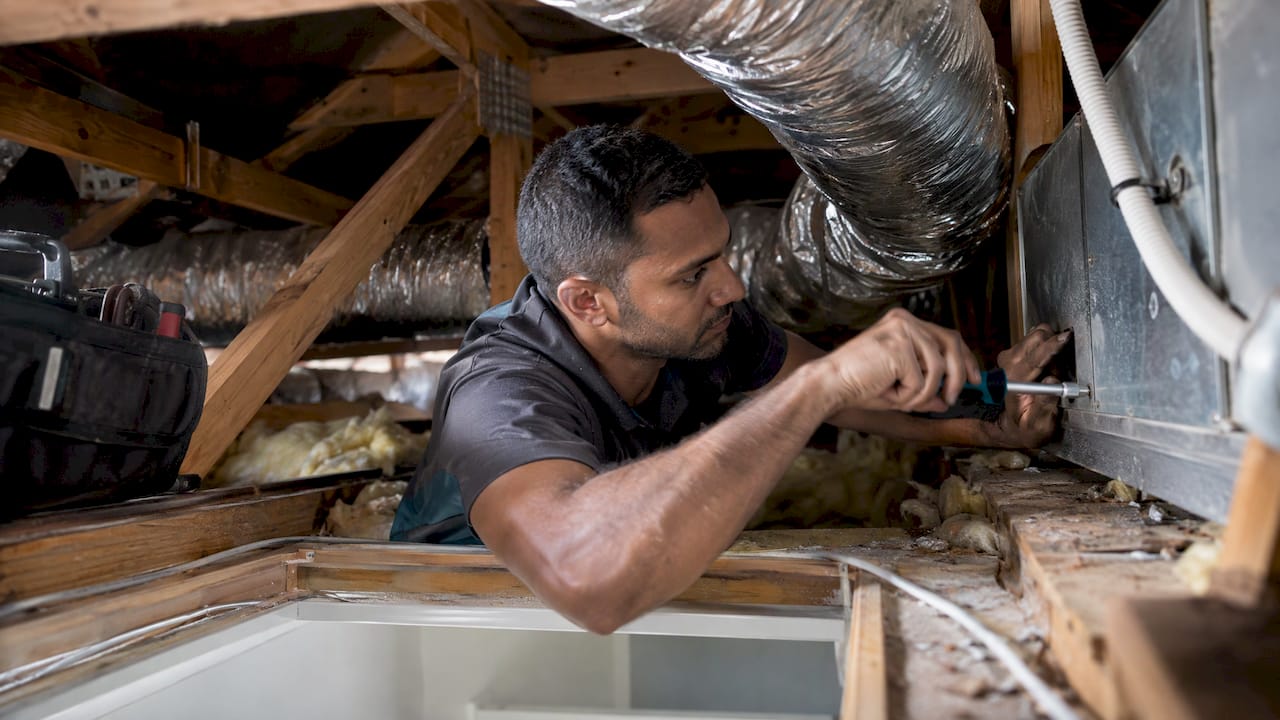
Ranking gets the call. Winning it is about response. Missed calls and slow replies to web forms are among the easiest leads to lose. Set up call forwarding or an answering process for peak days, and reply to forms and messages the same day. If you are on a roof or in a ceiling space, a text-back that confirms you received the request and will ring shortly keeps the customer from calling the next business on the list.
What it costs and how long it takes
Australian SEO is priced as a monthly service in most cases. One 2026 cost guide puts it at $750 to $3,000+ per month, with keyword competition and city the biggest swing factors. A tradie in a small regional town competes differently from one in a capital city suburb with dozens of rivals.
Two points help you plan:
- Timing. Local SEO is a compounding investment. Expect the first months to be spent fixing foundations, then gradual movement, not overnight results. Be wary of anyone who promises a fixed ranking by a fixed date.
- Scope. Compare what is actually done each month: profile management, page building, technical fixes, reporting. Compare the work, not just the price.
Our own guide to SEO pricing in Australia goes through what drives the figures. If your area is competitive, a local SEO approach built around your service area is usually more efficient than chasing broad national terms.
How search is changing
Search results are shifting, with AI-written summaries and map results taking more of the screen. The practical effect for a local trade is that the basics matter more, not less: accurate profile details, genuine reviews, clear service pages and consistent information across the web give any search system reliable facts about you. Businesses with thin pages and unclear details are the ones most likely to be left out.
Where to start this week
- Open your Google Business Profile and complete every field.
- Send a review link to your last ten customers.
- List your five most profitable jobs and check each has its own page.
- Test your site on a phone: can you ring in one tap?
- Review your quote form and cut it to the essential fields.
If you want a trained eye over all of it at once, that is what a site review is for.
Promo: a clear picture before you spend on SEO
Our Website Audit is a one-off $1,250 review of your website, so you know what is holding back your rankings and enquiries before committing to a monthly plan.
If you already know your site needs a full lift, our Business Website Optimisation Campaign is a one-off $3,125. For ongoing needs, our Search Engine Optimisation service is built for local service businesses, and WordPress care starts from a $59 per month Monthly Maintenance plan on our WordPress help and support page.
Our view
Most air conditioning and solar owners we speak to have the same problem: they are good at the job and invisible online. The fix is rarely a trick. It is a profile that is complete, a site that is quick and clear, and a habit of collecting reviews.
We design our work around local service businesses, which means pages written around the jobs you do and the places you serve, then a site that turns visitors into calls. Fixing speed, content and conversion together is how we aim to get more from the traffic you already earn.
Start with the foundations, measure what changes, and build from there.
Steve Doig
FAQ
Is SEO worth it for an air conditioning business?
For most local trades, yes, because customers search at the moment they need a job done and call one of the first businesses they see. Ranking in the map results and in ordinary results means enquiries without paying for every click. It takes months to build, so treat it as ongoing.
How long does SEO take for HVAC or solar companies?
Expect a period of foundation work first, then gradual improvement over several months. The timeline depends on your area and how strong the competition is. Quick wins usually come from fixing your Google Business Profile and your mobile site.
How many reviews do I need?
Google does not set a number. It says reviews and ratings can help local ranking, and that a business’s prominence counts. Aim for a steady flow of recent, genuine reviews rather than a fixed target.
Do solar installers need a different SEO approach?
The foundations are the same: profile, reviews, service pages. Solar adds content that answers pre-purchase questions about cost, system size and rebates, plus visible accreditation details. Buyers research longer, so this content reaches them earlier.