
Tree service SEO is the work of making your business appear when someone nearby searches for tree removal, stump grinding, pruning or an arborist. It comes down to three things: a Google Business Profile that is complete and busy with reviews, a website with one strong page per service and suburb you cover, and enough speed and trust that a visitor rings you instead of the next name on the list. Do those well and the phone rings with people who already need a tree dealt with.
This guide is written for tree business owners and managers. It explains what to fix, in what order, and where an experienced SEO partner saves you months of trial and error.
TL;DR
- Tree work is a local, urgent, high-value search: people want someone close, trusted and quick to quote. Your Google Maps listing and your service pages carry most of the result.
- Google weighs relevance, distance and prominence for local results, so a complete profile, accurate service areas and steady reviews come first.
- Build one page per core service (removal, pruning, stump grinding, emergency storm work) and one per area you serve, written the way customers actually describe the job.
- A slow, cluttered or hard-to-quote website wastes the ranking you earn. Speed, a visible phone number and a short quote form turn visits into jobs.
- Start with an audit so you know what is holding you back before you commit to monthly work.
Table of Contents
- Why SEO suits tree services so well
- How Google decides which tree service to show
- Step 1: Fix your Google Business Profile first
- Step 2: Build a website that matches what people search
- Step 3: Get the technical side right
- Step 4: Add content that earns trust and links
- What tree service SEO costs and how long it takes
- Where an SEO partner earns their fee
- Our perspective
- Start with an audit and a plan
- A simple 90-day plan
- Common mistakes to avoid
- FAQ
- Sources
Why SEO suits tree services so well
A tree that has dropped a limb on a fence, or a dead gum leaning towards the house, is not a project people research for weeks. They pick up the phone, search on it, and call one of the first few businesses they see. That behavior makes tree work one of the better fits for local search.
Three features of the trade work in your favor:
- High intent. Someone typing “tree removal near me” or “arborist [suburb]” wants a quote, not information.
- High job value. One removal or a large pruning job can pay for a good part of a month of marketing.
- Local competition only. You are not competing with the whole country. You are competing with the five or six tree businesses that serve the same suburbs you do.
The flip side is that those five or six competitors can be fierce, and the top three Maps results take most of the calls. The goal of SEO is to be in that group for the work you most want.
How Google decides which tree service to show
Google describes local results as a mix of three factors: relevance, distance and prominence. Search Engine Journal’s summary of Google’s guidance explains them like this: relevance is how well your listing matches the search, distance is how far you are from the searcher, and prominence is how well known you are, helped by reviews and ratings.
For a tree business, that translates into practical jobs:
| Factor | What it means for you | What you control |
|---|---|---|
| Relevance | Does Google understand exactly what you do? | Business category, services listed, website page content |
| Distance | How close are you to the person searching? | Accurate address or service area, consistent details across the web |
| Prominence | Do people know and trust you? | Reviews, ratings, links from local sites, a well-built website |
You cannot move your depot closer to every customer, so relevance and prominence are where you win. Both are within your control.
Step 1: Fix your Google Business Profile first
Your Google Business Profile is the listing that appears on Google Maps and in the box of three businesses above the normal results. For many tree services it brings in more calls than the website does, so it deserves the first week of effort.
Choose the right categories
Set your main category to the one that describes your core work, then add secondary categories for the other services you genuinely offer. Choosing a main category that is too broad makes Google less certain when to show you for specific searches.
List every service and describe it plainly
Add each service individually: tree removal, tree pruning, stump grinding, hedge trimming, emergency storm cleanup, arborist reports and so on. Write a short, plain description for each. Use the words your customers use, not trade shorthand.
Set service areas honestly
If you travel to customers, list the suburbs or council areas you actually cover. Listing the whole metro area when you only work in a handful of suburbs does not help you and creates calls you will not take.
Keep the basics accurate
Hours, phone number, website and photos should be current. Photos of real jobs, before and after, a crew at work and your trucks, tell a visitor you are a working business. Keep your name, address and phone number identical everywhere they appear online.
Earn reviews on a schedule
Reviews feed prominence, and Google says more reviews and positive ratings can improve a business’s local ranking. The simplest system is to send a review link by text the same day you finish a job, while the customer is looking at a clean yard. Reply to every review, good or bad, in a calm and specific way. A review that mentions the suburb and the job (“removed a large dead tree behind our house in Fremantle”) also helps Google match you to the right searches.
Step 2: Build a website that matches what people search
The website supports your Maps listing and wins the searches where Google shows normal results. Most tree service sites underperform for the same reason: one page tries to cover everything.
One page per core service
Create a dedicated page for each job you want more of. A typical set looks like this:
- Tree removal
- Tree pruning and lopping
- Stump grinding and removal
- Emergency and storm damage work
- Arborist reports and assessments
- Hedge and shrub trimming
Each page should explain what the job involves, how you work, what affects the price, the kind of properties you handle, photos from real jobs and a clear way to request a quote. A page with 400 to 800 useful words and real photos will usually beat a thin paragraph.
Mind the words your customers use
In Australia, people use different terms for similar work: tree removal, tree lopping, tree felling, tree cutting, arborist, tree surgeon. Customers often say “lopping” for work an arborist would call pruning or removal. Use the customer’s word in headings and the professional term in the body so you appear for both. Check how your own customers describe the job in their emails and calls, and mirror that language.
One page per area you serve
If you cover several suburbs or councils, create a page for each main area. These pages must be useful, not copies with the suburb name swapped. Mention local conditions, typical trees you see, the kinds of properties, nearby suburbs you cover and jobs you have completed there. Pages that repeat the same text with a different place name add little and can be treated as thin content.
Make the quote easy
Put your phone number at the top of every page and make it tap-to-call on mobile. Add a short quote form asking for name, phone, suburb and a photo of the tree. Fewer fields mean more enquiries. A person standing under a damaged tree will not fill in a twelve-field form.
Show proof
Insurance, qualifications, safety practices, equipment and before-and-after photos reassure a customer who is about to let a stranger work with a chainsaw near their home. State only what is true and can be shown, and put it where the visitor decides: next to the quote button.
Step 3: Get the technical side right
Technical SEO sounds heavy, but for a small tree business the essentials are short.
- Speed on mobile. Most searches for urgent tree work happen on a phone, often outdoors on a mobile connection. Large uncompressed job photos are the most common cause of slow tree service sites.
- Mobile layout. Buttons that are easy to press, text you can read without zooming, and a call button that stays visible.
- Secure site. The site should load over HTTPS with no browser warnings.
- Clean structure. Short, descriptive page addresses, a simple menu and links between related pages (from the removal page to the stump grinding page, for instance).
- Structured data. Marking up your business details helps search engines read them accurately.
If you are unsure how your site scores, a free scan such as our SEO Inspector shows the most visible problems in a few minutes.
Step 4: Add content that earns trust and links
Once the profile and service pages are working, content widens the number of searches you appear for. Good topics for a tree business come straight from the questions customers ask before they book:
- Do I need council approval to remove a tree on my property?
- How much does tree removal cost, and what changes the price?
- What is the difference between lopping, pruning and removal?
- What should I do after a storm drops a limb?
- When is the best time to prune different trees?
Answer these in your own words from your own experience and mention the rules that apply in your area, linking to your local council or state authority for the current requirements. Rules on protected or significant trees differ between councils and change, so always point readers to the official page rather than guessing.
Local links also matter for prominence. Sponsor a local sports club, join your local business group, or supply a quote to a local property manager’s resource page. A link from a real local organization says more than dozens of directory listings.
What tree service SEO costs and how long it takes

SEO builds over months rather than days. A new or rebuilt page needs time to be crawled and tested by Google, and reviews accumulate job by job. Be wary of anyone who promises a fixed ranking by a fixed date. Instead, track the things that tell you the work is moving: calls from your Business Profile, form enquiries, the number of search terms you appear for, and where your key pages sit.
As a guide to what working with us involves, these are our published prices:
| Service | Price |
|---|---|
| Website Audit | A$1,250 one-off |
| Business Website Optimisation Campaign | A$3,125 one-off |
| Website Built in a Day | A$750 one-off |
| Monthly Maintenance | A$59 per month |
| Monthly Updates | A$123 per month |
| Monthly Development | A$600 per month |
Our SEO and End-to-End Growth Engine™ services do not have a published price, because the right scope depends on your area, your competitors and your current site.
Where an SEO partner earns their fee
You can do a lot of this yourself, and the Business Profile steps above are a good start. The trouble is time. A tree crew is out on jobs all day, and the website and reviews get neglected until a slow month. An SEO partner pays for itself when it handles the parts that stall:
- Finding which pages and searches are costing you work, and ranking them by value.
- Rebuilding or speeding up a site so the ranking you earn turns into calls.
- Writing and publishing service and area pages on a regular schedule.
- Reporting in plain terms on calls and enquiries, not just rankings.
When you compare providers, ask what you will get each month, who does the work, and how results are reported. Choose one that explains its plan in plain words and works with local service businesses. Our guide to SEO services for small business covers the questions to ask in more detail.
Our perspective
We work with local service businesses, and the pattern repeats: the owner is excellent at the work and has never had time for the website. The business is busy through referrals, then a quiet month arrives and nothing is coming in from Google.
Our view is that SEO for a trade is not a bag of tricks. It is making your business easy for Google to understand and easy for a customer to choose. That means a complete profile, pages that match the jobs you want, a fast site and a simple way to get a quote.
That is why we begin with a Website Audit: it shows you what is holding the site back before you spend on anything else. From there we can optimize the site, build the pages that are missing and keep it running, so the work you earn on Google does not leak away on a slow or confusing website.
We prefer to be a local, hands-on partner who explains what we are doing and why, rather than an agency that sends a report you cannot use.
Steve Doig
Start with an audit and a plan
If you run a tree service and want more of your jobs to come from Google, the most useful first step is knowing exactly where your site and profile stand. Our Website Audit (A$1,250 one-off) reviews your website and sets out what to fix first. If you are ready to improve the site itself, the Business Website Optimisation Campaign (A$3,125 one-off) is our one-off project for it, and our Search Engine Optimisation service covers ongoing work to grow your rankings and enquiries.

If you would like to see where you stand first, you can claim a free website audit and talk through the results with us. Based in Perth, we work with local service businesses across Perth, Fremantle and Melville, and you can read more about SEO in Perth.
A simple 90-day plan
If you want a sequence to follow, this one fits around a working crew.
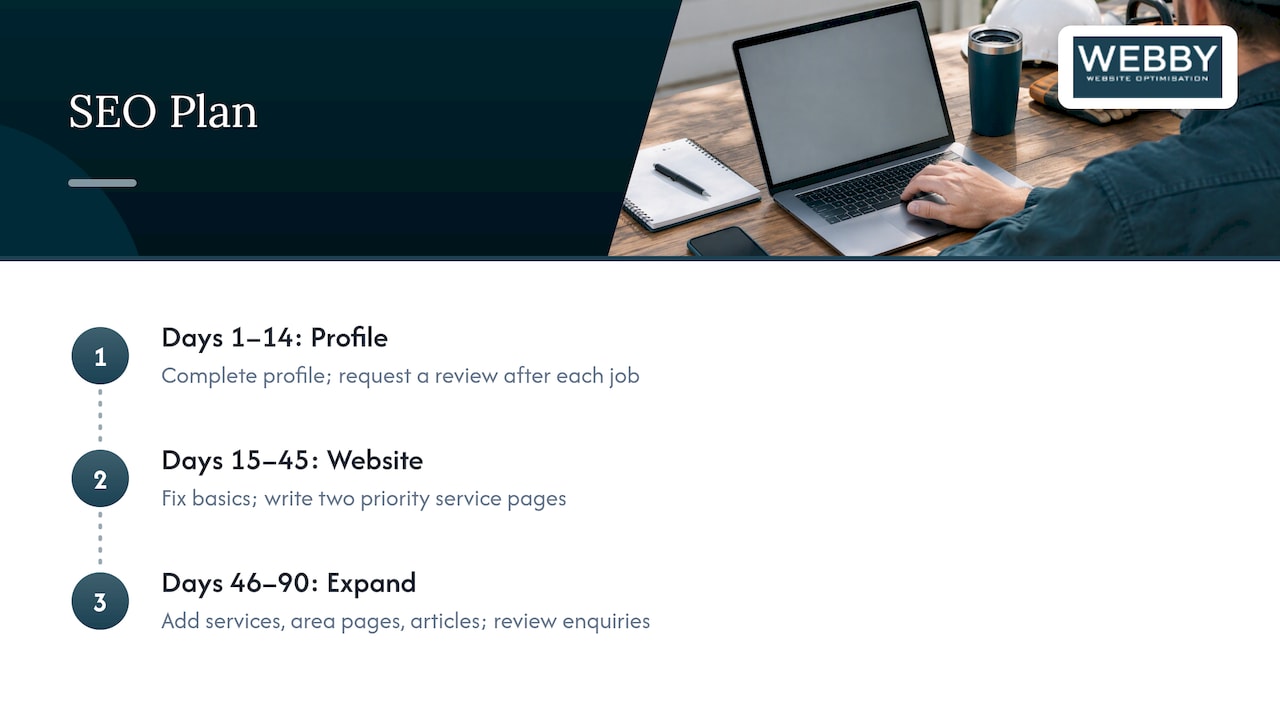
Days 1 to 14. Complete and correct your Google Business Profile: categories, services, areas, hours and photos. Set up a text message that asks for a review after each job.
Days 15 to 45. Fix the website basics: speed, mobile layout, tap-to-call number and a short quote form. Write or rewrite your two most valuable service pages, usually removal and pruning.
Days 46 to 90. Add stump grinding, emergency work and your main area pages. Publish two or three helpful articles that answer common customer questions. Review your calls and enquiries and see which pages are bringing them.
After that, repeat: add reviews, add pages for the next most valuable service or area, and refresh anything that has gone stale.
Common mistakes to avoid
- Using only one page for everything. Google cannot tell which job you most want, and neither can a visitor.
- Copying area pages. Swapping a suburb name in identical text adds little.
- Ignoring reviews. A profile with a handful of old reviews looks inactive next to a competitor with fresh ones.
- Hiding the phone number. Urgent customers will not hunt for it.
- Uploading huge photos. Slow pages lose the visitor before they read a word.
- Setting and forgetting. Hours, services and photos change, and search results move with them.
FAQ
How long does tree service SEO take to work?
Profile fixes and a faster website can show effects within weeks, while new pages and rising rankings usually build over several months. The speed depends on how competitive your area is and how much needs fixing. Track calls and enquiries rather than rankings alone.
Is Google Ads better than SEO for tree removal?
They do different jobs. Ads can bring calls quickly while you pay for each click, and SEO builds a steadier flow that keeps working without per-click costs. Many tree businesses use both, with the website and profile in good shape first so that paid clicks also convert. We manage Google and Microsoft Ads as well as SEO.
How many pages does a tree service website need?
Start with a home page, a page for each core service, a page for each main area you serve, and a contact page with a quote form. Add helpful articles over time. Every page should be useful on its own, not a copy of another.
Do reviews really affect my ranking?
Yes. Google states that more reviews and positive ratings can improve a business’s local ranking, as Search Engine Journal reports. Ask every customer, reply to each review, and keep the flow steady rather than collecting a burst.
Should I target “tree lopping” or “tree removal”?
Target both, on the right pages. Many Australians say lopping for work that is really pruning or removal, so use the customer’s word in headings and explain the difference in the body. Check your own enquiries to see which term your customers use most.