
Dentist SEO is the work of making your practice show up when someone nearby searches for a dentist, a specific treatment or an emergency appointment. For an Australian practice it comes down to three things: a well-kept Google Business Profile, a website with one clear page per treatment and per location, and advertising that stays inside AHPRA’s rules. Do those well and measure them by booked appointments, not by rankings alone. Everything below applies equally to physiotherapy and other allied health clinics, with the differences noted along the way.
The reader this is written for is the practice owner or manager who wants more of the right patients, not a lesson in algorithms. So each section says what to do, where it usually goes wrong and how to tell it is working.
TL;DR
- Most new patients choose from the map results and the first few organic listings, so your Google Business Profile and your treatment pages do most of the work.
- Build one page for each treatment you want more of (implants, Invisalign, emergency dentist, children’s dentistry) and one for each location you serve.
- AHPRA’s rules apply to your website and social media: testimonials about clinical care are not permitted in any advertising of a regulated health service.
- Track phone calls, form enquiries and booked appointments, not just clicks or rankings.
- Physio and allied health clinics follow the same playbook, with condition-based pages and referral-driven search behaviour.
Table of Contents
- What dentist SEO actually involves
- Step 1: Get your Google Business Profile right
- Step 2: Build treatment pages that match how patients search
- Step 3: Location pages for the suburbs you serve
- Step 4: The technical basics that hold everything together
- Step 5: Content that earns trust without breaking the rules
- Physio and allied health clinics: what changes
- How to tell whether SEO is working
- Perspective
- Where we can help
- Choosing an SEO provider for a practice
- FAQ
- Sources
What dentist SEO actually involves
Search engine optimisation (SEO) means improving your website and online listings so Google shows them higher for the searches that matter to you. For a dental practice, those searches are mostly local: “dentist near me”, “emergency dentist Fremantle”, “teeth whitening Subiaco”. Google answers them with a map block showing three businesses, followed by ordinary website results.
That gives you two places to compete, and they reward different work:
| Where you appear | What drives it | What you control |
|---|---|---|
| Map block (local pack) | Your Google Business Profile, how well it matches the search, distance and prominence | Profile accuracy, categories, photos, reviews, consistent name, address and phone number |
| Organic results below | Your website’s content, structure, speed and links from other sites | Treatment pages, location pages, page speed, mobile layout, schema markup |
Paid ads sit above both, and they stop the moment you stop paying. SEO is slower to build, but the traffic it earns does not come with a charge per click. A dentist keyword can carry a high cost per click in ads, which is one reason owners look at SEO as a steadier source of enquiries.
Step 1: Get your Google Business Profile right
Your Google Business Profile (GBP) is the free listing that feeds the map results. It is usually the highest-return hour you can spend, and the most common failures are simple.
- Choose the right primary category. “Dentist” is the obvious one, but if you are an orthodontist or a cosmetic dentistry practice, the primary category should say so. Add secondary categories for the services you actually provide.
- Keep name, address and phone number identical everywhere. Your website, GBP, Healthengine-style booking directories and social profiles should match character for character. Suite numbers and “Dr” prefixes are where mismatches creep in.
- List services individually. Each treatment gets its own entry with a short plain description.
- Use real photos. The reception, the surgery, the building entrance, the car park. Patients look for these to decide whether you feel approachable.
- Keep opening hours current, including public holidays and after-hours emergency arrangements.
- Use Posts and Q&A sparingly but accurately. An out-of-date offer on your profile is worse than none.
We cover more on this in our notes on Google Business Profile and in our wider look at local SEO in Australia.
Reviews: where health advertising rules bite
Reviews are a major trust signal, and this is where health practices differ from a plumber or a cleaner. AHPRA’s resource page states that testimonials are not permitted in any advertising of a regulated health service. It defines a testimonial as a positive recommendation about a clinical aspect of the service. Comments about customer service, such as friendly reception or easy parking, are not testimonials under that definition.
In practice:
- Do not copy patient comments about clinical results onto your website, into ads or into your own posts.
- Do not reshare or like a patient’s post praising their treatment.
- Ask your marketing provider to check any review widget on your site before it goes live, because many plug-ins pull clinical comments in automatically.
If you are unsure whether a specific piece of content crosses the line, check AHPRA’s advertising guidance or your professional body before publishing.
Step 2: Build treatment pages that match how patients search
The most common weakness we would expect on a practice website is a single “Services” page listing twenty treatments in bullet points. Google can only rank one page for one main topic, so a page that covers everything ranks for little.
Instead, build a page for each treatment that matters commercially:
- Dental implants
- Invisalign or clear aligners
- Teeth whitening
- Emergency dentist
- Children’s dentistry
- Check-ups and cleans
- Wisdom teeth
Each page should answer the questions a patient asks before booking:
- What is the treatment and who is it for?
- What does the process look like, visit by visit?
- How long does it take and how should I prepare?
- Roughly what does it cost, or what affects the cost? Patients leave pages that avoid the subject entirely.
- Who will treat me? A short practitioner profile with registration details helps.
- How do I book? A phone number and a booking button visible without scrolling on a phone.
Write as the clinician would explain it across the desk. Avoid promising outcomes. AHPRA’s advertising rules prohibit content that creates an unreasonable expectation of beneficial treatment, and wording such as “guaranteed perfect smile” is exactly the kind of claim to avoid.
Veneers, whitening and other cosmetic work
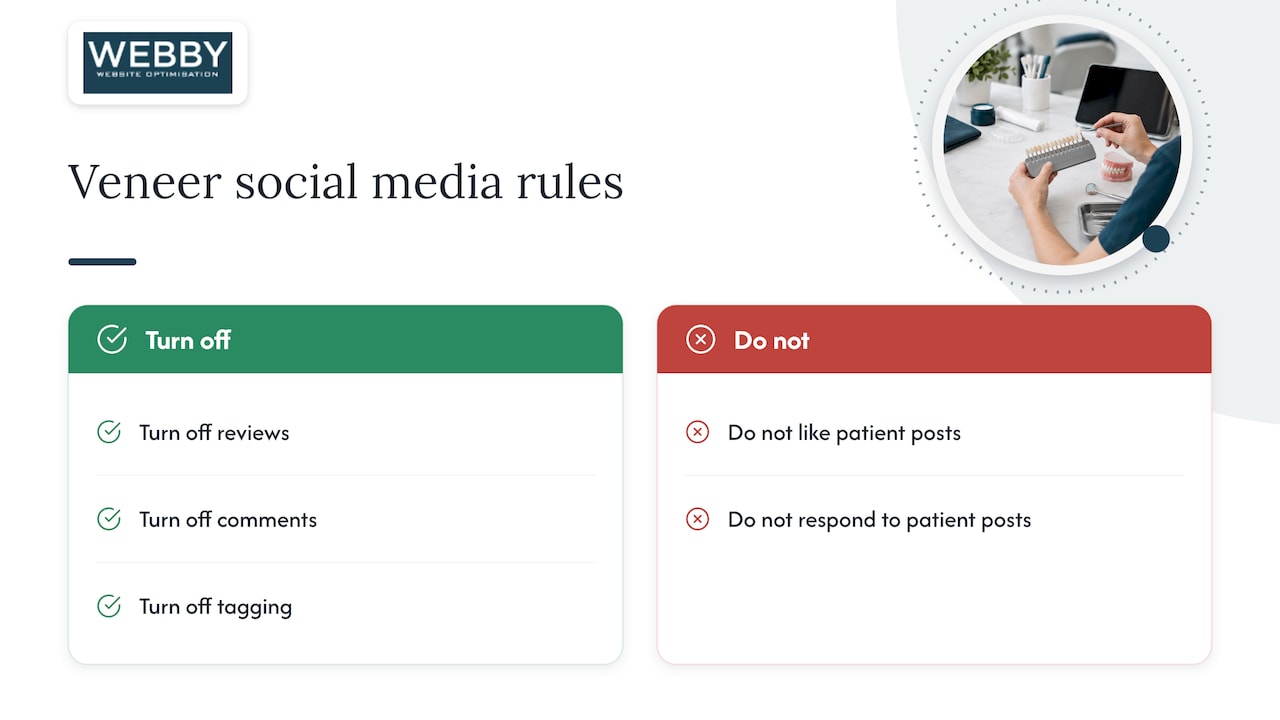
AHPRA’s do’s and don’ts guide for non-surgical cosmetic procedures lists dental veneers as a higher risk non-surgical cosmetic procedure. The same guide says advertisers should turn off reviews, comments and tagging on social media, and should not like or respond to a patient’s social media post. The guidelines for advertising these procedures took effect on 2 September 2025. If you promote veneers, review those pages and your social profiles against the guide.
Step 3: Location pages for the suburbs you serve
Patients search by suburb as much as by treatment. If your practice is in Fremantle but half your patients come from Melville, Bicton and Palmyra, a dedicated page for each area you genuinely serve gives Google a reason to show you there.
A useful location page is not the same paragraph with the suburb name swapped. Include:
- Directions from that suburb and nearest public transport or parking
- Which of your treatments patients from that area book most, if you know
- Your opening hours and a map embed
- Any local involvement, such as a school or sporting club you support
If you have several surgeries, each gets its own page and its own Google Business Profile. A practice with one location should resist creating dozens of thin suburb pages, because pages with nothing useful on them do not help.
Step 4: The technical basics that hold everything together
Technical SEO sounds intimidating, but for a practice site it is a short checklist.
- Mobile first. Most patients searching for a dentist, especially for an emergency, are on a phone. The phone number should be tappable and the booking button should be thumb-reachable.
- Speed. A slow site loses patients before the page appears. Large uncompressed photos of smiling people are the usual culprit.
- Secure and tidy. HTTPS across the site, no broken links, and a sensible menu with treatments grouped logically.
- Schema markup. This is code that tells search engines what the page is about: that you are a dental practice, your address, your hours and your services. It helps Google understand your business, and it needs to be correct, because a wrong address in markup causes trouble.
- Booking that works. If your online booking system opens in a clunky pop-up that fails on certain phones, you pay for the traffic and lose the booking.
Website speed and fixes of this kind are a routine part of what we do for local service businesses. Our WordPress help and support plans include Monthly Maintenance at A$59 per month, Monthly Updates at A$123 per month and Monthly Development at A$600 per month, plus Emergency Services at A$120 per hour.
Step 5: Content that earns trust without breaking the rules
Beyond treatment pages, a small number of helpful articles can bring in patients earlier in their decision. Examples that suit a dental practice:
- What to expect at your first visit
- What to do about a chipped or knocked-out tooth
- How long different treatments typically take
- How to prepare a child for the first dental appointment
Keep the tone educational. AHPRA’s guidelines, as summarised by an Australian consultancy, also prohibit advertising that is false or misleading, offers a gift or discount without stated terms, or encourages unnecessary use of health services. So if you run a new-patient offer, state its terms on the same page, in plain words.
When you add clinical information, have the treating dentist read it before it goes live. Accurate content is the foundation for both search performance and compliance.
Physio and allied health clinics: what changes
The fundamentals carry across to physiotherapy, chiropractic, podiatry, psychology and other allied health clinics: a strong Google Business Profile, a page for each service and location, fast mobile pages and compliant content. The differences are in how patients search.
| Area | Dental practice | Physio or allied health clinic |
|---|---|---|
| Typical search | Treatment plus suburb (“dental implants Fremantle”) | Condition or injury plus suburb (“lower back pain physio”, “sports injury physio”) |
| Urgency | Emergency searches are frequent and high-value | Often triggered by an injury, a referral or a plan from a GP or insurer |
| Page structure | Treatment pages | Condition pages plus service pages (rehab, dry needling, workplace injuries) |
| Compliance | AHPRA advertising rules, testimonial ban | Same rules apply to registered health practitioners |
For a physio clinic, a page for each condition you treat, written in plain language, often outperforms a generic “our services” page. Add the practitioners’ profiles, the funding pathways you accept (private health, workers’ compensation, NDIS where relevant) and clear directions to the clinic. The testimonial rules are the same, so the review caution above applies equally.
How to tell whether SEO is working
Rankings are a leading indicator, not the goal. The goal is booked appointments. Set up the following so you can see what is happening.
- Call tracking. Use a trackable number on your website and, where possible, your Google Business Profile, so you know how many calls came from search.
- Form and booking tracking. Record every enquiry form submission and online booking as a conversion in your analytics.
- Search Console. Google Search Console is free and shows the searches that bring people to your site, plus which pages they land on.
- Ask every new patient how they found you. Record the answer at reception. It catches the people who saw you on the map and then phoned.
- Review monthly, judge quarterly. SEO gains build over months. A single month’s dip rarely means much, but three quarters of flat enquiries does.
Take care with health data. Do not send patient details into analytics tools. Track the action (a booking made), not the person.
Perspective
We build and optimise websites for local service businesses, and the same pattern turns up again and again: the practice that wins on Google is rarely the one with the biggest budget. It is the one with accurate listings, one clear page for each thing it wants to be found for, and a site that loads quickly on a phone.
For a dental or physio practice, add compliance to that list. Your content needs to be helpful, honest and within AHPRA’s advertising rules, which also happens to be what patients want to read. We think the right approach is to fix the foundations first, measure enquiries from day one, and only then build on what the numbers show.
That is why we start with an audit of the website and then agree a plan, rather than pitching a long contract before anyone has looked at the site. Local businesses in Perth, Fremantle and Melville should not have to guess where their enquiries are going.
Steve Doig
Where we can help
If you want an independent look at what is holding your practice site back, our Website Audit is a one-off A$1,250 review of the site’s technical health, content and search visibility. If you would rather act on the findings in one go, the Business Website Optimisation Campaign is a one-off A$3,125 project. For ongoing work on search visibility, see our Search Engine Optimisation service.
You can also claim a free website audit to get started, or run a quick check of your pages with our SEO Inspector.
Choosing an SEO provider for a practice
Whoever you choose, ask for these things in writing before you sign:
- A plan tied to enquiries. The report should show calls, forms and bookings, not just a ranking chart.
- A clear scope. Which pages will be written or fixed, how many, and by when?
- Awareness of health advertising rules. The provider should know that testimonials are restricted and that your content is your responsibility under the advertising rules.
- Access to your accounts. Your Google Business Profile, analytics and website must stay in your name.
- Reasonable contract terms. SEO takes months, but you should still be able to see progress and understand what you are paying for.
For more on picking a provider, see our notes on SEO services for small business and what to expect when you hire an SEO agency.
FAQ
How long does dentist SEO take to work?
Expect the first measurable movement in a few months, with stronger results over six to twelve months depending on competition in your suburb and the state of your site. Fixes to a Google Business Profile can show up sooner than new content. Judge progress by enquiries, not just rankings.
Can I use patient reviews on my dental website?
Patient comments about clinical aspects of care count as testimonials, and AHPRA says testimonials are not permitted in advertising of a regulated health service. Comments about customer service, such as friendly staff, are not testimonials under AHPRA’s definition. Check any review widget on your site and your social media settings.
Is SEO for a physio clinic different from SEO for a dentist?
The foundations are the same: Google Business Profile, service and location pages, fast mobile pages. Physio searches tend to be about a condition or injury, so condition-based pages matter more. The AHPRA advertising rules apply to both.
Do I need a new website to do SEO?
Not always. Many practice sites can be improved by restructuring pages, fixing speed and adding treatment and location pages. If the site is very old or hard to edit, a rebuild may save money over time. An audit shows which case you are in.
Should I run Google Ads or SEO?
They do different jobs. Ads bring patients quickly while you pay for each click, and SEO builds visibility that continues without per-click costs. Many practices begin with SEO foundations and add ads for specific treatments.
Sources
- AHPRA: resources for advertising higher risk non-surgical cosmetic procedures
- AHPRA: the do’s and don’ts of advertising for non-surgical cosmetic procedures