
When people talk about search engine optimization SEO services, they’re referring to the whole range of professional work that goes into getting a website to rank higher in search results. It’s a mix of technical tweaks, smart content, and authority-building strategies, all aimed at driving more organic (unpaid) traffic from search engines like Google.
At its core, SEO is about making your website the single best answer to a potential customer's search query.
What Are Engine Optimisation Search SEO Services?
Let's break it down with an analogy. Imagine your website is a new shop, and Google is the busiest high street in the world. SEO services are everything you do to make sure your shop doesn't just blend in but actively draws people inside.
This isn’t about just having a 'We're Open' sign. It's a complete game plan. A good SEO strategy makes sure your shop has a prime location on that high street (high rankings), clear and inviting signage out front (optimised titles and meta descriptions), and a welcoming, easy-to-navigate layout once customers are inside (a fast, user-friendly site). Without these, even the most amazing shop will sit empty.
The Three Pillars of SEO
A solid SEO strategy always rests on three pillars. They all work together, and if you neglect one, the others will eventually suffer. Think of them as the foundation, walls, and roof of your digital shop—you need all three for it to stand strong.
This diagram shows how On-Page, Off-Page, and Technical SEO fit together to form a complete strategy.
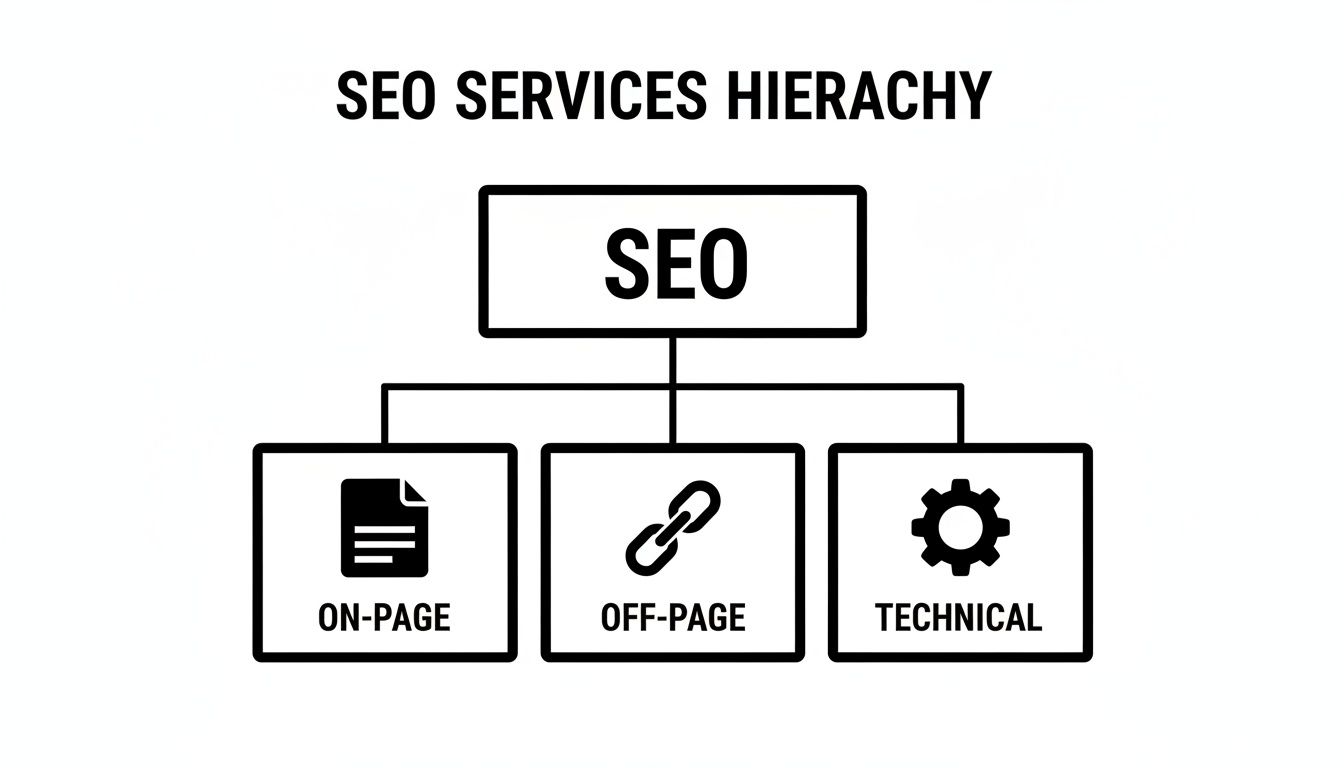
As you can see, a successful campaign isn’t about focusing on just one thing; it’s about a unified effort across all three areas.
To give you a clearer picture, here’s a quick summary of what each pillar involves.
The Three Pillars of SEO at a Glance
| SEO Pillar | Core Focus | Example Activities |
|---|---|---|
| On-Page SEO | Optimising the content and structure of your actual website pages. | Keyword research, writing high-quality content, optimising titles and headings, internal linking. |
| Off-Page SEO | Building your website’s authority and reputation around the web. | Earning backlinks from reputable sites, brand mentions, social media signals, guest posting. |
| Technical SEO | Ensuring your website’s backend is set up for search engine success. | Improving site speed, ensuring mobile-friendliness, implementing HTTPS security, creating a sitemap. |
Let's look a little closer at what these mean in practice.
On-Page SEO: This is everything that happens on your website. It’s about creating great content that uses the right keywords, writing compelling page titles, making your text easy to read, and using internal links to guide visitors and search engines through your site.
Off-Page SEO: This pillar is all about building your site’s credibility from the outside. The main goal here is earning high-quality backlinks from other respected websites. Google sees these links as "votes of confidence," which boosts your authority.
Technical SEO: This is the nuts and bolts under the hood. It’s what allows search engines to find, crawl, and index your site without any trouble. This includes things like site speed, mobile-friendliness, security (HTTPS), and structured data. A poor technical foundation can stop your content from ever being seen.
Understanding how these pillars support each other is key to turning your website from an online brochure into a genuine customer-generating machine. For a deeper dive, check out our quick guide to understanding SEO and learn how it can really drive growth for your business.
Why SEO Is Essential for Australian Businesses in 2026
For any Australian business operating in 2026, skipping search engine optimisation is like opening a fantastic shop but hiding it down a back alley with no sign. You might have the best products in the country, but if nobody can find you, you're practically invisible. This isn't just a marketing box to tick; it’s a fundamental part of staying competitive and growing your business.
Think about it. Right now, your ideal customer is pulling out their phone and searching for exactly what you offer. They’re typing "plumber in Parramatta" or "best coffee beans Melbourne" into Google. In that moment, they’re ready to spend money. The handful of businesses that show up on that first page are the ones getting the click and the call. Everyone else on page two or beyond might as well not exist.

This is why investing in professional engine optimization search seo services is so critical. It's how you claim your prime real estate online. Taking action gives you a serious competitive advantage, while doing nothing is like personally escorting customers to your competitors who are already putting in the work.
The Undeniable Power of Google in Australia
To really grasp why SEO matters so much, you just have to look at where Australians go to find things. The data tells a very clear story.
Here in Australia, Google isn’t just a search engine; it's the search engine. By 2026, it commands a staggering 88.89% market share of all searches. Sure, competitors like Bing have a sliver of the pie at 8.25%, but Google is the undisputed gateway to customers. You can see the full breakdown of this dominance by exploring the market share data from StatCounter.
This near-monopoly means that if you’re not visible on Google, you’re invisible to the vast majority of your potential customers. Every search for your services that doesn’t lead to your website is a missed opportunity—a sale handed to someone else.
This simple fact shifts SEO from a "nice-to-have" marketing extra to a core business function, as essential as having a phone number or a physical address.
More Than Just Traffic: Building a Sustainable Business Asset
Good SEO does a lot more than just bring visitors to your website; it builds a genuine, long-term asset for your business. Think of it this way: with paid ads, your visibility vanishes the second you stop paying. With SEO, the organic rankings you earn through quality work have real staying power.
Here’s what that looks like in practice:
- Building Trust and Credibility: When you rank highly on Google, it sends a powerful signal to searchers that you're a trusted authority. People instinctively trust organic results more than ads, which means the traffic you attract is often higher quality and more likely to convert.
- Cost-Effective Lead Generation: Once your rankings are solid, you get a consistent flow of leads without paying for every click. Over time, this drastically lowers your customer acquisition cost, making SEO one of the most profitable marketing channels you can invest in.
- Deeper Customer Insights: A proper SEO strategy forces you to understand exactly what your customers are searching for, what problems they need solved, and the exact words they use. This insight is pure gold for refining your products, services, and overall business strategy.
Ultimately, failing to invest in a solid SEO foundation isn't just a missed opportunity—it's a strategic risk. It's choosing to let your competitors own the conversation and win the customers you should be serving. For any Australian SMB wanting to thrive in 2026 and beyond, a smart approach to engine optimization search seo services is the key to unlocking sustainable growth.
Understanding the Core Components of SEO Services
So, you're looking into engine optimisation search seo services. It's easy to see it as just paying for a vague promise of "more traffic," but that's not the full picture. A quality SEO service is a targeted investment in a set of expert activities, all designed to make your website more visible and, ultimately, more profitable.
Think of it this way: you're not just buying a billboard; you're hiring an expert team to find the perfect location, design a compelling message, and ensure it gets seen by the right people. A comprehensive SEO program is built on three pillars that all work together. Knowing what they are helps you understand exactly what you’re paying for.
On-Page SEO: The Content and Structure of Your Site
On-page SEO covers everything that happens on your website—the things you and your visitors can see and interact with. It’s all about creating content that perfectly answers what your audience is searching for and structuring it so both people and search engines can easily digest it.
This journey always starts with keyword research. This isn't a guessing game. It’s a data-backed process of uncovering the exact words and phrases your ideal customers are typing into Google, how many people are searching for them, and how hard it is to rank for those terms.
Once we know what people are looking for, we can start optimising:
- Content Optimisation: This is the art of naturally weaving your target keywords into the most important parts of your page—the title, headings, body copy, and even the descriptive text for your images. On a WordPress site, a tool like Yoast SEO is brilliant for guiding this process on every single page and post.
- High-Quality Content Creation: The days of stuffing keywords onto a page are long gone. Today, SEO is about creating genuinely helpful, insightful content that solves a problem for the reader. A single, well-crafted article can become a powerful asset that brings in qualified traffic for years.
- Internal Linking: This simply means linking from one page on your site to another relevant page. It’s a fantastic way to guide your visitors on a journey through your site, and it also helps Google understand which of your pages are the most important.
Think of on-page SEO as merchandising your retail store. You place your most valuable products at eye level (optimised content) and use clear signage (headings) to help customers find precisely what they need.
Off-Page SEO: Building Authority and Trust
Off-page SEO includes all the activities that happen away from your website to build its authority and reputation. If on-page SEO is about how well-organised your shop is, off-page SEO is about getting word-of-mouth referrals and recommendations from other respected names in your industry.
The absolute cornerstone of off-page SEO is link building.
When another reputable website links to your site, Google interprets it as a vote of confidence. The more high-quality "votes" you collect, the more authoritative your website becomes, which is a massive factor in achieving higher rankings. It’s the digital equivalent of a trusted industry figure recommending your business.
A professional engine optimisation search seo services provider earns these links ethically, not by buying them. The focus is on real-world strategies like:
- Creating remarkable content that other websites genuinely want to link to as a resource.
- Writing guest articles for relevant industry blogs.
- Securing mentions in local news outlets or business directories.
This is about building real relationships and brand credibility across the web—not just chasing links for the sake of it.
Technical SEO: The Foundation for Performance
Technical SEO is all the work done "under the hood" to ensure your site has a rock-solid foundation. It’s about making sure your website is fast, secure, and easy for search engines to crawl and index. This is especially crucial for WordPress owners, where the platform's incredible flexibility can sometimes lead to technical headaches if it's not managed by an expert.
Imagine you've built a beautiful shop with amazing products, but the front door is jammed, the lights are flickering, and the floor plan is a confusing maze. That’s what a poor technical setup does to your website.
Key parts of technical SEO include:
- Site Speed: A slow website kills conversions and hurts your rankings. Optimising for speed involves things like compressing images, using browser caching, and, most importantly, choosing a high-quality hosting provider.
- Mobile Experience: The majority of Google searches now happen on mobile phones. Your site absolutely must look great and be easy to navigate on a small screen.
- Security (HTTPS): Having a secure website (the little padlock in the browser bar) protects your users' data and is a confirmed Google ranking signal. It’s non-negotiable.
- Clean Code and Proactive Management: For WordPress, this means keeping everything—the core software, your theme, and all your plugins—constantly updated. Outdated or poorly coded plugins are a leading cause of slow site speeds and security vulnerabilities.
At the end of the day, these three pillars are completely codependent. Incredible content won't rank without a solid technical base and the authority that comes from off-page signals. A technically perfect site is useless without compelling content. A truly effective SEO service addresses all three areas to build a resilient, high-performing online presence.
Using Local SEO to Attract Nearby Customers
If your business has a physical address or serves a specific local area—whether you're a café, plumber, dentist, or a local consultant—then local search engine optimisation isn't just a good idea; it's a game-changer. This isn't about trying to outrank every competitor on the internet. It's about winning the attention of the customers right on your doorstep.
Think of it as your digital shopfront window, perfectly placed where people in your community are already looking. The goal is to become the obvious choice for anyone searching for services "near me" or within your specific town or suburb. It’s a direct line to motivated customers who are ready to buy.
The opportunity here is enormous. A staggering 46% of all Google searches are now for local information. For Australian businesses, that translates to a massive pool of potential customers actively seeking local solutions. Research shows that landing in the top spot of the local results can capture nearly 25% of all clicks, making it incredibly valuable real estate.
Optimising Your Google Business Profile
The heart of any local SEO effort is your Google Business Profile (GBP). This is your free business listing that shows up in Google Maps and the "Local Pack"—that little box of three businesses you see at the top of the search results.
Getting this right is absolutely non-negotiable. A well-optimised GBP is like a mini-website built directly into Google, giving customers all the essential info they need in a single glance.
A powerful GBP needs:
- Complete and Accurate Information: Your business name, address, and phone number (NAP) must be perfectly consistent everywhere they appear online. Your opening hours need to be spot on.
- A Compelling Business Description: Go beyond the basics. Explain what you do, who you help, and what makes you the best choice in the area.
- High-Quality Photos and Videos: Show off your space, your friendly team, and your products or services in action. People want to see who they're dealing with.
- Regular Posts and Updates: Keep your profile fresh by sharing special offers, news, and events. An active profile signals to Google that you're an active business.
The Power of Local Keywords and Reviews
Beyond your GBP, your website itself must scream local relevance. This means weaving local keywords naturally into your content. Instead of just targeting "air conditioning repair," a Geelong-based business should be targeting phrases like "air conditioning repair in Geelong" or "emergency plumber Northern Beaches."
These are the exact terms real customers in your area are typing into their phones. When you include them in your page titles, headings, and service descriptions, you're sending a crystal-clear signal to Google about who and where you serve. If you want to dig deeper, our guide explains what a local search engine optimisation company can do to really turn up the volume on your local presence.
The other piece of the puzzle? Managing your online reviews.
Positive reviews on your Google Business Profile are one of the strongest trust signals you can have. They provide the social proof that convinces new customers to give you a try and directly impact how high you rank in the Local Pack.
Actively encouraging happy customers to leave feedback and responding professionally to all reviews—good and bad—is a vital part of any modern local SEO strategy. It shows you’re engaged and that you care about your customers, helping you stand out and turn casual searchers into loyal clients.
How to Measure the ROI of Your SEO Investment
Putting money into engine optimisation search seo services can feel like a leap of faith, but the results should be anything but a mystery. To know if your investment is paying off, you need a straightforward way to measure its return on investment (ROI). This means looking past "vanity metrics" like a simple jump in website visitors and focusing on the data that actually impacts your bottom line.
After all, the whole point of SEO is to attract qualified customers who are already searching for what you do. So, measuring success is really about tracking how well you’re hitting that target. It’s about turning your SEO spend into tangible outcomes like leads, sales, and real revenue.
Any good SEO partner will be an open book with these metrics, providing reports that show you exactly how their work is making a difference to your business.
Key Performance Indicators That Actually Matter
To get a true picture of your ROI, you have to track the right Key Performance Indicators (KPIs). These are the specific, measurable data points that prove you're moving towards your business goals. It's time to forget vague promises and zero in on the numbers that count.
A transparent SEO report should always feature:
- Organic Traffic Growth: This shows how many people are finding your site through unpaid search results. A steady climb here is a great sign that your visibility on Google is on the up.
- Keyword Ranking Improvements: Don't get bogged down tracking every possible keyword. Focus on the ones with commercial intent that are most valuable to your business. Seeing your site move up the rankings for a term like "emergency plumber Sydney" is a direct indicator that things are working.
- Conversion Rate from Organic Search: This is the big one. It’s the percentage of organic visitors who take a meaningful action—filling out a form, buying a product, or picking up the phone to call you.
A flood of website traffic is meaningless if none of those visitors turn into paying customers. The ultimate aim of any SEO campaign is to drive conversions, which is what directly grows your business.
Essential Tools for Tracking Your Success
The good news is you don’t have to just take your SEO provider’s word for it. Google offers several powerful, free tools that let you see the data for yourself and keep your agency accountable. Getting familiar with these platforms empowers you to have much more productive conversations about your campaign’s performance.
Two tools are absolutely non-negotiable for any business taking SEO seriously:
- Google Analytics 4 (GA4): Think of this as the main dashboard for everything happening on your website. Google Analytics 4 shows you where your visitors came from (like organic search), what pages they looked at, and, most importantly, whether they converted.
- Google Search Console (GSC): This tool gives you a direct look at how your site performs in Google's search results. Google Search Console reveals which search terms are bringing people to your site, your average ranking for those terms, and flags any technical problems that might be holding you back.
A trustworthy partner providing engine optimisation search seo services won't just help you get these tools set up properly; they’ll build their entire reporting strategy around the data they provide. Their reports should be clear, easy to digest, and always centred on the KPIs that prove you’re getting a solid return on your investment.
Choosing the Right SEO Partner for Your Business
Finding the right team for your engine optimisation search seo services is one of the most critical decisions you'll make for your online growth. It’s less about hiring a vendor and more about finding a genuine partner who is as invested in your success as you are. The best partnerships are built on transparency, a clear strategy, and goals you both agree on.
Think of it like this: you're hiring a specialist builder for a major extension on your business. You wouldn't just hire the first person who promises a finished building overnight, uses mysterious materials, or won't show you the blueprints. You’d want an expert who walks you through their process, explains the quality of their methods, and gives you regular updates. The exact same logic applies when you're looking for an SEO company.

This guide is here to arm you with the right questions, helping you spot a real expert from a digital cowboy.
Critical Questions for Any Potential SEO Agency
To get past the sales pitch and understand what a provider is really offering, you need a solid list of questions. Their answers will tell you everything you need to know about their competence, honesty, and overall approach.
Walk into your first meeting ready to ask:
- What’s your strategic approach for a business like mine? A good answer always starts with them wanting to learn about your business goals. Only then should they outline a customised plan, not a generic package.
- How do you measure success, and can I see a sample report? They should be talking about tangible results like conversions, leads, and organic traffic growth—not just keyword rankings. A sample report shows you exactly how they communicate progress.
- Can you share a case study from a similar business you’ve helped? While client confidentiality is important, they should be able to detail the strategy and results for a business in a similar field or with comparable goals.
- What does your communication process look like? You’re looking for specifics: a dedicated point of contact, a schedule for regular meetings, and a clear process for handling your questions.
A great partner is always an educator. They should be able to break down complex SEO concepts into simple terms, making you feel empowered to understand what they’re doing and why it matters.
Red Flags to Watch Out For
Knowing what to look for is only half the battle; you also need to know what to avoid. Some claims are immediate red flags, signalling an inexperienced or, even worse, an unethical provider.
Be very cautious of any agency that:
- Guarantees #1 Rankings: Nobody can guarantee a specific spot on Google. The algorithm is far too complex and is always changing. This is the oldest and most obvious red flag in the book.
- Is Secretive About Their Methods: If you hear phrases like "secret sauce" or "proprietary techniques," you should be concerned. Real, sustainable SEO is built on well-known best practices, not hidden tricks. This secrecy often masks risky "black-hat" tactics that can get your website penalised.
- Offers Unbelievably Low Prices: Proper SEO takes a significant amount of time and skill from experienced professionals. If a price seems too good to be true, it usually means they're cutting corners, outsourcing to low-quality workers, or using dangerous automated software.
Why a Partner Is Better Than DIY Tools
With a booming market for SEO software, going the DIY route can seem tempting. In Australia alone, the industry is expected to jump from USD 2.1 billion in 2024 to USD 5.2 billion by 2030, largely driven by small and medium-sized businesses trying to get ahead. You can read more on this trend in a detailed market analysis of the Australian digital economy.
But here’s the thing: these tools are just that—tools. They spit out data, but they don't provide the strategy or the expertise to interpret it and take action. A skilled SEO partner brings years of hands-on experience, a deep understanding of algorithm nuances, and the ability to build a comprehensive strategy that software simply can't match. For a closer look at what to expect, our guide on choosing an SEO company for your small business offers more valuable insights.
Frequently Asked Questions About SEO Services
If you're looking into SEO services, you've probably got a few questions. That's a good thing. Most business owners I talk to have similar concerns about how long it takes, what it costs, and whether it’s genuinely worth it. Let's clear up some of the most common ones so you can move forward with confidence.
Getting these things straight from the get-go is crucial. It helps you understand exactly what you're investing in and sets the stage for a great partnership where everyone's on the same page.
How Long Does It Take to See Results From SEO?
This is the big one, and the honest answer is: it's a marathon, not a sprint. While we can often see small wins from technical fixes in the first few weeks, you should expect to wait 4 to 6 months to see significant, needle-moving results in your rankings and organic traffic. This gives search engines enough time to crawl, index, and recognise all the positive changes we’re making.
Think of it like building a great reputation in a new town. You can't just show up and be the most trusted expert overnight. It takes consistent effort over time to become that go-to authority people seek out.
The exact timeline really depends on factors like how competitive your industry is, your website’s current health, and what your competitors are up to. For tough, crowded markets, cementing a top spot could take a year or more. Patience and consistency are your best friends here.
What Is the Difference Between SEO and Google Ads?
It's a classic question, and the simplest way to explain it is by thinking about "owning" versus "renting" your website traffic.
- Google Ads (PPC): This is like renting a massive, flashy billboard on the busiest highway in town. You pay for a premium spot to get seen, and the traffic starts flowing immediately. The catch? The moment you stop paying, your billboard comes down and the traffic disappears.
- SEO (Organic): This is about earning your place by building something of genuine value. It's like buying the land and constructing your own flagship store right on that highway. It takes more time and effort up front, but you're creating a sustainable, long-term asset that brings in customers for years to come, without paying for every single visit.
The smartest strategies often use both. Google Ads can deliver those quick wins and valuable data, while SEO builds the powerful, long-term growth engine for your business.
Can I Do SEO Myself for My WordPress Site?
Absolutely. You can definitely get started with the basics of on-page SEO on your own WordPress site. Things like optimising page titles, writing keyword-focused blog posts, and adding alt text to your images are great first steps, and a plugin like Yoast SEO makes it much easier.
Where it gets tricky, however, is moving beyond the basics. A truly effective SEO strategy goes much deeper into technical areas like optimising site speed, implementing schema markup correctly, and managing your site’s crawl budget. Not to mention the ongoing work of analysing competitors and building high-quality backlinks, which is incredibly time-consuming.
For most business owners, their time is better spent actually running their business. Partnering with a specialist means you have an expert focused on the technical heavy lifting required to get you ranking, while you focus on what you do best.
At Webby Website Optimisation, we live and breathe this stuff so you don’t have to. Our managed WordPress and growth services are designed to handle all the technical complexities, turning your website into a reliable customer-generating machine. Find out more about our WordPress help and support services and let's get you growing.