
Structuring your website for SEO success means organizing every page into a clear hierarchy, connecting content through strategic internal links, and building topic clusters that search engines and users can both follow without friction. The industry term for this is information architecture, and getting it right before you publish a single word of content is the single most impactful decision you can make for organic traffic. Most small and medium business owners focus on keywords and blog posts while ignoring the underlying architecture that determines whether Google can even find, crawl, and rank those pages. This guide covers the components, steps, and mistakes that separate sites that rank from sites that stall.
What are the key components of an SEO-friendly website structure?
An SEO-friendly website structure rests on five interconnected components: URL hierarchy, internal linking, navigation design, mobile performance, and structured data. Miss one and the others underperform. Get all five right and your site becomes far easier for Google to crawl and for visitors to convert.
URL hierarchy and flat architecture
A flat site architecture means any page on your site is reachable within three to four clicks from the homepage. Important pages reachable within 3 clicks receive stronger link equity and are crawled more frequently. Sites with deeply nested content waste crawl budget and push key pages further from PageRank flow. A simple rule: if a service page requires five clicks to reach, it will rank below a competitor’s page that requires two.
Your URL paths should mirror your topic structure. A plumbing business in Perth might use "/services/blocked-drains/rather than/page?id=47`. Clean, descriptive URLs signal topic relevance to Google and make internal linking far more logical.
Internal linking strategy
Contextual links embedded in content carry more ranking weight than links sitting in menus or footers. The hub and spoke model works best for most small businesses: one pillar page covers a broad topic, and several supporting pages cover subtopics, each linking back to the hub. This creates bidirectional linking loops that distribute authority across the cluster.

Navigation menus, breadcrumbs, and footer links still matter, but they should reinforce your contextual linking plan rather than replace it. Breadcrumbs in particular help both users and crawlers understand where a page sits within the hierarchy.
Mobile performance and Core Web Vitals
40% of users abandon a page that takes longer than three seconds to load. Google’s Core Web Vitals set the performance bar: Largest Contentful Paint under 2.5 seconds, Interaction to Next Paint under 200 milliseconds, and Cumulative Layout Shift under 0.1. These are not aspirational targets. They are ranking signals.
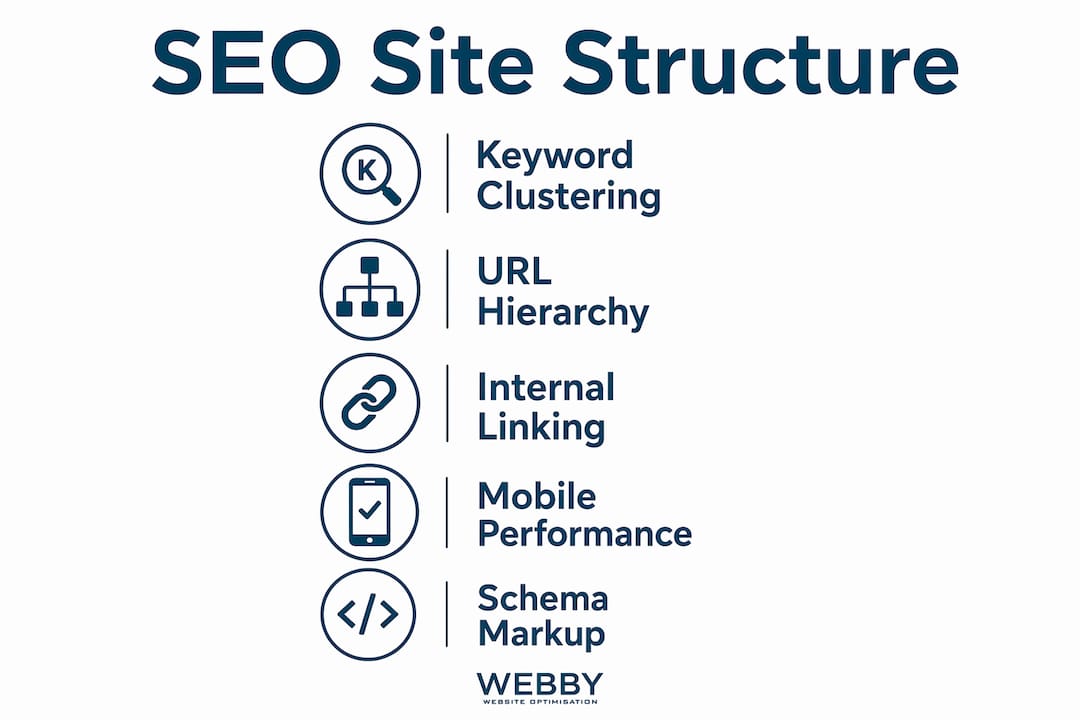
Mobile-first indexing means Google ranks your mobile version first. Body text must be at least 16px and tap targets at least 44×44 pixels. If your site fails these thresholds, you are penalized regardless of how strong your content is.
Schema markup and structured data
Schema markup using JSON-LD format feeds Google and AI answer engines with precise entity information. Implement Organization, Article, BreadcrumbList, and FAQPage schemas at minimum. Rich results like FAQ dropdowns and breadcrumb trails in search listings directly increase click-through rates without requiring any improvement in rankings.
Pro Tip: Use Google’s Rich Results Test to verify your schema implementation before publishing. A single syntax error can prevent all rich result features from appearing.
| Component | What it does for SEO |
|---|---|
| Flat URL hierarchy | Reduces crawl hops and strengthens link equity flow to key pages |
| Contextual internal links | Distributes PageRank more effectively than navigation links alone |
| Core Web Vitals compliance | Meets Google’s ranking thresholds for speed and visual stability |
| Mobile-first design | Satisfies Google’s primary indexing method and reduces bounce rates |
| Schema markup | Enables rich results and improves AI engine answer accuracy |
How to plan and build your site structure step by step
Building a well-organized site structure is not a one-day task, but the sequence matters more than the speed. Follow these steps in order and you will avoid the expensive retrofitting that most businesses face after launch.
Conduct keyword research by topic, not just by page. Use tools like Google Search Console, Ahrefs, or Semrush to group keywords by intent and theme. Every cluster of related keywords becomes a candidate for a hub page and its supporting content.
Map your information architecture before writing content. Search architecture maps every page’s role and linking relationship before a word is written. This prevents orphan pages, where content exists but receives no internal links, and stops keyword cannibalization, where two pages compete for the same term.
Design URL paths that reflect topic grouping. A landscaping business might structure paths as
/services/lawn-care/,/services/garden-design/, and/services/irrigation/. Each path signals to Google that these pages belong to a coherent topic cluster.Build hub pages first. Pillar pages covering broad topics establish topical authority before supporting content is added. Pillar and cluster pages signal topical depth to both traditional search engines and AI-driven answer engines.
Develop a bidirectional internal linking plan. Every spoke page links back to its hub. Every hub links out to its spokes. A crawl path strategy prioritizing money pages within one to three clicks of the homepage protects crawl budget and maximizes link equity flow to your highest-value pages.
Integrate SEO into the wireframe phase. SEO-by-design integrates information architecture at the template and wireframe stage, reducing long-term maintenance costs significantly. Decisions made at this phase, including heading hierarchy, navigation structure, and URL patterns, are far cheaper to get right now than to fix after launch.
Audit existing sites before restructuring. If you are working with an existing site rather than building from scratch, a DIY website SEO audit will surface orphan pages, crawl depth problems, and broken internal links. Fix these before adding new content.
Pro Tip: When auditing an existing site, use Screaming Frog SEO Spider to generate a full crawl report. Filter by click depth to instantly identify pages buried more than four levels from your homepage.
| Step | Primary tool | SEO outcome |
|---|---|---|
| Keyword clustering | Ahrefs, Semrush, Google Search Console | Defines page hierarchy and content scope |
| Architecture mapping | Screaming Frog, Miro | Prevents orphan pages and cannibalization |
| Hub page creation | WordPress, any CMS | Establishes topical authority for clusters |
| Internal link audit | Screaming Frog, Ahrefs | Identifies gaps in link equity distribution |
| Speed optimization | Google PageSpeed Insights, GTmetrix | Meets Core Web Vitals thresholds |
Common structural SEO mistakes and how to avoid them
Most SEO problems that small businesses face trace back to structural decisions made early and never revisited. These are the mistakes Webby Website Optimisation sees most often when auditing client sites.
Deep URL nesting. Burying pages five or six levels deep in a folder structure forces Google to spend crawl budget on paths that lead nowhere important. Sites with deep nested content dilute link equity and reduce crawl frequency for key pages. Keep your hierarchy to three levels maximum wherever possible.
Orphan pages. Publishing content without linking to it from anywhere else on the site means Google may never find it. Every page needs at least one contextual internal link pointing to it from a related page.
Overloaded navigation menus. A top navigation with 30 links distributes link equity so thinly that none of those pages receive meaningful authority. Limit primary navigation to your most strategically important pages and use footer links and contextual links for everything else.
Ignoring mobile usability. Over 60% of web traffic now comes from mobile devices. A site that passes desktop usability checks but fails mobile tap target or font size requirements will be penalized under mobile-first indexing.
Skipping schema markup. Many small business sites have zero structured data. This means Google has to infer what your pages are about rather than reading explicit signals. FAQPage and BreadcrumbList schemas alone can generate rich results that increase click-through rates without any ranking change.
Relying only on navigation links. Navigation links carry less ranking weight than contextual links placed within body content. A site with strong menus but no in-content linking leaves significant link equity on the table.
The most expensive SEO mistake is not a bad keyword choice or a slow image. It is launching a site with no architectural plan and spending years trying to fix the structure around content that was never organized correctly to begin with.
How AI-driven search is reshaping website structure
Generative Engine Optimization, or GEO, is the practice of structuring content so that AI answer engines like Google’s AI Overviews, ChatGPT, and Perplexity can extract and cite it accurately. Generative AI search engines reward clearly defined topical clusters with authoritative answers, which means the hub and spoke model is now doing double duty: it satisfies traditional Google crawling and positions your content for AI citation.
Several structural practices now matter more than they did two years ago:
Semantic HTML. Using proper heading tags (H1, H2, H3) in a logical hierarchy helps AI engines parse your content structure. A page where headings are chosen for visual style rather than semantic meaning confuses both crawlers and AI models.
FAQPage schema. AI answer engines frequently pull from FAQ sections marked up with structured data. FAQPage and BreadcrumbList schemas in JSON-LD format give AI engines explicit, machine-readable signals about your content’s structure and intent.
Topic cluster clarity. Vague, loosely connected content clusters do not earn AI citations. Each cluster needs a clearly defined pillar page and supporting content that addresses specific subtopics without overlapping.
SEO-by-design adoption. Building architectural readiness at site launch rather than retrofitting SEO later is the approach that positions sites best for both traditional and AI-driven search. Businesses that treat structure as an afterthought will find GEO even harder to achieve than traditional rankings.
The shift toward AI-driven search does not replace traditional SEO structure. It amplifies the importance of getting it right. Well-organized sites with clear topic clusters and proper schema markup are the ones appearing in AI-generated answers, not just blue links.
Key takeaways
A well-organized, flat site architecture with strategic internal linking and topic clusters is the foundation of every high-performing SEO strategy for small and medium businesses.
| Point | Details |
|---|---|
| Flat architecture wins | Keep every important page within three to four clicks of the homepage to protect crawl budget. |
| Hub pages first | Build pillar pages before supporting content to establish topical authority from day one. |
| Contextual links outperform nav links | Embed internal links within body content to distribute link equity more effectively than menus alone. |
| Schema markup is non-negotiable | JSON-LD structured data feeds both Google rich results and AI answer engines with precise entity signals. |
| SEO-by-design saves money | Integrating information architecture at the wireframe stage costs far less than restructuring after launch. |
Why architecture beats content volume every time
I have reviewed hundreds of small business websites over the years, and the pattern is always the same. The business owner has invested heavily in blog content, maybe 50 or 60 posts, but organic traffic has barely moved. When I pull a crawl report, the reason is immediately clear: the site has no real architecture. Posts are published in a flat blog roll with no internal linking, no hub pages, and no topic clusters. Google sees a pile of content, not a topical authority.
The counterintuitive truth is that ten well-structured pages will outrank a hundred poorly organized ones. A well-designed site architecture that maps page roles, linking relationships, and crawl priorities before content is created will generate more organic traffic than any content calendar built on top of a broken structure.
My strongest recommendation for any SME owner is this: spend one full day mapping your site architecture before you write another word of content. Draw the hub and spoke relationships on paper. Identify your three to five most important money pages. Plan the crawl path from your homepage to each of those pages. Then audit your existing site against that map using Screaming Frog or a similar tool.
The businesses I have seen achieve the fastest ranking improvements are not the ones that published the most content. They are the ones that fixed their architecture first, then let content fill a structure that was already built to rank. You can see exactly what that looks like in real SME SEO results from businesses that took this approach.
How Webby can help you build a site that ranks
If you have read this far and recognized your own site in the mistakes section, you are not alone. Most small business websites in Perth, Fremantle, and Melville were built without an SEO architecture plan, and fixing that is exactly what Webby Website Optimisation does every day.
Webby’s team conducts full site audits covering crawl depth, internal linking gaps, mobile usability, Core Web Vitals compliance, and schema markup. From there, the team designs or restructures your SEO-friendly website with a flat architecture, topic clusters, and a linking plan built to rank. Whether you need a new WordPress build or a structural overhaul of an existing site, Webby offers free consultations so you can understand exactly what your site needs before committing to anything. Contact Webby Website Optimisation today to book yours.
FAQ
What does it mean to structure a website for SEO?
Structuring a website for SEO means organizing pages into a clear hierarchy, connecting them through strategic internal links, and grouping related content into topic clusters so search engines can crawl, understand, and rank the site efficiently.
How many clicks deep should my pages be?
Important pages should be reachable within three to four clicks from the homepage. Pages buried deeper than four clicks receive less link equity and are crawled less frequently, which directly reduces their ranking potential.
Why do contextual internal links matter more than menu links?
Contextual links placed within body content are surrounded by relevant text, which helps Google understand the relationship between pages and distributes link equity more effectively than navigation or footer links.
What is schema markup and do small businesses need it?
Schema markup is structured data added to your site’s code that tells Google and AI engines exactly what your content is about. Small businesses benefit most from Organization, FAQPage, and BreadcrumbList schemas, which can generate rich results and improve AI citation rates.
How often should I audit my site structure?
A structural SEO audit should be conducted at least once per year, or any time you add a significant number of new pages, redesign your navigation, or notice a drop in organic traffic. Tools like Screaming Frog make this process manageable without technical expertise.