
What is the Google ranking algorithm?
Google’s ranking algorithm is an automated ensemble of systems that sorts hundreds of billions of webpages in milliseconds to surface the most relevant, useful results for any given query. It is not a single formula. It is a layered pipeline of AI models, traditional scoring systems, and specialized subsystems that each evaluate different signals before the final ranked list reaches your screen.
The core factors the algorithm weighs include:
- Query words and semantic meaning: What the searcher actually wants, not just the literal words typed
- Content relevance: How well a page addresses the query topic and related concepts
- Content quality (E-E-A-T): Expertise, Experience, Authoritativeness, and Trustworthiness of the source
- Page usability: Mobile-friendliness, page speed, and overall user experience
- User context: Location, language, device type, and search history
- Backlinks: The quantity and quality of external sites linking to a page
- Freshness: How recently content was published or updated, weighted heavily for time-sensitive queries
Crucially, these factors do not carry fixed weights. Google dynamically adjusts which signals matter most depending on the nature of the query. A breaking news search prioritizes freshness. A medical question prioritizes E-E-A-T. An e-commerce query weighs usability and reviews differently than a research query does. The algorithm is context-aware by design, not by accident.
The foundational systems underpinning all of this include RankBrain, BERT, PageRank, and Neural Matching. Each plays a distinct role, and none operates in isolation.
How Google’s search process works: crawling, indexing, and serving
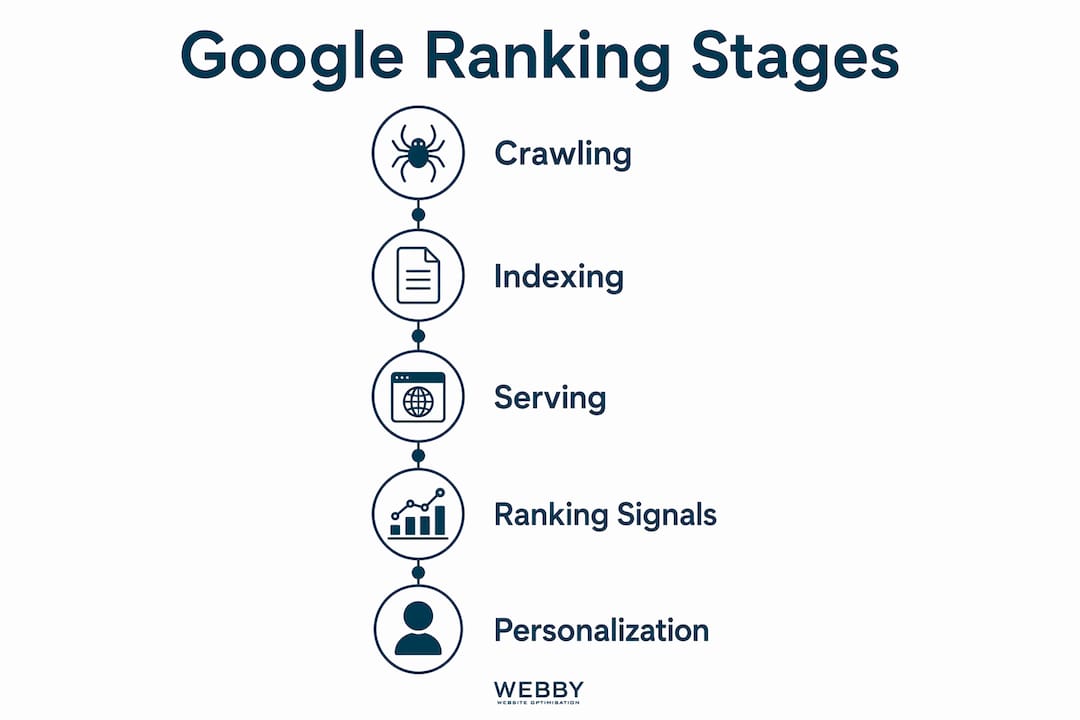
Before any ranking happens, Google needs to know a page exists. The process runs in three distinct stages, each feeding into the next.

Crawling is where Googlebot, Google’s web crawler, discovers and fetches pages across the internet. It follows links from known pages to new ones, continuously updating its map of the web. Not every page gets crawled on the same schedule. Pages with strong backlink profiles and frequent content updates tend to get recrawled more often.
Indexing is where Google analyzes the fetched content. This stage involves:
- Parsing text, images, and video on the page
- Assessing the canonical version of a URL when duplicates exist
- Assigning a document ID and clustering related content
- Evaluating the page’s topic, quality signals, and structured data
Serving is the ranking stage. When a user submits a query, Google’s algorithms process candidate documents through a multi-stage funnel, scoring and filtering them down to the final results. This entire process happens programmatically, with no human intervention and no payment influence on placement.
The serving stage is where the real complexity lives. Multiple ranking systems fire simultaneously, each contributing a different signal to the final score. The result you see at position one is not the output of a single calculation. It is the product of an orchestrated ensemble.
What are the core ranking signals Google uses?
Understanding Google SEO ranking factors means understanding that Google does not rank pages on any single criterion. It evaluates a constellation of signals, and the weight of each shifts based on query type.
The main signals include:
- Content relevance: Does the page address the query topic clearly and thoroughly? Google looks at keyword presence, but also semantic relationships between concepts on the page.
- E-E-A-T (Expertise, Experience, Authoritativeness, Trustworthiness): Google’s quality raters use these criteria to evaluate content quality, and their feedback trains the machine learning models that influence rankings. A medical article from a licensed physician carries more weight than one from an anonymous blog.
- Backlinks: Links from authoritative external sites remain one of the strongest signals of page authority. The logic traces back to PageRank: a page that many credible sites link to is likely more trustworthy.
- Page usability: Mobile-friendliness, Core Web Vitals scores, and page speed all factor into rankings. A page that loads slowly or breaks on a phone loses ground even if its content is excellent.
- Freshness: For queries where recency matters, like news, sports scores, or product releases, Google weights recently updated content more heavily.
- User interaction data: Click-through rates, dwell time, and pogo-sticking (clicking back quickly to the results page) all feed into systems like NavBoost, which adjusts rankings based on actual user behavior.
- Site diversity: Google caps how many results from the same domain appear in top positions, limiting the number of results from a single site in top positions, so a single site cannot dominate the first page even if it has the most relevant content.
Pro Tip: If you want to improve Google ranking for a specific page, start with the page itself, not the site. Ranking signals operate at the page level first. A weak page on a strong domain still underperforms a strong page on a moderate domain.
RankBrain, BERT, PageRank, and Neural Matching explained
These four systems form the backbone of how Google interprets queries and evaluates content. They work together, not as alternatives to each other.

RankBrain was Google’s first major AI-based ranking component, introduced in 2015. Its core function is mapping query words to underlying concepts, not just matching text strings. When someone searches for “best way to fix a leaky faucet,” RankBrain understands the intent is a how-to guide, not a product listing. It handles novel queries, the ones Google has never seen before, by finding conceptually similar queries it has processed and applying what it learned from those.
BERT (Bidirectional Encoder Representations from Transformers) goes deeper into language. Where RankBrain focuses on query-to-concept mapping, BERT understands the nuance of how words relate to each other within a sentence. The word “not” changes everything in a medical query. BERT catches that. Google uses BERT for both ranking and for understanding the content of pages being indexed, which means it affects both sides of the match.
PageRank is the original Google algorithm, developed by Larry Page and Sergey Brin at Stanford. The original paper described it as a way to measure the importance of a webpage by counting and weighting the links pointing to it. PageRank has evolved considerably since 1998, but the core principle still operates as a foundational signal. A page with many high-quality inbound links ranks higher, all else being equal.
Neural Matching connects related concepts even when the exact words do not appear in a query. If someone searches for “how to get rid of dark circles,” Neural Matching can surface pages about sleep deprivation, hydration, and skincare without requiring those pages to use the exact phrase. It is the system that makes Google feel like it reads your mind.
Beyond these four, Google has added Passage Ranking, which lets the algorithm assess individual sections of a long page rather than treating the whole document as a single unit. A 5,000-word guide might have one paragraph that perfectly answers a specific question. Passage Ranking can surface that paragraph even if the overall page is not the strongest match for the query. The role of AI in search rankings continues to expand, with AI Overviews now synthesizing content from multiple sources directly in the results page.
How user context and personalization shape your results
Two people searching the same phrase from different locations, on different devices, with different search histories will often see different results. That is not a bug. It is the algorithm doing exactly what it is designed to do.
The main personalization factors include:
- Location: A search for “plumber” in Austin returns Austin plumbers. A search for “best pizza” in Chicago pulls Chicago results. Google uses IP address and, with permission, GPS data to localize results.
- Language and search settings: The language you have set in your Google account and your browser preferences influence which language versions of pages appear.
- Device type: Mobile and desktop searches can return different rankings. Google’s mobile-first indexing means the mobile version of a page is the primary version evaluated, but the serving layer also adjusts rankings based on device context.
- Search history: Repeated visits to a specific site can boost that site’s visibility in your personal results. If you regularly click on a particular domain for cooking recipes, Google learns that preference.
- NavBoost: This re-ranking system tracks user interaction data across device types and contexts, dynamically promoting results that users actually engage with and demoting those they skip. It is one of the clearest examples of the algorithm learning from real behavior rather than static signals.
The practical implication for anyone trying to understand Google ranking criteria: rankings are not universal. What ranks first for you may rank third for someone else. Testing your rankings from a private browser window, or using a rank-tracking tool set to a specific location, gives a more accurate picture of where a page actually sits.
Common misconceptions about how Google ranks pages
Several widely repeated beliefs about Google’s ranking process are either wrong or significantly oversimplified. Getting these straight matters for anyone building an SEO strategy.
- “You can pay for better organic rankings.” False. Google does not accept payment for organic placement. Paid ads appear in labeled ad slots. Organic rankings are determined entirely by the algorithm.
- “Quality raters decide rankings.” Also false. Google employs human quality raters who evaluate search results using the E-E-A-T framework. Their assessments feed into training data for machine learning models. They do not directly influence any individual page’s ranking.
- “A strong domain guarantees strong page rankings.” Not quite. Ranking signals operate at both the page and site level, but a high-authority domain does not automatically lift every page on it. A weak, thin page on a strong domain still underperforms a well-optimized page on a moderate domain.
- “Backlinks alone drive rankings.” Backlinks are one signal among hundreds. A page with strong backlinks but poor content, slow load times, or weak E-E-A-T will lose ground to a page that addresses all signals together.
- “AI systems like RankBrain replace traditional ranking.” They do not. RankBrain, BERT, and Neural Matching work alongside PageRank and other classic signals, not instead of them. The ensemble approach is the whole point.
- “One site can dominate the first page for a competitive query.” Google’s site diversity mechanism prevents this. The cap of roughly two results per domain in top positions means even the most authoritative site on a topic cannot fill the first page.
The multi-stage ranking funnel also uses systems called Twiddlers, which are specialized subsystems that adjust signals like freshness and content diversity at the final ranking stage. Most SEO guides skip this entirely, which is why so many strategies focus narrowly on backlinks or keywords while ignoring the broader pipeline.
How structured data and schema markup affect rankings
Structured data does not directly boost a page’s ranking position, but it meaningfully affects how that page appears in search results, which in turn affects click-through rates and user engagement.
Schema markup is a standardized vocabulary, maintained at Schema.org, that webmasters add to their HTML to tell Google explicitly what a page is about. A recipe page with schema markup can display star ratings, cook time, and calorie counts directly in the search results. A local business with LocalBusiness schema can show hours, address, and phone number in the knowledge panel. These enhanced appearances, called rich results, make a listing more visible and more clickable without changing its ranking position.
Where structured data does influence ranking indirectly is through the signals it sends to Google’s indexing systems. Clearly marked-up content is easier for Googlebot to parse and categorize accurately. A product page with proper Product schema leaves no ambiguity about what is being sold, which helps Google match it to the right queries. For types of Google search features like featured snippets, knowledge panels, and AI Overviews, structured data is often the difference between appearing in those formats and being passed over entirely.
The practical takeaway: structured data is not optional for competitive pages. It is the clearest signal you can send to Google about what your content is and who it serves.
Key Takeaways
Google’s ranking algorithm is an automated ensemble of AI models and traditional systems that evaluates relevance, quality, and usability signals to rank billions of pages for every query.
| Point | Details |
|---|---|
| Automated ensemble, not one formula | Google uses multiple systems including RankBrain, BERT, PageRank, and Neural Matching working together, not independently. |
| Dynamic signal weighting | Google adjusts which ranking factors matter most based on query type, prioritizing freshness for news and E-E-A-T for health topics. |
| User context personalizes results | Location, device type, language, and search history all shift the results a specific user sees for the same query. |
| Structured data aids visibility | Schema markup does not directly raise rankings but improves how pages appear in results, lifting click-through rates. |
| Webby Website Optimisation applies this | Webby Website Optimisation builds SEO strategies around these exact signals, from page-level content quality to technical optimization for Perth service businesses. |
Why most SEO advice misses the point about Google’s algorithm
The conventional wisdom in SEO circles tends to collapse Google’s ranking system into a checklist: get backlinks, use keywords, write long content. That framing is not wrong exactly, but it is dangerously incomplete. The algorithm is an ensemble, and treating it like a checklist means optimizing for individual signals while ignoring how they interact.
The part most practitioners underestimate is the serving stage. By the time a query fires, Google has already crawled and indexed your page. What happens next is a multi-layer funnel where Twiddlers adjust for freshness and diversity, NavBoost re-ranks based on real click behavior, and Passage Ranking can surface a single paragraph from a long page. A site that scores well on traditional signals but has a confusing structure, slow mobile performance, or thin sections buried in long articles will lose ground at this stage, and the owner will never know why.
The E-E-A-T framework is another area where the gap between understanding and practice is wide. Most content teams interpret it as “add an author bio.” The actual signal is much deeper: it is about whether the content demonstrates genuine expertise through specificity, whether the site has a credible reputation in its field, and whether the page gives users enough information to trust the source. A well-written article from a named expert with verifiable credentials, published on a site with consistent topical depth, outperforms a generic article with a byline every time.
The algorithm is also not static. Google runs thousands of experiments and updates annually. Staying current with Google’s algorithm updates is not about chasing every change. It is about understanding the direction: toward more AI-mediated understanding of intent, toward more user-behavior-driven ranking, and toward richer, more structured content that machines can parse and humans want to read. Those trends have been consistent for a decade. Building for them is not a tactic. It is the strategy.
Webby Website Optimisation helps Perth businesses rank where it counts
Most service businesses in Perth are sitting on websites that Google cannot fully read, rank, or trust. The content is thin, the structure is unclear, and the technical signals that matter to the algorithm are either missing or broken. That gap between where a site sits and where it could sit is exactly where Webby Website Optimisation works.

Webby Website Optimisation builds SEO-optimized websites and runs targeted search campaigns for local service businesses in Perth, Fremantle, and Melville. The approach covers every layer of the ranking algorithm: content quality and E-E-A-T signals, technical performance and Core Web Vitals, structured data implementation, and backlink strategy. Case studies show real improvements in organic traffic and lead generation for clients across trades, professional services, and retail. If you want a free audit of where your site currently stands against Google’s ranking criteria, Webby Website Optimisation offers that as the first step.
Useful sources for learning more about Google’s ranking systems
These are the primary and authoritative references behind the information in this article:
- How Google Determines Ranking Results — Google’s own explanation of the signals and systems it uses to rank pages
- A Guide to Google Search Ranking Systems — Google’s developer documentation covering RankBrain, BERT, Neural Matching, Passage Ranking, and more
- How Google Search Works — The foundational overview of crawling, indexing, and serving from Google’s developer docs
- The Original PageRank Paper (Stanford) — Larry Page and Sergey Brin’s original 1998 paper describing the PageRank algorithm
- PageRank on Wikipedia — A well-maintained reference covering PageRank’s history, mechanics, and evolution
- How Google Search Ranking Works — A detailed breakdown of the multi-stage ranking funnel including Twiddlers and IR scoring
- NavBoost Explained — Marie Haynes’ analysis of how NavBoost uses click data to re-rank results dynamically
- Google Site Diversity Changes — Search Engine Journal’s coverage of how Google limits single-domain dominance in results
- Role of AI in Search Rankings — An analysis of how AI systems like RankBrain and BERT shape organic search in 2026
- Why Optimize for Google in 2026 — Current SEO strategies aligned with Google’s ranking priorities
- SEO website design insights — Practical guidance on building sites that satisfy Google’s ranking signals for service businesses