

Why your page loses visitors who arrive at different stages
Is your page talking to the wrong person?
Most pages pick one type of visitor and write for them. The traffic doesn’t cooperate. One person clicks a Facebook post with no idea you exist. Another searches your business name with a credit card in hand. A third has been comparing three quotes for a week. They all land on the same page and get the same pitch.
That pitch fits one of them, at best. A page written for someone ready to buy feels too sales-heavy to a person who has only just noticed a problem. A page that explains the basics feels slow to someone who wants a price. A vague page leaves everybody guessing.
Mismatch also starts before the page loads. When the message that brought someone in (an ad, a search result, an email, a social post) doesn’t carry through to the page, visitors have to work out whether they are in the right place. Many don’t bother. They leave.

The fix is the ladder of awareness, a framework from advertising writer Eugene Schwartz. It describes how much a person already knows when they reach you, and it gives you a way to align your message, offer, and call to action with that starting point.
By the end of this guide, you will be able to:
- Name the five stages in plain English.
- Work out which stage each of your traffic sources usually brings.
- Rewrite headlines, content, offers and buttons to suit each one.
- Run a simple test to see whether conversions improve.
A ladder that measures what your visitor already knows
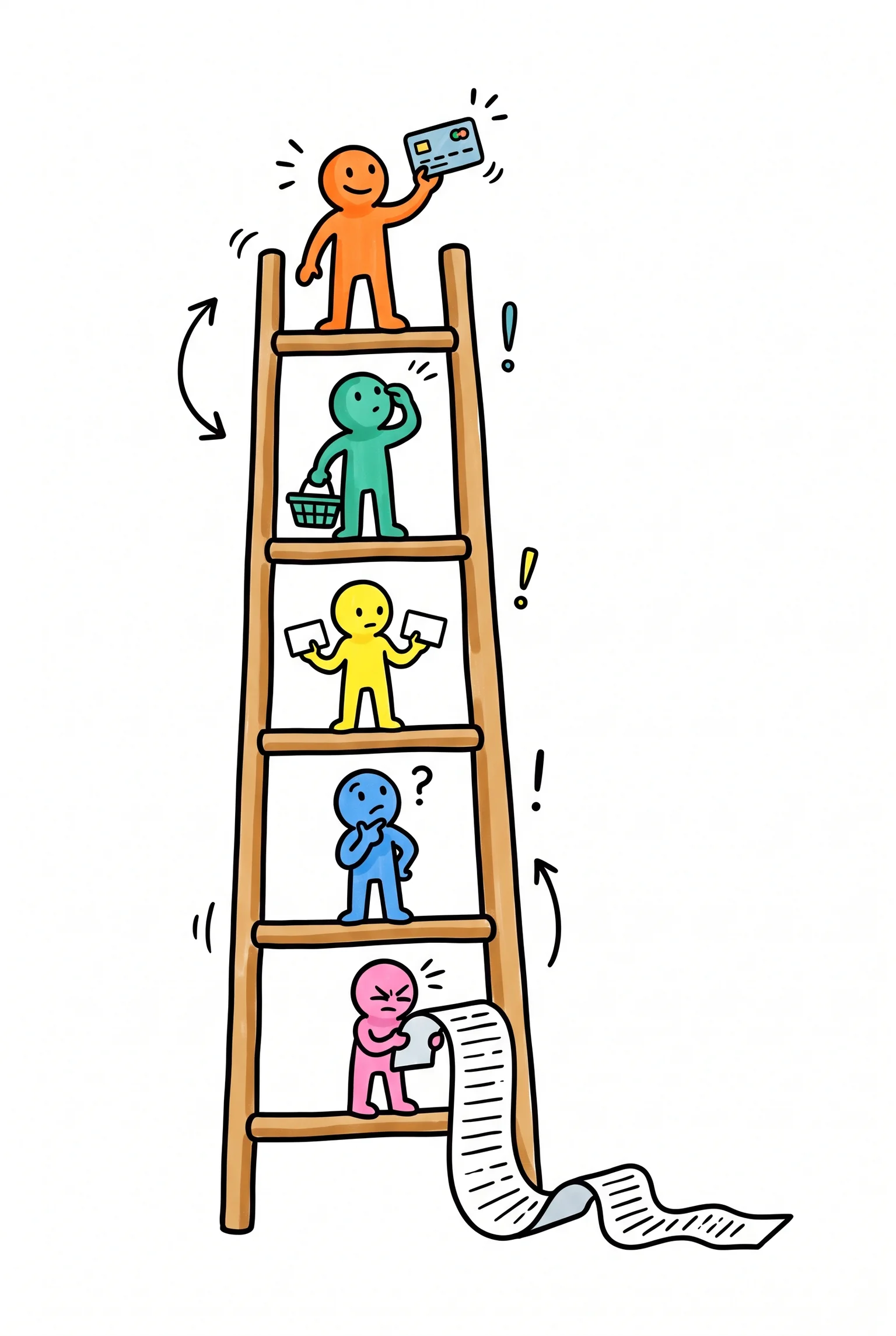
Picture a ladder with five rungs. The higher a visitor stands, the more they already know about their problem, the options for fixing it and your business. The lower they stand, the more you have to explain before they will listen to an offer.
Someone at the bottom doesn’t know they have a problem. Someone at the top knows your business, understands what you sell, and only needs a reason to act today. The rungs in between cover people who feel a problem but don’t know the fixes, and people who know the fixes but haven’t picked a supplier. The next section walks through each one.
The rule is simple. The higher the visitor stands, the less you need to explain and the more direct your ask can be. A visitor on a low rung needs a gentle step, like a guide or a question. A visitor on a high rung is ready for “Book now” or a price.
The idea comes from Eugene Schwartz, an American advertising copywriter. He set out five levels of awareness in his book Breakthrough Advertising, first published in 1966 by Prentice-Hall. Boardroom Books republished it in 1984, and later editions kept it in print, including editions in 2004 and 2017.
Schwartz wrote for print ads and direct mail, so a web page was never on his mind. The logic still carries over. A visitor arrives on your page with a certain amount of knowledge, and nothing about a screen changes that. Pages that assume everyone is ready to buy lose people who aren’t yet, which is the mismatch that started this guide.
Some writers use slightly different names for the rungs, such as “pain aware” instead of “problem aware”. The order and meaning stay the same. The ladder is also a way of thinking about your message rather than a strict sorting system, and different visitors may need different pages.
A conversion, for the record, is any visitor doing what you want them to do: calling, booking, buying or signing up.
The five stages, using one teeth-whitening clinic
To keep the stages concrete, picture a small dental clinic in Perth that sells teeth whitening. It is an illustration, not a real client. Here is what a visitor thinks and says at each rung.
- Unaware
This person has no idea there is a problem or a better outcome. They aren’t searching for anything, so they only meet you by accident, perhaps in a social feed. They might think: “My teeth are just the colour they are.” They would never type a search about it, though they might pause on a post about how coffee changes your smile.
- Problem aware
They feel the problem but don’t know a fix exists, or haven’t settled on one. Good messaging here describes the problem in familiar language, like “Coffee, tea and red wine can gradually darken your smile,” and points to the outcome, such as feeling more confident in photos and everyday conversations. They might search: “why are my teeth turning yellow?”
- Solution aware
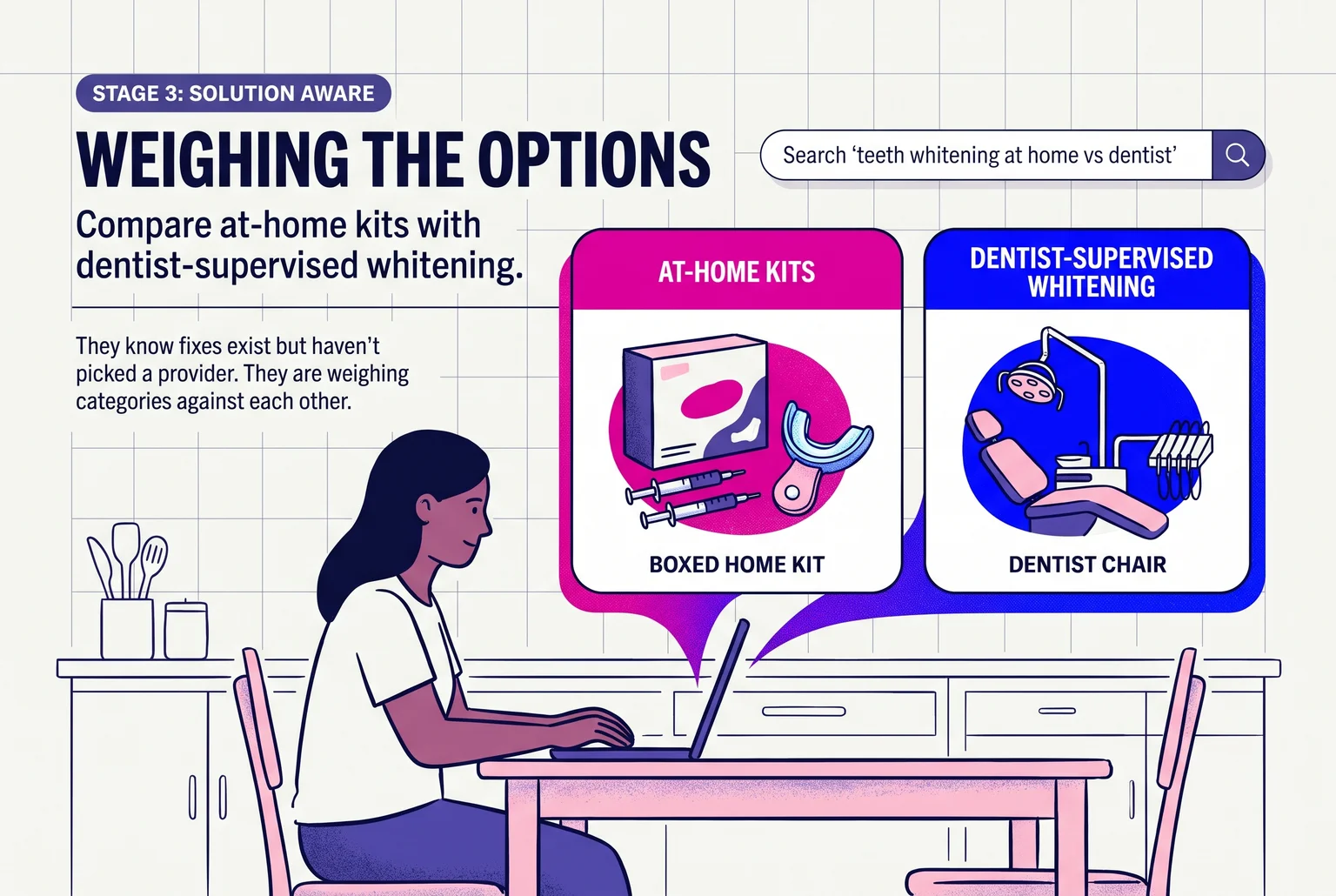
They know fixes exist but haven’t picked a provider. They are weighing categories against each other, so useful messaging compares them, like “Compare at-home kits with dentist-supervised whitening.” They might search: “teeth whitening at home vs dentist.”
- Product aware
They know your clinic and what you offer, but they still have doubts about price, trust, suitability or whether it works. Messaging here handles objections and gives proof, such as “Whitening for sensitive teeth: what to expect.” They might search: “[clinic name] whitening reviews” or “does professional whitening hurt?”
- Most aware
They know the offer and are close to acting. They need a clear reason to do it now, such as a clear offer, urgency or reduced risk. Messaging is short and direct, like “Book your whitening consultation this week.” They might type: “[clinic name] whitening price” or “book whitening Perth.”
The same clinic gets all five people in a single month. Each arrives knowing a different amount, so a page that says “Book now” loses the first three, and a page that explains why teeth stain bores the last two.
The ladder also works outside dentistry. A bookkeeper’s visitor might start at “why do I have no cash left after a busy month?” and later move to specific searches like “BAS records not ready” or “how to reconcile Xero bank transactions.” That is one illustrative journey, and people don’t all climb in the same order or at the same speed. Some jump straight to the top rung because a friend recommended you.
What to put on the page at each stage
Each stage needs a different headline, a different amount of explaining, a different offer and a different button. The teeth-whitening clinic from the last section shows how.
Unaware
HEADLINE: Lead with a situation the visitor recognises, not your service. “Does your smile look different in photos than it used to?” PAGE CONTENT: Tell a short story or share one useful insight. Keep the product out of the first screen. OFFER: A low-commitment resource, such as a short guide on what stains teeth. CTA: “Get the free guide.”
Problem aware
HEADLINE: Name the pain in the customer’s own words. “Why are my teeth turning yellow?” works better than “Premium whitening packages.” PAGE CONTENT: Confirm the problem, explain why it happens and hint that it can be fixed. Features come later. OFFER: A guide, a checklist or a free consultation. CTA: “See your options” or “Book a free smile check.”
Solution aware
HEADLINE: Say what your approach is and why it beats the alternatives. “Dentist-supervised whitening that avoids the sensitivity of off-the-shelf kits.” PAGE CONTENT: Explain how your method works and compare it with other routes. OFFER: A comparison guide or an assessment. CTA: “Compare your whitening options.”
Product aware
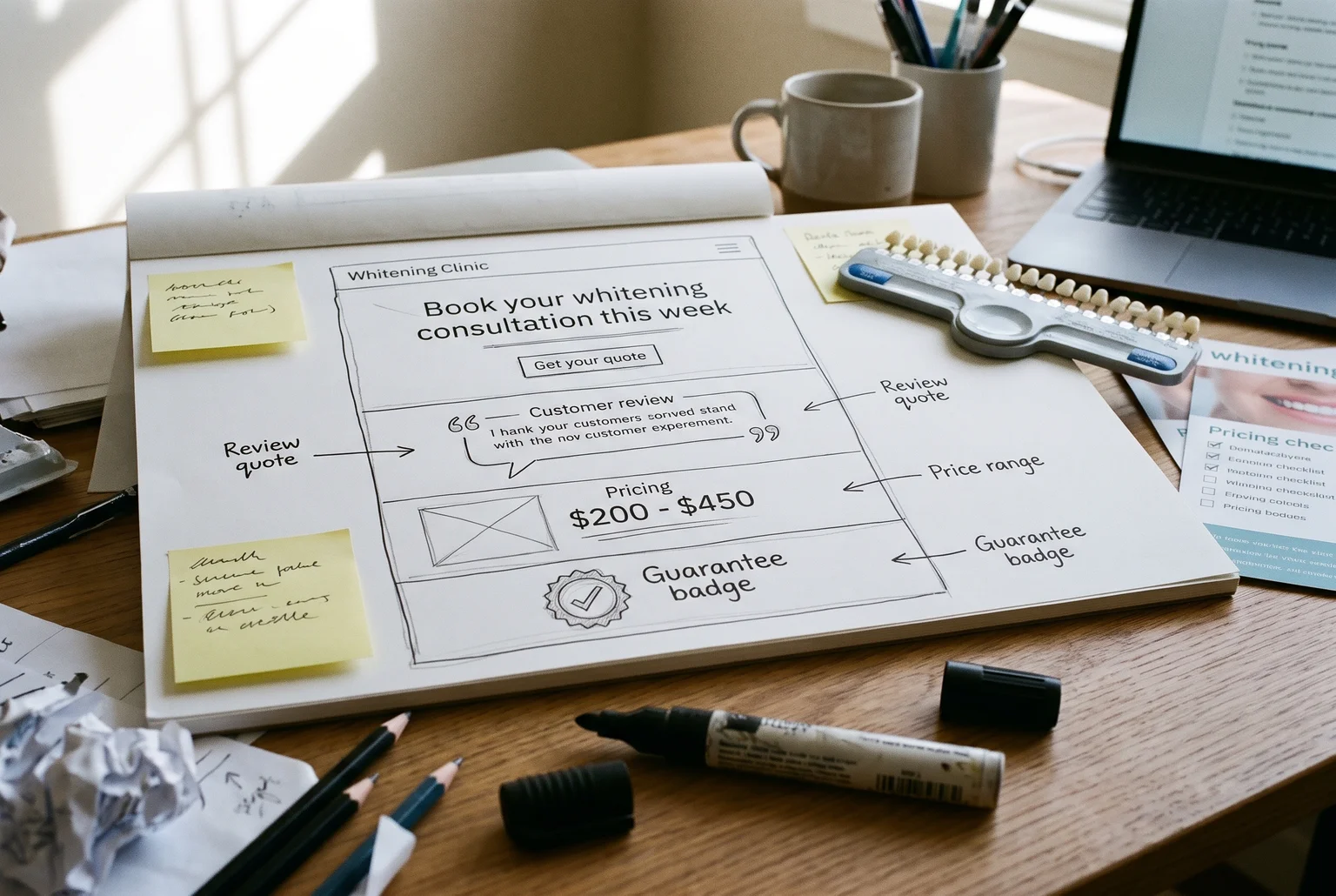
HEADLINE: Answer the doubt. “Whitening for sensitive teeth: what to expect.” PAGE CONTENT: Replace broad promises with testimonials, comparisons and proof points that deal with specific objections. Add guarantees, pricing detail and practical information. OFFER: A consultation, a quote or a risk reducer such as a satisfaction guarantee. CTA: “Get your quote.”
Most aware
HEADLINE: Lead with the offer. “Book your whitening consultation this week.” PAGE CONTENT: Keep it short. Confirm the product, price, inclusions and next steps. Skip the explanation of how whitening works, because the visitor already knows, and a long preamble can distract from a decision already made. OFFER: The sale itself, perhaps with a time-limited price or a booking slot. CTA: “Book now.”
Quick reference
| Stage | Headline leads with | Typical CTA |
|---|---|---|
| Unaware | A recognisable situation | Get the free guide |
| Problem aware | The pain, in their words | Book a free smile check |
| Solution aware | Your approach vs others | Compare your options |
| Product aware | Proof and answers | Get your quote |
| Most aware | The offer | Book now |
Both mistakes cost you
Early-stage visitors get low-commitment buttons. Late-stage visitors get direct ones. Swap them and enquiries drop. “Book now” in front of someone who has only noticed yellow teeth asks for a purchase before they understand the value. A three-paragraph history of whitening in front of someone ready to book delays a ready buyer and gives them time to leave.
The ad, email or post that sent the visitor also sets expectations. The page should continue the same message, at the same stage.
What each traffic source usually tells you about the visitor
Where someone clicked from gives you a first guess at their stage. Treat these as tendencies, not rules. Your own audience may behave differently, so check your results by traffic source before you commit.
Search. The words typed in tell you most. Someone searching “Why are my teeth turning yellow?” has informational intent, so they are problem-aware and want an explanation. Someone searching “whitening options compared” is comparing, which is solution aware. Someone typing your business name is looking for your site and is usually product aware or most aware, so send them to your homepage or booking page. Search intent is a useful proxy for readiness, but it doesn’t measure any one person.
Social media. Cold social visitors are often in a discovery mindset, scrolling rather than shopping. They tend to be either unaware or problem-aware, so they need context and a reason to trust you first. Cold social traffic typically converts at 0.5 to 1.5%, while people who have already seen your brand and come back convert 2 to 5 times more often. Those returning visitors can see a more direct page.
Email. Subscribers opted in, so they usually know you. Email is often a high-converting channel for that reason. They are typically product aware or most aware, so lead with the offer and keep the page short. A new subscriber from a free guide is the exception, and still needs some explaining.
Ads. Ads can land anywhere on the ladder, depending on what they promise. The page should closely match the ad and provide a clear path to the next step.
Where practical, give each source its own page, or at least its own section at the top of one page. Check your results by campaign and audience, not only by channel. Published conversion benchmarks are directional only, because studies define “conversion” differently.
Six steps to rewrite a page for the visitors you actually get
Pick one page to start. Your busiest page, or the one you pay to send people to, will show results fastest. Conversion rate, the share of visitors who take the action you want, is the number you are trying to lift.
- List where visitors come from. Check your analytics or ask your web person for the top three sources, such as Google search, social, email or ads. Write them down.
- Guess the stage for each source. Use the tendencies from the last section. For search, look at the words people typed. In Search Console, the Queries table lists the most popular searches that brought people to your site, though rare queries may be omitted.
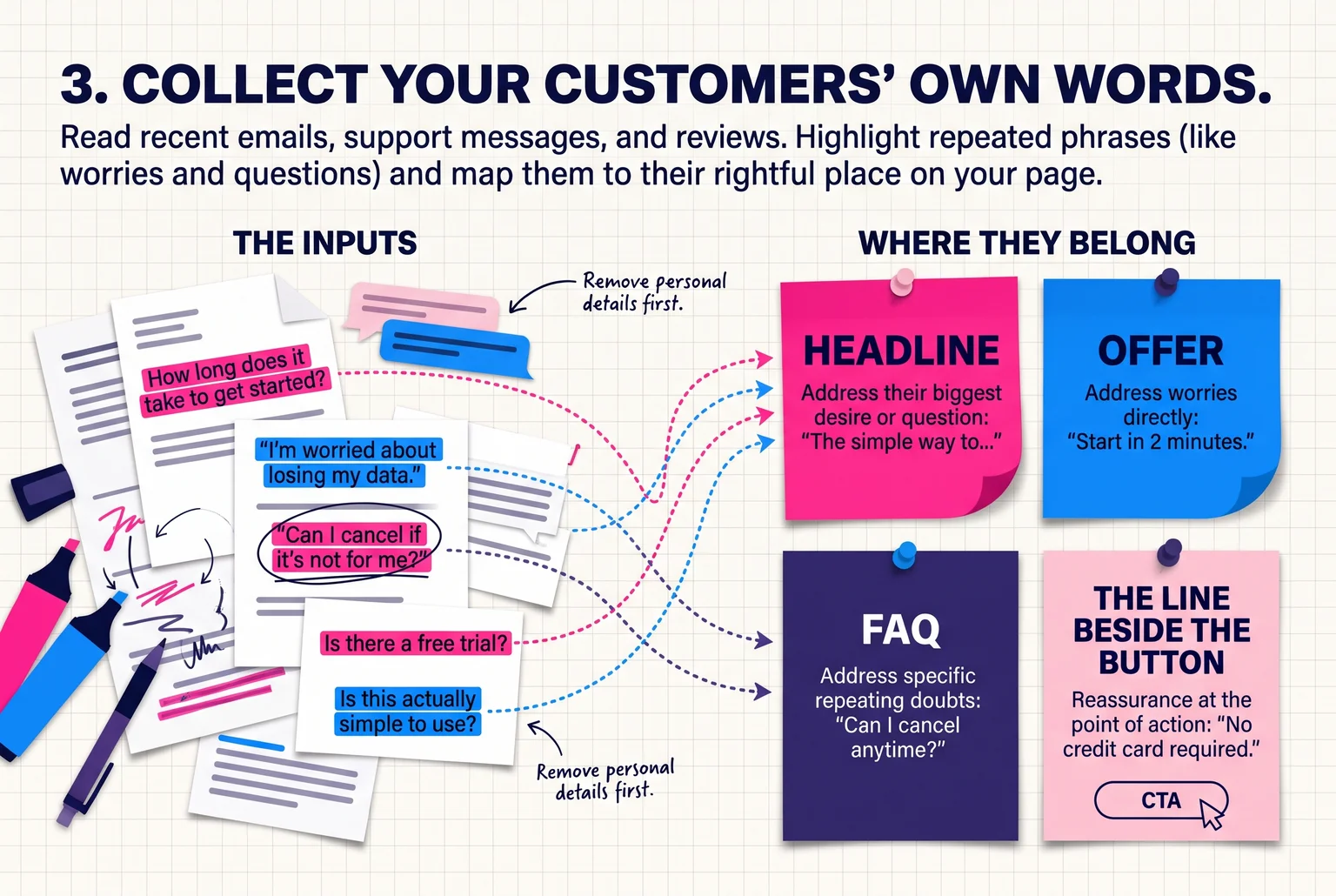
- Collect your customers’ own words. Read recent emails, support messages, and reviews, and note recurring phrases, such as worries and questions. Remove personal details when you copy them. Then decide where each phrase belongs: headline, offer, FAQ or the line beside the button.
- Check the page against that stage. Ask whether the opening makes clear what you offer and who it is for, whether there is one main offer, and whether proof sits near the decision point. Also check that the page works on a phone and that nothing competes with the main button.
- Rewrite three things. Change the headline to speak to the stage, the offer to fit it, and the call to action to ask for the right size of step. Keep one primary offer with its next step and any risk reducers, like a guarantee, stated plainly.
- Publish and note the date. Write down the old headline, the new one, the date and your current conversion rate. You will need those numbers for the next section.
Compare your new page with the old one in four weeks
Conversion rate is enquiries divided by visitors, multiplied by 100. If 400 people visit and 12 send an enquiry, that is 12 ÷ 400 × 100 = 3%. Count both numbers over the same period, and decide what counts as an enquiry (a form, a call, a booking) before you start. You can check form submissions in GA4 by sending a test entry and looking for it in the Realtime report.
With enough traffic, you can run the old and new pages side by side. Most small sites don’t have that, so compare periods instead. Run the new page for at least 7 days, and 2 to 4 weeks if traffic is low or results bounce around. These are rules of thumb, not guarantees. Match the weekdays, use the same traffic source, and compare rates and raw counts.
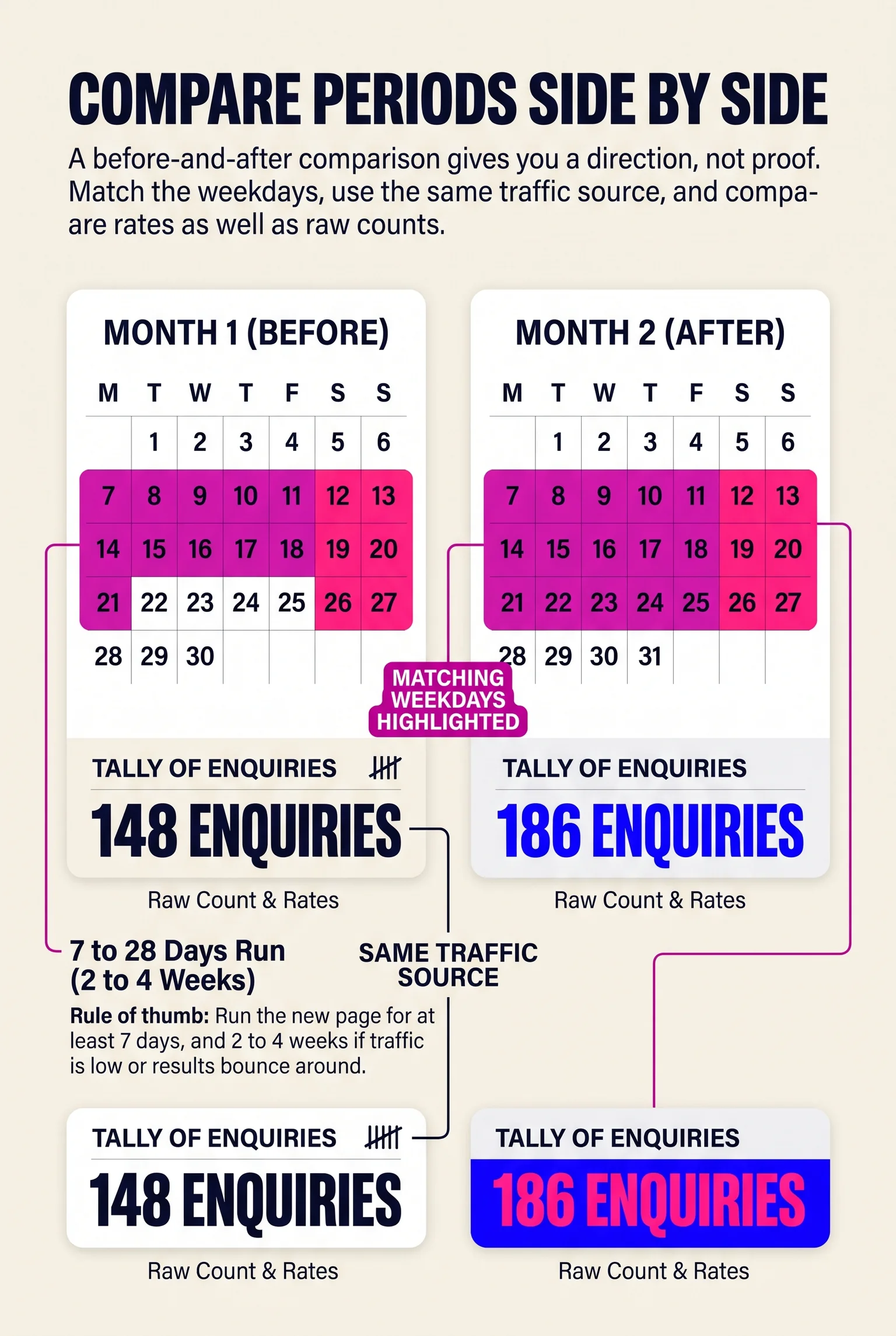
A before-and-after comparison gives you a direction, not proof. Seasonality, a promotion or a few lucky weeks can mislead you. If you can, send half your visitors to the old page for the same weeks, which removes most of that doubt.
Change one thing at a time if traffic is thin. If 3% becomes 4% on 30 enquiries, treat it as encouraging and keep watching. Don’t announce a win.
Four mistakes to avoid, and one job for this week
Using one page and one CTA for every visitor is the most common mistake. Early-stage visitors need education or a low-friction next step, while ready buyers need a clear offer. Related errors are pushing the sale on people who don’t yet know they have a problem, and over-explaining to people who already want to buy.
The fourth is changing too many things at once. If you rewrite the headline, layout and offer together, you can’t tell which change moved the result.
This week, pick your most important page and check where its main traffic source sits on the ladder. Rewrite only the headline and CTA to suit that stage. Record your current conversion rate first, publish, then leave the page alone for at least seven days.
If you’d like a second opinion on that page, get in touch, and I’ll take a look.
Sources
- Message Match — Unbounce
- Breakthrough Advertising: how to write ads that shatter traditions … — Internet Archive
- BA Preface – Breakthrough Advertising — Breakthrough Advertising
- The 5 Stages of Awareness | Exposure — Exposure
- The 5 Stages of Awareness: Schwartz’s 5 Levels + Examples – Selzee — Selzee
- Landing Page Optimisation: Complete Guide — GetUplift
- Landing Page Copy — Stripe Atlas
- Search Intent — Ahrefs
- What Is a Good Conversion Rate? Benchmarks by Industry — Lucky Orange
- About Landing Page Experience — Google Ads Help
- Performance report: Search results — Google Search Central Help
- The Anatomy of a Landing Page — Unbounce
- Realtime Report — Google Analytics Help
- Before-and-After Testing — Conversion Sciences
- Awareness Levels — Schwartz’s Framework for Understanding Your Audience | AI wiki — Primores
- Conversion Rate Optimisation — Fullstory