
Most business owners assume SEO is something you “switch on” and wait for traffic to roll in. That misunderstanding costs real money. An SEO campaign is a structured, goal-driven effort to improve your website’s visibility in organic search results through coordinated technical fixes, content creation, and authority building. It is not a one-time task, and it is not the same as running Google Ads. SEO typically requires 6 to 12 months before significant organic growth becomes visible, which means the strategy behind a campaign matters far more than any single tactic.
Table of Contents
- Key Takeaways
- What is an SEO campaign, and what does it actually include
- How to plan and prioritize your SEO campaign
- Measuring SEO campaign success
- Benefits and types of SEO campaigns
- My take on what actually makes SEO campaigns work
- Ready to build your SEO campaign with Net?
- FAQ
Key Takeaways
| Point | Details |
|---|---|
| SEO campaigns are goal-driven | Every activity should connect directly to a measurable business outcome, not just rankings. |
| Multiple components work together | Technical SEO, content, and link building must operate as a coordinated system, not isolated tasks. |
| Measurement requires two layers | Track leading indicators early and lagging indicators like revenue over 3 to 12 months. |
| SEO competitors are not always business competitors | Sites ranking for your target keywords matter more than sites selling similar products. |
| Patience is a strategic requirement | Results compound over time, making consistency more valuable than bursts of effort. |
What is an SEO campaign, and what does it actually include
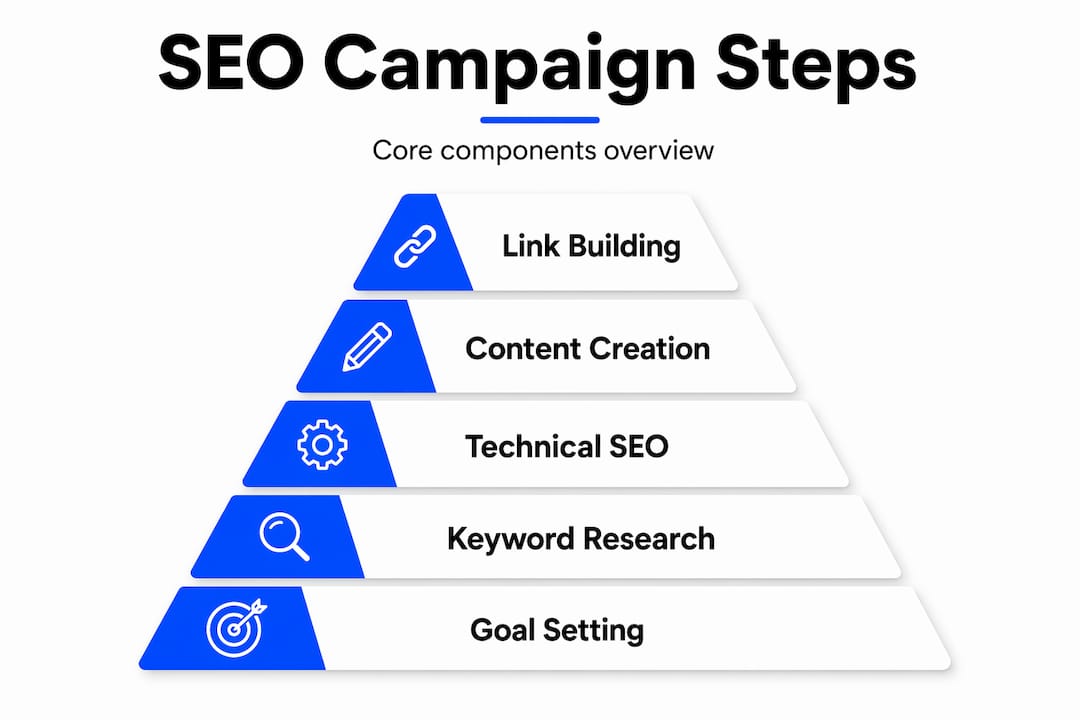
At its core, an SEO campaign is a coordinated set of activities designed to increase a website’s organic search visibility, attract qualified traffic, and convert that traffic into leads or customers. Think of it like a marketing campaign for paid media, except the “spend” is time, expertise, and content rather than a daily ad budget.
A well-structured campaign does not treat SEO as a checklist. Instead, it operates as a system where each component reinforces the others.
Goal setting
Before touching a single page, you need measurable goals tied to business outcomes. Not “rank higher,” but “generate 40 qualified leads per month from organic search within nine months.” SEO strategy should tie directly to revenue, not generic keyword chasing. This distinction changes everything about how you prioritize your time and budget.
Keyword research
Keyword research is not about finding the highest-volume terms. It is about understanding the commercial intent behind searches your potential customers make. A plumber in Perth does not need to rank for “plumbing history.” They need to rank for “emergency plumber Fremantle” and “blocked drain repair.” Targeting the wrong keywords wastes months of effort.
Technical SEO
Technical SEO covers everything that affects how search engines crawl, index, and understand your site. This includes page speed, mobile usability, internal linking structure, duplicate content issues, and structured data. A technically broken site will underperform regardless of how strong the content is.
Content creation
Content is how you answer the questions your customers are already asking. Search engines now prioritize content demonstrating E-E-A-T, meaning experience, expertise, authority, and trust. Generic content that could have been written by anyone about anything no longer performs. You need specificity, genuine expertise, and content that solves real problems.

Link building
Backlinks from credible, relevant websites signal authority to search engines. The key word is strategic. Prioritize link-building on pages supporting primary business goals rather than building links to easy targets that do not drive revenue.
Pro Tip: Map every SEO activity back to one specific business goal before you start. If you cannot explain why a task improves leads or revenue, it belongs lower on your priority list.
How to plan and prioritize your SEO campaign
Knowing the components is step one. Knowing what to tackle first, given your actual resources, is where most campaigns succeed or fail.
Conduct a full SEO audit. Review your site’s technical health, existing content quality, and current backlink profile. Free tools like Google Search Console reveal crawl errors and indexing issues immediately. A proper audit also surfaces which pages already generate organic traffic so you know what to protect and build on.
Identify your real SEO competitors. This step surprises many business owners. SEO competitors are any websites ranking for your target keywords, regardless of whether they sell similar products. A how-to blog could be your biggest competitor for informational keywords while a national directory dominates your service terms. Knowing this shapes your entire content and link-building strategy.
Separate quick wins from long-term plays. Quick wins are technical fixes, optimizing existing pages that already rank on page two, and adding internal links to underperforming content. Long-term plays are building topical authority through new content and earning backlinks to core service pages. Both matter. Most businesses underinvest in quick wins and overpromise on long-term outcomes.
Prioritize by effort versus impact. A simple two-axis framework: high impact, low effort fixes go first. A missing meta description on your homepage takes five minutes to fix and immediately improves click-through rates from search results. A full content hub on a competitive topic takes months and belongs in your 6 to 12 month plan.
Set milestone-based timelines. Months one through three focus on technical fixes and on-page optimization. Months four through six focus on content publishing and initial link building. Months seven through twelve measure compounding organic growth and refine based on data.
Aligning content and technical SEO efforts early avoids costly rework later in the campaign, which is a pattern Net sees repeatedly with new clients who skipped the audit phase.
Pro Tip: Do not let perfection delay execution. Publish an 80% perfect piece of content today and refine it in 60 days when you have ranking data. Waiting for perfect kills momentum.
Measuring SEO campaign success
One of the most common frustrations with SEO is that business owners look at the wrong numbers at the wrong time. Understanding the difference between leading and lagging indicators changes that.
Leading indicators shift within the first one to three months and tell you whether the campaign is technically on track:
- Crawl errors resolved
- Pages published and indexed
- Backlinks earned
- Core Web Vitals scores improved
- Keyword ranking movement on page two or three
Lagging indicators reflect real business impact and typically take three to six months or longer to materialize:
- Organic traffic volume
- Qualified leads from organic search
- Conversion rate from organic visitors
- Revenue attributed to organic search
Leading signals precede traffic; revenue improvements follow in a predictable sequence. If your leading indicators are improving but you are panicking because revenue has not moved at month two, that is expected behavior.
| Metric type | Examples | When to expect movement |
|---|---|---|
| Leading indicators | Crawl errors fixed, pages indexed, backlinks earned | 1 to 3 months |
| Traffic indicators | Organic sessions, impressions, click-through rate | 3 to 6 months |
| Business indicators | Leads, conversions, organic revenue | 6 to 12 months |
Tools worth using include Google Search Console for indexing and ranking data, Google Analytics 4 for traffic and conversion tracking, and a rank tracking tool for keyword position monitoring. The combination gives you a complete picture without requiring an enterprise-level budget.
Benefits and types of SEO campaigns
The reason businesses invest in SEO campaigns over paid advertising is simple: organic rankings build long-term brand visibility that compounds over time and cannot be switched off the moment you stop paying. A well-ranked page generates leads while you sleep.
The cost-per-acquisition from organic search typically drops significantly over a 12 to 24 month period as rankings stabilize. Paid ads require continuous spend to generate the same result. SEO does not. That compounding effect is the core financial argument.
However, not all SEO campaigns look the same. The right type depends entirely on your business model and goals.
| Campaign type | Best for | Primary focus |
|---|---|---|
| Local SEO | Service businesses in specific geographic areas | Google Business Profile, local citations, location pages |
| E-commerce SEO | Online stores with product catalogs | Product page optimization, category SEO, schema markup |
| Content-driven SEO | Businesses building topical authority | Long-form content, keyword clusters, internal linking |
| Technical SEO remediation | Sites with poor crawlability or indexing issues | Site speed, crawl fixes, structured data |
| Authority-building campaigns | Competitive industries requiring trust signals | Digital PR, guest posting, link acquisition |
The #1 organic result captures 27.6% of clicks versus 15.8% for the second position. That gap alone explains why a well-executed campaign targeting competitive service keywords can transform lead volume for a local business.
For service businesses in Perth and surrounding areas, local SEO campaigns tend to deliver the fastest return because competition at the suburb level is often lower than at the national level. It is a strategic starting point, not a compromise.
My take on what actually makes SEO campaigns work
I have worked with enough businesses to tell you the single biggest predictor of whether an SEO campaign succeeds: whether the person running the business treats SEO as a system or as a collection of tactics.
I have seen companies invest seriously in content, then ignore their technical issues entirely. I have seen others obsess over backlinks while publishing thin, unhelpful pages. Neither approach works long-term. SEO now requires a systemic mindset where technical health, content quality, and authority work in coordination.
The other pattern I notice consistently is chasing vanity metrics. Rankings for keywords that do not convert are not a success. Getting excited about high traffic from informational queries when your business needs service-intent clicks is a distraction. Every metric you track should map to a real business outcome.
Patience is not passive. The businesses I have watched build genuinely strong organic growth are the ones that keep publishing, keep fixing, and keep building links even in the months when nothing seems to be moving. That consistency is what separates a real SEO campaign from a short-term experiment.
— Steven
Ready to build your SEO campaign with Net?
Understanding the strategy is one thing. Executing it consistently while running a business is another challenge entirely. Net works with local service businesses in Perth, Fremantle, and Melville to build targeted SEO campaigns that are tied directly to lead generation goals, not just rankings. From technical audits to content strategy and authority building, every campaign is built around your specific business outcomes.
If you want a clearer picture of where your site currently stands, Net offers a free SEO audit to help you identify the fastest path to improved visibility and more qualified traffic. Reach out through webby.net.au to get started.
FAQ
What is an SEO campaign in simple terms?
An SEO campaign is a structured, goal-driven effort to improve a website’s organic search rankings through technical fixes, targeted content, and link building. Unlike paid ads, results build over time and compound as authority grows.
How long does an SEO campaign take to show results?
Most campaigns take 6 to 12 months to produce meaningful organic growth, though leading indicators like improved rankings and indexed pages often appear within the first 1 to 3 months.
What are the main components of an SEO campaign?
The core components include goal setting, keyword research, technical SEO, content creation, and link building. These elements work together as a system rather than independently.
How do you measure whether an SEO campaign is working?
Track leading indicators first, including crawl errors resolved, pages published, and backlinks earned. Then monitor lagging indicators like organic traffic, qualified leads, and conversions over a 6 to 12 month window.
What types of SEO campaigns suit a local service business?
Local SEO campaigns are typically the best fit, focusing on Google Business Profile optimization, local citation building, and location-specific service pages that target customers searching in your area.