
If you've been told your business needs a stack of DA60+ backlinks before you can rank, that advice probably wasn't built for the Australian market.
A Perth plumber, retailer, clinic, or local service business usually doesn't need mentions from giant global websites to compete in local search. In many cases, chasing those links is expensive, slow, and disconnected from the way Australian customers find businesses online. What matters more is whether the right local and industry-relevant sites trust you enough to link to you.
That changes the answer to what is da backlink. It isn't just “a link from a site with a high score”. It's a link that sits inside a broader SEO context: relevance, trust, editorial placement, and whether the referring site makes sense for your business and location.
If you're working through local search priorities, this broader view of small business SEO in Perth matters more than any single authority score.
The Truth About High DA Backlinks for Aussie Businesses
High DA links get talked about like a shortcut. For most Australian small businesses, they are usually a distraction.
I see this in Perth all the time. Owners get pitched expensive link packages built around big DA numbers, then wonder why traffic and enquiries barely move. The problem is usually fit. A link can come from a strong domain and still do very little if the site has no connection to your suburb, your service area, or your industry.
That matters more in Australia because the pool of relevant sites is smaller than in the US or UK. A local builder, clinic, accountant, or eCommerce brand selling into the Australian market will often get more value from a mention on a trusted Australian industry site, local publication, chamber page, or supplier website than from a flashy overseas placement that sends no qualified visitors.
That is also why chasing scores alone is outdated post-2025. SEO results for SMBs are shaped more by topical authority, local trust, and page-level relevance than by headline metrics on their own. Metrics still help with screening opportunities. For example, Ahrefs' Domain Rating (DR) can help compare domains, but it should never overrule common sense about relevance.
A practical link profile for an Aussie business usually includes links like these:
- Industry associations your customers would recognise
- Local business groups and community organisations
- Australian directories with actual editorial review
- Supplier, partner, or stockist pages that make commercial sense
- Local media or niche publications covering your field
If you are working on small business SEO in Perth, this approach is usually more realistic and more profitable than buying your way into generic DA targets.
High DA still has a place. If the link is relevant, indexed, editorially placed, and on a site real people in your market might use, it is worth pursuing. If it is just a high number on a site that has nothing to do with your business, treat it as a vanity metric, not a strategy.
What Domain Authority and Backlinks Actually Mean
A backlink is a link from another website to yours.
The easiest way to think about it is as a business referral. If a respected industry association, local publication, or partner business links to your site, they're signalling that your page is worth sending people to. Search engines use those signals to help judge trust and importance.
Domain Authority, or DA, is a score created by Moz. It's meant to estimate how likely a domain is to rank based on factors such as its backlink profile.
Important: DA is not a Google metric.
That point gets lost all the time. Google doesn't publish DA, and Google doesn't rank pages based on Moz's score. DA is still useful, but only as a third-party indicator.
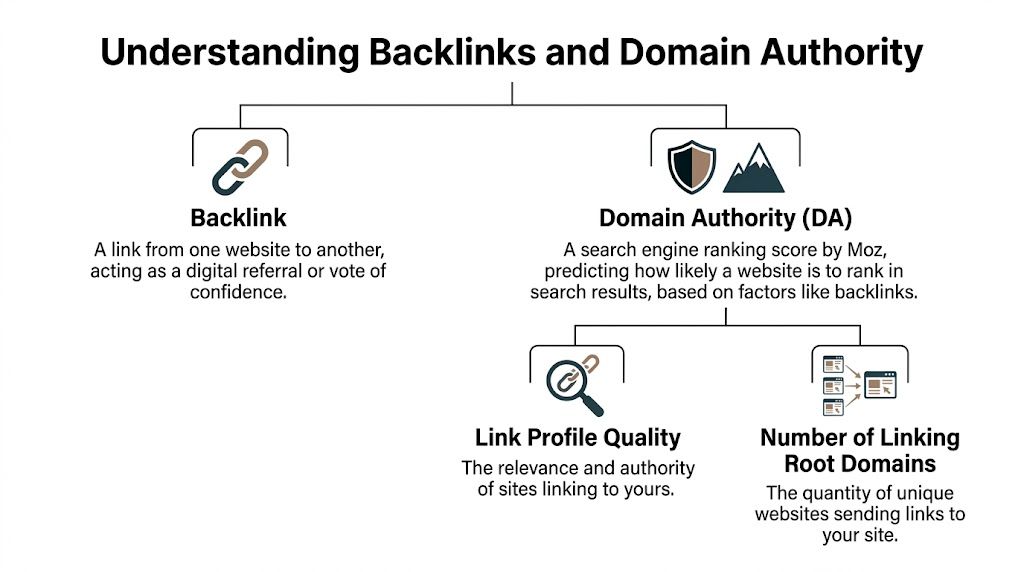
How backlink authority gets passed
Dofollow backlinks work through what's commonly called link juice. The referring page passes authority signals to the target page, and search systems inspired by PageRank evaluate how pages connect across the web.
BeyondWeb explains it plainly: a single dofollow backlink from a high-domain-authority Australian business publication can deliver significantly more SEO value than 50+ links from low-quality local directories in its backlink guide.
That doesn't mean every high-authority link is worth chasing. It means quality and source matter.
DA is one score, not the whole picture
Moz uses DA. Ahrefs uses DR. Other tools have their own authority models. If you want a simple comparison point, Ahrefs' Domain Rating (DR) is another widely used metric that estimates the strength of a site's backlink profile.
The exact number matters less than the pattern behind it:
- Who links to the site
- How many unique domains link to it
- Whether those links look natural
- Whether the content is trusted and relevant
A DA backlink, then, is best understood as a backlink from a site with measurable authority according to SEO tools. Useful, yes. Absolute truth, no.
Looking Beyond DA Other Important SEO Metrics
A DA score can help you compare sites quickly, but it is a poor shortcut for deciding where an Australian small business should spend time or money.
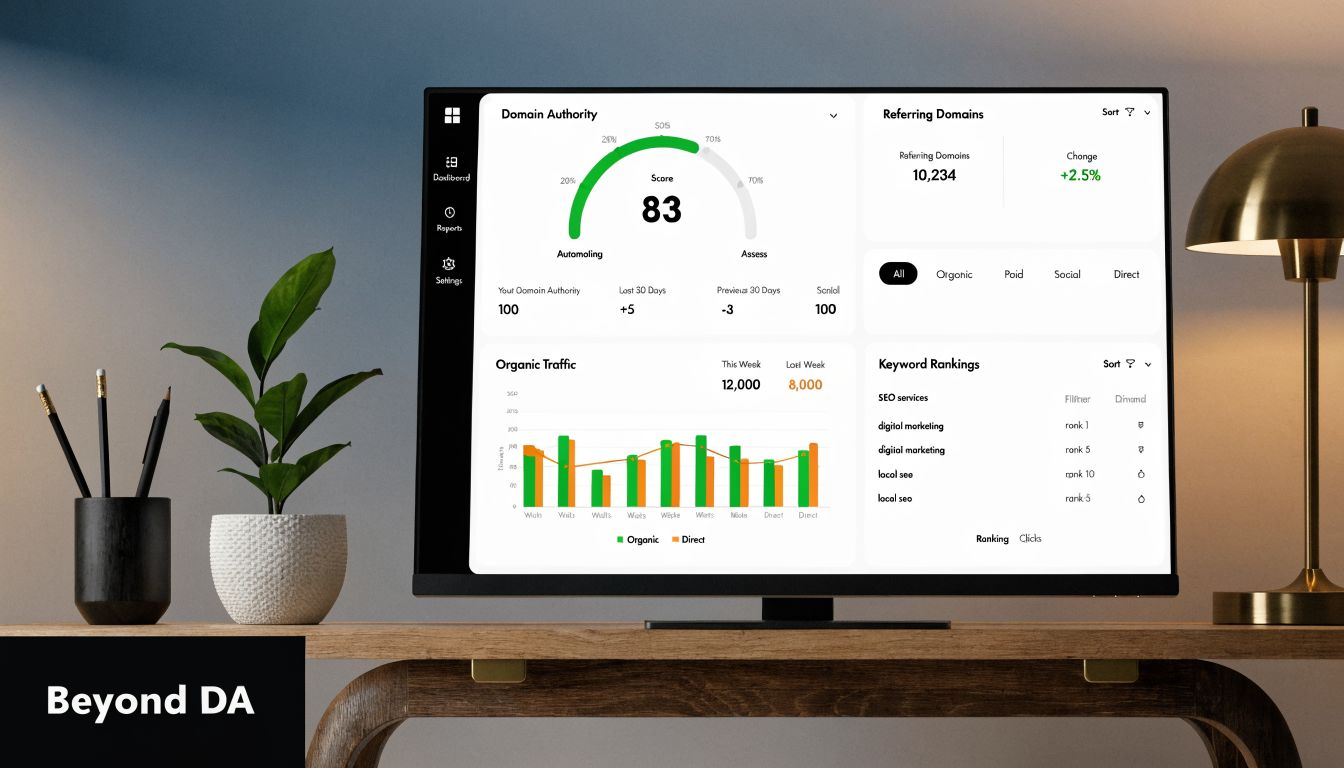
DA, DR, and PageRank
DA and DR are third-party estimates. They measure authority using different link indexes and formulas, so the same site can look stronger in one tool than another.
PageRank is the older idea underneath both. Google no longer shows a public PageRank score, but links still pass authority signals, and search systems still assess how pages connect and how much trust those connections deserve.
For Aussie SMBs, that means one thing. Use authority metrics as a filter, not as the final decision.
What business owners should track
A Perth plumber, accountant, physio, or builder does not need to chase the same link profile as a national publisher. In the Australian market, especially after years of aggressive link selling and recycled guest posts, local fit and topical relevance usually produce better results than chasing a flashy DA number on an unrelated site.
What matters more is whether the linking site sits close to your market, your service category, and your buyer.
A better checklist looks like this:
- Topical relevance to the page being linked
- Australian or local audience alignment
- Organic traffic quality, not just authority scores
- Editorial standards on the linking site
- Referral potential from real prospects
- Support for the destination page and its wider on-page SEO structure and content checklist
This is the trade-off business owners need to understand. A link from a DA 28 Australian industry site that your customers read can outperform a DA 70 overseas site with no local relevance, no referral traffic, and no business upside.
Authority still matters. Relevance, trust, and context usually matter more.
How to Evaluate the True Quality of a Backlink
When someone offers you a backlink, ignore the sales pitch and inspect the fit.
The best links usually make sense even if search engines didn't exist. A local supplier mentions your business. An industry body lists a member resource. A business blog quotes your advice because it helps their readers. That's the standard.
Relevance comes first
Chevron Editing's explanation of backlinks highlights a point many business owners miss: backlink value is driven by topical relevance clustering, and a link from a relevant local industry association can provide more SEO benefit than a link from an irrelevant, high-authority global news outlet as outlined here.
For a Perth electrician, a mention from an Australian building, trade, property, or renovation site makes sense. A link from an unrelated overseas crypto blog doesn't.
If the linking site wouldn't send you a suitable customer, it's usually a weak SEO prospect too.
Placement changes value
Not all links on a page carry the same weight.
A link placed naturally inside the main body of an article usually carries more value than one buried in a footer, author bio, or sitewide sidebar. Editorial context matters because it looks earned, not bolted on.
Use this checklist before saying yes
| Quality Signal | What to Look For (Green Flag) | What to Avoid (Red Flag) |
|---|---|---|
| Topical fit | The site covers your industry, services, products, or closely related topics | The site publishes unrelated content with no clear niche |
| Local relevance | Australian audience, local business focus, state or industry relevance | Overseas site with no connection to your market |
| Content quality | Clear writing, genuine articles, named business presence, useful pages | Thin articles, spun content, generic “SEO posts” |
| Link placement | Link appears in the main content and adds context | Link sits in footers, sidebars, widget blocks, or random author boxes |
| Editorial standards | The site appears selective about what it publishes | The site accepts anything and looks built purely for links |
| Traffic intent | The page could send interested visitors | The page exists only to host outbound links |
| Link pattern | Diverse outbound links that make editorial sense | Long lists of keyword-stuffed links to unrelated businesses |
Trust your commercial judgement
If a backlink opportunity feels manufactured, it probably is.
Good links often come from the same places good business relationships come from: associations, partnerships, sponsorships, suppliers, customers, and respected local publishers.
Actionable Link Building Strategies for WordPress Sites
Most WordPress site owners don't need a complicated link building system. They need a shortlist of practical moves they can repeat.
Start with the links you can earn locally
Begin with organisations and businesses that already have a reason to mention you.
Some of the strongest opportunities come from:
- Industry associations. If you're a member, ask whether they list members, suppliers, resources, or case studies.
- Complementary businesses. A wedding planner, photographer, florist, and venue can all link to each other in ways that help users.
- Australian business directories. Focus on legitimate listings with real local value, not mass submissions. A curated list of the best Australian business directories is a better starting point than random directory packages.
- Local chambers and community groups. Sponsorship pages, member profiles, and event recaps often create natural link opportunities.
Publish pages worth linking to
WordPress makes this easier than many businesses realise.
Create assets that another business, journalist, or association would reference:
- Local service guides for your city or region
- Helpful FAQs about buying, booking, safety, compliance, or delivery
- Supplier and partner pages that acknowledge real business relationships
- Case studies and project galleries that show work in context
A thin sales page rarely attracts links on its own. A useful resource page often does.
Practical rule: Build one page each quarter that deserves a mention from someone outside your business.
Use outreach like networking, not cold spam
The best outreach is short, specific, and relevant.
Mention the page. Explain why it fits their audience. Don't send a template that could have gone to two hundred sites.
This video gives a useful primer on backlink fundamentals and outreach thinking:
Make WordPress technically ready
Before you chase links, check the basics:
- Publish on a stable URL structure so linked pages won't be renamed next month.
- Improve page speed so referral traffic doesn't bounce on a slow site.
- Keep forms and conversion points working because a backlink only helps the business if the page converts.
- Add internal links from the target page to service, category, or enquiry pages.
A quality backlink to a weak page is a missed opportunity.
How to Audit and Clean Up Your Backlink Profile
Link building isn't only about adding links. It's also about removing risk.
Loganix notes that after Google's March 2025 AU core update, the weight of raw DA declined, while AI-generated spam backlinks surged 180% in Australia. It also warns that Google is penalising sites with unnatural link profiles in this overview. For WordPress site owners, that makes routine backlink audits part of standard maintenance.
Check what Google already sees
Start in Google Search Console.
Look at the sites linking to you and review them with basic common sense:
- Is this site relevant to my business or market?
- Does it look like a real publication or organisation?
- Is the link placed naturally, or does it look dumped into junk content?
You don't need to panic over every weak link. Most sites collect odd backlinks over time. The problem is a pattern of spam, manipulation, or hacked-site links.
What usually deserves scrutiny
Review links more closely when they come from:
- Irrelevant foreign sites with no reason to mention your business
- Thin content networks stuffed with outbound links
- Suspicious directories created purely for SEO
- Pages that look hacked or auto-generated
For online stores, this is especially important. If you want a broader tactical reference, this practical guide to link building for e-commerce sites is useful for separating sustainable tactics from risky shortcuts.
Use Google's Disavow Tool as a last resort, not a first reflex.
When disavow makes sense
Disavow is for cases where you've identified clearly harmful links and can't get them removed manually.
If you're unsure whether a batch of links is merely low value or actively toxic, get a second opinion before submitting a disavow file. A cautious audit beats an aggressive cleanup that throws away legitimate signals.
Conclusion Build a Backlink Profile That Drives Business
The best answer to what is da backlink is simple. It's a backlink from a site that SEO tools consider authoritative, but the score alone shouldn't drive your strategy.
For Australian SMBs, the stronger play is to build a backlink profile that looks natural, relevant, and commercially sensible. That means links from local organisations, industry sites, trusted partners, and useful editorial content. It also means keeping your WordPress site healthy enough to benefit from those links.
A good backlink doesn't just help rankings. It can send the right visitor, reinforce trust, and support enquiries or sales.
That's the ultimate goal.
If a link opportunity looks impressive but has no topical fit, no local value, and no realistic chance of sending a qualified visitor, it's probably not worth much. If a link comes from a site your customers might read, and it sits inside useful content, that's usually the better asset.
Build for relevance first. Authority follows more naturally when the profile makes sense.
Your DA Backlink Questions Answered
Should I buy backlinks?
Usually, no.
Buying backlinks often leads to the exact type of pattern search engines don't like: unnatural placements, irrelevant sites, and recycled guest posts built for SEO rather than readers. If you're paying for inclusion, make sure it's a legitimate sponsorship, directory, association membership, or editorial collaboration with real audience value.
How long does it take for backlinks to help rankings?
It depends on the site, the page, the crawl frequency, and how strong the rest of your SEO setup is.
Some links get indexed quickly. Others take time to be discovered, processed, and reflected in rankings. The practical view is to treat link building as a compounding activity, not a quick fix. One strong relevant link can matter, but it still works within the wider condition of your site.
Should I worry about links from low DA websites?
Not automatically.
A low-DA site can still be useful if it's relevant, local, trusted, and capable of sending the right people to your page. A local community organisation, niche association, or small business blog may have modest authority metrics and still be worth having in your profile.
What matters is whether the link looks natural and fits your business context. Low DA doesn't equal bad. Irrelevant, spammy, or manipulative is the problem.
If your WordPress site needs help with SEO, maintenance, malware recovery, speed, or backlink risk cleanup, Webby Website Optimisation provides Perth-based WordPress support for businesses across Australia.