
Search engine optimization (SEO) is the process of improving a website’s visibility in organic search results so that more potential customers find your business without paid advertising. Google alone processes over 8.5 billion searches per day, and businesses that rank on page one capture the overwhelming majority of that traffic. SEO works by aligning your website’s technical setup, content quality, and external authority with what search engines reward. Tools like Google Search Console, Ahrefs, and Google Analytics give you the data to measure and improve every element. For business owners and marketing professionals, understanding SEO basics is the foundation of any serious digital marketing strategy.
What is search engine optimization and how does it work?
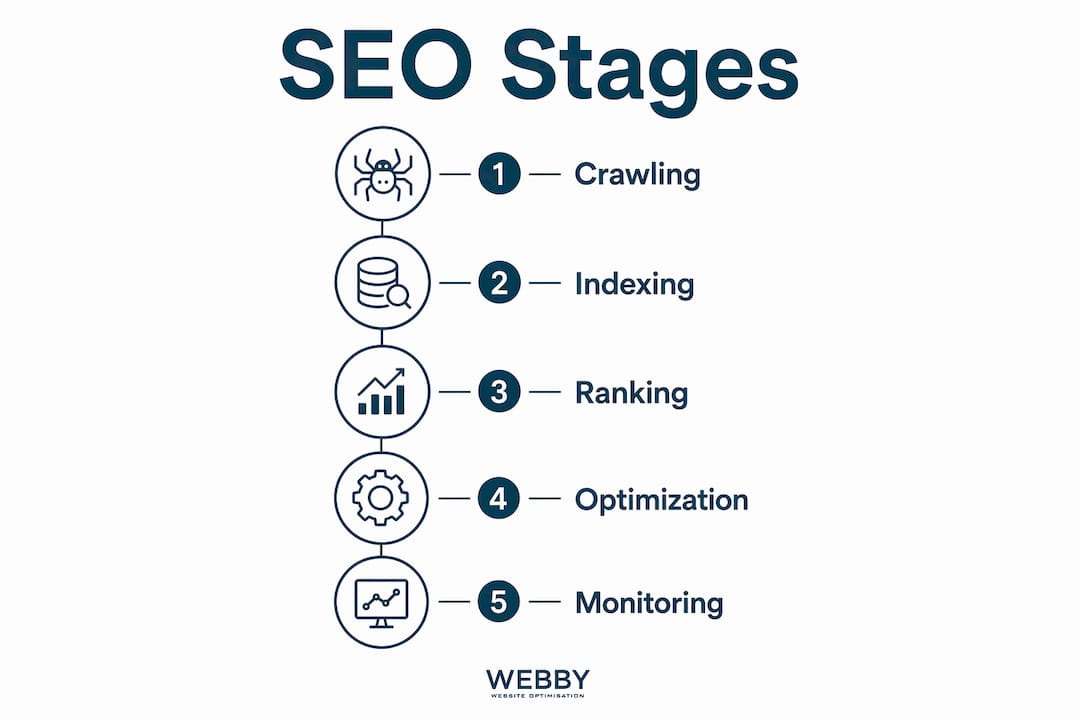
SEO follows three sequential stages: crawling, indexing, and ranking. Think of crawling as a librarian walking through every aisle of a library, reading the spine of each book. Indexing is when that librarian catalogs the book so it can be found later. Ranking is when someone asks for a book on a specific topic and the librarian decides which one to hand over first.
Google’s bots, called spiders or crawlers, visit your website and follow links from page to page. Once they understand your content, Google stores it in its index. When a user searches for something relevant, Google’s algorithm evaluates every indexed page and decides which ones best answer the query. Google uses over 200 ranking factors in this process, but the most influential are content quality, page speed and technical infrastructure, and backlink authority. Chasing every factor is a losing game. Focusing on those three delivers the most measurable impact.

The three pillars of SEO map directly to these stages: technical SEO supports crawling and indexing, on-page SEO drives content relevance and ranking signals, and off-page SEO builds the external authority that Google uses to judge trustworthiness.
Pro Tip: Set up Google Search Console before doing anything else. It shows you exactly which pages Google has indexed, which queries drive clicks, and where crawl errors are blocking your visibility.
- Crawling: Google discovers your pages by following links. Broken links, poor site structure, and blocked pages stop this process cold.
- Indexing: Pages with thin content, duplicate text, or no-index tags get excluded from Google’s catalog entirely.
- Ranking: Google scores indexed pages against the query using content relevance, user experience signals, and domain authority.
What are the three pillars of SEO and why do they work together?
Effective SEO is structured into three pillars: technical SEO, on-page SEO, and off-page SEO. Each addresses a distinct layer of your website’s performance, and weakness in any one of them limits the other two.
Technical SEO: the foundation
Technical SEO covers everything that determines whether search engines can access and understand your site. A thorough technical audit checks crawl errors, page speed, mobile usability, HTTPS status, and sitemap configuration. A beautifully written blog post ranks nowhere if Google’s bots cannot reach it. Site speed is particularly critical since Google’s Core Web Vitals measure loading performance, interactivity, and visual stability as direct ranking inputs. For local service businesses in Perth or Fremantle, a slow mobile site is not just a technical problem. It is a direct revenue problem.
On-page SEO: content and relevance
On-page SEO covers every element on the page itself: keyword placement in titles and headings, meta descriptions, image alt text, internal linking, and content depth. The goal is not to repeat a keyword as many times as possible. SEO expert Alex Moss frames it precisely: SEO is about aligning content with user intent rather than just placing keywords. A page targeting “emergency plumber Perth” needs to answer the questions a panicked homeowner actually asks, not just repeat the phrase. Internal linking, covered in depth in this on-page SEO guide, distributes authority across your site and helps Google understand your content hierarchy.
Off-page SEO: authority and trust
Off-page SEO is primarily about backlinks, which are links from other websites pointing to yours. Backlink quality outweighs quantity by a significant margin. One link from a respected industry publication does more for your rankings than fifty links from low-quality directories. Brand mentions, local citations in directories like Google Business Profile, and positive reviews also contribute to off-page authority. Website design affects how visitors perceive and share your content, which is why trust signals in design directly support your off-page reputation.
| SEO pillar | What it covers | Example actions |
|---|---|---|
| Technical SEO | Site infrastructure and crawlability | Fix crawl errors, improve page speed, add SSL |
| On-page SEO | Content relevance and page structure | Optimize title tags, improve content depth, add internal links |
| Off-page SEO | External authority and trust signals | Earn backlinks, build local citations, manage reviews |
Pro Tip: Ignoring technical SEO while investing heavily in content is one of the most common and costly mistakes. Audit your technical foundation first, then build content on top of it.
What are the most important SEO best practices for business owners?
SEO best practices are not a checklist you complete once. SEO is a continuous effort that compounds over time, unlike paid advertising which stops the moment you stop spending. The businesses that win in organic search treat it as an ongoing program, not a one-time project.
The following practices deliver the highest return for business owners and marketing professionals working with limited time and resources.
- Match content to search intent. Every page on your site should answer a specific question your customers are actually searching for. Use Google’s “People Also Ask” boxes and autocomplete suggestions to identify real queries, then write content that directly satisfies them.
- Prioritize mobile-first design. Google indexes the mobile version of your site first. If your mobile experience is slow or broken, your rankings suffer regardless of how good your desktop site looks.
- Build internal links deliberately. Linking related pages together helps Google understand your site’s structure and distributes ranking authority to pages that need it. A service page with no internal links pointing to it is effectively invisible.
- Earn backlinks through genuine value. Publish content that other sites in your industry want to reference. Case studies, original data, and practical guides attract links naturally. Avoid buying links or participating in link schemes, which Google penalizes.
- Monitor performance with Google Search Console. This free tool shows you which queries drive impressions and clicks, which pages have indexing issues, and how your Core Web Vitals score compares to competitors. Review it monthly at minimum.
- Avoid keyword stuffing. Repeating a keyword unnaturally throughout a page signals low quality to Google and reads poorly to humans. Write for the reader first. Google’s algorithm is sophisticated enough to understand context and synonyms.
A business-focused approach means balancing all three pillars rather than obsessing over any single tactic. Most websites see meaningful ranking improvements within three to six months of consistent effort, with competitive industries requiring six to twelve months or longer. Set realistic expectations and measure progress against your own baseline, not against established competitors with years of SEO investment behind them.
How is evolving search technology changing SEO in 2026?
Search engines in 2026 are fundamentally different from the keyword-matching systems of a decade ago. Modern search engines prioritize intent satisfaction over exact keyword matching, rewarding pages that fully answer a user’s underlying question rather than pages that simply contain the right words.
Here is how the major shifts are reshaping SEO strategy right now:
- AI-powered search results. Google’s Search Generative Experience and tools like Perplexity pull answers directly from web content, summarizing them at the top of the results page. Pages that provide clear, authoritative, well-structured answers are more likely to be cited in these AI summaries. This makes content depth and clarity more valuable than ever.
- Behavioral signals carry more weight. Click-through rate, dwell time, and bounce rate all signal to Google whether users found what they were looking for. A page that ranks on page one but gets skipped over, or that users immediately leave, will gradually lose its position. Writing compelling titles and delivering on their promise is now a ranking factor in practice.
- Search intent has replaced keyword density. Google’s natural language processing understands that “best plumber near me,” “top-rated plumber Perth,” and “emergency plumber Fremantle” all reflect similar intent. Optimizing for the intent cluster, not just a single phrase, produces more durable rankings.
- AI visibility tools are emerging. Platforms like Corvane Systems represent a new category of tools designed to help businesses understand and improve their visibility within AI-generated search results, a layer of optimization that did not exist two years ago.
- Social signals influence authority indirectly. While social media links do not directly boost rankings, content that earns shares and engagement builds brand recognition and attracts backlinks. A strong social presence amplifies the reach of your SEO content.
The shift toward AI and behavioral signals means that thin, keyword-stuffed pages are losing ground fast. Content that genuinely helps the reader, structured for clarity and depth, is the only sustainable SEO strategy in 2026.
Key takeaways
SEO succeeds when technical infrastructure, content relevance, and external authority work together as a single system rather than as isolated tactics.
| Point | Details |
|---|---|
| SEO is a three-pillar system | Technical, on-page, and off-page SEO must all function together for strong rankings. |
| Crawling and indexing come first | Google cannot rank pages it cannot access. Fix technical issues before investing in content. |
| Intent beats keyword density | Write content that fully answers the user’s question, not content that repeats a phrase. |
| Backlink quality drives authority | One strong backlink from a trusted domain outperforms dozens of low-quality links. |
| SEO results take time | Most sites see meaningful gains in three to six months. Consistent effort compounds over time. |
Why I think most businesses are approaching SEO backwards
After working with service businesses across Perth and the surrounding suburbs, the pattern I see most often is this: a business owner invests in blog content, social posts, and maybe a few directory listings, then wonders why Google still is not sending traffic. The answer is almost always the same. The technical foundation is broken.
Google cannot rank a page it cannot properly crawl and index. I have audited sites where entire service pages were accidentally blocked from Google by a single misconfigured robots.txt file. All the content investment in the world cannot fix that. The right sequence is always: technical audit first, content second, link building third.
The other mistake I see constantly is treating SEO as a campaign with a start and end date. Paid ads work that way. SEO does not. The businesses that dominate local search in competitive markets like plumbing, electrical, or legal services in Perth did not get there with a three-month push. They built authority gradually, updated their content regularly, and kept their technical setup clean. That compounding effect is what makes organic traffic so valuable. It does not stop when the budget runs out.
My honest advice: start with a DIY SEO audit to understand where your site stands technically, then build your content and link strategy on top of a solid foundation. Understand technical SEO fundamentals before spending another dollar on content creation. The businesses that do this in the right order consistently outperform those that skip straight to content.
— Steve Doig
How Webby Website Optimisation can accelerate your SEO results
If you have read this far, you understand that SEO is not a single task. It is a system that requires the right technical foundation, targeted content, and a steady build of authority over time.
Webby Website Optimisation works with local service businesses in Perth, Fremantle, and Melville to build exactly that system. The team starts with a thorough SEO audit to identify what is holding your site back, then builds a custom strategy around your specific industry and competition. Whether you need a faster website, stronger content, or a backlink profile that actually moves rankings, Webby Website Optimisation delivers tailored SEO services built for the local market. Contact the team today for a free consultation and find out where your biggest ranking opportunities are.
FAQ
What is search engine optimization in simple terms?
Search engine optimization is the practice of improving your website so that Google and other search engines rank it higher in organic results, sending more visitors to your site without paid ads.
How long does SEO take to show results?
Most websites see meaningful improvements within three to six months of consistent SEO work, though competitive industries can take six to twelve months or longer.
What is the difference between on-page and off-page SEO?
On-page SEO covers elements you control directly on your website, such as content, titles, and internal links. Off-page SEO refers to external signals like backlinks and brand mentions that build your site’s authority.
Do I need technical SEO if my content is good?
Yes. Poor site architecture or slow pages prevent Google from properly crawling and indexing your content, meaning even high-quality pages may never rank without a solid technical foundation.
Is SEO still relevant with AI search in 2026?
SEO is more relevant than ever. AI-powered search tools pull answers from well-structured, authoritative web content, meaning pages optimized for depth and clarity are more likely to be cited and surfaced in AI-generated results.