
URL structure is defined as the organized pattern of web addresses that tells search engines and users exactly what a page contains before they click. The role of URL structure in SEO goes beyond cosmetics. Clean, logical URLs signal topical relevance to Google’s crawlers, build user trust in search results, and support the site architecture that holds your entire SEO strategy together. Google’s John Mueller has confirmed that URLs carry contextual signals, and keyword-optimized URLs rank on average 1.4 positions higher than generic ones. For website owners and digital marketers in competitive local markets, getting URL governance right is one of the few technical wins that pays dividends across every page you publish.
How does URL structure affect SEO performance?
URL structure affects SEO performance through two distinct channels: direct signals to search engines and indirect signals through user behavior. The direct channel is modest. Google treats URL keywords as a minor ranking factor, using them to confirm topical relevance rather than drive rankings on their own. The indirect channel is where the real impact lives.
Readable URLs improve perceived trustworthiness and click-through rates by making it easier for users to assess page relevance directly in the search results page. When someone sees "/services/plumbing/hot-water-systems/versus/page?id=4829`, they know instantly what they are getting. That confidence translates to clicks. Pages with keyword-optimized, readable URLs can achieve up to 45% higher click-through rates than generic URLs. Higher CTR sends Google a strong engagement signal, which feeds back into rankings.
URL structure also supports site architecture and internal linking. A well-organized hierarchy like /blog/seo/url-structure/ tells crawlers how pages relate to each other, which strengthens topical clusters and distributes link equity more efficiently. You can see how this connects to website architecture for SEO in practice.
“URL structure is not a magic ranking lever, but it is the scaffolding that holds your site’s SEO logic together. Get it wrong and every other optimization becomes harder.”
The key takeaway is that URL structure is a minor direct ranking factor but a significant indirect one. Crawl efficiency, duplicate content prevention, and user trust all depend on it.
What are the best practices for SEO-friendly URL structures?
Creating SEO-friendly URLs requires discipline across every page you publish, not just your homepage. Follow these rules consistently and you build a site that search engines can read like a well-organized book.
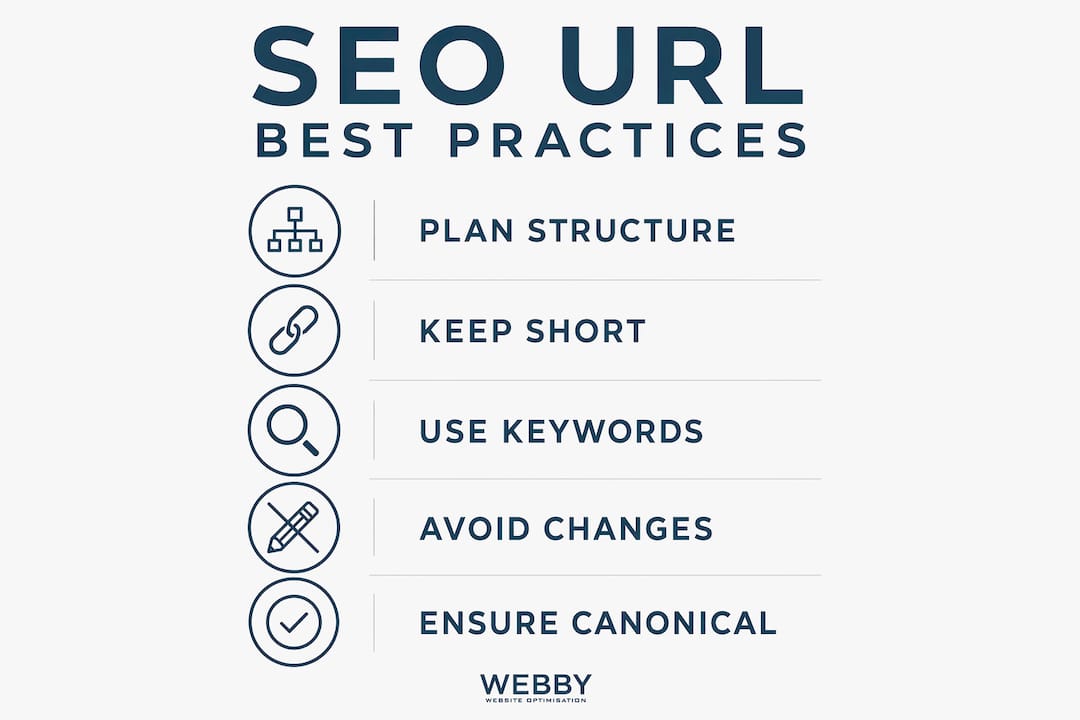
- Keep URLs short and lowercase. Long URLs with mixed capitalization create crawl confusion and reduce shareability. Aim for under 75 characters per URL where possible.
- Use hyphens to separate words. Hyphens in URLs are treated as spaces by search engines, making slugs readable. Underscores are not.
/hot-water-systems/beats/hot_water_systems/every time. - Include your primary keyword once. Place the target keyword in the slug naturally. Do not repeat it or force variations.
/services/seo-perth/is correct./services/seo-perth-seo-services-perth/is keyword stuffing. - Remove stop words unless they are critical. Search engines ignore stop words like “the,” “a,” and “of” in URLs. Removing them shortens the URL without any SEO penalty.
- Keep URL depth shallow. The ideal structure is domain > category > page, a maximum of three levels deep. Deep nesting beyond three levels dilutes authority and signals lower page importance to crawlers.
- Avoid dynamic parameters in canonical URLs. URL parameters for filtering or tracking create duplicate content issues. Use canonical tags on parameterized URLs to preserve SEO authority and prevent index fragmentation.
- Standardize trailing slashes. Pick one convention, either always include a trailing slash or never include one, and apply it across the entire site. Inconsistency creates duplicate URL variants.
Pro Tip: Never change a URL without a specific SEO reason. Frequent URL changes disrupt crawl patterns, break inbound links, and can cause temporary ranking drops even with proper redirects in place. Stability is a feature.
The biggest SEO benefits from URL optimization come from preventing duplicate content and maintaining canonical consistency, not from inserting keywords into individual slugs. Modern CMS platforms like WordPress auto-generate reasonable slugs. Your energy is better spent on systemic URL governance than on obsessing over individual slug wording.
Comparing common URL structure formats and their SEO impact
Not all URL formats perform equally. The table below compares the most common approaches across SEO impact, usability, and technical complexity.
| Format | Example | SEO impact | Usability | Complexity |
|---|---|---|---|---|
| Flat structure | /hot-water-systems/ | Good for small sites | High | Low |
| Hierarchical structure | /services/plumbing/hot-water-systems/ | Scales well, strong topical signals | High | Medium |
| Date-based URLs | /blog/2019/03/seo-tips/ | Weak for evergreen content | Low over time | Medium |
| Dynamic/parameterized | /page?id=4829&cat=seo | Poor without canonicalization | Low | High |
| Keyword-rich slugs | /services/seo-perth/ | Strong contextual signal | High | Low |
| Generic slugs | /services/page-1/ | Minimal signal | Low | Low |
Flat URL structures work well for small sites with limited content, but hierarchical structures scale better and reinforce topical relevance as your site grows. The critical point about date-based URLs is often misunderstood. Dates make sense for news sites where recency is the value proposition. For a local service business publishing evergreen content, a URL like /blog/2019/03/seo-tips/ signals age and invites users to question whether the content is still relevant.
Static keyword-rich slugs consistently outperform generic slugs on both user trust and search visibility. The practical rule is to use a hierarchical structure that mirrors your service or content taxonomy, keep it static, and avoid dynamic parameters wherever possible.
How URL structure influences AI-driven search in 2026
AI-driven search tools including ChatGPT, Perplexity, and Google’s AI Overviews use URL signals as a secondary content layer to categorize content before the page text is even processed. This is a meaningful shift from traditional SEO, where the URL was largely a user-facing label. For AI retrieval, the URL is a classification signal.
URLs that encode hierarchical contextual taxonomy, such as /resources/seo/url-structure/, improve the likelihood of citation and topical classification in AI responses. An AI model reading that URL can infer the content category, the subtopic, and the specificity of the page without reading a single word of body text. That inference improves citation accuracy and topical authority scoring.
Practical steps to optimize URLs for AI retrieval include:
- Remove internal codes and jargon from slugs. URLs like
/p/XJ-4492/are meaningless to AI systems. Replace them with descriptive slugs that reflect the actual content. - Mirror your topical taxonomy in the URL path. If your site covers SEO, web design, and local marketing, those categories should appear as URL segments, not as tag parameters.
- Audit high-value pages first. Run a DIY website SEO audit to identify pages with the most inbound links or organic traffic, then prioritize URL clarity on those pages.
- Avoid making URL changes purely for AI optimization. The SEO risk of changing established URLs outweighs the marginal AI citation benefit unless the current URL is genuinely unclear.
Pro Tip: Think of your URL structure as a filing system that both humans and AI models read. If a new employee could not guess the page topic from the URL alone, the URL needs work.
AI models map URLs semantically to help categorize content and improve citation quality. This means that URL clarity is no longer just a usability concern. It is a content discoverability concern in an AI-first search environment.
Practical steps for changing or optimizing URL structures safely
URL restructuring is one of the highest-risk technical SEO operations you can perform. Done carelessly, URL changes without proper redirects cause organic traffic drops of 30 to 50%. Done correctly, they improve crawl efficiency and long-term site health.
Follow this process whenever you need to change or restructure URLs:
- Audit existing URLs before touching anything. Document every URL that receives organic traffic, inbound links, or internal links. Tools like Screaming Frog or Google Search Console work well for this.
- Map old URLs to new URLs one-to-one. Every old URL needs a direct 301 redirect to its new equivalent. Redirect chains, where URL A redirects to B which redirects to C, bleed link equity and slow crawl speed.
- Test your redirect map before launch. Validate every redirect in a staging environment. A single broken redirect on a high-traffic page can cost weeks of ranking recovery.
- Update internal links across the site. Redirects preserve external link equity but internal links should point directly to the new URLs. Relying on redirects for internal navigation wastes crawl budget.
- Monitor Google Search Console for crawl errors and ranking changes for at least 60 days after launch. Ranking fluctuations in the first two weeks are normal. Sustained drops after 30 days indicate a redirect or canonicalization problem.
- Coordinate URL changes with broader redesigns. Changing URLs in isolation creates unnecessary risk. Batch URL changes with a site redesign or technical SEO overhaul to minimize disruption. Read more about what technical SEO involves before planning any restructure.
The cost-benefit calculation matters here. If a URL is already ranking well and receiving traffic, the risk of changing it almost always outweighs the benefit of a cleaner slug.
Key takeaways
URL structure is the foundation of crawlability, user trust, and topical authority. Getting it right once and maintaining it consistently delivers more SEO value than any amount of slug-level keyword tweaking.
| Point | Details |
|---|---|
| URL structure affects CTR directly | Keyword-optimized URLs achieve up to 45% higher CTR than generic URLs, improving engagement signals. |
| Governance beats slug keywords | Preventing duplicate content and maintaining canonical consistency delivers more SEO value than keyword insertion. |
| Shallow hierarchies scale better | Keep URL depth to three levels maximum to preserve authority and improve crawl efficiency. |
| AI search reads URLs as signals | Clear hierarchical URLs improve topical classification and citation likelihood in AI-driven search tools. |
| URL changes carry real risk | Traffic drops of 30 to 50% are common after poorly managed URL restructuring. Always use 301 redirects. |
Why I think most sites get URL structure exactly backwards
After working on SEO for local service businesses across Perth and Fremantle, I have seen the same mistake repeated constantly. Site owners spend hours debating whether a slug should be /plumbing-services-perth/ or /perth-plumbing-services/ while their site has 200 parameterized URLs creating duplicate content, no canonical tags, and a URL structure that changes every time someone rebuilds the site.
The obsession with slug-level keyword optimization is a distraction. The real SEO value from URL governance comes from systemic decisions: consistent canonicals, clean hierarchies, and stable URL patterns that do not change with every redesign. I have seen sites recover significant organic traffic simply by implementing canonical tags on filtered product pages, with zero slug changes.
The AI search dimension makes this even more pressing. When Perplexity or Google’s AI Overviews decide whether to cite your content, they are reading your URL as a classification signal. A URL like /services/seo/local-seo-perth/ communicates topical authority. A URL like /services/?cat=12&id=87 communicates nothing. The sites winning AI citations in 2026 are not the ones with the cleverest slugs. They are the ones with the clearest taxonomies.
My practical advice: treat URL structure as infrastructure, not decoration. Set a governance standard, apply it consistently, and resist the urge to rewrite URLs for cosmetic reasons. The SEO case studies that show real traffic gains almost always involve fixing structural problems, not polishing slugs.
Get your URL structure right with Webby Website Optimisation
If your site has grown organically over the years, the odds are high that your URL structure has grown with it, inconsistently. Parameterized URLs, duplicate paths, and shallow slugs are common problems that quietly drain organic performance.
Webby Website Optimisation works with local service businesses in Perth, Fremantle, and Melville to audit, fix, and future-proof URL structures as part of a broader technical SEO strategy. The process covers canonical management, redirect mapping, and URL hierarchy alignment with your site’s content taxonomy. Whether you are planning a site rebuild or cleaning up an existing site, Webby’s team handles the technical complexity so you do not lose rankings in the process. Contact Webby Website Optimisation for a free audit and find out exactly where your URL structure is costing you traffic.
FAQ
What is the role of URL structure in SEO?
URL structure helps search engines understand page content and hierarchy, supports crawl efficiency, and influences user click-through rates in search results. It is a minor direct ranking factor but a significant indirect one through engagement and site architecture signals.
How long should an SEO-friendly URL be?
SEO-friendly URLs should generally stay under 75 characters. Shorter URLs are easier to share, read, and process, and search engines do not penalize brevity.
Should I change old URLs to make them more SEO-friendly?
Only change URLs if the current structure causes genuine SEO problems such as duplicate content or missing keywords in high-priority pages. Always implement 301 redirects for every changed URL, since unredirected URL changes can cause traffic drops of 30 to 50%.
Do URL keywords directly improve Google rankings?
URL keywords are a minor ranking signal, not a primary one. Their bigger value is in improving click-through rates and helping AI-driven search tools classify content accurately.
How does URL structure affect AI search tools like Perplexity or ChatGPT?
AI systems use URL paths as a secondary content layer to categorize pages before reading body text. Clear hierarchical URLs like /resources/seo/url-structure/ improve the likelihood of accurate topical classification and citation in AI-generated responses.