
New websites rank slowly because search engines require time to build trust, evaluate authority, and crawl content before granting visibility. This delay, often called the “sandbox effect” by SEO practitioners, is not a bug. It is Google’s way of filtering unproven domains from established ones. Most new sites see significant traffic growth starting near month 8 to 12, not month one. Understanding why sites take time to rank gives you a real advantage. Tools like Google Search Console and domain authority metrics help you track progress and identify what is holding your site back.
Why new websites rank slowly: the core reasons
The ranking delay for new websites comes down to one word: trust. Google’s algorithms prioritize trust signals like consistent publishing history, backlink profiles, and user engagement patterns over domain age alone. A brand-new domain has none of these signals. Search engines have no evidence yet that your site is reliable, authoritative, or worth showing to users. Until that evidence accumulates, your pages sit lower in results than their content quality might otherwise deserve.
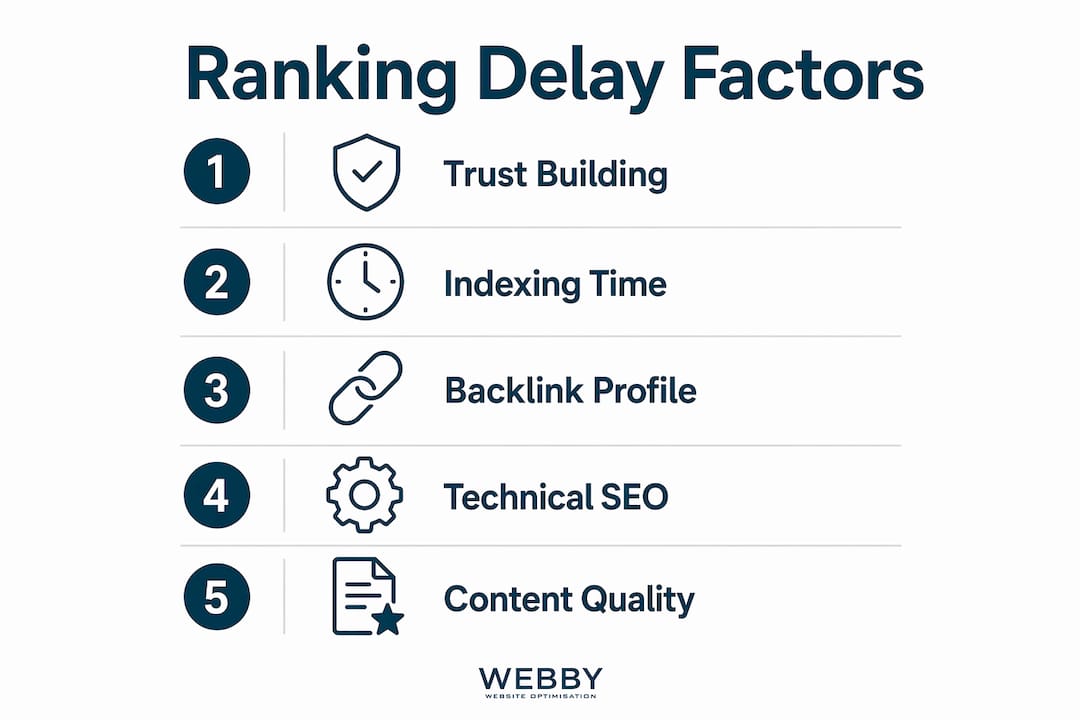
New website SEO challenges are not random. They follow a predictable pattern. Google needs to crawl your pages, index them, assess your backlink profile, and observe how users interact with your content. Each of these steps takes time, and they happen in sequence, not all at once.
What is the google sandbox and how does it affect rankings?
The Google Sandbox is an observed delay in ranking performance that affects new websites, typically lasting 3–6 months or longer in competitive niches. Google has never officially confirmed the sandbox exists. SEO practitioners named it based on consistent patterns they observed across thousands of new domains.
Here is what the sandbox period looks like in practice:
- Suppressed rankings: Your pages may appear in Google’s index but rank on page 5 or beyond, even for low-competition keywords.
- Flat traffic: Organic visits stay near zero for weeks or months despite publishing good content.
- Gradual improvement: Around months 4–6, rankings begin to shift. By months 8–12, meaningful traffic often arrives.
- Trust signal accumulation: Backlink quality, content consistency, and user engagement all feed into how quickly you exit this phase.
- Domain history matters: Expired domains with strong link profiles can sometimes skip or minimize the sandbox period entirely, because they carry inherited trust signals.
Pro Tip: If budget allows, purchasing an expired domain with a clean, relevant backlink profile can cut months off your sandbox period. Check the domain’s history in tools like Ahrefs or Majestic before buying.
The sandbox is not a penalty. Treating it like one leads to panic decisions, like rewriting all your content or restructuring your site, which only resets your progress.
How do domain authority and backlinks drive slow ranking?
Domain authority is a score that reflects accumulated trust and credibility built over time through backlinks, content, and user signals. New domains start at zero. That starting point is the single biggest reason for slow ranking on new domains.
Backlinks are the primary currency of domain authority. Each quality link from a reputable site tells Google that your domain is worth trusting. The catch is that backlinks take about 10 weeks on average to produce a measurable ranking boost. That lag is why many new site owners abandon their SEO efforts too early. They build links in month one and expect results by month two. The math does not work that way.
Here is a practical framework for building authority without triggering penalties:
- Start with foundational links. Get listed in Google Business Profile, industry directories, and local citations. These are low-risk and signal legitimacy immediately.
- Publish guest posts on relevant sites. One quality link from a niche-relevant blog outperforms ten links from unrelated directories.
- Build at a natural pace. Unnatural rapid link acquisition signals manipulative behavior, triggering algorithmic penalties and lengthening sandbox time.
- Monitor link quality. Use Google Search Console to identify and disavow toxic backlinks that could drag your authority down.
- Be patient with results. Most teams underestimate domain authority’s role, focusing too heavily on content over backlink acquisition, which delays ranking significantly.
“Domain authority is not built in a sprint. It is built through consistent, credible signals over months. The sites that win long-term are the ones that treat link building as a relationship strategy, not a numbers game.”
Quality beats quantity at every stage. A single link from a respected local news site or industry publication does more for your new domain than 50 links from low-authority blogs.
What technical and content factors cause slow ranking?
Technical SEO is the foundation your content sits on. If that foundation has cracks, even excellent content will not rank well. New websites with technical issues such as slow loading speed, crawl errors, or broken links face additional ranking delays on top of the standard sandbox period.

The table below shows the most common technical and content factors that affect ranking speed, and what each one costs you if ignored.
| Factor | Impact on Ranking Speed |
|---|---|
| Slow page load time | Poor Core Web Vitals scores hurt user engagement signals |
| Crawl errors and broken links | Googlebot skips pages it cannot access, delaying indexing |
| No XML sitemap | Search engines take longer to discover new pages |
| Thin or duplicate content | Signals low trust and reduces crawl priority |
| Poor internal linking | Authority fails to flow between pages, weakening the whole site |
| Non-mobile-friendly design | Reduces rankings on mobile-first indexing |
Content quality is equally critical. Thin, generic pages that cover a topic without depth signal to Google that your site is not an authority. Google evaluates topical authority across your whole site, not just individual pages. A site that publishes 20 focused articles on plumbing services ranks faster than a site that publishes five articles on plumbing, five on cooking, and five on travel.
Pro Tip: Use Google Search Console’s Coverage report weekly during your first six months. It shows exactly which pages are indexed, which are excluded, and why. Fixing indexing errors early prevents weeks of wasted ranking potential.
Site speed directly affects user experience metrics like bounce rate and time on page. Poor performance leads to bad user signals that hurt rankings indirectly. A well-structured site with fast load times and clear internal linking architecture gives Googlebot a clear map to follow and keeps users engaged long enough to generate positive signals.
How to accelerate ranking growth for a new website
Speeding up ranking growth is not about shortcuts. It is about removing every obstacle between your site and Google’s trust. Here are the strategies that produce real results for new domains:
- Publish content with topical depth. Cover one subject area thoroughly before branching out. A local plumber in Perth benefits more from 15 detailed articles on plumbing services than from scattered content across unrelated topics.
- Fix technical issues before adding content. Run a DIY SEO audit in your first month to catch crawl errors, broken links, and speed problems before they compound.
- Submit your sitemap to Google Search Console immediately. Do not wait for Googlebot to discover your site organically. Submission accelerates the new site indexing delay significantly.
- Build backlinks from relevant, reputable sources. Prioritize local business directories, industry associations, and niche publications over generic link farms.
- Maintain stability in your early months. Rapid structural or keyword changes cause algorithmic resets, meaning sites lose accrued trust signals and face extended delays.
- Track user engagement signals. Low click-through rates and high bounce rates tell Google your content is not satisfying search intent. Rewrite underperforming pages before adding new ones.
- Avoid mass automated link building. Bulk link schemes trigger penalties that can set your domain back by months, not weeks.
New sites also experience an invisible flatline period in the first 2–4 weeks where no measurable SEO progress occurs. This is normal. The absence of movement does not mean your efforts are failing. It means Google is still processing your site’s signals.
Key takeaways
New websites rank slowly because trust, authority, and technical credibility all take time to build, and no shortcut replaces that process.
| Point | Details |
|---|---|
| Sandbox effect is real | Most new sites face suppressed rankings for 3–6 months before meaningful visibility begins. |
| Backlinks have a lag | Links take about 10 weeks to produce measurable ranking gains, so start building early. |
| Topical focus accelerates trust | Publishing consistently within one subject area helps Google categorize and rank your site faster. |
| Technical issues compound delays | Crawl errors, slow load times, and poor internal linking add ranking delays on top of the sandbox period. |
| Stability protects progress | Avoid frequent structural or keyword changes in your first six months to preserve accrued trust signals. |
The patience tax every new site owner pays
I have worked with dozens of local service businesses in Perth and Fremantle who launched new websites expecting page-one results within 60 days. Almost every one of them made the same mistake: they changed things too fast when results did not come.
The most damaging pattern I see is what I call the “panic pivot.” A site owner publishes 10 pages, waits three weeks, sees no traffic, and then rewrites the whole site structure, changes the keyword targets, and starts over. That reset does not just waste time. It actively signals instability to Google and extends the sandbox period further.
The uncomfortable truth about new website traffic growth issues is that patience is not passive. You should be actively building backlinks, fixing technical issues, and publishing focused content during those quiet early months. The work you do in month two shows up in month six. The sites I have seen rank fastest are the ones that committed to a clear topical focus, built links steadily, and resisted the urge to overhaul everything when the flatline period hit.
One more thing worth saying directly: professional website design matters more than most new site owners realize. A site that looks credible earns more backlinks, gets more clicks, and generates better engagement signals. Those signals feed directly into ranking speed. You can see this pattern clearly in real SEO case studies where design quality and ranking timelines correlate strongly.
Ready to rank faster? webby website optimisation can help
If your new website is stuck in the slow ranking phase, the right support makes a measurable difference. Webby Website Optimisation works with local service businesses across Perth, Fremantle, and Melville to build sites that earn Google’s trust faster through technical precision, focused content strategy, and steady link building.
A professionally built site with clean architecture and strong on-page SEO removes the technical obstacles that extend ranking delays. Webby’s SEO and website design services are built specifically for small and medium businesses that need real results without wasted budget. Whether you need a new site built right from day one or an existing site fixed, the team at Webby Website Optimisation delivers strategies grounded in what actually works.
FAQ
How long does it take a new website to rank on google?
Most new websites begin seeing meaningful organic traffic between months 8 and 12 after launch. Competitive niches can push that timeline to 12–18 months without a strong backlink and content strategy.
What is the google sandbox effect for new sites?
The Google Sandbox is an observed period of suppressed rankings lasting 3–6 months or more for new domains. It reflects Google’s trust-building process before granting a new site significant search visibility.
Do backlinks help new websites rank faster?
Yes, but backlinks take about 10 weeks on average to produce measurable ranking gains. Building links steadily from reputable, relevant sources is the most reliable way to accelerate authority growth.
Can technical SEO issues delay a new site’s rankings?
Technical problems like crawl errors, broken links, and slow load times add ranking delays on top of the standard sandbox period. Fixing these issues in your first month removes unnecessary obstacles to indexing.
Does domain age affect how quickly a new site ranks?
Domain age alone is not a primary ranking factor. Google prioritizes trust signals like content quality, backlink profiles, and user engagement over raw domain age when determining ranking speed.