
Locksmith SEO is the work of making your business show up on Google when someone locked out of a car or home searches for help nearby. For most Australian locksmiths it comes down to three things: a properly built Google Business Profile, one strong page for each service and suburb you cover, and a steady flow of real reviews. We build all three for local service businesses at Webby, and this guide shows how they fit together so you can judge where your own site stands.
TL;DR
- Locksmith customers search in a hurry and call the first trustworthy result, so the map results and the top of the organic listings decide most jobs.
- Google ranks local results on relevance, distance and prominence, and you cannot pay for a better local position, so the profile, website and reviews have to earn it.
- Build separate pages for each core service (emergency lockout, car keys, rekeying, safes) and each main area, with a phone number that is easy to tap.
- Measure calls, form enquiries and booked jobs, not rankings alone. Expect months, not days, for a new site to build momentum.
- A website audit shows what is holding your site back before you commit to a monthly campaign.
Table of Contents
- Why locksmith SEO works differently from other trades
- How Google decides who appears for “locksmith near me”
- Set up your Google Business Profile as a service-area business
- Build a website that backs up the profile
- Reviews, links and citations: building prominence
- Keywords locksmith customers actually use
- Measuring results: calls, enquiries and jobs
- What locksmith SEO costs in Australia
- Our view on locksmith SEO
- Where to start with Webby
- FAQ
- Sources
Why locksmith SEO works differently from other trades
Most trades sell a planned job. A locksmith often sells a rescue. The person searching is standing outside a locked car, or has just lost a key, and wants a number to ring within a minute. That changes what a good website does.
Three things follow from it:
- Searchers rarely scroll. They tap the top map listing or the first organic result, so being in the top three matters far more than being on page one.
- Trust is judged in seconds. Reviews, a local address or service area, and a real phone number carry more weight than a long about page.
- Phones do the work. Most of these searches happen on a mobile, so a click-to-call button and a fast page are part of SEO, not extras.
There is also a lot of national and directory competition for locksmith searches. A local owner wins by being the most relevant, closest and best-reviewed option for the suburbs they actually serve. That is a job a small business can do well.
How Google decides who appears for “locksmith near me”
Google’s own help page says local results are mainly based on relevance, distance and prominence. Here is what each means for you:
- Relevance: how well your profile and website match what the person typed. A profile that lists “car locksmith” and “emergency lockout” as services matches those searches better than a vague “security services” description.
- Distance: how close you are to the searcher, or to the area named in the search. You cannot change where customers are, but you can make clear which areas you serve.
- Prominence: how well known you are. Google says this draws on factors such as how many websites link to your business and how many reviews you have.
The same page states there is no way to request or pay for a better local ranking. That is why the steady, practical work below matters: it is the only route.
Set up your Google Business Profile as a service-area business
Most locksmiths travel to the customer, so you are what Google calls a service-area business. Google’s guidelines for representing your business say such a business should have one profile for the central office with a designated service area, and that the service area should not extend farther than about 2 hours’ driving time from where you are based. They also say premium phone numbers are not acceptable.
In practice:
- One profile, not many. Resist creating a profile for every suburb. Create one for your base and list the areas you cover.
- Pick the right categories. Choose “Locksmith” as the primary category, then add secondary categories that truly describe what you do.
- List services in plain words. Emergency lockout, car key replacement, lock rekeying, lock changes, safe opening. Use the words customers type.
- Use a local number you answer. A number that rings out or goes to a call centre costs you the job, and premium-rate numbers break Google’s rules.
- Add real photos. Your van, your tools, finished work. Keep them current.
- Keep hours accurate. If you offer after-hours call-outs, say so clearly.
We cover the fundamentals in more detail in our guide to Google Business Profile for local service owners. Our approach to service-area trades is profile first, then the website pages that back it up, which we set out in GBP First: 3 service pages that win service area business SEO.
Build a website that backs up the profile
Your profile gets people to see you. Your website convinces Google you are relevant and convinces the customer to call. For a locksmith, an effective site is simple and specific.
The pages every locksmith site needs
- Home page: who you are, the main areas you serve, your phone number at the top, and a short list of core services.
- One page per core service: emergency lockout, car locksmith and key replacement, home rekeying and lock changes, commercial and master key systems, safes. Each page should explain the problem, what you do, how quickly you can arrive and what a customer should have ready when they call.
- One page per main area: a page for each major suburb or region you serve, with genuine local detail such as the streets and neighbourhoods you cover, typical response times and jobs you have done there. Do not copy one page and swap the suburb name; Google and customers both see through it.
- Contact page: phone, a short form, your service area and your ABN or licence details where relevant.
- Reviews or work page: real customer feedback and photos of finished jobs.
What each page needs to convert
| Element | Why it matters for a locksmith |
|---|---|
| Tap-to-call button, visible without scrolling | Mobile searchers in a hurry will not hunt for a number |
| Clear service and area in the heading | Tells Google and the customer the page is relevant |
| Typical arrival times and what the job involves | Reduces hesitation and wasted calls |
| Pricing guidance, such as call-out and after-hours structure | Customers worry about being overcharged at night |
| Licence, insurance and review snippets | Builds trust quickly |
| Fast loading on mobile | Slow pages lose people stuck outside a car |
Speed deserves a note. A page that takes many seconds to load on a phone loses the customer before the content is read. Speed optimisation is part of what we do for local businesses, and it is often the quickest improvement on an older WordPress site.
Reviews, links and citations: building prominence
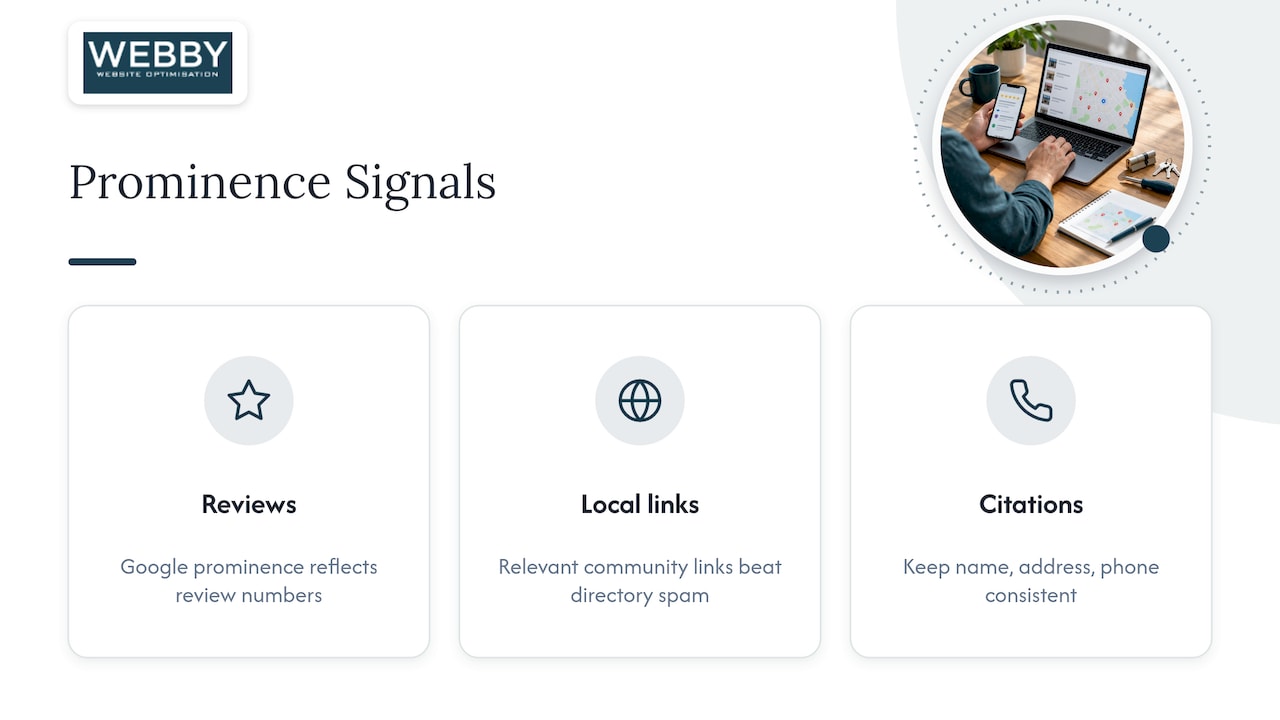
Since Google ties prominence to the number of reviews and to how many websites link to you, these are worth steady attention.
Reviews. Ask every satisfied customer, ideally the same day while the relief is fresh. Send them the direct link to your review form by text. Reply to each review, good or bad, politely and specifically. Never offer payment for reviews, and never write your own.
Local links. Links from sites that matter to your community: the local chamber of commerce, suburb business groups, real estate or strata partners you work with, sponsorships of local clubs. A handful of relevant local links beats a pile of directory spam.
Citations. These are mentions of your business name, address and phone number on other sites. The rule is consistency: the same name, the same number and the same service area everywhere. A mismatch between your website, your profile and a directory listing creates confusion for Google and customers alike.
Keywords locksmith customers actually use
Make a list of the searches that lead to a paid job and give each a home on your site. For locksmiths, they generally fall into groups:
- Urgent: emergency locksmith, 24 hour locksmith, locked out of house, locked out of car.
- Automotive: car locksmith, car key replacement, spare car key, lost all keys.
- Residential: lock change, rekey, deadlock installation, locks after a break-in or tenancy change.
- Commercial: master key system, office lock upgrades, access control.
Add the suburb or region to the ones that apply. Write the way your customers talk, not the way the trade does. A search for “locked out” is far more common than one for a technical lock term, and your headings should reflect that.
Measuring results: calls, enquiries and jobs
Rankings are a means, not the goal. The numbers that tell you whether SEO is paying for itself are:
- Phone calls from the website and profile. Use call tracking or the profile’s call reporting so you know where each call came from.
- Form and message enquiries. Count them separately from calls.
- Booked jobs and revenue. Ask each new caller how they found you and record it. This closes the gap between a call and a sale.
- Map and search visibility. Watch impressions and clicks in your profile insights and in Google Search Console, the free tool that shows which searches bring people to your site.
Check monthly and look at trends over a quarter. Local SEO usually builds over months rather than days, because Google needs time to see new pages, new reviews and new links. Our own electrician guide describes a GBP-first approach to local calls in 2 to 6 weeks for early movement on the profile, and the same logic applies to locksmiths. Bigger gains on competitive searches take longer, and a lower-competition suburb is a sensible place to start.
What locksmith SEO costs in Australia
Costs depend on the size of your service area, how many services you want to rank for, the state of your current website and how contested your suburbs are. Rather than quote a figure we cannot stand behind, here is how we structure the work at Webby, with the prices we publish:
| Service | Price |
|---|---|
| Website Audit | $1,250 one-off |
| Business Website Optimisation Campaign | $3,125 one-off |
| Website Built in a Day | $750 one-off |
| WordPress Monthly Maintenance | $59 per month |
| WordPress Monthly Updates | $123 per month |
| WordPress Monthly Development | $600 per month |
| Emergency WordPress services | $120 per hour |
Ongoing SEO is scoped to your business and area. If you are planning a budget, start with the audit: it tells you what is worth fixing first, so the money goes where it produces calls.
Our view on locksmith SEO
We work with local service businesses, and locksmiths are among the clearest examples of why local SEO pays. The customer has an urgent problem and a phone in their hand. The business that appears first, looks trustworthy and answers the phone gets the job.
Our approach starts with the Google Business Profile, because that is where most locksmith calls begin, then builds the service pages and area pages that give Google and customers a reason to pick you. We pair that with a fast, clean WordPress site so the page loads and the number is one tap away.
What we are designed to deliver is practical, trackable improvement: more visibility in the suburbs you serve, and more of the right calls. We aim for transparent communication and a hands-on local presence, so you always know what is being done and what it is producing.
Steve Doig
Where to start with Webby
If your site is slow, thin or out of date, the best first step is a Website Audit at $1,250. It reviews your site and gives you a clear list of priorities. When you are ready to act on it, the Business Website Optimisation Campaign at $3,125 one-off is our fixed-price route to a better-performing site, and our Search Engine Optimisation service covers the ongoing local search work.
If you would like to see where you stand first, you can claim a free website audit. For a broader grounding in the subject, our guide to local SEO for small business is a good companion to this one.
FAQ
What is locksmith SEO?
It is the work of improving your website and Google Business Profile so your locksmith business appears when people nearby search for help. It covers your profile, service pages, area pages, reviews, local links and site speed. The goal is more calls and booked jobs from the suburbs you serve.
Can I pay Google to rank higher on the map?
No. Google’s help page says there is no way to request or pay for a better local ranking. Local results are based mainly on relevance, distance and prominence, so the way to improve is a complete profile, a relevant website and genuine reviews.
Should I create a Google profile for every suburb I serve?
No. Google’s guidelines say a service-area business should have one profile for its central office with a designated service area, kept to about 2 hours’ driving time from your base. Cover individual suburbs with pages on your website instead.
How do I know if my SEO is working?
Track calls, form enquiries and booked jobs, not rankings alone. Use call reporting on your profile, Google Search Console, and a simple habit of asking new customers how they found you. Review the trend over a quarter.