
Use Target CPA when every conversion is worth about the same to you, such as phone calls or quote requests. Use Target ROAS when conversions carry different dollar values and you want a specific return on ad spend. Google’s own strategy guidance draws the line in exactly this place. The rest of this article shows how to apply that rule to a real Australian small business account, what data each strategy needs, and how to set a target that doesn’t quietly choke your lead flow.
TL;DR
- Target CPA (tCPA) aims for as many conversions as possible at an average cost per conversion. Target ROAS (tROAS) aims for conversion value at an average return on ad spend.
- Equal-value conversions (leads, calls, bookings) point to tCPA. Conversions with different values (orders, quotes of different sizes) point to tROAS.
- tROAS needs values attached to tracked conversions and enough recent conversion data. tCPA needs conversion tracking but can start without history.
- A target set too aggressive on either strategy cuts volume. Base it on your real margins and recent results, then adjust gradually.
- Both strategies are only as good as your conversion tracking, so fix that first.
Table of Contents
- What each strategy actually does
- Target CPA vs Target ROAS at a glance
- When Target CPA is the right call
- When Target ROAS is the right call
- Worked example: one electrician, two strategies
- How to set a realistic target
- Fix tracking before you pick a strategy
- A simple decision path
- How we can help
- FAQ
- Sources
What each strategy actually does
Both are Smart Bidding strategies. You give Google a goal, and it sets the bid for each auction using signals available at that moment. The difference is the goal.
Target CPA means you tell Google the average amount you want to pay per conversion. Google uses historical information and auction-time signals to find as many conversions as it can while averaging around that figure. Google describes the target as an average, not a hard cap on every single conversion. Some leads will cost more than your target and some less.
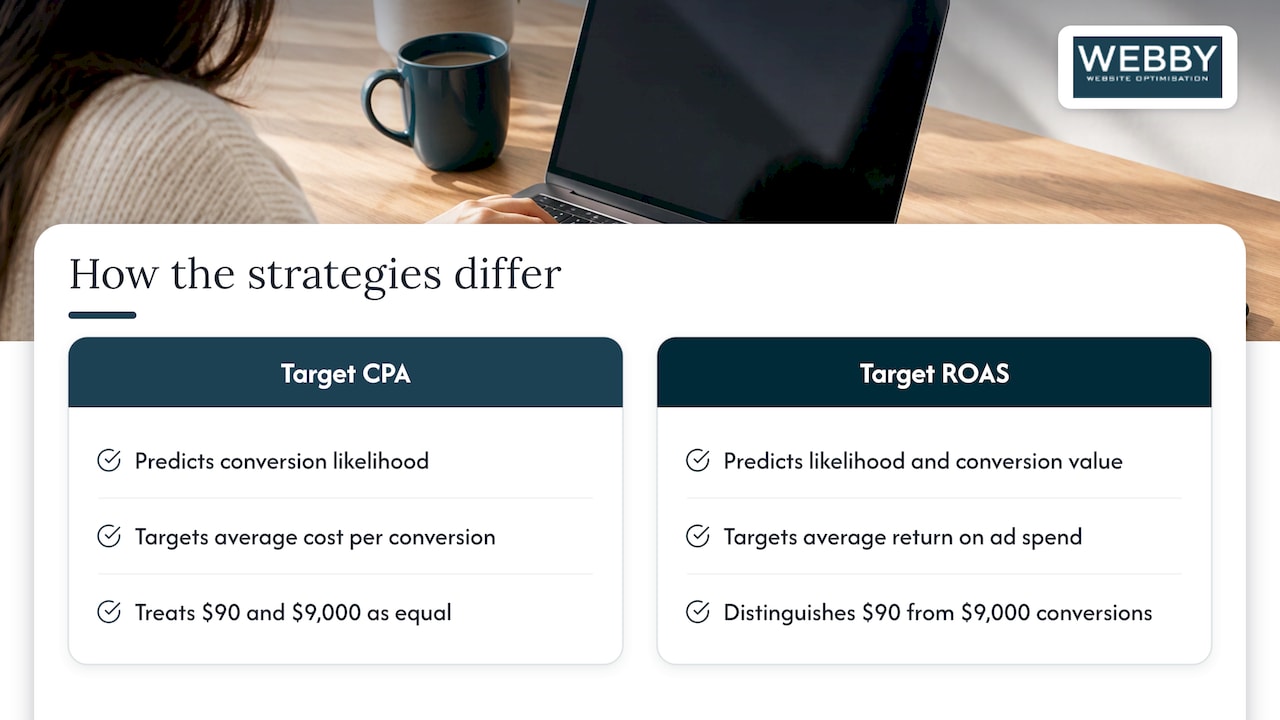
Target ROAS means you tell Google the return you want for each dollar spent, for example 400%. Google’s definition of target ROAS says the system predicts both the chance of a conversion and its likely value at auction time, then bids to maximize conversion value while pursuing your average return.
That extra prediction is the heart of the difference. According to Google’s bid calculation guide, tCPA predicts how likely a click is to convert. tROAS predicts how likely it is to convert and how much that conversion is probably worth. If all your conversions are worth the same, the second prediction adds nothing. If they differ widely, ignoring it means treating a $90 job and a $9,000 job as the same win.
A note on the new names
If you’ve seen the labels change in your account, you’re not imagining it. Starting in June 2026, Google began relabeling “Maximize conversions with a target CPA” as “Target CPA” and “Maximize conversion value with a target ROAS” as “Target ROAS”. Google says the underlying behavior does not change. So older tutorials that describe these as options within Maximize conversions or Maximize conversion value are still describing the same bidding.
Target CPA vs Target ROAS at a glance
| Target CPA | Target ROAS | |
|---|---|---|
| Goal | Average cost per conversion | Average return per ad dollar |
| Best when | Conversions are valued equally | Conversions have different values |
| Typical fit | Leads, calls, bookings, enquiries | Online sales, tiered quotes, varied job sizes |
| What Google predicts | Chance of conversion | Chance of conversion and its value |
| Data needed | Conversion tracking; can start with no history | Conversion values on tracked conversions, plus recent volume |
| Main risk | Target too low means fewer conversions | Target too high means lower volume |
| Your target expressed as | Dollars (e.g. $60) | Percentage (e.g. 400%) |
When Target CPA is the right call
Target CPA suits most local service businesses at the start. Think of a Perth plumber, a Fremantle physio clinic or a Melville accountant. Their main conversions are phone calls, form fills and booking requests. A lead is a lead, and the owner’s question is simply: what can I afford to pay for one?
Three things make tCPA a comfortable first choice:
- Simple goal. You can state it in a sentence: “I want leads at around $80 each.”
- Low barrier to entry. Google says you can start using Target CPA without conversion history and that it works for campaigns of all sizes, provided conversion tracking is in place.
- No value setup. You don’t need to assign dollar amounts to each form or call.
Our guide to Google Ads for trades covers the phone-lead side of this in more detail.
The catch: a cheap lead is not always a good lead
Target CPA treats every conversion the same. If your form gets both $150 enquiries and $6,000 enquiries, tCPA has no way to know the difference and may chase whichever is cheapest to generate. Practitioners recommend that a lead-generation CPA reflect downstream value rather than cheap form fills. That means counting how many leads turn into paying customers.
If you can feed Google better signals, such as separating qualified leads from raw enquiries as distinct conversion actions, tCPA gets much sharper. If you can attach real values, it may be time for tROAS.
When Target ROAS is the right call
Target ROAS earns its place when conversions are worth different amounts and you can tell Google how much. Typical situations:
- An online store with products from $20 to $2,000.
- A service business with tiered offers, such as a $250 service call versus an $8,000 installation.
- A business that records a quoted or invoiced value against each converted lead.
In these cases tROAS can pay more for clicks that look likely to produce a high-value conversion and less for the rest. Commentary on the topic often notes that Target ROAS tends to result in lower total conversion volume but higher revenue, but the exact balance depends on your target and account. Treat that as a pattern to watch for, not a promise.
What you need before switching to tROAS
Target ROAS requires values on your tracked conversions. Eligibility varies by campaign type. For Search and Shopping, Google’s requirement is at least 15 conversions in the past 30 days at the conversion-tracking level. For Demand Gen campaigns, the bar is higher: 50 conversions with value in the past 35 days, including at least 10 in the past 7 days, or 100 conversions with value across the account’s Demand Gen campaigns in 35 days.
If your account is small, a handful of conversions a month won’t support tROAS. Stay on tCPA, build volume, and revisit.
Worked example: one electrician, two strategies
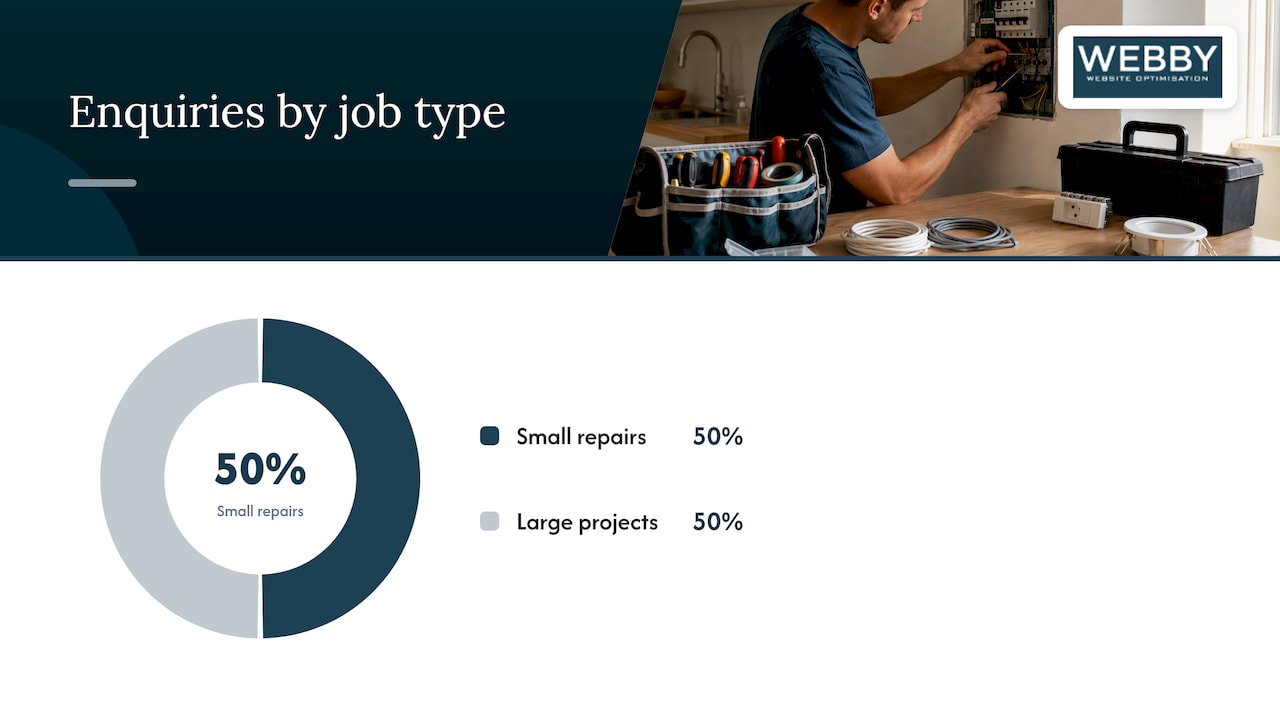
These numbers are illustrative, not client results.
An electrician in Perth gets about 40 enquiries a month from Google Ads. Roughly half are small repair jobs worth about $300 in revenue. The other half are larger projects such as switchboard upgrades, averaging $4,000.
- Under tCPA, every enquiry counts equally. Google might find many cheap repair enquiries because they convert more often, and the account looks healthy at $70 per lead while revenue disappoints.
- Under tROAS, once the electrician records the actual job value against each enquiry, Google can learn which searches and signals tend to precede the $4,000 jobs and bid up for them.
The catch is the work behind it. Someone has to pass job values back into Google Ads. Without that, tROAS has nothing to learn from.
How to set a realistic target
The most common mistake with either strategy is picking a number that sounds good instead of one the business and the market can support. Google warns that a Target CPA set too low may cause Google Ads to skip clicks that could convert, giving you fewer conversions in total. A target ROAS set too high does the same thing from the other side.
Start from your history
For Target CPA, Google’s recommendation is based on your average CPA from the previous 30 days, adjusted for conversion delays, when history exists. Google also suggests evaluating performance over the last 30 days with at least 30 conversions. For Display, its guidance is to base initial CPA or ROAS targets on recent historical performance and account for conversion lag.
For Demand Gen, Google suggests setting the ROAS target about 20% below the historical average and leaving the campaign alone for the first 14 days. Its FAQ then recommends gradual changes of plus or minus 10%. The Demand Gen figures are specific to that campaign type, but the habit carries over: begin a little gentler than your past results and move in small steps.
Work out your break-even
History tells you what you’ve achieved. Your margins tell you what you can afford. A Search Engine Land guide separates these two ideas:
- Break-even ROAS = 1 divided by profit margin. At a 25% margin, that’s 1 ÷ 0.25 = 4, or 400%.
- Achievable ROAS = conversion rate × average order value ÷ cost per click.
- Break-even CPA for leads = average profit per customer within your payback period × lead-to-sale conversion rate.
Here’s a quick example. If an average customer brings $900 in profit and one in five leads becomes a customer, break-even CPA is $900 × 0.20 = $180. A target of $120 leaves room for profit. A target of $40 may be unreachable and would likely throttle volume.
The same guidance warns that an overly ambitious target can be met by sacrificing volume. Hitting your number is not the same as growing the business.
Give it time
Don’t judge a new target after three days. For Search campaigns using value-based bidding, Google recommends waiting one to two conversion cycles after starting or changing value reporting. If your sales cycle runs for weeks, that matters. Changing targets every few days resets the learning you’re trying to build.
Fix tracking before you pick a strategy
Smart Bidding reacts to the data it receives. Google notes that inaccurate conversion tracking can cause swings in conversion volume, CPA or ROAS. That’s true for every automated strategy, and it’s why strategy choice is rarely the real problem in a struggling account.
Before comparing tCPA with tROAS, check:
- Are you counting the actions that matter (calls, qualified forms, bookings), not just page views?
- Are duplicate conversions firing on one form submission?
- Do conversion values reflect real revenue or margin, not placeholder numbers?
- Is the landing page converting visitors at a reasonable rate?
We wrote a short GA4 conversion setup checklist for Australian small businesses with four QA checks you can run yourself. If clicks are arriving but enquiries aren’t, our guide to diagnosing a site that gets no leads helps you work out whether the problem sits in traffic, targeting or conversion.
A simple decision path
- Is conversion tracking accurate? If not, fix it first.
- Do all your conversions have roughly the same value? Yes: use Target CPA.
- Do values differ, and can you report them to Google? Yes: consider Target ROAS.
- Do you have enough recent conversions? For Search and Shopping, 15 in the past 30 days is Google’s minimum for tROAS. If not, use tCPA and build volume.
- Set the target from history and break-even, not hope. Start slightly easier than your past results and adjust in small steps.
- Wait, then review. Look at conversions, cost and revenue together.
What we see in small business accounts
Most of the local service accounts we look at don’t have a bidding problem. They have a measurement problem. The owner asks whether to use tCPA or tROAS, and when we look inside, the account is counting button clicks as conversions, or the phone number on the site isn’t tracked at all. Smart Bidding will faithfully optimize toward whatever you feed it.
Our view is simple. Get the tracking right, then start with Target CPA if your enquiries are broadly similar in value. Move to Target ROAS when you can pass real job or order values back to Google and have the volume to support it. The strategy matters less than the quality of the signal behind it.
The second thing we push is that the ad click is only half the job. A well-built, fast WordPress site with clear calls to action makes any target easier to hit, because more of the traffic you pay for turns into enquiries. That is why we look at the account, the tracking and the website together rather than in isolation.
Steve Doig
How we can help
If you’re not sure whether your account is ready for either strategy, a Website Audit is a good first step, priced at $1,250 AUD one-off. It reviews your site so you know what’s helping and what’s holding back enquiries before you commit more ad budget.

If you want the whole picture handled, our End-to-End Growth Engine™ brings the site, the search presence and the campaigns together. You can also claim a free website audit to start the conversation. We work with local service businesses around Perth, Fremantle and Melville.
FAQ
Is tCPA or tROAS better for lead generation?
For most lead generation, tCPA is the natural fit because leads usually carry similar value and tCPA needs no value setup. If you can record how much each lead is worth once it becomes a job, tROAS becomes an option. Either way, set your target from what a lead is worth to you, not from the cheapest figure you’ve seen.
Can I switch from Target CPA to Target ROAS later?
Yes. Many advertisers start on tCPA, build conversion volume, add values to their conversions, and then test tROAS. Google advises waiting one to two conversion cycles after changing value reporting on Search before judging results, so give the switch time rather than reacting in the first few days.
Is a 2.3 ROAS good?
It depends on your margin. Break-even ROAS is 1 divided by your profit margin, so a business with a 50% margin breaks even at 2.0, while one with a 25% margin needs 4.0. A 2.3 ROAS is profitable in the first case and loses money in the second.
What does the target CPA actually guarantee?
Nothing individual. Google treats the target as an average, so single conversions can cost more or less than the figure you set. Judge results over a meaningful period with enough conversions, not conversion by conversion.
Sources
- Pick the right bid strategy – Google Ads Help
- About Target CPA bidding – Google Ads Help
- About target ROAS bidding – Google Ads Help
- How Google Ads calculates bids – Google Ads Help
- Value-based bidding for Demand Gen campaigns – Google Ads Help
- Demand Gen frequently asked questions – Google Ads Help
- Set up Smart Bidding for a Display campaign – Google Ads Help
- The 4-step health check for your target ROAS and CPA – Search Engine Land