

An SEO penalty is defined as a negative impact on a website’s search rankings caused by violations of Google’s guidelines, delivered either as a manual action or an algorithmic demotion. Both types can strip a site of organic traffic overnight, cutting leads and revenue for local businesses that depend on Google visibility. Understanding what is a penalty in SEO is the first step toward protecting your rankings. Google now issues 500–600 algorithm updates annually, making the risk of an unintentional violation higher than ever. Website owners who recognize the signs early recover faster and lose less.
What is a penalty in SEO, and why does it matter?
An SEO penalty is the formal term for any Google-imposed ranking suppression triggered by guideline violations. The industry uses “penalty” loosely, but the precise SEO penalty definition covers two distinct mechanisms: manual actions and algorithmic demotions. Confusing the two wastes recovery time and resources, as industry glossary standards confirm.
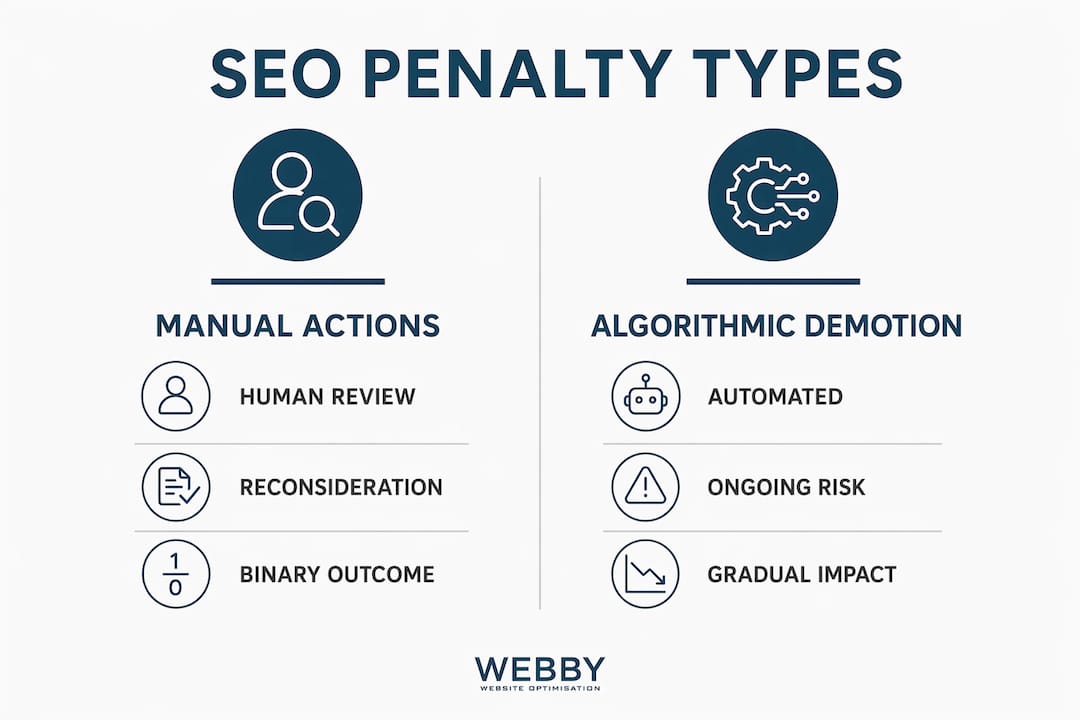
Manual actions are decisions made by a human reviewer at Google. They appear directly in Google Search Console under the Manual Actions report, with a description of the specific violation. Algorithmic demotions are automatic. Google’s systems, including SpamBrain and core update filters, apply them without any direct notification to the site owner.

The business impact of both types is serious. A site hit by either can drop from page one to page five or disappear from search results entirely. For a local service business in Perth or Fremantle, that kind of visibility loss translates directly into fewer calls, fewer quote requests, and lower revenue.
What are the main types of SEO penalties?
The two types of SEO penalties behave very differently, and treating one like the other leads to wasted effort.
| Feature | Manual action | Algorithmic demotion |
|---|---|---|
| Triggered by | Human Google reviewer | Automated algorithm (e.g., SpamBrain, core updates) |
| Notification | Yes, in Google Search Console | No direct notification |
| Scope | Specific pages or entire site | Broad ranking suppression |
| Recovery path | Fix issues, submit reconsideration request | Improve content and experience over time |
| Timeline | Weeks after reconsideration approval | Gradual, tied to future algorithm refreshes |
Manual actions are binary. Google either lifts them or it does not, based on whether the documented fix satisfies the reviewer. Manual actions show up in Search Console with specific issue details, so the diagnosis is clear from the start.
Algorithmic demotions are more ambiguous. A site may lose rankings after a core update without any message in Search Console. The drop looks identical to a manual penalty on the surface, which is why many website owners misdiagnose the cause. Checking Search Console is always the first diagnostic step.
Pro Tip: If Search Console shows no manual action but your traffic dropped sharply after a known Google update date, treat it as an algorithmic demotion and focus on content quality rather than submitting a reconsideration request, which will not help.
Common causes of SEO penalties and how to avoid them
Google enforces 18 core spam policies, and violations of any one of them can trigger a penalty with serious business consequences. The most frequent causes include:
- Link schemes. Buying links, participating in private blog networks, or exchanging links purely for ranking manipulation all violate Google’s guidelines. Google’s SpamBrain system detects unnatural link patterns at scale.
- Thin or auto-generated content. Pages with little original value, scraped text, or content generated purely to rank without serving users trigger algorithmic filters.
- Cloaking. Showing different content to Google’s crawler than to human visitors is a direct violation and one of the fastest ways to earn a manual action.
- Keyword stuffing. Forcing a target keyword into a page unnaturally, especially in titles, meta descriptions, and body text, signals manipulation.
- Unmoderated user-generated content (UGC). Forum posts, comment sections, and review pages that contain spammy links or low-quality content are the site owner’s responsibility. Google’s SpamBrain system demands active moderation of UGC, and responsibility for that content lies with the site owner.
Proactive compliance is more efficient than reactive recovery. Frameworks that score site compliance against Google’s spam policies help website owners catch violations before they trigger a penalty. A spam policies compliance framework monitors all 18 policy areas and flags risk areas before Google acts.
Pro Tip: Audit your backlink profile in Google Search Console’s Links report at least once per quarter. Disavow toxic links using Google’s Disavow Tool before they accumulate enough to trigger a manual action.
How to detect if your website has been penalized
Detection follows a clear sequence. Skipping steps leads to misdiagnosis and wasted effort.
- Check Google Search Console for manual actions. Open Search Console, go to Security and Manual Actions, then Manual Actions. A message here confirms a manual penalty and describes the violation. No message means the drop is likely algorithmic or competitive.
- Analyze your traffic pattern. A sudden, steep drop on a specific date points to a manual action or algorithm update. A gradual decline over weeks or months suggests competitive relevance loss or a slow-moving algorithmic filter.
- Cross-reference the drop date with known Google updates. Google publishes confirmed core update dates. If your traffic fell within days of a confirmed update, an algorithmic demotion is the likely cause.
- Triangulate by query, page, device, and region. Use Search Console’s Performance report to isolate whether the drop affects all pages or specific ones, all devices or mobile only, and all regions or a specific market. This narrows the cause significantly.
- Rule out technical issues. A crawl error, accidental noindex tag, or broken sitemap can mimic a penalty. Run a DIY SEO audit to eliminate technical causes before assuming a penalty.
Sharp traffic drops do not always mean penalties. SEO expert Nizam Ud-Deen notes that competitive relevance decline produces identical symptoms. Misidentifying the cause leads to submitting unnecessary reconsideration requests or making content changes that do not address the real problem.
How to recover from an SEO penalty
Recovery strategy depends entirely on penalty type. Applying the wrong approach wastes months.
Recovering from a manual action
Manual penalties require fixing the documented violation and submitting a reconsideration request, a process that often takes several weeks. The reconsideration request must document every fix in detail. Google reviewers reject vague submissions. Specific steps include:
- Identify every page or link flagged in the manual action report.
- Remove or disavow violating backlinks using Google’s Disavow Tool.
- Rewrite or remove thin, cloaked, or keyword-stuffed pages.
- Document all changes with before-and-after evidence in the reconsideration request.
- Submit through Search Console and wait for a reviewer response.
Successful recovery hinges on quality improvements and compliance monitoring over time, not a single fix. Sites that revert to old practices after reinstatement receive the same penalty again.
Recovering from an algorithmic demotion
Algorithmic recovery is gradual and tied to future algorithm refreshes. There is no reconsideration request to submit. The path forward requires:
- Auditing all content for thin pages, duplicate content, and low user value.
- Removing or consolidating underperforming pages that dilute overall site quality.
- Improving page experience signals: load speed, mobile usability, and Core Web Vitals.
- Building topical authority through original, well-researched content.
- Monitoring ranking recovery after each subsequent Google update.
Ongoing site maintenance is not optional during algorithmic recovery. Sites that treat recovery as a one-time project and then go dormant rarely regain their previous rankings. A detailed step-by-step recovery guide can help structure the process for site owners managing recovery without an agency.
Pro Tip: Set a Google Alert for “Google core update” and track your Search Console performance weekly. Catching a ranking shift within 48 hours of an update gives you a head start on diagnosis and recovery.
Key Takeaways
An SEO penalty is a Google-imposed ranking suppression triggered by guideline violations, and the type of penalty determines the entire recovery path.
| Point | Details |
|---|---|
| Two distinct penalty types | Manual actions appear in Search Console; algorithmic demotions do not and require different recovery steps. |
| 18 spam policies enforced | Google enforces 18 core spam policies; link schemes, thin content, and UGC spam are the most common triggers. |
| Detection starts in Search Console | Check the Manual Actions report first, then cross-reference traffic drops with confirmed Google update dates. |
| Manual recovery is documented | Fix violations, document every change, and submit a formal reconsideration request through Search Console. |
| Algorithmic recovery is gradual | Improve content quality, page experience, and topical authority, then wait for the next algorithm refresh. |
The uncomfortable truth about SEO penalties in 2026
Most website owners I work with arrive convinced they have a Google penalty. After diagnosis, the majority do not. What they have is a relevance problem. Their content no longer matches what their target searchers actually want, and a competitor with better content took their rankings. That is not a penalty. It is a signal to improve.
The real danger of misdiagnosing a relevance decline as a penalty is the response it triggers. Site owners start disavowing links that were never the problem, submitting reconsideration requests that go nowhere, and rebuilding pages that were not the issue. Weeks pass. The actual problem, outdated or shallow content, goes untouched.
The sites I have seen recover fastest from genuine penalties share one trait: they treat the penalty as a quality audit, not a paperwork exercise. They do not just fix the flagged violation. They audit the entire site, remove weak pages, and raise the content floor across the board. That approach works for both manual actions and algorithmic demotions.
Google issuing 500–600 updates annually means the SEO environment in 2026 is not stable. A site that passes today’s quality bar may not pass next quarter’s. The only durable defense is a site built on genuine user value, clean link practices, and active content maintenance. Chasing penalties after the fact is expensive. Building a site that does not earn them is the better investment.
— Steve Doig
How Webby Website Optimisation helps protect your rankings
A site built on a weak technical foundation is far more vulnerable to algorithmic demotions and manual actions than one built to Google’s current standards.

Webby Website Optimisation works with local service businesses in Perth, Fremantle, and Melville to build and maintain websites that hold their rankings. From professional web design that meets Core Web Vitals standards to ongoing SEO maintenance that keeps content and structure compliant, Webby covers the full picture. The benefits of professional web design for local services go well beyond aesthetics. A properly structured site is harder to penalize and faster to recover when algorithm updates hit. Contact Webby Website Optimisation for a free SEO audit and find out where your site stands today.
FAQ
What is the SEO penalty definition in simple terms?
An SEO penalty is a Google-imposed ranking suppression caused by violating Google’s webmaster guidelines. It appears as either a manual action in Search Console or an algorithmic demotion with no direct notification.
How do I know if my site has a manual action?
Open Google Search Console, go to Security and Manual Actions, then select Manual Actions. A message with violation details confirms a manual penalty is active on your site.
What are the most common causes of SEO penalties?
The most common causes include manipulative link schemes, thin or auto-generated content, cloaking, keyword stuffing, and unmoderated user-generated spam. Google enforces 18 core spam policies that cover all of these violations.
How long does it take to recover from an SEO penalty?
Manual action recovery typically takes several weeks after a reconsideration request is approved. Algorithmic recovery is gradual and depends on future Google update cycles, often taking months of sustained content improvement.
Can a traffic drop always be blamed on an SEO penalty?
No. Sharp traffic drops are often caused by competitive relevance decline, seasonal changes, or technical issues rather than a genuine penalty. Always check Search Console for a manual action before assuming a penalty is the cause.
Recommended
- What Is Technical SEO and Why It Matters
- The Role of Social Media for SEO: 2026 Guide
- How to perform a DIY website SEO audit in 2026
- What Is On-Page Optimisation? Your 2026 SEO Guide
If this post raised some questions feel free to ask me a question