

Most people assume on-page optimisation is just about stuffing the right keywords onto a page and calling it done. That assumption costs rankings every single day. Understanding what is on-page optimisation at a real strategic level means recognizing it as the most controllable pillar in your entire SEO program. Get it right, and you give search engines exactly what they need to rank your pages. Get it wrong, and no amount of backlinks will save you. This guide breaks down every element, every technique, and every common mistake so you can build pages that rank and convert.
Table of Contents
- Key Takeaways
- What on-page optimisation really means
- The key elements you need to get right
- How on-page SEO fits with the other pillars
- Practical on-page SEO techniques that actually move the needle
- My honest take on on-page SEO after years of audits
- See how Webby can improve your on-page SEO
- FAQ
Key Takeaways
| Point | Details |
|---|---|
| On-page SEO is more than keywords | It covers title tags, headings, meta descriptions, internal links, images, and structured data working together. |
| Intent alignment beats keyword density | Pages that match what searchers actually want consistently outperform pages built around raw keyword counts. |
| Title, H1, and content must align | Mismatches between these three elements cause Google to rewrite your titles and confuse users in search results. |
| On-page SEO is the most controllable lever | Unlike backlinks or technical infrastructure, every on-page element is entirely within your control to fix today. |
| Schema markup needs careful validation | Incorrect or excessive structured data can hurt your results. Always validate using Google’s Rich Results Test. |
What on-page optimisation really means
On-page optimisation is the practice of improving every element on a web page that is directly within your control, with the goal of making that page clearly relevant, useful, and trustworthy to both search engines and real people. As Search Engine Land defines it, it covers content relevance, page structure, keyword usage, metadata, internal links, and images working together as a system.
The key phrase there is “within your control.” That distinction matters because SEO has three distinct pillars.
- On-page SEO covers what lives on your actual pages: content, HTML elements, headings, and internal linking.
- Off-page SEO covers external signals like backlinks and social mentions that others control.
- Technical SEO covers the infrastructure your site runs on: crawlability, site speed, Core Web Vitals, and indexing.
What is SEO on-page work, then, at its core? It is the process of making a page clearly relevant to search intent and easy for search engines to interpret accurately. A page can have excellent backlinks and fast load times and still rank poorly if the content itself fails to signal relevance to the right query.
The reason the importance of on-page SEO is so significant is simple. On-page factors contribute roughly 50 to 60 percent of ranking potential by establishing page relevance and clarity. That is the largest single controllable variable in your SEO work. You cannot control who links to you, but you can control every word, tag, and heading on your own pages.
The key elements you need to get right
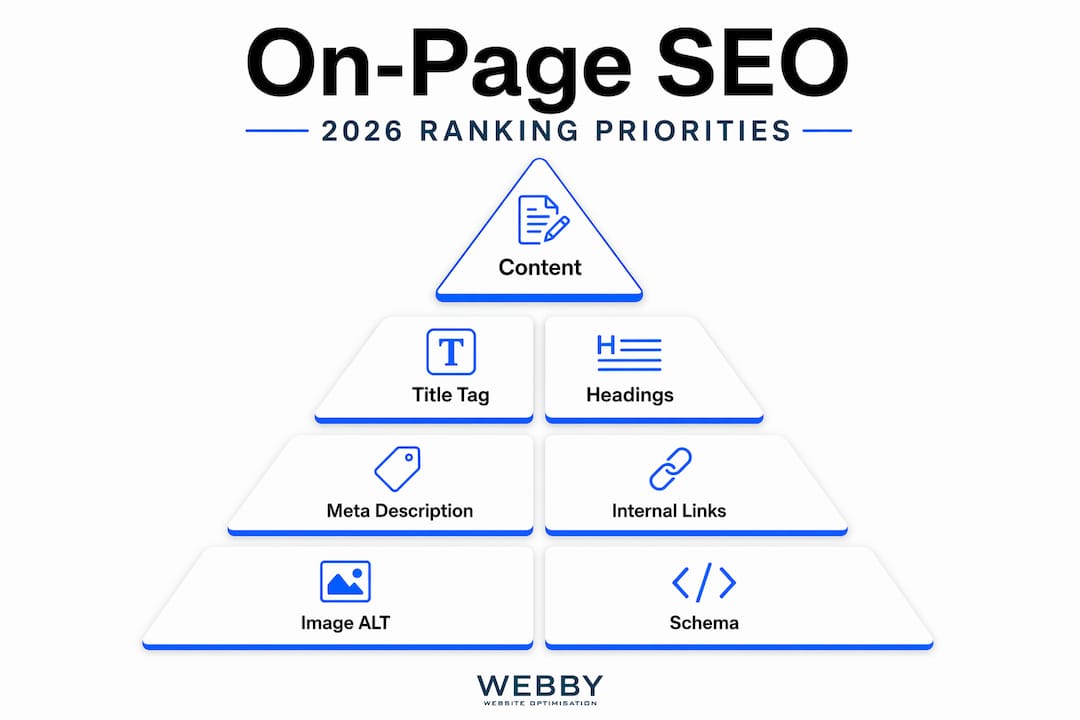
Understanding how to optimize pages starts with knowing which specific elements carry the most weight. On-page SEO includes both visible content and HTML signals, including title tags, meta descriptions, heading hierarchy, image ALT tags, and anchor text in links. Here is how each one works and what best practice looks like.
Title tags and H1 alignment
Your title tag is the clickable headline Google shows in search results. Your H1 is the main heading on the page itself. These two must align with each other and with the content below them. When they conflict, Google often rewrites your title, and the resulting SERP snippet confuses searchers about what your page actually covers. Keep title tags under 60 characters, lead with your primary keyword, and make sure the H1 reinforces the same core topic.

Meta descriptions
Meta descriptions do not directly influence rankings, but they significantly affect click-through rates. A well-written meta description gives the searcher a specific reason to click yours over the other nine results on the page. Write them as intent-matched summaries, not generic blurbs. Keep them under 160 characters and include a natural variation of your target keyword.
Pro Tip: Write your meta description like a Google Ad headline. Ask yourself: “Would I click this?” If the answer is no, rewrite it until the answer is yes.
Headings structure
Your H1 through H3 headings create a navigable hierarchy for both users and crawlers. Think of them as a table of contents for your page. Each heading should map to a distinct subtopic or user question. This structure directly influences your chances of earning featured snippets in Google.
Content quality and keyword placement
Content is where the real work happens. Depth, accuracy, and genuine usefulness matter far more than keyword count. Place your primary keyword in the first 100 words, use natural variations throughout the body, and write for the person reading, not the algorithm indexing.
Internal links and anchor text
Descriptive anchor text in internal links helps both crawlers understand your page relationships and users navigate logically through your site. Replace vague phrases like “click here” with specific, meaningful descriptions of what the linked page actually covers.
Image optimization
Every image on your page should have an ALT attribute that describes the image content accurately. This helps screen readers, signals relevance to crawlers, and can drive traffic through Google Images. File names matter too. “team-meeting.jpg” tells a crawler far more than “IMG_4892.jpg.”
Structured data and schema markup
Schema markup helps search engines understand your content’s meaning and can unlock rich results like star ratings, FAQs, or product details in SERPs. It is not a direct ranking factor, but the visibility gains from rich results are real. Validate every schema implementation using Google’s Rich Results Test before you publish.
| Element | Primary benefit | Common mistake |
|---|---|---|
| Title tag | Controls SERP headline | Too long or misaligned with H1 |
| Meta description | Improves click-through rate | Generic, no clear value proposition |
| H1/H2 headings | Signals page structure and topics | Missing H1 or multiple H1s on one page |
| Image ALT text | Accessibility and image search visibility | Left blank or stuffed with keywords |
| Schema markup | Enables rich results | Unvalidated or overloaded with incorrect types |
| Internal links | Guides crawlers and users | Vague anchor text or orphaned pages |
How on-page SEO fits with the other pillars
A frequent mistake in SEO planning is treating the three pillars as separate projects. They are not. On-page optimisation is distinct from off-page and technical SEO, but all three work together to determine where your pages rank.
Here is the practical reality of how they interact.
- Technical SEO gets your pages crawled and indexed. Without it, your on-page work is invisible.
- On-page SEO tells search engines what your pages are about and why they deserve to rank. Without it, technical SEO has nothing meaningful to surface.
- Off-page SEO builds the authority that makes Google trust your site enough to rank it competitively. Without it, even perfect on-page work plateaus.
The reason on-page SEO should come first is straightforward. It is entirely within your control and produces improvements immediately. You do not need to wait for a link building campaign to bear fruit or a developer to fix crawl errors. You can open a page today, improve the title, restructure the headings, and sharpen the content before lunch.
Understanding the full picture of an SEO campaign’s moving parts helps you prioritize. Start with on-page. Layer technical improvements next. Build off-page authority over time.
Practical on-page SEO techniques that actually move the needle
Knowing what to optimize is half the battle. Knowing how to do it page by page is where rankings actually improve. Here is a process that works in practice.
-
Map intent before writing a single word. Identify what the searcher actually wants when they type your target keyword. Informational, navigational, transactional, or commercial investigation? Your entire page structure should flow from that answer.
-
Align your title tag, H1, and opening paragraph. These three elements must reinforce the same core topic. Google rewards consistency and penalizes ambiguity. Make all three say the same thing in slightly different ways.
-
Place your primary keyword in the first 100 words. Not awkwardly, not twice. Once, naturally, in a sentence that earns its place. Follow it with related terms and natural synonyms throughout the body.
-
Structure headings around user questions. Each H2 and H3 should answer a specific question your target reader would ask. This approach directly supports scannability and snippet eligibility, which are two outcomes that directly impact both rankings and time-on-page.
-
Audit your internal links. Every page should link to and receive links from other relevant pages on your site. Run a crawl, find orphaned pages with no internal links pointing to them, and fix them. Orphaned pages rarely rank well.
-
Validate all schema before publishing. Run every structured data implementation through Google’s Rich Results Test. Overloaded or incorrectly formatted schema actively harms your search appearance. Less done correctly beats more done poorly every time.
-
Monitor Google Search Console weekly. Track CTR changes after on-page updates. A title tag change that drops CTR by 20 percent tells you something important. A meta description update that lifts CTR by 15 percent tells you something even more valuable.
Pro Tip: When you run a page audit, check your website SEO audit process and cross-reference on-page signals against your Google Search Console performance data. Pages with high impressions but low CTR almost always have weak title tags or misleading meta descriptions.
On-page SEO best practices are not a checklist you complete once. They are a refinement cycle. Pages that ranked well eighteen months ago may need reworking as searcher behavior, competitors, and Google’s understanding of content evolve.
My honest take on on-page SEO after years of audits
I have audited hundreds of websites across industries, and the same pattern shows up constantly. Business owners and even experienced marketers spend enormous effort on backlink campaigns while the on-page fundamentals on their core service pages are broken. Title tags that do not match the H1. H1s that do not reflect the content below them. Meta descriptions written in 2019 that no longer match how people search today.
The single highest-impact shift I have seen is when a client stops asking “how many times does this keyword appear?” and starts asking “does this page answer the exact question the searcher typed?” That mental shift changes everything. Pages get restructured. Headings become questions. Content gets sharper. Rankings follow.
I have also seen schema markup done badly cause real harm. One client had conflated FAQ schema and How-To schema on the same page, neither implemented correctly. Google stripped their rich results entirely. Fixing it properly took less than an hour, but it cost them weeks of lost visibility.
My honest advice: treat on-page SEO as a continuous process, not a launch task. The best time to audit your core pages is right now, not when rankings drop. The second best time is when rankings drop.
— Steve Doig
See how Webby can improve your on-page SEO
At Webby Website Optimisation, we work with local service businesses across Perth, Fremantle, and Melville to fix exactly the kinds of on-page issues covered in this guide. From title tag rewrites to heading restructures and schema validation, our SEO audits go page by page through your site to identify what is holding your rankings back.
If you want to understand where your website currently stands, our Perth SEO services are designed specifically for small and medium businesses that need practical, affordable improvements without the agency runaround. You get a real strategy, not a generic report. Reach out for a free consultation and find out what your pages are actually telling Google.
FAQ
What is on-page optimisation in SEO?
On-page optimisation is the practice of improving individual page elements, including content, title tags, headings, meta descriptions, and internal links, to make a page more relevant and understandable to search engines and users.
How does on-page SEO differ from technical SEO?
Technical SEO addresses site infrastructure like crawlability, speed, and indexing. On-page SEO focuses on the content and HTML elements within each page that signal relevance and intent to search engines.
Do meta descriptions affect Google rankings?
Meta descriptions do not directly influence rankings, but they significantly impact click-through rates. A well-written meta description that matches searcher intent can meaningfully increase traffic from the same ranking position.
How often should you update on-page SEO?
On-page SEO should be treated as an ongoing process. Review high-priority pages at least every six months and after any significant shift in rankings, traffic, or search behavior in your niche.
What is the most important on-page SEO element?
Content quality and intent alignment carry the most weight, but title tag and H1 consistency is the single most commonly broken element in real-world audits and the fastest to fix for immediate ranking impact.
Recommended
- How to perform a DIY website SEO audit in 2026
- What Is an SEO Campaign? A Guide for Marketers
- SME Website Design Best Practices That Convert
- Why website design affects trust: A local business guide
If this post raised some questions feel free to ask me a question
Trackbacks/Pingbacks