

Backlink quality matters because a handful of relevant, editorial links move rankings, referral traffic, and search trust further than hundreds of low-value ones. Search engines and AI systems both weigh a link by where it sits, not just that it exists.
- Ranking signal: A single authoritative, topically aligned link can outperform dozens of weak ones, largely thanks to PageRank-style authority transfer that still runs under the hood of modern ranking systems.
- Discovery and trust: High-quality links get pages crawled faster, send higher-intent referral visitors, and feed the E-E-A-T signals search engines use to judge whether a source deserves trust.
- One relevant editorial link often beats 100 low-value ones for actual ranking movement, according to Backlynk’s analysis of backlink quality versus quantity.
Key Takeaways
Backlink quality drives rankings, discovery, and referral traffic more reliably than link volume, especially as AI systems now weigh citations alongside links.
| Point | Details |
|---|---|
| Quality beats volume | One relevant editorial link often outperforms 100 low-value links for ranking impact. |
| Check six signals | Judge relevance, E-E-A-T, traffic, placement, anchor naturalness, and indexation before accepting a link. |
| Unique domains matter | Links from many different sites correlate with rankings more than repeat links from one source. |
| Watch anchor-text patterns | Heavy exact-match anchors and sudden link spikes signal risk worth a cleanup. |
| Use the 3-2-1 rule | Score relevance, trust, and traffic or placement before accepting any link opportunity. |
Table of Contents
- What Is a Backlink, Exactly?
- Why Backlink Quality Matters More Than Raw Numbers
- What Makes a Backlink High Quality?
- How Do Search Engines and AI Systems Use Backlinks Today?
- How Does Your Overall Link Profile Affect Site Health?
- How Do You Evaluate a Backlink Opportunity Fast?
- Proven Ways to Build High-Quality Backlinks
- The 3-2-1 Rule for Prioritizing Link Opportunities
- An Agency View on Why Link Quality Wins
- Frequently Asked Questions
- Sources
What Is a Backlink, Exactly?
A backlink is a link from one website to another, and search engines have long treated it as a vote of confidence, similar to a citation in academic work. If a plumbing supply blog links to a contractor’s step-by-step guide on pipe insulation, that’s an editorial backlink: earned because the content was useful, not paid for or swapped.
Not every link carries the same weight. A dofollow link passes authority signals to the target page; a nofollow link (common on comment sections and press releases) tells search engines not to pass that credit along.
Why Backlink Quality Matters More Than Raw Numbers
Four outcomes shift when you chase quality over volume: rankings move faster, new pages get discovered and indexed sooner, referral traffic arrives with higher intent (a link from a niche industry blog sends readers who are already primed to buy), and third-party endorsement strengthens the E-E-A-T signals search engines use to vet a site.
Compare one relevant editorial link to 100 low-value ones. The single link, placed in the body of a page that already ranks and gets organic traffic, tells search engines “an authority in this topic vouches for you.” A hundred directory or footer links tell search engines almost nothing, and past a certain point they can look manipulative.
- Unique referring domains matter more than total link count. Pages that rank in top positions tend to draw links from many different domains, and that diversity correlates with rankings more strongly than sheer volume.
- Ten links from ten different relevant sites almost always outperform fifty links from the same source posted repeatedly.
- Quality-first link building also carries less risk: Search Engine Land’s 2026 guidance frames volume-based tactics as the riskier, more penalty-prone path compared to targeting relevant, healthy sites.
What Makes a Backlink High Quality?
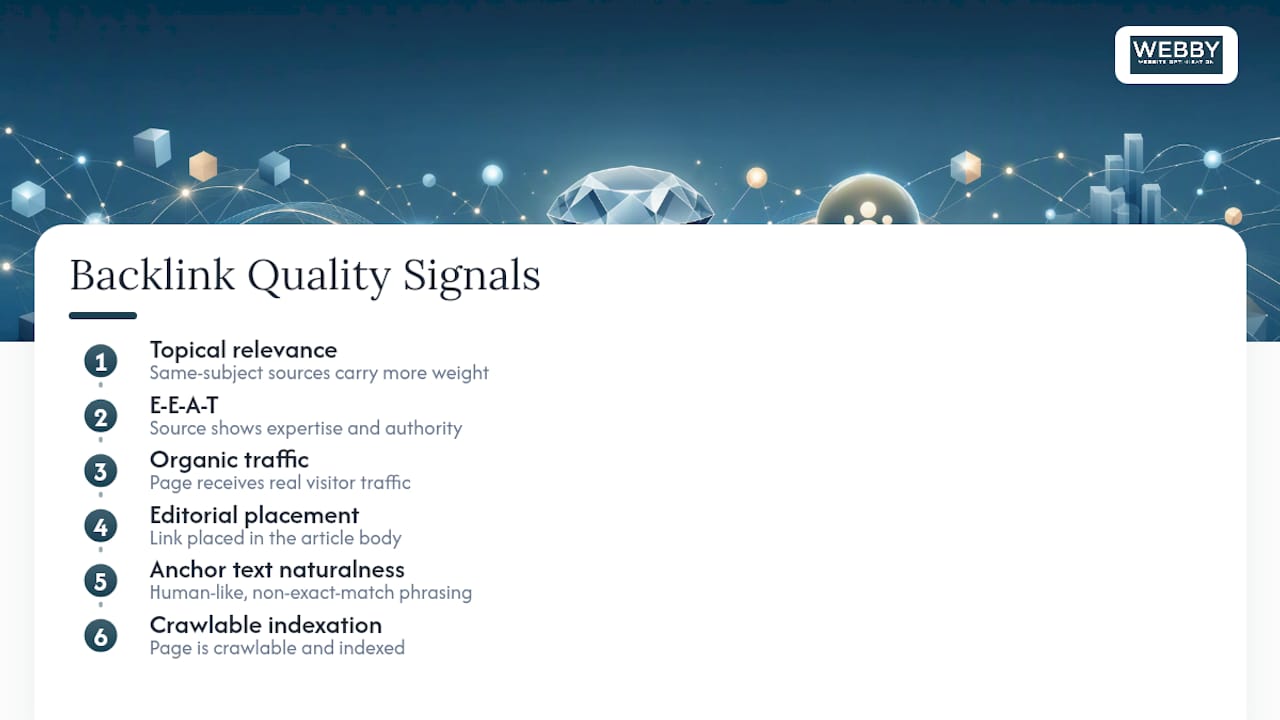
Six signals separate a link that helps from one that’s dead weight. Topical relevance comes first: a link from a site covering the same subject matter carries more weight than one from an unrelated domain. E-E-A-T of the linking page matters almost as much. Does the source demonstrate real expertise and authority in its niche?

Organic traffic on the linking page is a signal too many people skip. A link buried on a page that gets zero visitors passes far less value than one living on a page people actually read. Editorial in-body placement beats a link stuffed in a sidebar or footer widget. Anchor text naturalness counts: a link phrased “check this guide on window insulation” looks organic; a link stuffed with the exact keyword every time looks engineered. Finally, the page has to be crawlable and indexed, otherwise none of the above matters.
Domain-level metrics like DR or DA are useful as one data point, never the whole picture. Backlynk’s research on backlink quality confirms no single metric captures link value on its own, which is why a DA/DR guide is worth reading alongside traffic and relevance checks, not instead of them.
Pro Tip: Before you accept a guest post placement, spend five minutes on three checks: search “site:domain.com” plus a keyword to confirm indexation, pull an estimated traffic number for the specific page (not the whole domain), and scan the anchor text they plan to use for anything that reads like it was written for a bot instead of a person.
How Do Search Engines and AI Systems Use Backlinks Today?
PageRank-style authority transfer still runs underneath modern ranking systems: when an authoritative, topically relevant page links to yours with a dofollow tag, some of its earned trust passes through. That mechanic hasn’t disappeared, it’s just one input among many now.
What’s changed is the AI layer sitting on top. Generative search and AI overview systems increasingly weigh backlink signals alongside how often a brand or page gets mentioned by name across the web, according to Similarweb’s 2026 analysis of how backlinks function in the current search landscape.
- Editorial dofollow links still feed traditional ranking algorithms.
- Named mentions and citation frequency now feed AI-driven answer engines, whether or not those mentions carry a clickable link.
- The practical move is earning links that double as citations: content authoritative enough that people reference it by name, not just link to it.
How Does Your Overall Link Profile Affect Site Health?
A healthy link profile grows steadily over time, pulls from a wide mix of referring domains, blends dofollow and nofollow naturally, and shows varied anchor text (branded, generic, partial match, exact match, and plain URLs).
Watch for warning signs: sudden spikes in link velocity, heavy reliance on exact-match anchors, site-wide footer or sidebar placements repeated across dozens of pages, or clusters of low-value directory links. Google’s spam systems, including the Penguin-related models now built into core ranking, specifically flag over-optimized anchor distributions. If you spot a pattern like this, a cleanup is worth running; the disavow tool is for genuinely toxic or spammy links you can’t get removed manually, not a routine maintenance step for an otherwise normal profile.
How Do You Evaluate a Backlink Opportunity Fast?
- Check indexation. Search the linking page’s URL directly to confirm Google has it indexed.
- Scan topical relevance. Does the site’s overall focus match your niche, not just the one article?
- Estimate traffic. Look at the specific page’s traffic, not the domain’s homepage numbers.
- Check E-E-A-T signals. Author bylines, cited sources, and an About page all count.
- Review the anchor text. Natural phrasing beats exact-match keyword stuffing.
- Assess placement. In-body, contextual links beat footer or sidebar links every time.
For tools, Google Search Console shows indexing and referring-domain data straight from Google, while platforms like Ahrefs, Semrush, or Moz add traffic estimates and domain metrics. On a tight budget, manual site searches and a quick look at the page itself catch most red flags without a paid subscription.
Proven Ways to Build High-Quality Backlinks
Sustainable link building starts with content worth citing: original data, a genuinely useful how-to, or an industry benchmark other writers will want to reference, combined with a proven SEO link building platform to build quality backlinks at scale. Pair that with targeted outreach to journalists and niche publications covering your exact space, active participation in industry forums or communities where you can offer real expertise, and partnerships with trade associations or local business groups.
A working outreach note references the recipient’s specific published article, points out one concrete way your resource adds to (not repeats) their existing point, and asks for nothing more than consideration, no scripted pitch required.
Content quality and link quality work together; a technically sound page that already satisfies user intent gets far more lift from a new backlink than a thin page ever will.
Pro Tip: Track link ROI by referral conversions and ranking movement over the following weeks, not by the DR or DA number alone. A DR 40 link that sends three qualified leads beats a DR 70 link that sends none.
The 3-2-1 Rule for Prioritizing Link Opportunities
Run every prospect through this filter before you invest outreach time:
- 3 relevance checks: topic match, audience overlap, content quality of the linking page.
- 2 trust signals: indexation status and visible E-E-A-T (author, sourcing, site reputation).
- 1 traffic or placement threshold: real organic traffic on the page, or guaranteed in-body editorial placement.
Meets all three tiers? Accept. Meets two? Pause for a closer look. Meets one or none? Reject and move on.
An Agency View on Why Link Quality Wins
One client’s site sat flat for months despite steady content output. After a technical cleanup and a single editorial placement on a relevant industry blog, that page jumped into the top rankings within weeks. That’s typical of what we see across client work at Webby Website Optimisation: quality links amplify a site that’s already technically sound, they don’t fix one that isn’t.
If your link profile needs a second opinion, a website design and development foundation paired with a focused link audit is usually the fastest path forward.
Frequently Asked Questions
Why does backlink quality matter more than quantity?
A few relevant, editorial links pass more ranking authority and trust than dozens of weak ones, and they carry far less risk of triggering spam-related penalties.
What makes a backlink high quality?
Topical relevance, strong E-E-A-T on the linking page, real organic traffic, editorial in-body placement, natural anchor text, and confirmed indexation all factor in.
Do nofollow links still help SEO?
They don’t pass PageRank-style authority the way dofollow links do, but they can still drive referral traffic and contribute to the named mentions AI systems increasingly track.
How many backlinks does a page need to rank?
There’s no fixed number. Unique referring domains and link relevance matter far more than total count, and one strong link can outweigh many weak ones.
When should I use Google’s disavow tool?
Only for genuinely toxic or spammy links you can’t get removed manually, not as routine maintenance for a normal, healthy link profile.
Sources
- Backlinks in 2026: What They Are & How to Get Them | Similarweb
- How important are backlinks for SEO in 2026? | Search Engine Land
- High Quality Backlinks: What Google Actually Considers Quality | Backlynk
- Content Quality vs. Backlink Quality: Which Matters Most? | Search Engine Journal
Recommended
If this post raised some questions feel free to ask me a question