
It’s the first question on every business owner’s mind: "How much is a new website going to cost?"
If you're looking for a quick answer, a professional brochure-style website in Australia typically lands somewhere between $3,000 and $8,000. If you need to sell products online, an e-commerce site will usually start from $8,000 and can go well over $20,000.
Of course, the final price tag always comes down to the specifics—what you need it to do, how it needs to look, and the level of custom work involved.
How Much Does Web Design Cost in Australia?
Trying to pin down a firm cost for a website can feel like guesswork, but it doesn't have to be. Let’s cut through the noise and give you a realistic picture of what Australian businesses should expect to budget for a new site in 2026. This will help you plan your investment wisely.
Understanding the Price Tiers
I often tell clients to think of it like building a house. A simple brochure website is like a standard, well-built home—it’s solid, looks great, and does its job perfectly. On the other hand, a complex e-commerce platform is more like an architecturally designed smart home, packed with custom integrations, advanced automation, and sophisticated security. Each serves a very different need and, naturally, comes with a different budget.
The Australian web design industry is booming, with market data showing it hit a revenue of USD 679.51 million in 2024 and is projected to grow by 10.2% annually until 2031. This growth is driven by businesses demanding more from their websites, moving beyond simple online brochures to powerful business tools. If you're interested, you can dive deeper into data on Australian web design costs to see these trends in action.
A website is far more than an online flyer; it's a strategic asset designed to generate leads, drive sales, and fuel your growth. Viewing it as an investment—not just an expense—is the key to getting a great return.
To give you a clearer idea of where your project might fit, here’s a quick breakdown of what you can expect to pay for different types of WordPress websites in Australia.
Australian Web Design Price Estimates for 2026
This table summarises the estimated costs for different types of WordPress websites in Australia, helping businesses quickly identify a budget range.
| Website Type | Typical Price Range (AUD) | Best For |
|---|---|---|
| Basic Brochure Site | $3,000 – $5,000 | Startups, sole traders, and businesses needing a simple online presence. |
| Small Business Website | $5,000 – $8,000 | Established businesses needing a professional site to generate leads. |
| Custom E-commerce Site | $8,000 – $20,000+ | Retailers and businesses aiming to sell products and services online. |
Now that you have a ballpark figure, let's explore the "why" behind these numbers and look at the specific factors that will shape the final cost of your website.
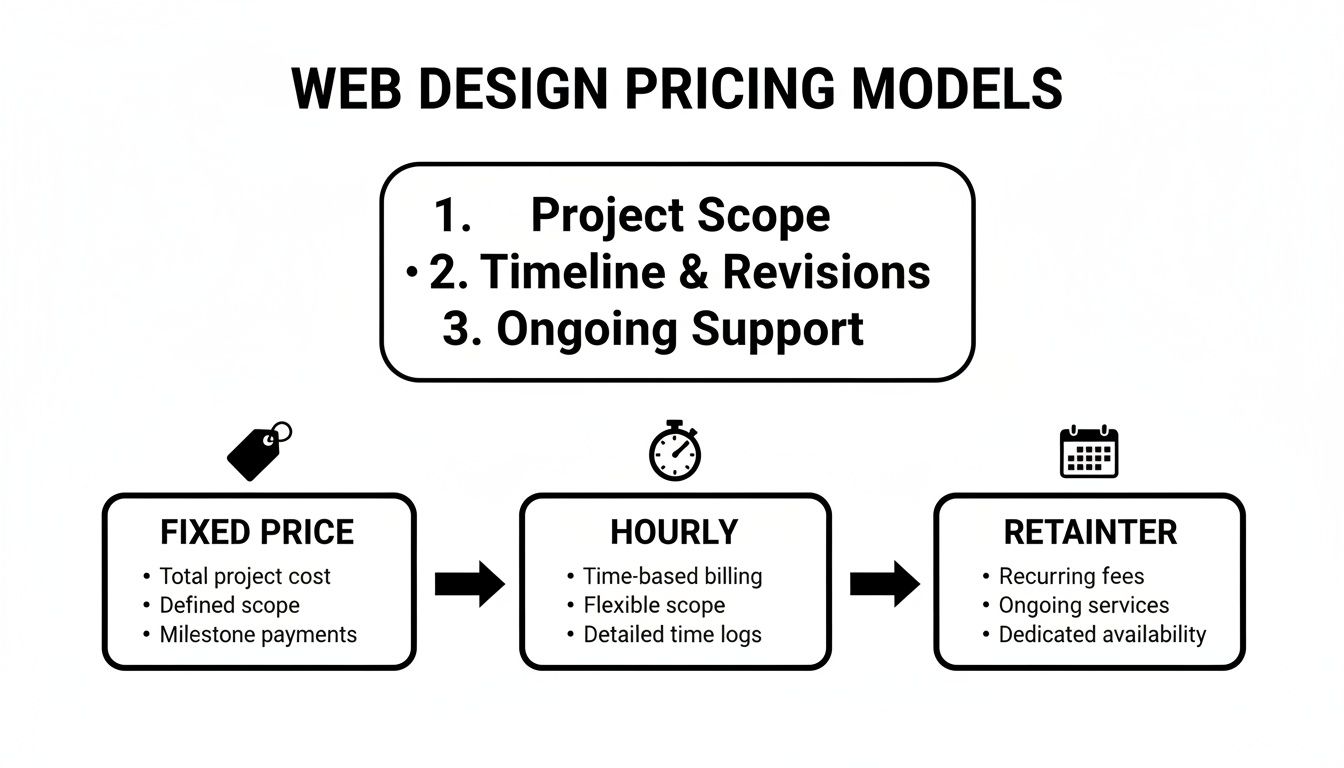
Understanding the Core Web Design Pricing Models
Ever looked at a few web design quotes and wondered why they're so different? One might be a single, all-inclusive number, while another breaks things down by the hour. It’s not random; it all comes down to the pricing model the agency uses. Getting your head around these is the first step to making sense of any proposal you receive and is key to understanding pricing web design.
Think about it: you wouldn’t pay for a buffet, a taxi ride, and a monthly gym membership the same way. Each one has a payment structure that just makes sense for what you're getting. It’s exactly the same in web design.
Let's look at the three main ways agencies charge for their work.
The Fixed Project Price
This is the model most people are familiar with. You agree on a very specific list of deliverables—say, a five-page website with a contact form and a photo gallery—and you get a single, fixed price for that entire package.
It’s like ordering from a set menu at a restaurant. You know precisely what you're getting and exactly what it will cost before any work begins. For businesses that need to manage their cash flow tightly, this budget certainty is a massive plus.
The success of a fixed-price project hinges on one thing: a crystal-clear scope. If you decide to add new features or pages after the project has started (what we call "scope creep"), that extra work will almost always need a separate quote. This model is perfect for projects with well-defined goals and very few unknowns.
The Hourly Rate
With an Hourly Rate, you're paying an agency for the actual time they spend on your project. This is a common approach for work where the scope is a bit more fluid or for ongoing support after your site goes live.
Imagine hopping in a taxi. The final fare is based on how long and how far you travel. In the same way, your website's final cost is tied to the total hours your design and development team puts in. Here in Australia, those rates can range from $70 to over $250 per hour, depending on an agency's size, location, and expertise.
An hourly model gives you incredible flexibility. It’s ideal for complex jobs where the requirements might change as you go, or for one-off tasks like fixing a bug or getting some expert advice.
The trade-off, of course, is a degree of budget uncertainty. Without a clear estimate or a capped number of hours, the costs can climb if the project takes longer than first thought. This model works best when you have a strong sense of trust and your web partner provides transparent time-tracking.
The Monthly Retainer
A Monthly Retainer is essentially a subscription for ongoing web design, development, and support. You pay a set fee each month for access to a certain number of hours or a specific list of services.
Think of it like having a personal trainer on a monthly plan. You get consistent, expert support to keep your website in peak condition. This is a fantastic model for businesses that know they’ll need regular updates, security monitoring, performance optimisations, and content changes.
A retainer offers some real advantages:
- Proactive Maintenance: It shifts your website care from a reactive "fix-it-when-it-breaks" panic to a proactive strategy that keeps issues from popping up in the first place.
- Priority Support: Agencies usually prioritise their retainer clients, meaning your requests get handled much faster.
- Predictable Costs: Budgeting becomes a breeze when you have a fixed monthly expense for your website's health and growth.
This model isn't so much about building the site from scratch, but rather about creating a long-term partnership to make sure your website keeps performing and delivering a return on your investment.
When you start looking at website quotes, you’ll quickly notice a major price difference between a "brochure" site and an "e-commerce" site. It’s not just an arbitrary gap—the two are fundamentally different beasts, built for entirely different jobs.
Think of it this way: a brochure website is like a brand-new company car. It’s sleek, professional, and perfectly designed to get your brand message from A to B, encouraging potential customers to pick up the phone. It's an essential vehicle for making a great first impression.
An e-commerce website, on the other hand, is a commercial-grade delivery truck. It needs a powerful engine (robust hosting), a sophisticated navigation system (product search and filters), complex logistics (inventory and shipping), and Fort Knox-level security (payment processing). It's built for heavy-duty, 24/7 work.
What Is a Brochure Website?
A brochure website is your business's digital front door. Its main purpose is to build trust, showcase your work, and turn visitors into leads. It tells people who you are, what you offer, and why they should choose you.
These sites are all about marketing and information. You'll typically find:
- Essential Pages: A Home, About, Services/Products, and a Contact page with a submission form.
- Professional Design: A custom, branded look that feels authentic to your business.
- Easy Updates: A Content Management System (CMS) like WordPress so you can edit content yourself.
- Mobile-Friendly Layout: A responsive design that works perfectly on any device.
Even though it doesn't sell anything directly, a well-executed brochure site is a lead-generation machine. The investment is channelled into creating a seamless user experience that guides visitors toward making an enquiry.
Agencies will typically bill for a project like this using a fixed price for budget certainty, or an hourly rate if the scope is more fluid. For ongoing work, a retainer model is common.
What Is an E-commerce Website?
An e-commerce website takes everything a brochure site has and adds a massive layer of new functionality: the ability to sell products online. This is where the complexity—and the cost—really starts to climb.
It’s not just a "shopping cart add-on." You're essentially building a digital point-of-sale system, stockroom, and fulfilment centre directly into your website.
An e-commerce site is an active business asset that processes financial transactions 24/7. The investment reflects the need for higher security, more complex development, and integrations that are critical for running a successful online store.
This is why the price jump is so significant. For example, a quality small business website in a competitive city like Perth might start around $5,000 to $10,000 AUD. An e-commerce build, however, quickly moves into the $10,000 to $25,000+ AUD range to properly handle product catalogues, secure payment gateways, and shipping logic.
The investment pays dividends, though. According to recent data, Australian businesses that invest in a professional, high-quality website report 34% higher lead generation. You can dig deeper into these Australian web design statistics to see the impact.
WordPress Website Feature and Cost Comparison
To give you a clearer picture of what you’re paying for, let's break down the common features side-by-side. The table below compares what you can expect from a standard brochure site versus a full e-commerce build on WordPress in Australia.
This is a great reference to have on hand when you're reviewing quotes from different agencies, as it helps you see exactly where the value lies.
| Feature | Brochure Website ($5k - $10k AUD) | E-commerce Website ($10k - $25k+ AUD) |
|---|---|---|
| Core Pages | 5-10 pages (Home, About, Services, Blog, Contact) | All brochure pages + Shop, Product, Cart, Checkout, Account |
| Design | Custom design or heavily customised premium theme | Fully custom design focused on conversions and user experience |
| CMS | Standard WordPress installation | WordPress with WooCommerce plugin |
| Functionality | Contact forms, image galleries, blog | Product listings, inventory management, payment gateways |
| Security | Standard SSL, basic security hardening | Advanced security, PCI compliance, fraud detection |
| SEO | On-page SEO setup for core pages and content | Product SEO, category optimisation, structured data for products |
| Maintenance | Basic updates and backups | More intensive updates, security monitoring, transaction checks |
As you can see, an e-commerce site isn't just a brochure site with a "buy now" button. It's a far more complex system with critical responsibilities, and the pricing reflects the expertise required to build it right.
The Key Factors That Actually Shape Your Website’s Cost
So, you’ve seen the general price ranges and the different ways agencies structure their fees. But what is it that makes one website quote come in at $5,000 while another soars past $30,000? The answer isn't a single thing, but a handful of crucial variables that determine the work involved.
Think of it like getting a quote to renovate your kitchen. A basic refresh with new paint and handles is one price. But if you want a custom island bench, stone countertops, and top-of-the-line European appliances, the cost will naturally climb. Web design works on the exact same principle; every feature and customisation adds to the final tally.
Let's unpack the main drivers that will influence the bottom line on your proposal.
Scope and Complexity
This is the big one. In agency-speak, "scope" just means the size and scale of your project. Are we building a simple five-page brochure site, or a 50-page behemoth with different layouts for services, case studies, and team profiles? The page count alone is a major factor.
Complexity, though, is about what the website needs to do. A simple contact form is low on the complexity scale. A multi-step booking system that needs to sync with your Google Calendar, process payments securely, and fire off automated email reminders? That's a whole different level of complexity.
Key things that add to the scope and complexity include:
- The number of unique page layouts: More pages needing a distinct design or function will increase the design and development time.
- Specialised features: This could be anything from a private members-only portal or an interactive map to a custom-built pricing calculator for your services.
- Third-party software integrations: Getting your site to "talk" to other tools you use is a common request. This could mean connecting to a CRM like Salesforce, an accounting program like Xero, or an email platform like Mailchimp.
Design and User Experience
How your website looks and feels to a visitor is another significant cost driver. You generally have two paths to choose from: starting with a pre-made template or commissioning a fully custom design from the ground up.
A template-based site uses a pre-built theme as its foundation. This is a much faster and more affordable way to get started, but you are working within the creative constraints of that theme. It's a bit like buying a house and redecorating—you can change the paint colours and furniture, but you can’t easily start moving walls.
A custom design, on the other hand, is like hiring an architect to design a home perfectly suited to your family’s unique needs. It’s built from scratch, purely for your brand and your customers. This path allows for a unique user experience (UX) crafted to guide visitors toward your business goals, but it requires a much larger investment in design and development hours.
A great website isn't just about looking good; it's about being effective. A custom UX design is a strategic investment in guiding users toward the actions you want them to take, such as making a purchase or filling out a form.
Technical Foundations for Growth
Finally, some of the most important cost factors are the ones working "behind the scenes". You might not see them as clearly as the design, but they are absolutely critical for your site's long-term performance, visibility, and security. These aren't optional add-ons; they're foundational.
For example, web design hourly rates in Australia can range from $70 to over $250 AUD, often driven by the expertise needed for these technical tasks. It’s a worthwhile investment. Research highlights that 29% of Aussie small businesses budget between $2,500 and $10,000 for a professional website, and as a result, they see 34% more leads and a 27% lower bounce rate compared to DIY alternatives. You can read more about the real costs and returns of Australian web design to see the data for yourself.
These foundational investments almost always cover:
- Technical SEO: This is about building your site so that Google can easily find, crawl, and understand your content. It involves things like clean code, a logical site structure, and fast-loading pages.
- Performance Optimisation: A slow website is a conversion killer. Proper optimisation means compressing images, fine-tuning code, and configuring server caching to ensure your site loads at lightning speed for every single visitor.
- Security Hardening: Protecting your website from hackers and malicious bots isn’t negotiable. This involves setting up firewalls, using security plugins, and following development best practices to keep your business and your customers' data safe. These services are often included as part of a quality WordPress maintenance plan.
How to Evaluate Quotes and Maximise Your Investment
Once the quotes start rolling in, the real work begins. The trick is learning how to read between the lines to compare the genuine value you’re being offered, not just the final price tag. A surprisingly low price often means crucial elements have been cut, which almost always leads to bigger costs and headaches down the track.
Think of it like buying a car. One dealer might offer a rock-bottom price, but then you realise air conditioning, floor mats, and even the spare tyre are all expensive add-ons. Another dealer’s price is a bit higher, but the car comes with everything, fully serviced and ready to hit the road. The initial sticker price simply doesn’t tell the whole story.
Look Beyond the Bottom Line
In the world of pricing web design, the cheapest quote is rarely the best deal. A lowball offer can be a major red flag, often signalling that the designer is just slapping your logo on a generic template, cutting corners on security, or has no real plan for foundational SEO. To properly size up a proposal, you need to pull it apart and see what you’re actually getting for your money.
A good quote is a detailed document, not just a one-line email. It should transparently break down every stage of the project, from initial design concepts and development right through to testing and launch. If a proposal is vague, it’s a good sign the provider might be, too.
A professional website isn't an expense; it's a strategic investment in an engine that generates leads and sales for your business. The goal is to find a partner who understands that and can deliver a return, not just a product.
Critical Questions to Ask Your Potential Partner
To properly vet a web designer and make sure there are no nasty surprises waiting for you, you need to ask some direct questions. These questions force them to be clear and help you understand the long-term value and ownership of what you're buying.
Here’s a checklist of questions you should absolutely ask before signing anything:
- Who owns the website after it’s paid for? You must have full ownership of all files, databases, and assets. No exceptions.
- What does your ongoing maintenance plan include? Get specifics on what’s covered for security, software updates, and backups.
- What specific SEO foundations are included in this build? A good build is "SEO-friendly," but ask what that actually means to them. Are they setting up title tags, meta descriptions, and sitemaps?
- How is the site's performance and speed addressed? Ask about their process for image optimisation, caching, and cleaning up code.
- What happens if I need changes or additions after launch? You need to understand their process and rates for future work.
Asking these questions shifts the conversation away from just cost. It becomes a much more valuable discussion about partnership and long-term success, and the answers will quickly reveal which provider is genuinely invested in your business growth.
Your website is a powerful asset. By evaluating quotes with a sharp focus on value and return on investment, you ensure the money you spend today will continue working for you for years to come.
Planning for Your Website's Ongoing Success
It’s easy to get caught up in the excitement of a website launch. After all the planning and investment, seeing your new site go live feels like crossing the finish line. But here’s a hard-won lesson from years in the industry: launch day isn’t the end, it’s the very beginning.
One of the biggest mistakes business owners make when budgeting for a web design project is focusing solely on the upfront build cost. They forget to plan for what comes next.
Thinking your website is ‘done’ after launch is like buying a brand-new car and expecting it to run perfectly forever without an oil change, new tyres, or even a top-up of fuel. Just like a car, your website needs regular, professional attention to keep it performing reliably and, more importantly, to protect your investment.
Why Ongoing Care Isn't Just a 'Nice-to-Have'
I've seen it happen too many times. A business sinks a significant budget into a stunning website, only to watch it slowly degrade. Without a plan for ongoing care, even the most brilliantly built site will eventually run into trouble.
And these aren't minor headaches. Neglect can seriously damage your reputation and your bottom line. Hackers, slow load times, and broken contact forms are the fast track to losing customer trust. A proactive care plan is simply the smartest way to make sure your site remains a valuable asset.
Here are the most common risks of letting your website gather dust:
- Security Breaches: Outdated software is the digital equivalent of leaving your front door wide open. It’s the number one way hackers get in, potentially leading to stolen data, a Google blacklist, and a credibility nightmare.
- Slow Performance: Over time, old code and bloated plugins can bog your site down. This sluggishness frustrates visitors and tells search engines your site isn’t worth ranking highly.
- Functionality Breakdowns: A simple software update can sometimes create a conflict that breaks your contact forms, your checkout process, or even crashes the entire site.
- Loss of Data: If you don’t have a rock-solid backup system, a server crash or a hack could erase your whole website in an instant, with no way to get it back.
Your website is a living asset that requires continuous care to thrive. You wouldn't leave your physical shop unlocked and unmaintained, and your digital storefront deserves the same level of protection and upkeep.
The Essential Services That Keep a Website Healthy
So, what does this ongoing care actually look like? A proper maintenance plan isn't about frantically calling a developer when something breaks. It’s a proactive strategy designed to stop problems before they start, keeping your site secure, fast, and always up-to-date.
Think of it as a health and wellness subscription for your website. It’s about making sure your site is always in peak condition, ready to work for your business. Investing in a professional WordPress maintenance plan is one of the wisest financial decisions you can make after your site goes live.
Typically, these essential ongoing services include:
- Managed Hosting: High-quality hosting specifically optimised for a platform like WordPress.
- Regular Software Updates: Proactively managing and testing updates for the core software, themes, and plugins.
- Security Monitoring: 24/7 surveillance for malware, spam, and attempted hacks.
- Performance Optimisation: Regular checks and tweaks to keep the site loading quickly.
- Consistent Backups: Daily or weekly backups of your entire site, stored securely offsite.
By factoring these services into your budget from day one, you swap a stressful, reactive "break-fix" approach for a calm, predictable strategy. This not only protects the initial cost of your web design but ensures your site continues to deliver a real return for years to come.
Answering Your Burning Questions About Web Design Prices
Even after breaking down the models and costs, a few questions always pop up. It's completely normal. Let's tackle the specific concerns we hear from business owners every day, so you can move forward with total clarity.
Why Are Web Design Quotes So Wildly Different?
It can be baffling, right? You ask three different providers for a quote and get three wildly different numbers, sometimes thousands of dollars apart. The reason for this massive gap usually boils down to one thing: what you're actually buying.
A freelancer using a pre-built template simply can't (and shouldn't) charge the same as a specialised agency building a custom website from the ground up. The cheap quote is for a quick assembly job. The expensive one likely includes in-depth strategy, bespoke design, thorough testing, and a solid foundation that will actually help your business grow. You're not just comparing prices; you're comparing the process, the expertise, and the long-term value.
Can I Really Get a Website Built for Under $3,000?
Technically, yes. You can find providers—often overseas or solo operators using cheap templates—who will build you something for under $3,000. But you need to ask yourself what corners are being cut to hit that price point.
We’ve heard the horror stories. A business owner invests in a "bargain" website, only to find it's slow, full of security holes, or completely invisible on Google. That cheap initial price often leads to expensive fixes down the road.
A price that seems too good to be true often is. These budget sites frequently come with baggage: zero support when things go wrong, critical security flaws that leave you vulnerable to hackers, and a structure that Google’s crawlers can't make sense of. Investing a little more with a reputable local expert buys you a reliable asset and, just as importantly, peace of mind.
What Ongoing Costs Should I Budget for After Launch?
Getting your website live isn't the finish line—it’s the starting block. To protect your new investment and keep it working for you, you must plan for a few essential ongoing costs. Think of it like owning a car; you don't just buy it and forget it. It needs fuel, insurance, and regular servicing.
Your website's ongoing costs typically include:
- Website Hosting: The plot of land your website "lives" on.
- Domain Name Renewal: The small annual fee to keep your web address (like your
.com.au). - Maintenance Plan: Absolutely critical for security updates, backups, and performance checks.
Does a Website Quote Automatically Include SEO?
This is a big one, so let’s be crystal clear: A standard web design quote almost never includes a full, ongoing SEO campaign.
A great designer will build you an "SEO-friendly" website. This means it has clean code, a logical page structure, and fast loading times, giving you the best possible starting point. It’s like building a high-performance race car—the engine is tuned and the aerodynamics are perfect. But SEO itself is the ongoing race strategy, the pit crew, and the skilled driver needed to actually win. That work—keyword research, content creation, link building—is a separate, continuous service.
A proactive maintenance plan is the best way to protect your new digital asset. The team at Webby Website Optimisation offers specialised WordPress support to keep your site fast, secure, and delivering results long after launch. Learn more about our WordPress help and support services.