
Navigating the world of cheap web hosting can feel like you're walking through a maze blindfolded. But finding the right affordable host is one of the most important first steps for your website. It’s not just about nabbing the lowest monthly price; it’s about striking a careful balance between performance, reliability, and support—all of which directly impact everything from how users see your site to where you rank on Google.
Finding Value in Australian Web Hosting
Think of choosing a web host like picking the foundation for a new house. A cheap, poorly laid foundation might save you a few bucks upfront, but it’s guaranteed to cause endless, expensive problems down the track. In the same way, the right cheap hosting Australia provides a solid base for your digital presence, making sure your website is fast, secure, and easy for your local audience to find. It’s the engine that powers your online business, and getting it right from the start saves you from painful migrations and performance headaches later on.
And this decision is more important than ever. The demand for affordable online solutions has absolutely exploded, with the Australian web hosting market projected to hit AUD 4.07 billion in 2025. This growth is being driven by small businesses and e-commerce stores—a clear sign that Australian SMEs are looking for cost-effective ways to keep their WordPress sites running smoothly. With the market forecast to reach AUD 11.56 billion by 2035, knowing what you’re actually paying for is critical.
More Than Just a Low Price Tag
True value in web hosting goes way beyond the headline monthly fee. It’s a blend of essential features that all need to work together to support your business goals. When you're weighing up your options, these are the core things to consider:
- Performance and Speed: How quickly does your site load for visitors in Sydney, Melbourne, or Perth? Where the server is physically located makes a massive difference for local SEO and user experience.
- Reliability and Uptime: Can your customers reach your site 24/7? Consistent uptime isn't just a nice-to-have; it's essential for building trust and making sales.
- Customer Support: When something inevitably goes wrong, can you get help from a real expert, and fast? Responsive, knowledgeable support can be the difference between a minor hiccup and a major outage.
- Security Features: Does the host include the basics, like free SSL certificates, malware scanning, and regular backups to protect your data and your customers?
Think of your hosting fee as an investment in your online infrastructure. A few extra dollars a month for better speed, security, and support is often a bargain compared to the cost of a slow, hacked, or offline website.
At the end of the day, your hosting fee is just one piece of your overall online budget. For the complete picture, it’s worth understanding all the expenses involved in building and maintaining your site. Check out our guide on how much a website costs in Australia to see how hosting fits into the bigger picture. Knowing the true cost helps you make a smarter, more informed decision that aligns with where you want to take your business.
Comparing Affordable Hosting Types
Choosing the right type of cheap hosting in Australia is a bit like picking the right vehicle. You wouldn't take a scooter on a cross-country road trip, and you don't need a semi-trailer to pop down to the shops. In the same way, the hosting that's perfect for a brand new blog will buckle under the pressure of a busy online store.
Let's break down the main options so you can find the best fit for your website, right where it is today.
To make this even clearer, here's a quick decision tree. It maps out which hosting type makes the most sense based on your site's current stage and where you see it going.
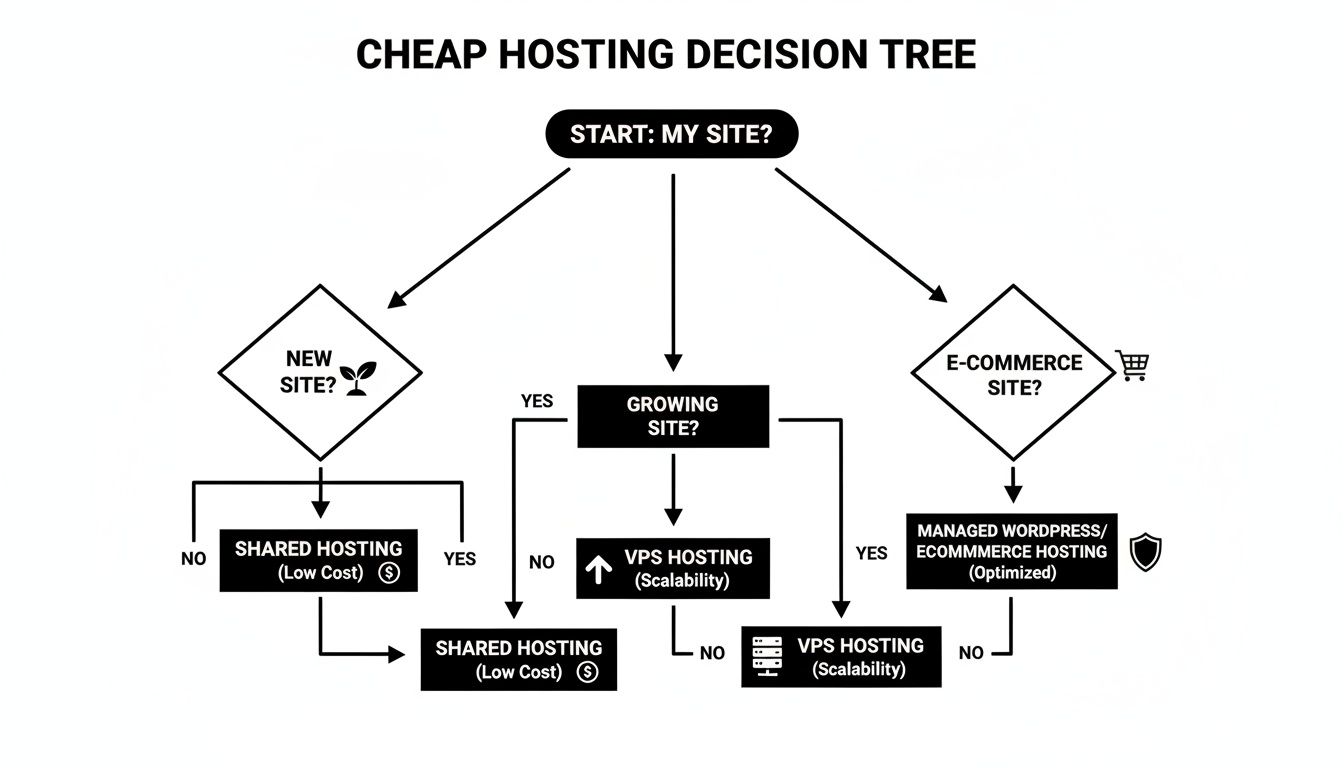
The key takeaway is simple: your needs will change as your website grows. The smart move is to pick hosting that matches your current reality but allows you to upgrade smoothly when the time comes.
Shared Hosting: The Apartment Building
Shared hosting is by far the most common and cheapest entry point. It's the go-to for most people just starting out.
Think of it like living in a big apartment building. You have your own apartment (your website files), but you're sharing the building's core utilities—water, power, and internet—with hundreds of other tenants.
This setup keeps your rent—or in this case, your hosting bill—incredibly low. The server's power (CPU), memory (RAM), and storage are all split among many users. The downside? If your neighbour throws a massive party and uses all the hot water, you're left with a cold shower. In hosting terms, if another website on your server gets a sudden traffic spike, your site might slow to a crawl.
- Best For: New blogs, personal portfolios, and small business sites with low to moderate traffic.
- The Appeal: It's the most budget-friendly way to get online, often bundled with easy one-click installers for platforms like WordPress.
The market for this type of cheap hosting in Australia is fierce. You’ll see introductory offers from some providers dipping as low as AU$1.51/month, with the average price sitting between AU$1.53 and AU$7.50 per month. These deals are often sweetened with a free domain for the first year to get you in the door.
To help you navigate the options, here's a quick comparison of the most common budget hosting types.
Affordable Hosting Options at a Glance
This table breaks down the typical hosting choices for Australian businesses, highlighting where each one shines and what its main drawbacks are.
| Hosting Type | Best For | Typical Monthly Cost (AUD) | Key Limitation |
|---|---|---|---|
| Shared Hosting | New blogs, portfolios, and small business brochure sites. | $2 – $15 | Performance can be affected by other websites on the same server ("noisy neighbours"). |
| VPS Hosting | Growing businesses, e-commerce stores, and high-traffic blogs. | $20 – $80+ | Requires more technical know-how to manage, or a "managed" plan which costs more. |
| Cloud Hosting | Sites with unpredictable traffic, applications, and businesses that need high scalability. | $15 – $100+ | Costs can be unpredictable as they are based on resource usage (pay-as-you-go). |
Choosing the right starting point saves you headaches later. Shared hosting is a fantastic launchpad, but knowing when to move to a VPS or Cloud solution is key to sustainable growth.
VPS Hosting: The Townhouse
When you've outgrown the apartment building, a Virtual Private Server (or VPS) is the logical next step. Think of it as moving into a townhouse. You still share the plot of land (the physical server) with a few neighbours, but your house is entirely your own. You have your own walls, your own utilities, and a dedicated parking spot.
A VPS works by dividing one powerful physical server into several isolated virtual machines. Each user gets a guaranteed slice of the server’s resources—CPU, RAM, and bandwidth—that is completely ring-fenced from everyone else. This means your website's performance is stable and won't be dragged down by what others on the server are doing.
A VPS gives you the control and dedicated resources of a much more expensive server, but at a far more accessible price point. It’s the perfect middle ground for websites that have outgrown the limits of shared hosting.
This option is ideal for growing businesses, e-commerce stores that process payments, or any website with noticeable spikes in traffic. It costs more than shared hosting, of course, but the boost in stability and speed is usually well worth it. You also get much more control, with the freedom to customise your server environment. If that sounds a bit daunting, our team offers expert WordPress help and support to handle all the technical heavy lifting for you.
Cloud Hosting: The Flexible Utility
Cloud hosting is the most modern and flexible of the bunch. Instead of your site living on one single server, it’s spread across a vast, interconnected network of servers (the "cloud").
It's a bit like your home’s electricity supply. You don't know or care which power station is generating the electricity; you just plug your appliances into the grid and pay for what you use.
If your website suddenly gets featured on the news and traffic explodes, the cloud can instantly pull more resources from the network to handle the load. This incredible scalability is its biggest selling point. It's also highly reliable—if one server in the network goes down, another one seamlessly takes over, so your site stays online.
This model is a fantastic solution for sites with unpredictable traffic or for businesses that prefer a pay-as-you-go structure. While it offers top-tier performance and uptime, the costs can be less predictable than a fixed-price plan, so you'll want to keep a close eye on your usage.
The Hidden Trade-Offs of Budget Hosting
That rock-bottom monthly price on a hosting plan can look incredibly tempting, but it almost always comes with some serious compromises. Before you get locked into a contract, it’s vital to understand what you might be giving up. Choosing the right cheap hosting Australia isn't just about the initial outlay; it's about finding a service that won't cost you your reputation down the line.
Think of it like buying the cheapest car you can find. Sure, it might get you from A to B, but you wouldn't be surprised if it struggled on hills, had questionable brakes, and came with zero roadside assistance. Budget hosting works the same way—the savings have to come from somewhere, and that usually means making cuts to the four pillars of quality hosting.
Let’s pull back the curtain on the most common trade-offs you'll run into.
Performance and Speed Issues
Performance is often the first place where the cracks in cheap hosting start to show. And let’s be clear: a slow website isn't just a minor annoyance. It actively drives potential customers away and tells Google your site isn't worth ranking.
There are two main culprits here:
- Server Location: A lot of budget hosts keep their servers in the US or Europe simply because it's cheaper. For your Australian audience, this is a huge problem. Data has to travel thousands of kilometres across undersea cables, adding precious seconds to your page load time. Google is all about user experience, and a sluggish site is a poor experience for your local visitors.
- Overloaded Servers: With shared hosting, the business model is to cram as many websites as possible onto a single server. It keeps their costs low. The downside? If just one of those sites gets a sudden surge in traffic, it can hog all the server’s CPU and RAM, slowing every other site—including yours—to a crawl.
A delay of just 1-3 seconds in page load time can increase the probability of a visitor leaving your site by 32%. In a competitive market, that's a gamble most businesses simply can't afford to take.
A faster website directly leads to better engagement and more sales. You can see how a focused approach delivered a significant website speed increase for one of our clients in our case studies.
Security Vulnerabilities
Security is another area where budget providers love to cut corners. They'll all give you a free SSL certificate (which is pretty much standard these days), but the proactive, heavy-duty measures needed to keep your site genuinely safe are often missing or sold as pricey add-ons.
This leaves your site dangerously exposed. Cybercrime is a constant threat, and cheap hosts are a prime target because they house thousands of websites with wildly inconsistent security practices, making them an easy mark for attackers.
Here are the common security shortcuts:
- Infrequent Malware Scans: Premium hosts scan for malware daily. Budget plans might only scan weekly—if at all. That leaves your site vulnerable for days if it gets infected.
- Weak Firewalls: A basic Web Application Firewall (WAF) might be in place, but it's unlikely to be configured to block the latest, more sophisticated threats.
- Limited DDoS Protection: Distributed Denial of Service (DDoS) attacks are designed to knock your site offline. Basic plans offer minimal, if any, real protection against these common assaults.
These aren't just theoretical risks. Governments in Australia, the US, and the UK have had to jointly sanction international "bulletproof hosting" providers that knowingly supported cybercrime operations, which just goes to show the real-world dangers of poorly secured infrastructure.
Support and Backup Limitations
When your website goes down or you hit a critical error at 2 AM, you need expert help, fast. This is where the difference between cheap and quality hosting becomes painfully obvious.
Budget hosts usually have a tiered support system. Their first-line agents are trained to handle only the most basic questions, often just reading from a script. They rarely have the deep technical knowledge to troubleshoot a complex WordPress issue. Getting your problem escalated to someone who actually knows what they're doing can take hours, or even days.
Backups are a similar story. The service on cheap plans is often frustratingly minimal.
- Backup Frequency: They might only back up your site once a week. If it crashes, you could lose up to six days of new content, customer orders, or user data.
- The Restoration Process: Getting your site back online is rarely a simple one-click process. Many budget hosts will hit you with a hefty fee to restore your site for you, turning that 'free' backup feature into a costly emergency service right when you're most vulnerable.
Ultimately, the hidden cost of budget hosting isn't paid in dollars. It's paid in lost customers, a damaged reputation, and hours of your life spent dealing with frustrating downtime.
How to Spot Hidden Fees and Renewal Traps

That super-low introductory price is the oldest trick in the book. You see a hosting plan advertised for a few dollars a month and think you've snagged a bargain, but the real cost is often hiding in the fine print, just waiting to pop up at checkout or a year down the track. Finding genuinely cheap hosting in Australia is all about learning to see past the flashy headline and work out the total cost.
It’s a bit like booking a budget airline ticket. The flight itself looks cheap, but then you get hit with extra fees for choosing a seat, bringing a carry-on, and even printing your boarding pass. Suddenly, the final cost is double what you first saw. Budget hosting providers often play the same game, relying on sneaky upsells and massive renewal price hikes to turn a profit.
Let’s pull back the curtain on the most common traps so you know what to watch out for.
The Aggressive Checkout Upsell
The moment you click "buy," the sales pitch kicks into high gear. The checkout process is cleverly designed to make you feel like you need a dozen different add-ons to keep your website safe and running smoothly. Some might be useful, but many are just overpriced or completely unnecessary.
Keep an eye out for these classic upsells:
- "Essential" Security Scans: They'll try to sell you a daily malware scanner for an extra fee. Honestly, any decent host should already be providing a secure environment as part of their standard service.
- Manual Backup Services: You’ll see offers for "premium" backup plans. Basic, regular backups should be a given, not a luxury you have to pay more for.
- Email Hosting: A lot of cheap plans don't include professional email addresses (like
you@yourdomain.com.au). They’re more than happy to sell you this service separately, usually at a hefty markup.
The goal of the upsell is to create a sense of urgency, maybe even a little bit of fear. By taking a moment to review each add-on and ask yourself, "Do I really need this right now?", you can stop your bill from getting bloated with services you don't actually want.
The Renewal Price Shock
This is the big one—the most common trap of them all. That amazing price that got you to sign up is almost always just for your first term, which is typically one to three years. When that initial period is over, your plan automatically renews at the "regular" rate, which can be 200-300% higher than what you first paid. Your $3-a-month deal can easily jump to $12 a month overnight.
This whole strategy is designed to lock you in. Once your website is live and running, moving it to another host is a real pain—a hassle most people will pay to avoid. These renewal hikes are a stark reminder that cheap doesn't always stay cheap. In fact, it's what pushes many savvy business owners towards managed services, where the total cost of ownership often makes more sense when you factor in the integrated support that keeps your site fast and secure. You can discover more insights about web hosting costs in Australia and see how these figures compare.
To protect yourself, always do this before you hand over your credit card details:
- Find the Renewal Rate: Hunt around the provider’s website for their standard pricing table. It's often tucked away in the terms of service or a separate pricing page that’s hard to find.
- Calculate the True Cost: Take the monthly renewal rate and multiply it by 12. Then, compare that annual figure to the introductory offer. This will give you a much more realistic idea of what you’ll be paying long-term.
By getting wise to these common pricing tactics, you can make a much smarter decision and ensure your "affordable" hosting plan actually stays that way.
Knowing When to Upgrade from Cheap Hosting
Kicking off your online journey with a cheap hosting plan is a smart move. It gets your website up and running without breaking the bank. But just like a growing business eventually needs a bigger office, a successful website will eventually need a more powerful home. The trick is knowing when you’ve hit that point.
Think of your first shared hosting plan as a set of training wheels. It's brilliant for getting started and learning the ropes, but eventually, it will hold you back. Sticking with it for too long is like trying to win a race with those training wheels still attached—it just won't happen.
Spotting the warning signs early means you can upgrade before your site starts to fail, avoiding the kind of costly downtime and customer frustration that can really hurt your business.
Key Triggers That Signal an Upgrade is Due
When your hosting starts to become a bottleneck, the signs are usually pretty obvious. They often show up as performance problems, security worries, or the nagging feeling that you're spending way too much time fixing things instead of growing your business.
If any of these sound familiar, it's a strong sign your cheap hosting in Australia has served its purpose and it’s time to move on.
Your website is getting slower. This is the big one. As your traffic picks up or you add more features and products, a basic shared server just can't keep up. Pages start to drag, especially during busy periods, and that slow-loading experience is a surefire way to send visitors packing.
You're experiencing frequent downtime. Getting alerts that your site is offline? That’s a massive red flag. Cheap shared hosting environments are often overloaded and unstable. Even a few minutes of downtime erodes trust and can cost you sales.
Security is a constant worry. As your business grows, you become a more attractive target. If you're constantly worried about malware, or your host doesn’t offer proactive security like regular scans and a decent firewall, you’re gambling with your business data and your customers' information.
Upgrading isn't just another expense—it's an investment in reliability, performance, and peace of mind. A fast, secure, and stable website is a core business asset that pays for itself through happier customers and a stronger reputation.
So, What's Managed WordPress Hosting?
When you hit these limits, the next logical step for most businesses is Managed WordPress Hosting. This isn’t just a slightly faster server; it’s a completely different type of service, built from the ground up to take the technical headaches of running a WordPress site off your plate.
Here’s an analogy: it's like the difference between renting an empty warehouse versus a fully serviced office. With the empty warehouse (your cheap host), you’re on the hook for everything—security, maintenance, cleaning, and all the repairs. With the serviced office (managed hosting), all of that is handled for you, so you can focus 100% on your actual work.
A good managed provider takes care of all the crucial but time-sucking tasks:
- Proactive Maintenance: They handle core WordPress, theme, and plugin updates for you, closing security gaps before they become a problem.
- Automated Backups: Daily, reliable backups are standard, so if the worst happens, you can restore your site in a flash.
- Specialised Security: Your site is shielded by firewalls and malware scanners specifically configured to protect WordPress.
- Performance Tuning: The servers are fine-tuned for WordPress, using things like server-level caching to make your site fly.
The real return on investment here is your time. Instead of pulling your hair out over technical glitches, you can get back to what you do best—running your business. This is exactly where a service like Webby’s WordPress Help and Support comes in, offering the expert hands to manage your site's health so you don't have to.
Making Your Final Hosting Decision
Alright, you've done the homework. You know how to look past the flashy banners and see what’s really on offer. Choosing a host isn't just about grabbing the cheapest deal you can find; it’s about finding a reliable home for your website. This is where we pull it all together and make a confident choice.
At the end of the day, this has to be a practical decision based on what your business actually needs. The right cheap hosting Australia for a busy Melbourne e-commerce store is going to look very different from the needs of a Perth photographer's online portfolio. The trick is to filter every potential host through the lenses of performance, support, security, and honest pricing.
Your Final Host Evaluation Checklist
Before you hand over your credit card details, run your top one or two choices through this final checklist. Think of it as a last-minute inspection. It's designed to force you to look beyond the tempting monthly price and see the real value you’re getting for your money.
| Evaluation Area | Key Question to Ask | Why It Matters |
|---|---|---|
| Performance | Are their servers physically located in Australia (e.g., Sydney) or somewhere close like Singapore? | Local servers are the number one factor for snappy page loads for your Aussie visitors. It’s a huge deal for user experience and your Google rankings. |
| Support Quality | What are the support options (phone, chat, ticket) and when are they available? What do real customer reviews say about their response times? | When your site goes down at a critical moment, you need someone who knows their stuff, fast. "24/7 support" is meaningless if the person on the other end is slow or unhelpful. |
| Pricing Transparency | What’s the exact renewal price after the honeymoon discount ends? Are backups and other essentials included, or are they sneaky add-ons? | This reveals the true long-term cost. It helps you dodge that classic trap where a cheap first-year deal balloons into a budget-breaker at renewal time. |
| Essential Features | Does the plan include free, automatic daily backups and a free SSL certificate? Is there any kind of proactive malware scanning? | These are your absolute must-haves for security and peace of mind. A host charging extra for these is cutting corners where it matters most, leaving your site vulnerable. |
Answering these questions honestly will quickly show you which provider truly fits your business for the long haul.
Pairing Hosting with Professional Support
Just remember, your hosting is only the foundation. Even the world’s best server can’t save a website from a dodgy plugin or an out-of-date theme. The smartest move for any serious business is to pair your hosting with professional website maintenance.
Think of it this way: your host gives you a secure garage to park your car, but a dedicated support service is your expert mechanic, keeping the engine tuned and everything running smoothly.
This two-pronged approach ensures your site stays fast, secure, and ready for business. It lets you step away from the stress of technical updates and security scans so you can focus on what you do best—running your business. If you'd rather have a hands-off approach that guarantees your site is always in top shape, it's well worth looking into a dedicated WordPress Help and Support service.
Got Questions About Cheap Hosting? We've Got Answers
Dipping your toes into the world of affordable web hosting can feel a bit confusing. Let's clear up some of the most common questions Australian business owners ask, so you can choose your plan with confidence.
Can I Actually Get Good, Cheap Hosting with a .com.au Domain?
You sure can. It's quite common for hosts chasing the Aussie market to throw in a free .com.au domain for the first year if you commit to a 12-month plan. It’s a great little perk for getting started.
But here's the catch you need to watch for. That "free" domain isn't free forever. Always, and I mean always, check the renewal price for that domain. That’s what you'll be paying every year after the first. It's also vital to make sure the provider has servers located right here in Australia (Sydney is best) or at least close by in Singapore. That's non-negotiable for keeping your site zippy for local customers.
What's the Single Biggest Blunder to Avoid with Cheap Hosting?
Hands down, the biggest mistake is getting mesmerised by a super-low introductory price and completely ignoring everything else. A host dangling a $3 per month deal looks fantastic on the surface, but it can be a trap.
What happens when that plan jumps to $12 per month at renewal? What if it doesn't include something as basic as daily backups or a decent security scanner? Suddenly, it's not so cheap. The other classic error is picking a US or European server just to save a few bucks a month. This almost guarantees a sluggish site for your Aussie visitors and can seriously hurt your local search rankings.
The true cost of a hosting plan isn't just the sticker price. It's the total sum of its price, performance, and the peace of mind it gives you. A "bargain" plan that skimps on speed or security will end up costing you far more in lost sales and headaches.
How Much Traffic Can a Cheap Shared Hosting Plan Realistically Handle?
Most basic shared hosting plans are built to handle a respectable amount of traffic, usually somewhere in the ballpark of 10,000 to 25,000 visits per month. You'll see hosts advertise "unlimited" bandwidth, but there's always a fair use policy lurking in the background.
Think of it like this: your site is sharing a house with other websites. While you have plenty of room, you're all sharing the same plumbing and electricity (the server's CPU and RAM). If your site suddenly throws a massive party (a traffic spike), the landlord (the host) will step in and dim the lights to make sure everyone else isn't left in the dark. If you're seeing steady growth or regular traffic surges, it's a clear sign you’re outgrowing the house and it’s time to upgrade.
Your hosting is the foundation, but that's just the beginning. Keeping a WordPress site fast, secure, and running like a well-oiled machine takes work. If you'd rather not spend your time on updates, backups, and security scans, you need an expert in your corner. At Webby Website Optimisation, we offer specialised WordPress support and maintenance to handle all the technical stuff, so you can get back to what you do best. Learn more about our WordPress Help and Support services.