
So, what exactly is a website care plan? Think of it as an ongoing subscription service dedicated to keeping your website in peak condition—fast, secure, and running smoothly. It’s all about proactive management, taking care of the technical heavy lifting so you don't have to.
Your Website's Most Important Investment

Your website is your digital shopfront, open 24/7 to potential customers across Australia and the world. Now, imagine leaving that shop unlocked overnight, with the windows uncleaned and no security guard on duty. That’s what running a website without a proper care plan is like.
It's a common mistake to view a website as a 'set and forget' project. But a website isn't a brochure you print once; it's more like a company vehicle that needs regular servicing to perform at its best and avoid a complete breakdown.
You simply wouldn't drive your car for years without changing the oil or checking the tyres. Why? Because you know it’s a recipe for an expensive and inconvenient disaster. The exact same logic applies to your website.
The Real Cost of Neglect
Without consistent maintenance, your website slowly becomes a liability. These aren't just abstract threats; they have tangible, bottom-line consequences.
- Security Breaches: Out-of-date software is the number one backdoor for hackers. A single attack can expose customer data, destroy your reputation, and rack up huge clean-up bills.
- Slowing Performance: Over time, sites get bloated and slow down. A laggy website frustrates visitors, sending them straight to your competitors and damaging your Google rankings.
- Lost Sales and Leads: If your site goes down, even for an hour, you're actively losing money. Every minute of downtime is a lost opportunity.
A website care plan fundamentally changes your approach from reactive panic to proactive protection. Instead of facing a huge, unexpected bill to fix a crashed or hacked site, you’re making a small, predictable investment to stop those disasters from ever happening.
To understand just how differently these two approaches play out, take a look at this quick comparison.
DIY Website Management vs Professional Care Plan
| Aspect | DIY Management | Professional Care Plan |
|---|---|---|
| Updates | Risky; you might break something or miss a critical patch. | Handled by experts who test updates in a safe environment first. |
| Security | Reactive; you're often finding out about a hack after the damage is done. | Proactive; constant monitoring and prevention to block threats. |
| Backups | Often irregular, incomplete, or stored in the wrong place (like on the same server). | Automated, daily, and stored securely off-site for fast recovery. |
| Support | You're on your own. Google and forums are your only helpdesk. | You have a dedicated expert on call to solve problems quickly. |
| Cost | Seems cheap until a crisis hits, then becomes incredibly expensive. | A predictable, affordable monthly investment that prevents costly emergencies. |
| Focus | Your time is spent troubleshooting tech issues instead of growing your business. | Your time is freed up to focus entirely on your customers and operations. |
As you can see, the 'savings' from DIY management are often an illusion, quickly wiped out by the first major incident.
A Smarter Financial Move
Investing in a care plan is a strategic decision for any serious business owner. It protects your most valuable digital asset, making sure it continues to be a powerful engine for growth, not a ticking time bomb of risk. To truly realise its role, it's worth understanding why your website is more than a digital business card.
Ultimately, it’s about peace of mind. Knowing a team of specialists is constantly monitoring, updating, and optimising your site lets you get back to what you do best: running your business. That’s what makes website care plans not just another expense, but a core investment in your company’s stability and future success.
Of course. Here is the rewritten section, crafted to sound completely human-written with genuine expertise, following all the provided instructions.
The Five Pillars of an Effective Care Plan
Not all website care plans are created equal. A great plan isn't just a checklist of technical tasks; it's a complete system designed to keep your site fast, secure, and reliable. It’s built on five core pillars that work together.
Getting your head around these five areas is key. It helps you look past the price and figure out if a plan offers real-world value or just a few surface-level promises. Let's break down each pillar and what you should expect from a quality provider.
1. Proactive Updates
Think of software updates as immunisations for your website. New viruses pop up, and we get vaccines to protect us. It’s the same with your site—hackers are always finding new security holes, and updates are the patches that close them. Ignoring them is like leaving your digital front door unlocked.
But here’s a crucial point: a quality website care plan doesn't just blindly hit the "update" button. That’s a risky game to play, as a dodgy plugin update is one of the most common reasons a website breaks. Instead, a proper technician will:
- Test in a Staging Environment: They’ll apply updates to a private copy of your site first. This is a non-negotiable step to ensure a new plugin version doesn't clash with your theme or break a critical function.
- Manage Core, Theme, and Plugin Updates: It's a full package deal. They look after the core WordPress software, your theme, and all your plugins, making sure the entire ecosystem is current and working in harmony.
- Schedule Updates Strategically: Updates are done regularly but at times that won’t disrupt your business. No one wants their site going down in the middle of a sales campaign.
This careful, methodical approach is what prevents the very downtime that DIY updates can accidentally cause. It’s the absolute cornerstone of reliable website management.
2. Secure Backups
If updates are your site’s immunisations, then backups are your digital time machine. They are your ultimate safety net, giving you a way to turn back the clock if the worst happens—whether that's a hack, a server crash, or a simple human error.
But a simple backup from your web host often isn't enough, especially when disaster strikes.
A truly effective backup strategy is your insurance policy against digital disaster. It must be frequent, stored securely away from your main server, and easily restorable so you can get back online with minimal disruption and data loss.
A solid care plan must include:
- Daily or More Frequent Backups: For an active e-commerce store, losing even a few hours of orders and customer data can be catastrophic. Daily backups are the minimum standard here.
- Offsite Storage: Keeping backups on the same server as your live site is like taping your spare house key to the front door. Backups must be stored in a separate, secure location, usually in the cloud.
- Verified and Restorable Copies: A backup is completely useless if it doesn't work. Good providers regularly test their backups to ensure they can be restored quickly and correctly when you're in a pinch.
3. Advanced Security
While updates patch known weak spots, a dedicated security pillar acts as your 24/7 digital security guard. It’s actively scanning for trouble and blocking threats in real-time. With cyberattacks on Australian businesses on the rise, this proactive defence is no longer a "nice to have"—it's essential.
This is all about creating multiple layers of protection to make your website a much harder target for criminals. It’s a constant process, not a set-and-forget task.
Key security services you should be looking for include:
- Malware Scanning: Regular, automated scans that hunt for and remove any malicious code that might have snuck onto your site.
- Web Application Firewall (WAF): This acts like a bouncer at the door, filtering out shady characters and known threats before they can even get close to your website.
- Brute Force Protection: This service spots and blocks the relentless automated bots that try to guess your login details—a very common and simple attack method.
- Blacklist Monitoring: Getting flagged as malicious by Google can kill your traffic and reputation overnight. This service keeps an eye on industry blacklists and helps you get removed if your site is ever flagged.
4. Performance Optimisation
Think of performance optimisation as a professional engine tune-up for your website. Over time, sites get bogged down with clutter like huge images, clunky code, and an inefficient database. This digital baggage doesn't just frustrate your visitors; it actively hurts your Google rankings and your conversion rates.
Performance isn't a one-off fix. It’s about continuous fine-tuning to keep your site running as smoothly and quickly as possible, and a good care plan handles this for you.
Services that keep your site snappy and improve the user experience are:
- Database Optimisation: Regularly cleaning out the digital cobwebs from your site's database, like old post revisions, spam comments, and other junk that slows things down.
- Image Compression: Automatically shrinking new and existing images so they load fast without looking pixelated. This is a huge factor in page speed.
- Caching Implementation: Setting up a system that serves visitors pre-loaded, static versions of your pages. This dramatically cuts down server work and makes your site feel incredibly fast.
5. Expert Support
The final pillar is your direct line to a specialist when you really need one. This is your on-call web expert, ready to answer questions, fix things that break, and offer genuine advice. It's the human element that brings all the technical services together.
When your contact form suddenly stops sending emails or you can’t log in, the last thing you want is to be digging through forums for an answer. You need a reliable expert you can call on directly.
Look for a care plan that provides:
- Defined Support Channels: Clear, simple ways to get in touch, like a dedicated email address, a proper support ticket system, or a phone number.
- Clear Response Times: A good provider will have a Service Level Agreement (SLA) that tells you exactly how quickly they’ll respond to and handle your requests.
- Access to Expertise: You’re not just paying for a helpdesk. You're getting access to experienced developers who know how to troubleshoot complex, real-world problems.
These five pillars are the foundation of any website care plan worth its salt. Together, they provide the comprehensive protection and ongoing maintenance your business website needs to succeed online.
How Much Should You Invest in Website Care?
So, what's the right amount to spend on keeping your website healthy? It’s a question that trips up a lot of business owners. The temptation is to look at a monthly fee and compare it to doing nothing, which costs zero. But that’s the wrong way to think about it.
The real comparison isn't a small monthly cost versus zero; it’s a small, predictable cost versus a massive, out-of-the-blue emergency bill. Investing in a website care plan isn't just an expense. It's a smart move to protect your revenue and shield your business from some serious financial pain down the track. The price you pay is directly tied to the value you get—the more complex your site, the more comprehensive the support you’ll need.
Understanding Pricing Models
Most providers package their care plans into tiers. This makes it much easier to find a fit for your specific needs and budget. While the plan names might change from one agency to another, they generally fall into three common categories:
- Basic Plans: Perfect for simple brochure sites or personal blogs without any fancy features. This tier covers the absolute must-haves: core software updates, daily backups, and security monitoring.
- Standard Plans: This is the sweet spot for most small businesses with more dynamic websites. You get everything from the basic plan, plus performance optimisation, uptime monitoring, and usually a little bit of monthly support time for small tweaks and changes.
- Premium or E-commerce Plans: Built for websites where every minute of downtime means lost sales, like online stores. These plans offer more frequent backups (sometimes as often as every hour), advanced security measures, and priority support with lightning-fast response times.
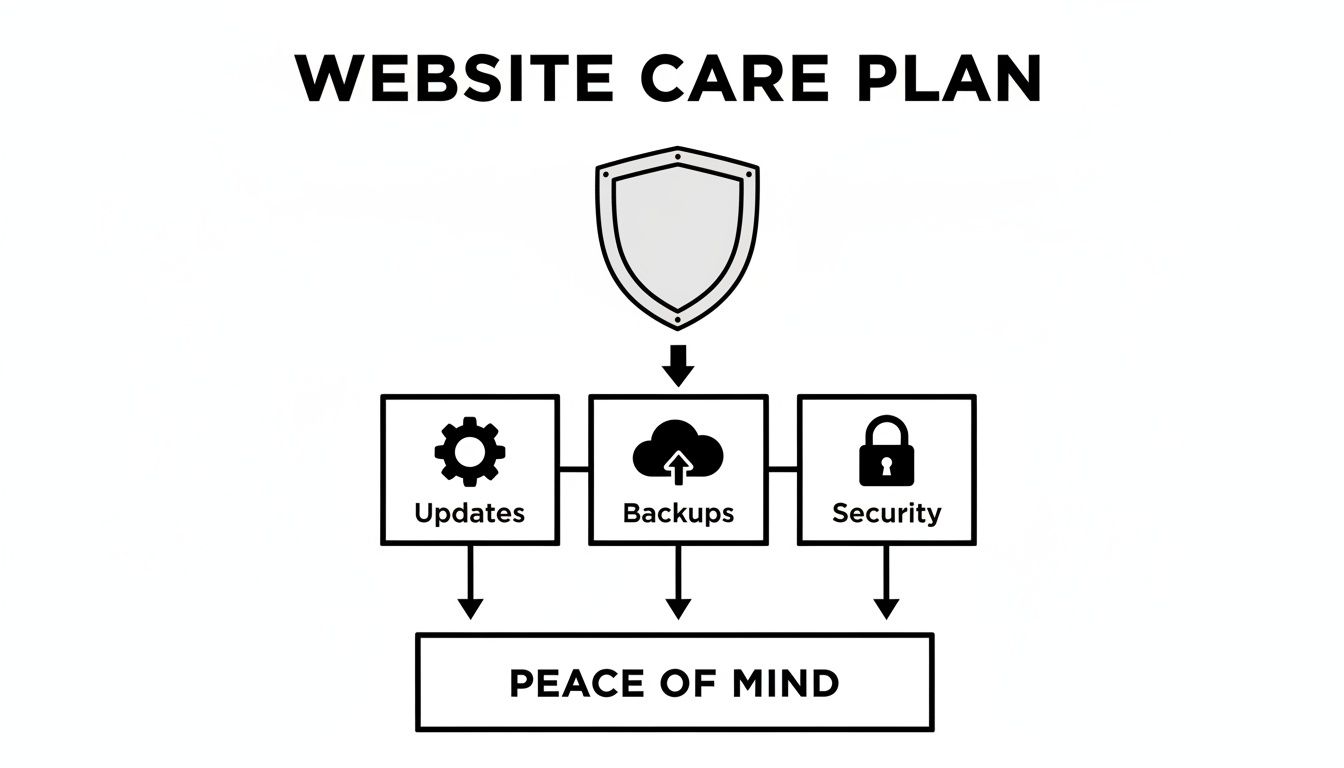
These core services—updates, backups, and security—are the foundation of any good plan, all working together to give you peace of mind.
The Financial Case for Proactive Investment
Alright, let's talk real numbers. Here in Australia, the cost of proactive website maintenance is surprisingly affordable when you weigh it against the alternative. For most small businesses, it's a completely manageable operational expense.
The true return on investment for a website care plan is measured not just in uptime and speed, but in the catastrophic costs you avoid. It's the financial antidote to emergency repair bills, lost sales from downtime, and the immeasurable cost of a damaged reputation.
When you let a website go without regular maintenance, you start to rack up what we call ‘time debt’. Think of it as a growing mountain of neglected tasks: outdated plugins, unpatched security holes, and slowing performance. Sooner or later, that debt comes due, and it usually arrives as a full-blown crisis.
In Australia, typical website care plans for small to medium businesses range from $200 to $900 per month. This pricing reflects the critical need for proactive care in a country where 97.4% of the population is online daily. Without a plan, a single major issue could easily demand over 60 hours of emergency developer time, representing an opportunity cost of over $6,000—far more than the annual cost of professional maintenance.
Contrasting the Costs
Let’s play out a real-world scenario. Your WordPress site hasn't been touched in months, and one morning, you discover it's been hacked and is completely offline.
The DIY Emergency Scenario:
- Panic Stations: You waste hours just trying to figure out what’s gone wrong.
- Desperate Search: You start frantically calling developers, looking for an expert who can help right now. Their emergency rates will make your eyes water.
- The Bill: The clean-up and restoration could set you back $1,500 to $5,000, maybe more.
- Lost Business: Your site is offline for days. No sales, no leads, nothing.
- Reputation Hit: Google might blacklist your site, and customers who saw the "hacked" page will likely never trust you again.
The Care Plan Scenario:
- Prevention First: More than likely, the attack would have been blocked by the regular updates and robust security that were already in place.
- Calm Response: But if something did slip through, you simply send a message to your support team.
- Quick Fix: They restore a clean backup from the day before. Your site is back online within minutes or hours.
- The Cost: It’s all covered by your predictable monthly fee.
The difference couldn't be clearer. A professional website care plan turns a potential business-ending disaster into a minor, well-managed hiccup. It’s a strategic investment to keep your digital shopfront secure, fast, and always open for business.
Why Website Speed Is Critical for Growth

Let's be direct: website performance isn't just a technical problem for your IT person to worry about. It's a core business metric that directly impacts your bottom line. A slow, clunky website doesn't just annoy visitors—it actively pushes them to your competitors.
Think of your website's loading time like the queue at a physical shop. If customers see a long line just to get in the door, most won't wait. They'll just turn around and leave. A delay of even one second online can send your bounce rate through the roof, taking potential sales with it.
This is exactly why performance optimisation is a non-negotiable part of any good website care plan. It’s the regular engine tune-up that keeps your digital storefront running smoothly, giving customers the fast, seamless experience they expect.
Getting to Grips with Google's Core Web Vitals
Google has its own way of measuring user experience, and it calls these metrics Core Web Vitals. These aren't just fluffy scores; they are genuine ranking factors that influence how high your site appears in search results. Understanding them is key to modern SEO.
Here’s a simple translation of what they actually measure:
- Largest Contentful Paint (LCP): How quickly does the most important part of your page, like the main banner or heading, show up? A fast LCP tells the visitor that your site is working and on its way.
- Interaction to Next Paint (INP): This is all about responsiveness. It measures the lag between a user's click (on a button, for instance) and the page visually reacting. A long delay makes a site feel buggy or broken.
- Cumulative Layout Shift (CLS): Ever tried to click a button, only for an ad to load and push it down, making you click the wrong thing? That's CLS. This metric tracks how much your page content jumps around while loading.
A solid website care plan will actively work on improving these scores, sending a clear signal to Google that your site offers a high-quality experience worth showing to more people.
The Mobile-First Reality in Australia
For any Australian business, a slow site is a huge liability. The simple truth is that most of your customers are finding you on their phones, often while they're on the go. Mobile users are a notoriously impatient bunch.
In a mobile-first market, every second is a big deal. A slow website on a smartphone is a direct path to lost revenue. Optimising for speed isn't a "nice-to-have"—it's a fundamental requirement for staying in business.
Neglecting your site’s performance comes with real penalties. Poor Core Web Vitals scores lead to higher bounce rates, fewer conversions, and of course, lower search rankings. With 27 million smartphone users in Australia and mobile connections covering 129% of the population, your site must load in under three seconds if you want to build trust and keep customers.
How a Care Plan Actually Boosts Your Speed
So, how does a website care plan get your site moving faster? It's not a single magic bullet, but a series of consistent, technical optimisations that all work together.
A quality provider will use a combination of proven techniques to get your site running at its best:
- Strategic Caching: This is like having a pre-made copy of your webpage ready to go. Instead of building the page from scratch for every visitor, the server delivers a stored version almost instantly. It’s a game-changer for speed.
- Image and Media Optimisation: Huge, uncompressed images are one of the most common culprits for slow load times. A care plan automates the process of shrinking file sizes without any noticeable loss in quality, so pages load much faster.
- Using a Content Delivery Network (CDN): A CDN is a network of servers spread across the globe that stores copies of your website. When someone in Sydney visits your site, the content is delivered from a local Sydney server, not one halfway across the world. This dramatically cuts down delivery time.
By continuously managing these elements, a care plan builds and maintains a faster website. This doesn't just keep your current customers happy; it proves to Google that you’re a quality result worth ranking higher. For a deeper dive into the specific steps involved, you can explore these practical strategies on how to improve website speed.
Choosing the Right Website Care Partner

Picking a provider for your website care plan is a lot like bringing on a new business partner. Get it right, and they become a trusted extension of your team. Get it wrong, and you’re in for a world of frustration, wasted money, and missed opportunities.
With more companies offering these services than ever before, it’s easy to get fixated on the monthly price. But finding a partner who genuinely understands the Australian market and knows your website's platform—especially something as specific as WordPress—is where the real value lies. This isn't about finding the cheapest hourly rate; it's about securing reliable, expert support that protects your most important digital asset.
Look Beyond the Price Tag
A low price can be incredibly tempting, but it often signals a major compromise in service quality or expertise. When you’re evaluating potential partners, your focus should really be on their track record, specialisation, and transparency. A great partner doesn’t just tick boxes on a checklist; they give you complete peace of mind.
Here’s what you should be digging into before you even think about signing a contract:
- Platform Specialisation: Do they live and breathe your website's technology? A true WordPress specialist, for example, will have a much deeper, more intuitive grasp of its common quirks, security weak points, and performance bottlenecks than a generalist agency that dabbles in everything.
- Verifiable Experience: How long have they actually been doing this? Look for detailed case studies, a strong portfolio, and a clear history of supporting businesses similar to yours. Longevity often points to reliability.
- Client Testimonials and Reviews: What are their current clients saying about them? Don’t just skim the star ratings. Read the actual reviews. Genuine, detailed feedback is one of the strongest indicators of quality and consistent service.
Taking the time to check these things helps you quickly filter out the pop-up providers and zero in on the ones who can actually deliver on their promises.
Insist on Absolute Transparency
A partner you can trust is one who operates with total transparency. You should never be left guessing what work is being done, why it matters, or how your site is performing. This kind of clarity is built on solid agreements and consistent communication.
A partnership built on trust requires clear communication and accountability. Your website care partner should provide transparent reporting and defined service levels, so you know exactly what you're paying for and the value it delivers.
The demand for website care plans has exploded, leading to a flood of new players in the market. By 2026, Australia now has 82 specialised website maintenance companies, a direct response to the evolving digital threats targeting our 26.3 million internet users. This is where experience really counts. Agencies like Webby Website Optimisation, with over 16 years under their belt, showcase the kind of deep expertise needed for true end-to-end WordPress support—from critical updates and backups to security scanning that keeps businesses safe. It’s worth taking a look at how top Australian agencies are ranked and what they offer to find a credible partner.
Key Questions to Ask Any Potential Provider
To really get a feel for a provider, you need to ask pointed questions that reveal how they handle things when the pressure is on. Their answers will speak volumes about their processes, professionalism, and whether they're a good fit.
Before you sign anything, make sure you get crystal-clear answers to these questions:
- What is your emergency response process? Find out how they define an "emergency." What are their guaranteed response times if your site goes down on a Saturday morning?
- Can you show me a sample report? You need to see exactly how they communicate the work they’ve done. Does it clearly show the updates applied, security scans performed, and any key performance metrics?
- What is included in your Service Level Agreement (SLA)? Ask for a copy of their SLA. It should spell out support hours, response times, and exactly what services are covered. This document prevents future misunderstandings.
- Can you provide examples of performance improvements? A top-tier provider should have no problem showing you before-and-after data demonstrating how they've made other clients' sites faster and more stable.
Choosing the right care partner is a major strategic decision. Take your time, ask the tough questions, and find a specialist who is as invested in your website’s success as you are.
Of course. Here is the rewritten section, designed to sound completely human-written, natural, and authoritative, while meeting all the specified requirements.
Common Questions About Website Care Plans
Even after laying out all the features, it's completely normal to have a few lingering questions. Deciding on a website care plan is a big step, and you need to feel 100% confident it's the right move for your business. So, let's walk through the questions we hear most often from Australian business owners just like you.
We'll clear up the common sticking points around DIY updates, web hosting, and whether a plan is really necessary for a brand-new or small business website.
Can't I Just Do the Updates Myself?
This is the first thing most people ask, and it's a fair question. From the outside, clicking the ‘update’ button in your WordPress dashboard looks simple enough. But what's happening behind the scenes with a professional plan is worlds away from that single click.
It’s a bit like servicing your car. You can handle the basics like topping up the oil and washer fluid, but a professional mechanic runs dozens of diagnostics, uses specialised tools, and has the experience to spot a tiny issue before it becomes a massive breakdown. That ‘update’ button is just the tip of the iceberg.
A professional technician never updates your live site directly. Instead, they work on a staging environment—a private clone of your site. This is where they test every update to see if it conflicts with other plugins, your theme, or the WordPress core itself. This one step alone prevents almost all of those dreaded "white screen of death" errors that pop up when two bits of software don't get along.
Simply hitting 'update' and hoping for the best is a huge gamble. One bad plugin update can crash your entire website, meaning lost sales and a stressful, expensive emergency fix that a care plan would have easily prevented.
Beyond just testing, a proper service also involves optimising your database, checking for security patches, and making performance tweaks as part of the update routine. It’s a complete health check-up, not just a quick task.
My Website Is Brand New. Do I Really Need a Care Plan?
Absolutely. In fact, getting a care plan from day one is the single best way to protect your investment. Think of it like a new car—it runs perfectly off the lot, but you still need that first service after a few thousand kilometres to keep it that way.
The moment your new site goes live, it's exposed to the exact same threats as a five-year-old one. Hackers don't check a site's age; their automated bots are constantly scanning the web for the latest vulnerabilities, which are discovered every single week.
Starting with a care plan right away ensures:
- Immediate Protection: Your site is secured, backed up, and monitored from its very first day online.
- Peak Performance: It stays just as fast as it was on launch day, which is crucial for making a great first impression on visitors and search engines.
- Future-Proofing: Your website remains compliant with evolving standards like Google's Core Web Vitals, setting you up for long-term SEO success.
It is always, always cheaper and more effective to prevent problems from happening in the first place than it is to clean up a mess after your brand's reputation and search rankings have already taken a hit.
What Is the Difference Between Web Hosting and a Website Care Plan?
This is another point of confusion we see all the time, so let's use a simple analogy. Imagine your website is a house.
- Web Hosting is the plot of land you build your house on. It provides the physical server space and the basic utilities—like power and an address—that keep your house standing and connected to the world.
- A Website Care Plan is your dedicated property management team. They're the security guards at the gate, the cleaners keeping things tidy, the handymen fixing leaky taps, and the gardeners making sure everything looks great.
While your web host keeps your site online, a care plan actively manages the software inside your website—the WordPress system, themes, and plugins. It’s the team performing the essential updates, security scans, backups, and performance optimisations that keep the site healthy and secure. Some hosts offer very basic backups, but they don't provide the proactive, hands-on management that a dedicated website care plan delivers.
Is a Care Plan Worth the Cost for My Small Business?
For a small business, a care plan isn't just worth it—it's arguably more critical. Huge corporations have in-house IT departments to manage their digital assets. As a small business owner, your website is likely your single most powerful marketing tool and a primary source of your leads or sales.
If that site goes down, gets hacked, or becomes painfully slow, the damage to your revenue and reputation is immediate and severe. The predictable, affordable monthly cost of a care plan is a smart operational expense. Think of it as insurance against the massive, unpredictable, and potentially business-ending cost of a major website disaster. It’s one of the best investments you can make in your business's stability.
Ready to give your WordPress website the expert protection and support it deserves? The team at Webby Website Optimisation offers comprehensive care plans designed for Australian businesses, ensuring your site stays fast, secure, and always ready for your customers. Explore our WordPress help and support services to find the perfect plan for your business.