
When you're searching for cheap web hosting in Australia, it's tempting to just sort by price and pick the lowest number. But that’s rarely the smartest move. The real goal is to find maximum value—a plan that gives you all the essentials without forcing you to empty your pockets.
For most Aussie small businesses, that sweet spot is usually found in a quality shared hosting plan. It’s about getting a fair price for the features that actually matter.
What Does 'Cheap' Web Hosting Really Mean in Australia?
Let's talk about the word 'cheap'. For many, it brings to mind slow-loading websites, support tickets that go unanswered for days, and a whole lot of frustration. In the world of web hosting, 'cheap' shouldn't mean poor quality. It should mean 'great value'.
Think of it like buying a ute for your trade. You wouldn’t just buy the cheapest one you can find. You need something reliable that won't guzzle fuel, has room for your gear, and won’t leave you stranded on the way to a job. The rock-bottom option often ends up costing you more in lost time and repair bills.
It's the exact same principle with your website's hosting. The right plan is a solid foundation for your online business, not a financial drain. It's all about finding that perfect balance where an affordable price tag meets the non-negotiable performance your business needs to grow.
The Value Equation for Aussie Businesses
So, what does a high-value hosting plan actually look like for an Australian business, especially if you're running a WordPress site? These aren't fancy extras; they're the absolute must-haves for anyone serious about their online presence.
A plan that offers genuine value will always include:
- Local Data Centres: Your website needs to be hosted on servers physically located in Australia, like in Sydney or Melbourne. This is the single biggest factor in making your site load quickly for local customers.
- Reliable Performance: The server needs enough grunt to handle your visitors without slowing to a crawl. A smooth, fast experience keeps people on your site.
- Strong Security: Non-negotiables like a free SSL certificate (the padlock in the browser) and malware scanning are vital to protect your business and your customers' data.
- Responsive Local Support: When you hit a snag, you need to talk to someone who's in your time zone and understands the local landscape. Waiting 24 hours for a reply from an overseas team just doesn't cut it.
The demand for hosting in Australia is huge, with the market expected to hit an incredible AUD 4.07 billion by 2025. This explosion is driven by our booming e-commerce scene, which needs affordable hosting that can keep up. It proves that local businesses are actively seeking solutions that are both cost-effective and powerful. You can read more on these Australian web hosting market trends from Expert Market Research.
Trying to choose a web host can feel a bit like staring at a massive cafe menu with a hundred different milk and syrup options. It's confusing. To actually find the best cheap web hosting in Australia that fits what you need, you first have to understand what you're buying.
Let’s break down the three most common budget-friendly choices you'll come across.
Shared Hosting: The Perfect Starting Point
Think of Shared Hosting as renting a room in a big, well-managed share house. It's incredibly cheap because you and a bunch of other website owners are all using the same server resources—the processor is the shared kitchen, the memory is the living room, and the bandwidth is the Wi-Fi. It all gets split between everyone.
This setup is absolutely perfect for new websites, personal blogs, or small Aussie businesses just getting their feet wet online. It's the cheapest way to get started, which is why it’s so popular. The Australian web hosting market is worth a whopping AUD 4.07 billion, and shared hosting is a huge slice of that pie. For around AUD 5-15 a month, small businesses from Perth to Brisbane can get online without breaking the bank. You can see more on these trends in this research on web hosting statistics from Hostinger.
The only real catch with shared hosting is the "noisy neighbour" problem. If another website on your server suddenly gets a massive flood of traffic, it can slow your site down temporarily. For most new sites, though, the massive cost savings make this a very small risk worth taking.
VPS: Your Step Up for Growth
A Virtual Private Server (VPS) is your next logical step up. It’s like leasing your own self-contained unit in an apartment building. You're still sharing the main building (the physical server), but you have your own dedicated space with walls around it.
This means your resources—your slice of the processor, memory, and storage—are completely yours. What your neighbours do has zero effect on you. This gives you a lot more power and control, making it the ideal choice for:
- Businesses that have clearly outgrown their shared hosting plan.
- E-commerce stores with steady, growing traffic.
- Developers needing the freedom to install custom software.
A VPS does require a bit more technical confidence to manage, but it gives you a stable, scalable foundation to grow on without jumping to the much higher cost of a fully dedicated server.
Managed WordPress Hosting: The 'Done-For-You' Option
Finally, we have Managed WordPress Hosting. If a VPS is your own unit, this is the fully serviced apartment. You get a space that has been purpose-built and fine-tuned specifically for one thing: running WordPress sites brilliantly.
The best part? A dedicated team of experts handles all the technical chores. Security monitoring, daily backups, software updates, and performance optimisations are all done for you.
This means you can stop worrying about server updates or security patches and just focus on what you do best—running your business. It certainly costs more than a basic shared plan, but the value is in the time you save and the sheer peace of mind. It’s a smart investment for any serious business where the website is a critical tool for generating revenue and leads.
To make the choice a bit clearer, here's a quick side-by-side look at these options.
Cheap Hosting Types Compared for Australian Businesses
This table provides a quick comparison of the three main budget-friendly hosting options based on cost, performance, and technical requirements.
| Hosting Type | Best For | Typical Monthly Cost (AUD) | Performance Level | Technical Skill Needed |
|---|---|---|---|---|
| Shared Hosting | New websites, blogs, small startups | $5 - $15 | Basic (can be affected by others) | Low |
| VPS Hosting | Growing businesses, e-commerce stores | $20 - $80 | Medium to High (dedicated resources) | Medium |
| Managed WordPress Hosting | Businesses valuing time and security | $30 - $100+ | High (optimised for WordPress) | Low |
Ultimately, the "best" option depends entirely on where your business is right now and where you plan to take it. A starter blog has very different needs from an online store processing daily orders.
Essential Features for Australian Hosting

When you're on the hunt for a bargain, it’s all too easy to let the price tag do all the talking. But with something as important as web hosting, a cheap price tag can hide some serious compromises. The real value isn't just about saving a few dollars; it's about finding a service that delivers the core features your Australian audience truly needs.
Think of it like this: you wouldn't open a café in Melbourne and have your coffee beans shipped from an obscure, slow supplier just to save a few cents. The long wait and poor quality would send your customers straight to the competitor next door.
Your website works the same way. The features that look like minor details on a comparison chart are often what make or break your online presence.
Australian Data Centres Are Non-Negotiable
For any business targeting an Aussie audience, the most critical factor is where your website physically lives. You absolutely need a hosting provider with data centres located in Australia—ideally in major hubs like Sydney or Melbourne. This isn’t a luxury; it’s fundamental to your site’s performance.
Here’s why: when someone in Brisbane visits your site, their request has to travel to the server and back again. If your server is in Texas, that data is making a trip across the Pacific Ocean. That delay is called latency, and it’s a killer for page speed.
A website hosted in Australia can load up to 5 times faster for local visitors compared to one hosted overseas.
That speed boost isn't just for show. It directly translates to a better experience for your users and is a well-known ranking signal for Google, giving you a real advantage in local search results. Faster site, happier customers, and better SEO—it all starts with choosing a local server.
Local Support in Your Time Zone
Picture this: it's 3 PM on a Friday, and your website suddenly goes offline. With a cheap overseas host, you're now at the mercy of a support team that’s just waking up. You could be waiting 12, or even 24 hours, for a proper response. That's an entire business day of lost sales and frustrated customers.
This is where having a local support team proves its worth. An Australian-based team means you get:
- Help When You Need It: You can actually talk to a real person during your business hours.
- Local Knowledge: They understand the local market, public holidays, and the challenges Aussie businesses face.
- Quicker Fixes: Problems are solved in hours, not days, which minimises downtime and protects your reputation.
Choosing a provider with genuine Aussie support is like having an expert IT department on call. And while we’re on the topic of website essentials, security is just as crucial. In fact, a quality host can help you protect your entire online presence with something like a wildcard SSL certificate, which secures your main domain and all its subdomains at once.
We’ve all seen them—those hosting deals that seem too good to be true, promising the world for just a couple of dollars a month. While being savvy about finding affordable cheap web hosting in Australia makes good business sense, chasing the absolute lowest price is often a fast track to headaches you didn't sign up for. The money you save upfront can vanish in an instant when faced with the real-world fallout from sluggish performance and flimsy security.
It’s a bit like buying a dirt-cheap car battery. Sure, it might start the engine today, but you’re left wondering if it’ll leave you stranded on the way to a crucial client meeting. Ultra-cheap hosting runs on that same shaky promise; it works just fine until, suddenly, it doesn’t.
The True Cost of Performance Trade-Offs
So, what’s really going on behind the scenes with these rock-bottom prices? It usually comes down to overselling. To make the numbers work, providers will cram hundreds, sometimes even thousands, of websites onto a single server. It creates a chaotic free-for-all where everyone is fighting for the same limited resources, like processing power (CPU) and memory (RAM).
The result? Your website loads at a snail’s pace, especially when you get a bit of traffic.
For an online business, this is a killer. Research shows even a one-second delay in page load time can slash conversions by up to 7%. If your site goes down during a flash sale because the server buckled under the pressure, you're not just losing sales—you're losing customer trust. Poor performance from a bargain-bin host can directly sabotage your efforts to improve website conversions.
Security Flaws and Costly Cleanups
To keep prices so low, security is often the first corner that gets cut. This can leave your website wide open to malware, brute-force attacks, and data breaches. It’s a gamble you really don’t want to take.
A single security breach can unravel into a nightmare:
- Expensive Cleanups: Getting a professional to scrub malware from your site and patch vulnerabilities can easily set you back hundreds, if not thousands, of dollars.
- Reputation Damage: A hacked website can quickly get blacklisted by Google, greeting your visitors with a scary warning page. That’s a trust-killer.
- Total Data Loss: In the worst-case scenario, you could lose everything. This is precisely why reliable, automated backups are non-negotiable. We actually have a whole guide on how to properly back up a WordPress website.
Australia's web hosting market is booming, set to reach AUD 4.07 billion in 2025, with many SMEs seeking value. However, as e-commerce drives digital growth, the need for reliable, low-latency Australian servers becomes critical for SEO and sales. You can find more detail on these global hosting trends and their impact on Australia.
Ultimately, paying a little more for quality hosting isn't just another bill. It's one of the smartest investments you can make in your business's stability, ensuring your website remains a valuable asset, not a constant source of stress.
Your Smart Hosting Provider Checklist
Alright, let's cut through the marketing fluff. When you're looking for cheap web hosting in Australia, it’s easy to get lost in a sea of seemingly identical offers. This checklist is your practical guide to telling the good from the bad. It's not about finding the absolute lowest price, but about finding the best actual value.
Choosing the wrong host isn't just an inconvenience; it can actively harm your business. This decision tree shows exactly how a 'cheap' choice can quickly spiral into slow speeds, security breaches, and lost customers.
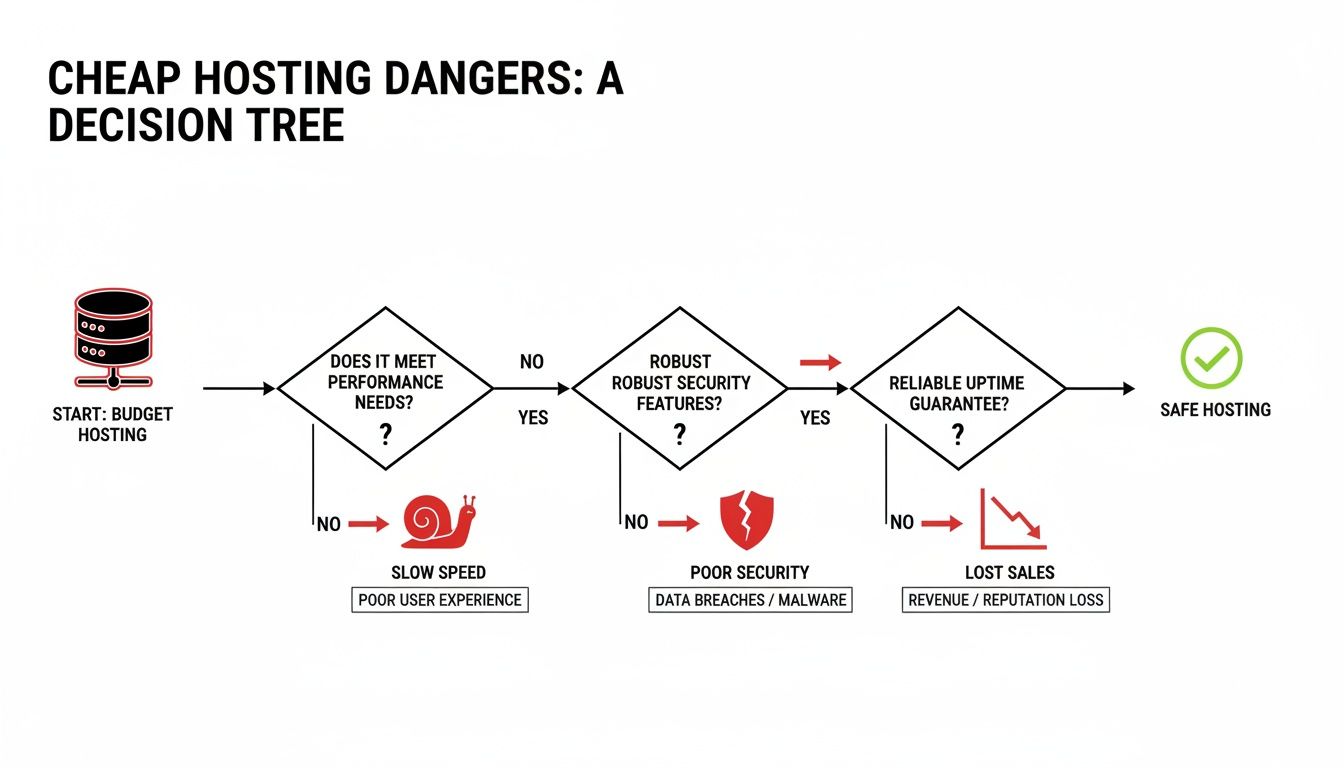
As you can see, cutting corners on your hosting foundation puts your site's performance, security, and ultimately your revenue, at serious risk.
Your Core Essentials Checklist
Any host you seriously consider must have these fundamentals locked down. Think of these as the absolute non-negotiables for any Australian business website.
Australian Data Centres (Sydney/Melbourne): This is mission-critical. You need to confirm their servers are physically located here in Australia. It’s the biggest factor for ensuring fast website load times for your local audience, which is huge for both user experience and your Google rankings.
Free, Automatic Daily Backups: Your website is a valuable asset. A good host knows this and provides automated backups every single day, storing them safely off-site. If disaster strikes, you need to be able to restore your site in minutes, not days. Weekly backups just don't cut it.
Free SSL Certificate (Let's Encrypt or similar): That little padlock in the browser address bar is a must-have for building trust and securing data. There's simply no reason to pay extra for a basic SSL certificate in 2026. It should be included for free and set to auto-renew.
Support and Reputation Checks
The tech specs are only one part of the puzzle. The people behind the service are just as crucial, because a great plan is worthless if you're left stranded when you need help.
Before signing up, spend five minutes searching for recent reviews on Google or Trustpilot. Pay close attention to what customers say about support response times and how the company handles problems. This is the clearest window you'll get into how they'll treat you when things go wrong.
A provider's reputation for support can truly make or break your entire experience.
Performance and Security Guarantees
Finally, let's look past the vague promises. Terms like "fast" and "secure" mean nothing without specific commitments to back them up.
Your final checks should include:
- A Clear Uptime Guarantee: Hunt for a Service Level Agreement (SLA) that promises at least 99.9% uptime. If a host won’t put that in writing, they aren't confident in their own infrastructure.
- Web Application Firewall (WAF) and Malware Scanning: These aren't optional extras; they're essential security layers. A quality provider includes these tools as standard to actively block common attacks before they can ever reach your site.
- Transparent Renewal Pricing: That super-low introductory price is designed to get you in the door. What happens in year two? Reputable providers are completely upfront about their renewal costs, so you can budget properly without any nasty surprises.
Working through this checklist will help you see beyond the initial price tag. You'll be equipped to choose a genuine hosting partner that gives your business a stable, fast, and secure platform to grow on.
Knowing When to Upgrade from Cheap Hosting
Every successful business hits a point where its starter home just doesn't cut it anymore. That first cheap web hosting in Australia was perfect when you were getting started, but as your traffic grows and your customer base expands, it can quickly turn from a helpful tool into a serious bottleneck.
The warning signs are usually pretty clear. Is your website starting to feel sluggish, even after you’ve done all the right things like optimising your images? Are you finding yourself wrestling with weird errors or spending more time on tech support than on actually running your business? These are the classic growing pains that tell you your current plan is struggling to keep up.
Shifting from DIY to Done-For-You
This is the moment when moving to a managed WordPress service starts to make a lot of sense. It’s more than just getting "better" hosting; it’s about bringing a strategic partner on board. Think of it as having an expert IT department dedicated to your website, but for a fraction of the cost.
A managed service isn't just another expense—it's an investment in your site's reliability and your business's growth. It frees you from the constant technical headaches of updates, security, and performance, giving you back the time to focus on what you do best.
When you make the switch, a team of specialists takes over all the critical behind-the-scenes work. They’re proactively managing your site, which means they handle:
- Performance Tuning: Making sure your site is always running fast and smoothly for your visitors.
- Proactive Security: Actively scanning for threats and hardening your site against attacks.
- Reliable Backups: Running daily backups so you know your data is always safe and can be restored in a flash.
- Software Updates: Taking care of all WordPress core, theme, and plugin updates for you.
This move helps turn your website from a source of stress into a dependable asset that helps drive your business forward. Of course, preparing for the move itself is key. Our comprehensive website migration checklist will walk you through the entire process, ensuring a smooth, stress-free transition with no lost data or downtime.
Frequently Asked Questions About Cheap Web Hosting
When you're hunting for affordable hosting, a few questions always seem to pop up. Let's tackle the most common ones we hear from Australian business owners, so you can find the right cheap web hosting in Australia with total confidence.
Can I Find Good WordPress Hosting Under $15 a Month in Australia?
You bet. It's entirely possible to find a solid entry-level shared hosting plan in that price range, which is perfect for a brand-new website, blog, or small business.
The trick is to look past the tempting price tag and check what you're actually getting. Make sure any plan you're considering includes these non-negotiables:
- Australian data centres to give your local visitors the fastest possible experience.
- Free daily backups, because you need a safety net if things go wrong.
- A free SSL certificate to secure your site and show visitors you're trustworthy.
Just remember, these starter plans have their limits. They’re a fantastic launchpad, but as your traffic starts to climb, you’ll likely need to upgrade to keep your site performing well.
How Hard Is It to Move My Website to a New Australian Host?
It's probably a lot less painful than you're imagining. Many of the best Australian hosts, particularly those focused on WordPress, will handle the entire move for you with free or low-cost migration services. They take care of all the technical heavy lifting.
For business owners who want zero hassle and complete peace of mind, a WordPress specialist can manage the move from start to finish. This ensures there is absolutely no downtime or data loss, making the switch completely seamless and stress-free.
This approach lets you reap the rewards of better hosting without getting tangled up in the technical weeds.
Do I Really Need a Host with Servers in Australia?
If your customers are here in Australia, then yes—it’s an absolute game-changer. Hosting your site locally dramatically cuts down on latency, which is simply the time it takes for data to get from the server to your visitor's screen.
Think of it like posting a letter. Sending it across town is much faster than sending it overseas. The result is a website that loads noticeably faster for your Aussie audience. That speed boost doesn't just make for happier visitors; it also gives you a real edge in local Google search rankings, making it a crucial piece of the puzzle for any Australian business.
Ready to stop worrying about your website's performance and security? The expert team at Webby offers proactive WordPress help and support, ensuring your site stays fast, secure, and up-to-date. Get the reliable WordPress support your business deserves.